Wiadomości Bocheńskie 1
Total Page:16
File Type:pdf, Size:1020Kb
Load more
Recommended publications
-
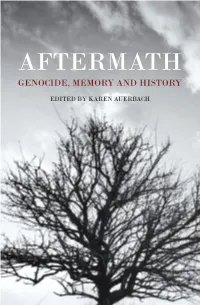
Genocide, Memory and History
AFTERMATH GENOCIDE, MEMORY AND HISTORY EDITED BY KAREN AUERBACH AFTERMATH AFTERMATH GENOCIDE, MEMORY AND HISTORY EDITED BY KAREN AUERBACH Aftermath: Genocide, Memory and History © Copyright 2015 Copyright of the individual chapters is held by the chapter’s author/s. Copyright of this edited collection is held by Karen Auerbach. All rights reserved. Apart from any uses permitted by Australia’s Copyright Act 1968, no part of this book may be reproduced by any process without prior written permission from the copyright owners. Inquiries should be directed to the publisher. Monash University Publishing Matheson Library and Information Services Building 40 Exhibition Walk Monash University Clayton, Victoria, 3800, Australia www.publishing.monash.edu Monash University Publishing brings to the world publications which advance the best traditions of humane and enlightened thought. Monash University Publishing titles pass through a rigorous process of independent peer review. www.publishing.monash.edu/books/agmh-9781922235633.html Design: Les Thomas ISBN: 978-1-922235-63-3 (paperback) ISBN: 978-1-922235-64-0 (PDF) ISBN: 978-1-876924-84-3 (epub) National Library of Australia Cataloguing-in-Publication entry: Title: Aftermath : genocide, memory and history / editor Karen Auerbach ISBN 9781922235633 (paperback) Series: History Subjects: Genocide. Genocide--Political aspects. Collective memory--Political aspects. Memorialization--Political aspects. Other Creators/Contributors: Auerbach, Karen, editor. Dewey Number: 304.663 CONTENTS Introduction ............................................... -

Auschwitz Gesamt
„GERICHTSTAG HALTEN ÜBER UNS SELBST“ (FRITZ BAUER) SZENISCHE LESUNG AUSCHWITZPROZESS Unter Mitwirkung des Gipsy-Swing-Ensembles Roberto Rosenberger Buchcafé Bad Hersfeld, 27. Januar 2016, 20:00 Uhr Aus Anlass des Tages der Befreiung des VernicHtungslagers AuscHwitz Programm Einführung Szenische Lesung Anlagen: - Kurzvita Oswald Kaduk, WilHelm Boger, Stefan Baretzki - Urteil 1. Frankfurter AuscHwitz-Prozeß (ohne Begründung) - Sonstige Urteile AuscHwitz-Täter im In- und Ausland (nicHt vollständig) 1 „GERICHTSTAG HALTEN ÜBER UNS SELBST“ (FRITZ BAUER) SZENISCHE LESUNG AUSCHWITZPROZESS Unter Mitwirkung des Gipsy-Swing-Ensembles Roberto Rosenberger Buchcafé Bad Hersfeld, 27. Januar 2016, 20:00 Uhr Aus Anlass des Tages der Befreiung des VernicHtungslagers AuscHwitz. SZENISCHE LESUNG Rollen - Richter - Staatsanwalt - Angeklagte Oswald Kaduk WilHelm Boger Stefan Baretzki - Zeugin Texteinrichtung: Dieter Schenk Mit freundlicHer Unterstützung des Fritz Bauer Instituts Frankfurt a.M. PROGRAMM Begrüßung durch das Buchcafé Einführung: Dieter Schenk Fritz Bauer und der AuscHwitzprozess Gipsy-Swing/Eröffnung I VerHör Angeklagter Oswald Kaduk Richter/Staatsanwalt Zeugin (Auszug VerneHmung Anna ScHmidt) Gipsy-Swing/Zwischenmusik II VerHör Angeklagter WilHelm Boger Richter Zeugin (Auszüge VerneHmung Maryla RosentHal u.a.) Gipsy-Swing/Zwischenmusik III VerHör Angeklagter Stefan Baretzki Richter/Staatsanwalt Zeugin (Auszüge VerneHmung Lilliy Jansen u.a.) Gipsy-Swing/Zwischenmusik IV Plädoyer Staatsanwalt (AusscHnitt Allgemeiner Teil) V Video Angeklagte im -

Emergent from the Holocaust and the Atomic Bombings
Critical Comparative Approaches to Testimonial Literature Emergent from the Holocaust and the Atomic Bombings Gwyneth Dodger This thesis is submitted in partial fulfilment for the requirements of a PhD English Literature Department University of Sheffield 2007 Acknowleftements Although only my nameappears on the title pageof this thesis,this projectwould not havebeen possible without the supportand encouragementof many otherpeople. The provision of a grant from the AHRC allowed me to devote much-neededtime to my researchin the early stagesof my work, for which I am grateful. I would like to take this opportunity to thank my supervisors, Dr Sue Vice and Dr Alex Houen. Their guidance and academic rigour has informed my own approach to this sometimes difficult area of testimonial literature. Without their valuable advice and enthusiasm for the subject, it is likely that my own motivation would have flagged much earlier. A special thanks is due to Sue who in the final weeks before submission endured endlessstressed emails and requeststo "cast a quick eye" over final revisions! My thanksare also due to Lucia Faltin and Dr Melanie Wright, as well the rest of my colleagues at the Centre for the Study of Jewish Christian Relations, Cambridge, for whosecontinuing support and friendshipI remaingrateful. A special thanks is due to my wonderful friends who have kept me sanethroughout this period and have often retrieved me from under large piles of books to bring me outside, blinking in the light. Extra special love and thanks to Ruth Ireland, Ann Flenley, Kate Dorney and Helen Blakeman. Finally, it remains only to thank my family - Matthew, my mother Avril, my father Lyndon, and my sister Caitlin. -

Schindler's Ark
Schindler's Ark by Thomas Keneally, 1935– Published: 1982 Serpentine Publishing Co. Ltd. J J J J J I I I I I Table of Contents Dedication Author‘s Note Prologue & Chapter 1 … thru … Chapter 38 Epilogue Appendix J J J J J I I I I I TO THE MEMORY OF OSKAR SCHINDLER, AND TO LEOPOLD PFEFFERBERG, WHO BY ZEAL AND PERSISTENCE CAUSED THIS BOOK TO BE WRITTEN Author‘s Note In 1980 I visited a luggage store in Beverly Hills, California, and inquired the prices of briefcases. The store belonged to Leopold Pfefferberg, a Schindler survivor. It was beneath Pfefferberg’s shelves of imported Italian leather goods that I first heard of Oskar Schindler, the German bon vivant, speculator, charmer, and sign of contradiction, and of his salvage of a cross section of a condemned race during those years now known by the generic name Holocaust. This account of Oskar’s astonishing history is based in the first place on interviews with 50 Schindler survivors from seven nations—Australia, Israel, West Germany, Austria, the United States, Argentina, and Brazil. It is enriched by a visit, in the company of Leopold Pfefferberg, to locations that prominently figure in the book: Cracow, Oskar’s adopted city; Płaszów, the scene of Amon Goeth’s foul labor camp; Lipowa Street, Zablocie, where Oskar’s factory still stands; Auschwitz- Birkenau, from which Oskar extracted his women prisoners. But the narration depends also on documentary and other information supplied by those few wartime associates of Oskar’s who can still be reached, as well as by the large body of his postwar friends. -

WIADOMOŚCI BOCHEŃSKIE 11 Lat Wdowy Po Uszlachconym Kupcu Krakowskim Szymonie a Do Pokoju Wpadały Kule Karabinowe
Fot. Paweł Klasa Fot.Fot. PPaweawełK Klasalasa JESIEŃ fot. St. Zięba 2009 WIADOMOŚCI BOCHEŃSKIE WB nr 3(82) WB nr ROK XVInr3(82) ISSN 1426-195 jesien 2009 Cena: 4zl 1 2 WIADOMOŚCI BOCHEŃSKIE JESIEŃ 2009 Muzeum Motyli „Arthropoda” Nowe muzeum w Bochni Na ścianie pół- nocnej są w górnej części motyle noc- ne Azji, a na dole największe motyle świata Athacus At- las. Na pietrze pre- zentowane są motyle z rejonu Australii na stelarzach od strony północnej i motyle Morpho Ameryki Południowej i Środkowej. Muzeum powstało jako firma rodzinna Krystyny i Jacka Kobielów, a prowadzi je ich syn Filip Kobiela. Kolekcję mo- tyli uzbierał przez ponad trzydzieści lat Jacek Kobiela, z za- wodu artysta plastyk konserwator dzieł sztuki. Zbiór powstał 12 września bieżącego roku zostało otwarte w Bochni Muze- w większości przez zakupy starych zbiorów oraz okazów od um Motyli „Arthropoda” Nazwa pochodzi od greckiego określe- firm z całego świata, które trudnią się hodowlą motyli. Naj- nia stawonogów do których należą motyle – najliczniejsze zwie- większy wpływ na charakter zbioru miał przyjaciel Jacka Ko- rzęta na świecie. Jest to jedyna w Polsce taka placówka prezentu- jąca systematyczny przegląd motyli świata. Muzeum Motyli Arthropoda ma na celu przybliżyć ich pa- sjonujący świat, który oglądamy tylko w mediach. Właśnie tu podczas wizyty posłuchać można o krótkim życiu motyla, o tym jak rodzi się piękno, jak motyl chroni sie przed drapieżnikami, o życiu motyla, wcale nie tak kolorowym jak jego skrzydła. To miejsce gdzie przekonasz się, że ćma nie zawsze jest szara, a mo- tyl może być liściem, zebrą czy tygrysem. Na parterze wybudowanego na ten cel pawilonu przy ulicy Czackiego 9 (wejście od strony plant), na ścianie wschodniej po- łudniowej i zachodniej zamontowane są specjalne łukowate ste- laże, w których umieszczono gabloty z okazami. -

Dwa Światy W Więziennych Teczkach
K jo a n n a lu b e c K a , iPn Kr a K ó w om E n dWa ŚWIaTy T a W WIęZIENNYCH TECZKaCH RZE hist Wielki ceglany budynek, raczej dość ponury... Prawie w centrum Krakowa, przy ulicy montelupich. nie cieszy się dobrą sławą, mimo że jego historia zaczyna się dość niewinnie. Był własnością bogatej o włoskiej rodziny bankierów montelupich. W 1905 r. władze austriac- r kie przeniosły tam z Wawelu sąd wojskowy. jednak najgorszą sławę y n zyskał w okresie rządów hitlerowskich i stalinowskich. oba reżimy CZ urządziły tam więzienia o zaostrzonym rygorze. W czasach stali- E nowskich w więzieniu przy ul. montelupich oprócz działaczy Polski Podziemnej przetrzymywani byli również naziści. Gdy zapadła decyzja, że proces czterdziestu członków załogi Auschwitz odbędzie się w Krakowie, niemieckich oskarżonych osadzono właśnie w tym więzieniu. Byli sądze- ni z tego samego dekretu z 31 sierpnia 1944 r., z którego oskarżano żołnierzy i działaczy Polskiego Podziemia. Jak się szacuje, ze wszystkich skazanych na podstawie tego dekretu 34 proc. stanowiły osoby narodowości niemieckiej, pozostałe 76 proc. to ludzie oskarżani o „kolaborację”, w tym żołnierze AK, NSZ oraz innych formacji podziemia niepodległościo- wego, którym zarzucano „działanie na szkodę Państwa Polskiego”. Tak więc w więzieniu na Montelupich – często w sąsiadujących ze sobą celach – siedzieli kaci i ich ofiary. Koperta z brązowym lakiem Dokumentacja więzienna prowadzona była dość skrupulatnie. Standardowa teczka więź- nia składa się przede wszystkim z formularza, w którym oprócz dokładnych danych osobo- wych znajdował się bardzo szczegółowy kwestionariusz dotyczący wyglądu więźnia. W pra- wym górnym rogu na pierwszej stronie zamieszczano informację o podstawie prawnej, na mocy której skazano więźnia – w przypadku wszystkich nazistów był to dekret sierpnio- wy. -

Juicios De Núremberg De Wikipedia, La Enciclopedia Libre
Juicios de Núremberg De Wikipedia, la enciclopedia libre Imagen de la bancada de acusados en el Proceso principal de Núremberg. A la izquierda, de arriba a abajo : Hermann Goering, Rudolf Hess, Joachim von Ribbentrop, Wilhelm Keitel. A la derecha, de arriba a abajo : Karl Doenitz, Erich Raeder, Baldur von Schirach y Fritz Sauckel. Los Juicios de Núremberg o, también, Procesos de Núremberg, fueron un conjunto de procesos jurisdiccionales emprendidos por iniciativa de las naciones aliadas vencedoras al final de la Segunda Guerra Mundial, en los que se determinaron y sancionaron las responsabilidades de dirigentes, funcionarios y colaboradores del régimen nacionalsocialista de Adolf Hitler en los diferentes crímenes y abusos contra la Humanidad cometidos en nombre del III Reich alemán a partir del 1 de septiembre de 1939 hasta la caída del regimen alemán en mayo de 1945. Desarrollados en la ciudad alemana de Núremberg entre 1945 y 1946, el proceso que obtuvo mayor repercusión en la opinión pública mundial fue el conocido como Juicio principal de Núremberg o Juicio de Núremberg, dirigido a partir del 20 de noviembre de 1945 por el Tribunal Militar Internacional (TMI) (cuyo sustento era la Carta de Londres), en contra de 24 de los principales dirigentes supervivientes del gobierno nazi capturados, y de varias de sus principales organizaciones. Otros doce procesos posteriores fueron conducidos por el Tribunal Militar de los Estados Unidos, entre los cuales se encuentran los llamados Juicio de los doctores y Juicio de los jueces. La tipificación de los crímenes y abusos realizada por los tribunales y los fundamentos de su constitución (Ver Principios de Núremberg) representaron un avance jurídico que sería aprovechado posteriormente por las Naciones Unidas para el desarrollo de una jurisprudencia específica internacional en materia de guerra de agresión, crímenes de guerra y crímenes en contra de la humanidad, así como para la constitución, a partir de 1998, del Tribunal Penal Internacional permanente. -

Nr. Akt NTN 5/47 WYROK W IMIENIU RZECZYPOSPOLITEJ POLSKIEJ
Nr. akt N.T.N. 5/47 WYROK W IMIENIU RZECZYPOSPOLITEJ POLSKIEJ ! Dnia 22 grudnia 1947 roku NAJWYŻSZY TRYBUNAŁ NARODOWY pod przewodnictwem Sędziego N.T.N. Dr Alfreda Eimera1 przy udziale Sędziów N.T.N.: Witolda Kutznera2 dr Józefa Zembatego3 i ławników posłów na Sejm Ustawodawczy4: Albina Jury5 Edwarda Dobrusia6 Romana Pawełczyka7 1 Alfred Eimer (1888-1961) – absolwent Uniwersytetu Jagiellońskiego, później auskulant przy Sądzie Powiatowym w Podgórzu, sędzia Sądu Powiatowego w Andrychowie, Oświęcimiu, prokurator Sądu Okręgowego w Poznaniu, od 1947 r. – członek Stronnictwa Demokratycznego, w 1945 r. sędzia Sądu Apelacyjnego w Krakowie, 1945-47 Prezes Specjalnego Sądu Karnego w Krakowie; od 1947 sędzia Sądu Najwyższego oraz Najwyższego Trybunału Narodowego w Warszawie; 1945-50 wiceprezes Zrzeszenia Prawników Demokratów; 1949-52 członek Wojewódzkiej Rady Narodowej w Krakowie; od 1952 członek Wojewódzkiego Komitetu Frontu Narodu; w 1953 r. przeszedł w stan spoczynku i został adwokatem. Por. Dane osoby z katalogu kierowniczych stanowisk partyjnych i państwowych PRL, https://katalog.bip.ipn.gov.pl/informacje/90128 [dostęp: 3 lutego 2020 r.]. 2 Witold Kutzner (1890-1963) – powstaniec wielkopolski, w okresie międzywojennym wiceprezes Sądu Apelacyjnego w Krakowie. Por. B. Polak, Kutzner Witold Marian Feliks (1890-?) [w:] A. Czubiński, B. Polak (red.), Słownik biograficzny powstańców wielkopolskich 1918-1919, , Poznań 2002, s. 184. 3 Józef Zembaty (1894-1962) – w młodości alumn juwenatu karmelitanów bosych w Wadowicach, później sędzia sądów grodzkich w Tyczynie i Wadowicach, później Sądu Okręgowego w Wadowicach, po wojnie sędzia Sądu Specjalnego w Katowicach, a także orzekający w tzw. sekcji tajnej Sądu Najwyższego prywatnie ojciec Macieja Zembatego. Por. P. Neumann, Karmelici bosi w klasztorach polskich w okresie ich przynależności do austriackiej prowincji zakonu (1875-1911) [:] Karmelici bosi w Polsce 1605-2005. -
The Role of the Polish Supreme National Tribunal in The
Historical Origins of International Criminal Law: Volume 2 Morten Bergsmo, CHEAH Wui Ling and YI Ping (editors) PURL: http://www.legal-tools.org/doc/d88600/ E-Offprint: Patrycja Grzebyk, “The Role of the Polish Supreme National Tribunal in the Development of Principles of International Criminal Law”, in Morten Bergsmo, CHEAH Wui Ling and YI Ping (editors), Historical Origins of International Criminal Law: Volume 2, FICHL Publication Series No. 21 (2014), Torkel Opsahl Academic EPublisher, Brussels, ISBN 978-82-93081-13-5. First published on 12 December 2014. This publication and other TOAEP publications may be openly accessed and downloaded through the website www.fichl.org. This site uses Persistent URLs (PURL) for all publications it makes available. The URLs of these publications will not be changed. Printed copies may be ordered through online distributors such as www.amazon.co.uk. © Torkel Opsahl Academic EPublisher, 2014. All rights are reserved. PURL: http://www.legal-tools.org/doc/d88600/ 39 ______ The Role of the Polish Supreme National Tribunal in the Development of Principles of International Criminal Law Patrycja Grzebyk* 39.1. Introduction Poland was essential in bringing German war criminals to justice since the beginning of the Second World War.1 In fact it was the Polish and the Czechoslovakian governments in exile that initiated the organisation of the international conference at St James’s Palace, London in January 1942, where the Inter-Allied Declaration condemning German atrocities in occupied territories and a proposal for the creation of a United Nations Commission for the Investigation of War Crimes were adopted.2 General Władysław Sikorski, who presided over the conference, stressed that the war criminals would not escape judicial penalty, regardless of the 3 positions they held. -

Beautiful Monsters Felicia Morris Southern Illinois University Carbondale
Legacy Volume 11 | Issue 1 Article 6 2011 Beautiful Monsters Felicia Morris Southern Illinois University Carbondale Follow this and additional works at: http://opensiuc.lib.siu.edu/legacy Recommended Citation Morris, Felicia (2011) "Beautiful Monsters," Legacy: Vol. 11: Iss. 1, Article 6. Available at: http://opensiuc.lib.siu.edu/legacy/vol11/iss1/6 This Article is brought to you for free and open access by OpenSIUC. It has been accepted for inclusion in Legacy by an authorized administrator of OpenSIUC. For more information, please contact opensiuc@lib.siu.edu. Felicia Morris Beautiful Monsters Providence assigned to woman the cares of a world that is particularly her own, and it is only on this that man’s world can be shaped and constructed. That is why these two worlds are never in conflict. They complement each other, they belong together, as man and woman belong together. We feel it is not appropriate when woman forces her way into man’s world, into his territory; instead we perceive it as natural when these two worlds remain separate. -Adolf Hitler1 Though it was Adolf Hitler who spoke these words aloud, his speech reflected the feelings of many men and women in the Third Reich. According to Nazi ideology, it was the man’s place to go out and provide monetary sustenance for the family while woman’s existence was solely to serve as the carrier and cultivator of Nazi Germanic perfection. As Hitler later mentioned in the same speech, What man offers in heroic courage on the battlefield, woman offers in ever-patient devotion, in ever-patient suffering and endurance. -

General Government from Wikipedia, the Free Encyclopedia Coordinates: 50°03′N 19°56′E
Create account Log in Article Talk Read Edit View history General Government From Wikipedia, the free encyclopedia Coordinates: 50°03′N 19°56′E The General Government, also sometimes General Governorate (German: Navigation Generalgouvernement, Polish: Generalne Gubernatorstwo, Ukrainian: Генеральна General Government Main page губернія) was an occupied area of the Second Republic of Poland that was under Nazi Generalgouvernement (German) Contents German rule during the duration of World War II, from 1939 to early 1945. The Nazi Generalne Gubernatorstwo (Polish) Featured content government designated the territory as a separate administrative region of the Third Reich. Генеральна губернія (Ukrainian) Current events [1] It included much of central and southern Poland, western Ukraine, and included the Administratively autonomous component Random article major cities of Warsaw, Kraków, and Lviv. Following the German invasion of the Soviet of Nazi Germany[1] Donate to Wikipedia Union in Operation Barbarossa in June 1941, the region of Eastern Galicia, formerly Polish → ← territory which was invaded and annexed by the Soviet Union subsequent to the Nazi– 1939–1945 → Interaction Soviet pact, was incorporated into the General Government. In terms of international and civil law, all of these acts were illegal from their inception, Help according to section III of the Fourth Hague Convention (1907) accepted by Germany.[2] The About Wikipedia area was not a puppet state; its rulers had no goal of cooperating with Poles or Ukrainians Community portal throughout the war, regardless of their political orientation. The Nazi authorities made a Recent changes determined effort to avoid even mentioning the name "Poland" in government Flag Insignia Contact Wikipedia correspondence. -

Political and Transitional Justice in Germany, Poland and the Soviet Union from the 1930S to the 1950S
Political and Transitional Justice in Germany, Poland and the Soviet Union from the 1930s to the 1950s Political and Transitional Justice in Germany, Poland and the Soviet Union from the 1930s to the 1950s Edited by Magnus Brechtken, Władysław Bułhak and Jürgen Zarusky We dedicate this volume to the memory of Arseni Borisovich Roginsky (1946-2017), the co-founder and long-time chairman of the board of Memorial, and to the memory of Jürgen Zarusky (1958-2019), who dedicated his academic life to the research on historical and political justice and inspired this volume. Bibliografische Information der Deutschen Nationalbibliothek Die Deutsche Nationalbibliothek verzeichnet diese Publikation in der Deutschen Nationalbibliografie; detaillierte bibliografische Daten sind im Internet über http://dnb.d-nb.de abrufbar. Der Band wird im Open Access unter der Creative-Commons-Lizenz CC-BY-NC-ND 2.0 auf dem Dokumentenserver »Zeitgeschichte Open« des Instituts für Zeitgeschichte München-Berlin bereitgestellt (https://doi.org/10.15463/ifz-2019-1). Die Veröffentlichung wurde durch den Open-Access-Publikationsfonds für Monografien der Leibniz-Gemeinschaft gefördert. © Wallstein Verlag, Göttingen 2019 www.wallstein-verlag.de Vom Verlag gesetzt aus der Adobe Garamond Umschlaggestaltung: Susanne Gerhards, Düsseldorf unter Verwendung zeitgenös- sischer Illustrationen. Von oben nach unten: Standbild aus der Aufnahme des Dritten Moskauer Schauprozess 1938, https://vimeo.com/147767191; Volksgerichtshof, Prozeß nach dem 20. Juli 1944, © Bundesarchiv, Bild 151-39-23 / CC-BY-SA 3.0; Prozess gegen Priester in Krakau (Proces księży Kurii Krakowskiej), Zygmunt Wdowiński 1953 © CAF, Polska Agencja Prasowa S.A. ISBN (Print) 978-3-8353-3561-5 Contents Magnus Brechtken, Władysław Bułhak and Jürgen Zarusky (†) Introduction .