LSE IDEAS Emerging Powers in Africa
Total Page:16
File Type:pdf, Size:1020Kb
Load more
Recommended publications
-

Anti-Black Racism and the Foreign Black Other: Constructing Blackness and the Sporting Migrant
View metadata, citation and similar papers at core.ac.uk brought to you by CORE provided by Illinois Digital Environment for Access to Learning and Scholarship Repository ANTI-BLACK RACISM AND THE FOREIGN BLACK OTHER: CONSTRUCTING BLACKNESS AND THE SPORTING MIGRANT BY MUNENE FRANJO MWANIKI DISSERTATION Submitted in partial fulfillment of the requirements for the degree of Doctor of Philosophy in Sociology in the Graduate College of the University of Illinois at Urbana-Champaign, 2014 Urbana, Illinois Doctoral Committee: Associate Professor Margaret Kelley, Chair Professor Tim Liao Associate Professor Moon-Kie Jung Associate Professor Monica McDermott ABSTRACT The popularity and globalization of sport has led to an ever-increasing black athletic labor migration from the global South to, primarily, the U.S. and Western European countries. While the hegemonic ideology surrounding sport is that it brings different people together and ameliorates social boundaries, sociologists of sport have shown this to be a gross simplification. Instead, sport is often seen to reinforce and recreate social stereotypes and boundaries, especially as it regards race and the black athlete in body and culture. At best we can think of sport as a contested terrain for both maintaining and challenging racial norms and boundaries. The mediated black athlete has thus always, for better or worse, impacted popular white perceptions of blackness broadly and globally. While much work has been done to expose the workings of race and racism in sport, studies have tended to homogenize black populations and have not taken into account the varying histories and complexities of, specifically, black African migrant athletes. -

Research Focus: European Media Discourses of Africa
Research focus: European Media Discourses of Africa blogs.lse.ac.uk/polis/2015/12/16/research-focus-european-media-discourses-of-africa/ 2015-12-16 Eva Polonska-Kimunguyi is a Visiting Fellow at LSE doing research into European (international) broadcasting and its coverage of African affairs. Looking at four international broadcasters: BBC World Service, France 24, German Deutsche Welle, and pan-European Euronews, her research combines media and international relations. It looks at the broadcasters’ policies towards Africa, their narratives on African issues in the news on the one hand, as well as African perceptions of European discourses on the other. The project will examine how the media policies and discourses all sit within the broader Europe-Africa relations and where they can take us in the future. On the whole, the majority of news from Africa as reported by European international broadcasters from Europe is not positive. Despite the proliferation of special interest programs, such as ‘African Voices’ (CNN), ‘Focus on Africa’ (BBC), or ‘Africa on the Move’ (DW), the old journalistic maxim ‘if it bleeds, it leads’ remains strong in the news sections. A quick survey of African topics trending in European broadcasters’ news quickly reveals a never-ending spectacle of blood, deadly blasts, victims, state of emergency and ‘catastrophic’ levels of things. Politicians traveling to the continent also see some of its countries such as Kenya as ‘hotbed of terror’. Africa is hardly seen as a hotbed of creativity or innovation. The old-age stereotypes of Africa as a problem prevail. If we go deeper into the stories, we will discover that it is mostly non-African voices that speak about Africa. -

The Political Economy of Africa's Natural Resources And
Theme On The Environment, Macroeconomics, Trade And Investment (TEMTI) Economic Perspectives on Global Sustainability TEMTI Series EP 02/2015 The Political Economy of Africa’s natural resources and the ‘Great Financial Crisis’ Bram Büscher Sociology of Development and Change, Wageningen University, the Netherlands; Department of Geography, Environmental Management and Energy Studies, University of Johannesburg and Department of Sociology and Social Anthropology, University of Stellenbosch in South Africa Recommended Citation Büscher, B. (2015), The political economy of Africa’s natural resources and the ‘Great Financial Crisis,’ TEMTI Series of Economic Perspectives on Global Sustainability, EP 02- 2014, TEMTI –CEESP / IUCN. Available at: http://www.iucn.org/about/union/commissions/ceesp/what_we_do/wg/temti.cfm Original publication: Büscher, B. (2012), The political economy of Africa’s natural resources and the ‘Great Financial Crisis,’ in Tijdschrift voor Economische en Sociale Geografie – 2012, Vol. 103, No. 2, pp. 136–149. Original article available at: http://onlinelibrary.wiley.com/doi/10.1111/j.1467- 9663.2012.00708.x/ International Union for the Conservation of Nature (IUCN) Commission on Environmental, Economic and Social Policies (CEESP) THE POLITICAL ECONOMY OF AFRICA’S NATURAL RESOURCES AND THE ‘GREAT FINANCIAL CRISIS’tesg_708 136..149 Bram Büscher1 ABSTRACT Over the last decade, Africa’s natural resources have seen another rapid rise in political- economic importance. The continent’s abundant biodiversity underpins the fast-growing (eco)tourism industry, while its rich energy resources have seen renewed attention from global powers. Obviously, these boom-and-bust cycles of interest in African natural resources have signified the continent’s place in the capitalist world order for a long time. -

White Man's Country: the Image of Africa in the American Century By
White Man’s Country: The Image of Africa in the American Century By Aaron John Bady A dissertation submitted in partial satisfaction of the requirements for the degree of Doctor of Philosophy in English in the Graduate Division of the University of California, Berkeley Committee in charge: Professor Bryan Wagner, Chair Professor Donna Jones Professor Scott Saul Professor Michael Watts Fall 2013 Abstract White Men’s Country: The Image of Africa in the American Century By Aaron John Bady Doctor of Philosophy in English University of California, Berkeley Professor Bryan Wagner, Chair It is often taken for granted that “the West’s image of Africa” is a dark and savage jungle, the “white man’s grave” which formed the backdrop for Joseph Conrad’s hyper-canonical Heart of Darkness. In the wake of decolonization and independence, African writers like Chinua Achebe and Ngugi wa Thiong’o provided alternate accounts of the continent, at a moment when doing so was rightly seen to be “The Empire Writes Back.” Yet in the years since then, “going beyond the clichés” has itself become a kind of cliché. In the last decade in particular, the global investment class has taken up the appeal to “Re-brand Africa” with a vengeance. Providing positive images of Africa is not necessarily a radical critique of empire’s enduring legacies, in other words; it can also be an effort to brand and market “Africa” as a product for capital speculation. In White Men’s Country: The Image of Africa in the American Century, I describe how American literary investments in Africa grew, alongside the slow decline of European cultural imperialism. -

U.S. Mass Media Portrayal of the African Continent: the African Perspective
U.S. MASS MEDIA PORTRAYAL OF THE AFRICAN CONTINENT: THE AFRICAN PERSPECTIVE by Sheba Manya A Thesis Submitted in Partial Fulfillment of the Requirements for the Degree MASTERS OF ARTS Major Subject: Communication West Texas A&M University Canyon, Texas December 2016 ABSTRACT This thesis explores how Africans perceive their continent is portrayed by U.S. media, and what Africans think about these portrayals. Africa is a continent known in the United States and other Western nations for darkness, wars, famine and other vices. Africans were asked to describe the kinds of news stories on Africa they see reported by U.S. media, whether those representations are accurate or not, and ways they feel those misrepresentations can be corrected. The participant responses were analyzed using Walter Fisher’s narrative paradigm as the theoretical framework. An online survey was administered through Qualtrics resulting in 99 participants dropping to 68 qualitative responses. Participants argued that though Africa is faced with some negativity, there is more to the continent and its people than is portrayed, stating that the good outweighs the bad. Keywords: Africa, Africans, Perception, Portrayal, Misrepresentation, U.S. Media, Narrative Theory. ii ACKNOWLEDGEMENTS This thesis is dedicated to my pillar, my Mum. I first and foremost want to give thanks to God Almighty, for His immense grace and favor upon my life, which will have no meaning without Him. When I made the decision to go the thesis route, I knew it was going to a challenge, but I was willing to face and overcome it. My committee members: Dr. Drumheller, Dr. -

Africa in the "New Worldorder": Old Myths, Andreality
DOCUMENT RESUME ED 347 842 FL 020 536 AUThOR Goke-Pariola, TITLE Abiodun Africa in the "New WorldOrder": Old Myths, andReality. Assumptions, PUB DATE Mar 92 NOTE 38p.; Paperpresented at the AnnualEastern Michigan UniversityConference on for World Languages andCommunication Business andthe Professions Ypsilanti, MI, (11th, March 25-28,1992). uneven type Appendices have PUB TYP; quality. Speeches/Conference Papers (150)-- Viewpoints (Opinion/Position Papers, Essays,etc.) (120) EDRS PRICE MF01/PCO2 PlusPostage. DESCRIPTORS Business AdministrationEducation; Awareness; *nultural *Cultural Differences;Cultural Traits; *Developing Nations;*Ethnic Bias; Global Approach; ForeignCountries; InternationalCommunication; *MulticulturalEducation; Racial Bias; ProfessionalTraining; IDENTIFIERS *Stereotypes *Africa; NewWorld Order ABSTRACT Old stereotypes Africans are and prejudicesabout Africa addressed inthis paper and curriculum and on globalizingthe business is noted internationalizingthe training that Africa of professionals.It continues tosuffer from that includesa historical, a traditionof neglect world. Examples systematicexclusion from from theworks of Western the rest ofthe cited that scholars andthe media perpetuate thestereotypes and are and objectives misunderstandings. are presentedthat should Themes Africa. Theyinclude the underlie anyteaching about fact; all following: thedistinction peoples havea significant between mythand similar basic past: allpeoples must problems; theimportance of deal with shaping asociety's family andkinship in -

Thompson, Jack: Images of Africa
OCCASIONAL PAPER Centre of African Studies University of Copenhagen Images of Africa: Missionary Photography in the Nineteenth Century: an Introduction T. Jack Thompson February 2004 ISBN 87-91121-13-2 Images of Africa: Missionary Photography in the Nineteenth Century: an Introduction T. Jack Thompson Centre of African Studies & Centre for the Study of Christianity in the Non-Western World, The School of Divinity University of Edinburgh February 2004 Dr. T. Jack Thompson visited the Centre of African Studies in May 2003 where he gave two papers as part of his ongoing research project on the missionary photography and its impact on creating stereotypes of Africa in Europe. This Occasional Paper represents a revised version of his two presentations. ii TABLE OF CONTENTS List of Photographic Sources iv Introduction 1 David Livingstone and Photography 4 ‘Dr. Livingstone, I presume?’ 9 African Christians and Photographic Identity 11 Types of Missionary Photography 13 Photographic Manipulation 16 Conclusion 21 Bibliography 23 iii PHOTOGRAPHIC SOURCES Fig. 1 Thomas Annan photograph of Disruption painting; original oil painting in Free Church of Scotland headquarters, Edinburgh Fig. 2 Courtesy of George Eastman House, Rochester, New York Fig. 3 Thomas Annan photograph of David Livingstone, reproduced from David Livingstone and the Victorian Encounter with Africa, National Portrait Gallery, p. 202 Fig. 4 Lithograph, Frontispiece, Livingstone's Last Journals Figs. 5 and 6 From an original oil painting in the Royal Geographical Society, London Fig. 7 Lithograph, opposite page 412, H. M. Stanley, How I found Livingstone Fig. 8 Frank McLynn, Stanley: the Making of an African Explorer, after p. -

And Others TITLE Are You Going to Teach About Africa? INSTITUTION African-American Inst., New York, N.Y
DOCUMENT RESUME ED 044 324 SO 000 293 AUTH03 Collins, H. Thomas; And Others TITLE Are You Going to Teach About Africa? INSTITUTION African-American Inst., New York, N.Y. SPONS AGENCY New York State Education Dept., Albany. Center for International Programs and Cooperative Services.; Off.".ce of Education (DHEW) , Washington, D.C. PUB DATE Aug 70 NOTE 92p. AVAILABLE FROM African-American Institute, 866 United Nations Plaza, New York, New York 10017 ($2.00; quantity discount) EDRS EDRS Price 1E-S0.50 HC-$4.70 DESCRIPTORS *African Culture, *African History, Area Studies, Bibliographies, *Curriculum Guides, Elementary Grades, Inservice Teacher Education, *Resource Guides, Seconuary Grades, *Teaching Guides ABSTRACT this guide for educators at the elemkintary and secondary levels contains articles written by people directly concerned with African stAies. Charles Sillings, in his article, "Africa in the Curriculum," offers a rationale for African studies and puts forward a number of useful suggestions regarding content, approaches and emphases. Commonly held myths about Africa, which provide a good starting place for an African unit, and a critique of recommended secondary school paperbacks and their suggested use, are dealt with in separate articles by Susan Hall. In "Nfrican Studies Resources," Harry Stein and Monica Fletcher suggest items representing the range of African materials available for classroom use. Barry Beyerts article provides guidelines and insights for anyone who is responsible for developing in- service activities for teachers of African studies. A chart at the back indicates for each of the independent states of Africa: Capital city, area, population, year of independence, pre-independent status, present State and Government leadership, and how the present government came to power. -

African Culture and the Zoo in the 21St Century
African Culture and the Zoo in the 21st Century: The “African Village” in the Augsburg Zoo and Its Wider Implications Report to the Max Planck Institute for Social Anthropology Advokatenweg 36 06114 Halle/Saale Germany http://www.eth.mpg.de Authors Prof. Dr. Nina Glick Schiller Dr. Data Dea Markus Höhne (Ph.D. candidate) 4th July 2005 Copyright © 2005 Glick Schiller, Dea, Höhne 1 Executive Summary The announcement by the zoo in Augsburg Germany that it was hosting an “African Village” set off a wave of controversy that received widespread media coverage. A global protest developed, fueled by the rapidity of e-mail communication, with concern voiced by African-German organizations, rights organizations, academic associations, a Nobel Prize winner, and concerned individuals from many countries. This report is based on attendance at the four day event, the “African Village” in the zoo from 9 June to 12 June 2005 and interviews with the various participants. Our findings are as follows: (1) The event was not a village displaying people but a market in the zoo augmented by African singing, drumming, and “oriental” belly dancing. (2) The event was organized primarily to earn revenue for the zoo, the promotion company, and the exhibitors and performers. (3) The event organizers linked the zoo and Africans in an endeavor to attract visitors by an “exotic” event; they perceived the zoo with its “African panorama” as a perfect environment for an African fair. (4) Solidarity with African people and mutual understanding were not primary aims of the event. (5) After visiting the zoo, visitors frequently linked Africa, Africans, wild animals and nature. -
Anti-Black Racism and the Foreign Black Other: Constructing Blackness and the Sporting Migrant
ANTI-BLACK RACISM AND THE FOREIGN BLACK OTHER: CONSTRUCTING BLACKNESS AND THE SPORTING MIGRANT BY MUNENE FRANJO MWANIKI DISSERTATION Submitted in partial fulfillment of the requirements for the degree of Doctor of Philosophy in Sociology in the Graduate College of the University of Illinois at Urbana-Champaign, 2014 Urbana, Illinois Doctoral Committee: Associate Professor Margaret Kelley, Chair Professor Tim Liao Associate Professor Moon-Kie Jung Associate Professor Monica McDermott ABSTRACT The popularity and globalization of sport has led to an ever-increasing black athletic labor migration from the global South to, primarily, the U.S. and Western European countries. While the hegemonic ideology surrounding sport is that it brings different people together and ameliorates social boundaries, sociologists of sport have shown this to be a gross simplification. Instead, sport is often seen to reinforce and recreate social stereotypes and boundaries, especially as it regards race and the black athlete in body and culture. At best we can think of sport as a contested terrain for both maintaining and challenging racial norms and boundaries. The mediated black athlete has thus always, for better or worse, impacted popular white perceptions of blackness broadly and globally. While much work has been done to expose the workings of race and racism in sport, studies have tended to homogenize black populations and have not taken into account the varying histories and complexities of, specifically, black African migrant athletes. In my work here I take ten black African (im)migrant athletes as a conceptual starting point in order to analyze and interrogate discursive representations of blackness, anti-black racism and global white supremacy, in a transnational manner. -

Russia's Africa Policy
RUSSIA’s AFRICA POLICY OCCASIONAL PAPER NO 157 Global Powers and Africa Programme September 2013 Russia’s Africa Policy Alexandra Arkhangelskaya and Vladimir Shubin s ir a f f A l a n o ti a rn e nt f I o te tu sti n In rica . th Af hts Sou sig al in Glob African perspectives. ABOUT SAIIA The South African Institute of International Affairs (SAIIA) has a long and proud record as South Africa’s premier research institute on international issues. It is an independent, non-government think tank whose key strategic objectives are to make effective input into public policy, and to encourage wider and more informed debate on international affairs with particular emphasis on African issues and concerns. It is both a centre for research excellence and a home for stimulating public engagement. SAIIA’s occasional papers present topical, incisive analyses, offering a variety of perspectives on key policy issues in Africa and beyond. Core public policy research themes covered by SAIIA include good governance and democracy; economic policymaking; international security and peace; and new global challenges such as food security, global governance reform and the environment. Please consult our website www.saiia.org.za for further information about SAIIA’s work. ABOUT THE GLOBAL POWERS AND AFRICA PROGRAMME The Global Powers and Africa (GPA) Programme, formerly Emerging Powers and Africa, focuses on the emerging global players China, India, Brazil, Russia and South Africa as well as the advanced industrial powers such as Japan, the EU and the US, and assesses their engagement with African countries. -
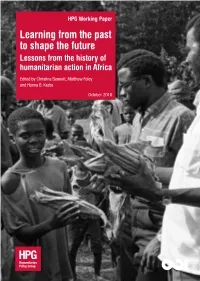
Learning from the Past to Shape the Future Lessons from the History of Humanitarian Action in Africa
HPG Working Paper Learning from the past to shape the future Lessons from the history of humanitarian action in Africa Edited by Christina Bennett, Matthew Foley and Hanna B. Krebs October 2016 HPG Humanitarian Policy Group Acknowledgements The editors would like to thank the following individuals for their expertise and advice during the development and shaping of this collection: David Anderson, University of Warwick; Luka Biong Deng, Kush, Inc.; Karl Blanchet, London School of Hygiene and Tropical Medicine; Laura Hammond, School of Oriental and African Studies, University of London; Simone Haysom, HPG Research Associate; Sara Pantuliano, HPG; Severine Rugumamu, University of Dar Es Salaam; Jeremy Swift, Sahara Conservation Fund; Joost Fontein, British Institute for East Africa; and Costantinos Costantinos at Africa Humanitarian Action. The editors would also like to thank Sharon Abramowitz for her contribution to the symposium on which this collection of papers is based. Humanitarian Policy Group Overseas Development Institute 203 Blackfriars Road London SE1 8NJ United Kingdom Tel. +44 (0) 20 7922 0300 Fax. +44 (0) 20 7922 0399 E-mail: hpgadmin@odi.org Website: http://www.odi.org/hpg © Overseas Development Institute, 2016 Readers are encouraged to quote or reproduce materials from this publication but, as copyright holders, ODI requests due acknowledgement and a copy of the publication. This and other HPG Reports are available from www. odi.org.uk/hpg. Contents 1 Introduction from the editors 1 2 Biafra’s legacy: NGO humanitarianism and the Nigerian civil war 5 Kevin O’Sullivan 3 Iconographies of humanitarian aid in Africa 15 Sonya de Laat and Valérie Gorin 4 Controlling sleeping sickness amidst conflict and calm: 31 remembering, forgetting and the politics of humanitarian knowledge in Southern Sudan, 1956–2005 Jennifer J.