2017 25 Universidad De La Laguna Cuadernos
Total Page:16
File Type:pdf, Size:1020Kb
Load more
Recommended publications
-

Contes Bretons De La Harpe Celtique Yvon Le Quellec
Sommaire 32 HARPES D'EXIL BROCELIANDE le Festival Un chapitre du livre Musiciens, changez de "De la Source à l'Océan" Hubert, métier ! un loup en hiver Édito, par DS Aziliz Le Gallo The Mc Peake Family of Belfast Par Paul Wright Myrias Un nouveau duo pour Ameylia et Marie Contes Bretons de la Harpe Celtique Yvon Le Quellec Célébration du triangle Par AMADIS Harpes dans L'Ennedi Une chanson et une harpe par jour, avec François Pernel Cahier de musique : Les vertus du carbone Camac Odyssey Guillaume, Antoine et Pierre Par Jakez François Pour jouer léger ! Rêve pour demain Noël du Jura Alix Colin Pastiche de Nedeleg Yvon Le Quellec Port an deorai Se fath mo bhuartha François Hascoët Lemoni Peggy of Letermore Audrey Pierre Quel grand bruit ! Eva Fogelgesang Soazig Noblet Making Progress on the Irish Harp quelques liens Ma barre-lyre Reidun Lynch Yaouen le marin Khyunghee Kim Sutre Tianjin Academy Searching for the celtic spirit Daniel Perret Yoka Boka Jeff Mayors Elisabeth Collard La harpe au sein de l'orchestre Édito 32 : Musiciens, vous n'avez qu'à changer de métier ! Alors qu’une récente étude indiquait qu’un tiers des musiciens professionnels britanniques ont l’intention d’abandonner complètement leur carrière en raison des difficultés financières auxquelles ils sont confrontés depuis le début de la pandémie de coronavirus, Rishi Sunak le Chancelier de l’échiquier, au lieu de les rassurer, leur conseille de chercher du travail dans d’autres secteurs. Près de 400 musiciens britanniques, parmi lesquels la célèbre violoniste écossaise Nicola Benedetti, la clarinettiste Emma Johnson ou le violoncelliste Bill Barkley, ont manifesté ce matin devant le Palais de Westminster, siège du Parlement à Londres. -

African and African-American Contributions to World Music
Portland Public Schools Geocultural Baseline Essay Series African and African-American Contributions to World Music by John Charshee Lawrence-McIntyre, Ph.D. Reviewed by Hunter Havelin Adams, III Edited by Carolyn M. Leonard Biographical Sketch of the Author Charshee Lawrence-Mcintyre is Associate Professor of Humanities at the State University of New York at Old Westbury in the English Language Studies Program. PPS Geocultural Baseline Essay Series AUTHOR: Lawrence-McIntyre SUBJECT: Music CONTENTS Content Page BIOGRAPHICAL SKETCH OF THE AUTHOR.............................................................................................. I CONTENTS ..........................................................................................................................................................II INTRODUCTION .................................................................................................................................................1 CLASSICAL AFRICA'S INFLUENCE ON OTHER CIVILIZATIONS ........................................................4 ANCIENT EGYPTIAN INSTRUMENTS .....................................................................................................................4 ANCIENT EGYPTIAN MUSIC AND FORMS .............................................................................................................8 MIGRATION AND EVOLUTION OF MUSIC THROUGHOUT CONTINENTAL AFRICA ...................12 TRADITIONAL INSTRUMENTS .............................................................................................................................14 -

INSTRUMENTAL MUSIC in the ROMAN AGE.1 the Cultivation Of
INSTRUMENTAL MUSIC IN THE ROMAN AGE.1 THE cultivation of instrumental music remained in a backward state among the Greeks in the fifth and fourth centuries, B.C. - This was certainly not due to any want of taste for music.as a whole, for-no race ever valued it higher than did the Greeks. The reasons seem to have been, first, the bondage of-the instrument to the voice, second, the unsettled state of the musical scale, and thirdly, the dislike of the Greeks for over-elaboration in music. • .. • .-..-. ' . These three points are well illustrated in. the Republic of Plato, In opening the discussion on the admissibility of certain modes,-Socrates is made to say that a musical composition is made up of three things, the 'words,' the 'harmony,' and the 'rhythm,' and that the musical "words' are in themselves in no way different from the words of. common speech.2 In another place much scorn is cast by Glaucon on the musicians that sought for the least perceptible interval to make that the unit of sound-measurementr some of the experimenters declaring that they could distinguish an intermed- iate note, where others insisted that the two sounds had passed into unison.3 Socrates answers 'You mean those gentlemen who tease and torture the strings, screwing them up on the pegs.' . • Socrates and Glaucon both speak as amateurs in music, and their feelings must have been shared by many Athenians at the time. Just as with us there are some who long for the return of Handel's 'noble harmonies,' as a relief from the chromatic aberrations of the Wagnerian school, so these two worthy Greeks looked back to the sturdy Dorian airs of Terpander as the true strains of the Hellenic muse, before she had learnt to voice the subtler moods of the heart of man. -

The Venusian Triad: Love, Music and Death
SŁAWOMIRA ŻERAŃSKA-KOMINEK (Warszawa) The Venusian Triad: Love, Music and Death We accept as evident and natural the kindred nature of music and love, sensing keenly the commonality of their expressive-emotional potential. This occurs in great measure thanks to literary and iconograph ie conventions, which frequently employ musical metaphor to express love and to describe erotic experience. (One typical manifestation of such convention is the image of the lover singing a serenade beneath his be loved’s window.) However, the genesis of the affinity between music and amorous feelings, to which philosophy, art and literature make very fre quent reference, is neither obvious nor, much less, easy to elucidate. A cer tain role is played here by the semantic polyvalence of music, by dint of which it is deemed the most excellent language of sentiment. The verbal expression of erotic experience, meanwhile, is practically impossible, as the Polish philosopher Stanisław Lem discussed in Filozofia przypadku: The specific problem from the field of literary studies that we would like to examine is whether literature can penetrate the realm of culture to its very limits, or does it fall short? The limits of literature coincide with the limits of language. The ques tion is thus whether language has the right of unhindered access to the core of all cultural phenomena, or do there remain certain preserves that lie beyond its bounds? The fact is that man [...] can experience certain events only tacitly, ac cording to the facts which present themselves and are consciously experienced or perceived, but not according to some kind of articulation. -

Musical Instruments... : with Numerous Woodcuts
'.''" 1I win*®. $ r I 462 I ". 1 c:"7 yfJ.V ("**.': .5™i •« V ViS U 8«w - ^^^^^^^^^^^^ IhH fl Cornell University B Library The original of this book is in the Cornell University Library. There are no known copyright restrictions in the United States on the use of the text. http://www.archive.org/details/cu31924022319994 SOUTH KENSINGTON MUSEUM ART HANDBOOKS. Edited by WILLIAM MASKELL. No. 5 -MUSICAL INSTRUMENTS. These Handbooks are reprints of the dissertations prefixed to the large catalogues of the chief divisions of works of art in the Museum at South Kensington ; arranged and sofar abridged as to bring each into a portable sha£e. The Lords of the Committee of Council on Education having determined on the publication of them, the editor trusts that they will meet the j>urj>ose intended; namely, to be useful, not alone for the collections at South Ken- sington but for other collections, by enabling the public at a trifling cost to understand something of the history and character of the subjects treated of. The authorities referred to in each book are given in the large catalogues ; where will also be found detailed descriptions of the very numerous examples in the South Kensington Museum. W. M. August, 1875. MUSICAL INSTRUMENTS. BY CARL ENGEL, WITH NUMEROUS WOODCUTS. Published for the Committee of Council on Education BY SCRIBNER, WELFORD, AND ARMSTRONG, NEW YORK. 1876. LIST OF WOODCUTS. Prehistoric whistle .,.. VI MUSICAL INSTRUMENTS. Hindustan, vina . Persian, chang . „ bagpipe Turkish harp Persian dulcimer The rebab Aztec whistles . Antique pipe from central America Pipes of the Aztecs Peruvian bone pipe „ huayra-puhura »» >» Orinoco Indian trumpet South American Juruparis Indian trumpets . -

Edited by Annie Caubet the Power of Images
edited by Annie Caubet The Power of Images Venice, Palazzo Loredan / Istituto Veneto di Scienze, Lettere ed Arti, Campo Santo Stefano 15 September 2018 – 20 January 2019 Cover, Back Cover, page 4 Exhibition curated by Fondazione Giancarlo Ligabue With the Patronage of “Oxus Lady” called “Ligabue Venus” Eastern Iran, Central Asia Annie Caubet Inti Ligabue President Oxus Culture (ca. 2200–1800 BC) General Coordination Ligabue Collection, Venice Secretariat for Management, Massimo Casarin (cat. 86) Administrative and Public and Private Loans Executive Vice President Secretariat Shipping and Insurance Design Lucia Berti Claudia Ghedin Marcello Francone Coordination and Communication Lucia Berti Editorial Coordination Claudia Ghedin Eva Vanzella Public Lenders Management of Public and Private Loans, Promotor Copy Editor Transport and Insurance Emily Ligniti Archäologische Sammlung der Universität Zürich Petra Lanza Layout (Zurich, Switzerland) Archive and Iconography Serena Parini Platinum Sponsor Translations Ashmolean Museum of Art and Archaeology Marta Dal Martello Lauren Sunstein for Scriptum, Rome University of Oxford Archive and Installation (Oxford, United Kingdom) Iconographical Research Communicative Layout Paola Lamanna Badisches Landesmuseum Federico Dei Rossi Main Sponsor (Karlsruhe, Germany) Ubis Three First published in Italy in 2018 by Congregazione Armena Mechitarista Photography Skira editore S.p.A. (Venice, Italy) Hughes Dubois Palazzo Casati Stampa Caroline Leloup Department of Antiquities Cyprus Via Torino 61 Archivi FGL 20123 Milano (Nicosia, Republic of Cyprus) Exhibition Design Italy Musée d’Archéologie nationale www.skira.net Luca Facchini Saint-Germain-en-Laye www.fondazioneligabue.it Ubis Three (Saint-Germain-en-Laye, France) © 2018 Fondazione Giancarlo Ligabue, Multimedia Projects Musées Royaux d’Art et d’Histoire Venice Marco Morbiato © 2018 Skira editore, Milan (Brussels, Belgium) Simone Tasselli All rights reserved under international Musei Civici di Padova – Sergio Pingenti copyright conventions. -

The Biblical Nebel*
Catalog TOC <<Page>> THE BIBLICAL NEBEL* Bathja Bayer, Jerusalem The nebel, mentioned 27 times in the Bible, is generally supposed to have been a harp, and probably of the upperchested type (i.e. with the resonator held upright against the body of the player).1 We have been led to doubt this for several reasons, of which three seemed to be the most important. First the sources did not necessarily prove the nebel to have been a harp, if one did not assume a priori that they ought todo so. Secondly the archaeo logical evidence now available for the Syropalaestinian area showed no repre sentations of harps before the hellenistic period; those that then appeared were few in number, and in both form and context belonged to the "cosmo politan" hellenistic background.2 Even granting the random factors of survival and discovery a correspondence between "textual" and "material" frequency was evident for most of the other identiifable Biblical instruments such as tof (frame drum), mesiltayim (cymbals) and most important kinnor (lyre). How could this silence of the archaelogical record be explained for the supposed nebel = harp ?One could not but be remindedof the curious incident of the dog in the nighttime ("The dog did nothing in the nighttime." "That was the curious incident", remarked Sherlock Holmes). Lastly some of the most "decisive5' sources did not seem to be in the nature of evidence at all, although it was they which were supposed to prove the equation ofnebel=harp. They were much later than the Biblical or even the Second Temple period (Hieronymus at the beginning of the iffth century CE, or Se'adyah Ga'on in the ninth!), and therefore belonged to the history of exegesis. -

Violin-Making : As It Was and Is, Being a Historical, Theoretical, And
CORNELL UNIVERSITY LIBRARY BOUGHT WITH THE INCOME OF THE SAGE ENDOWMENT FUND GIVEN IN 1891 BY HENRY WILLIAMS SAGE [USIC Cornell University Library ML B02.H56 1885 Violin-making :as it was and Is, bein 3 1924 022 320 216 The original of tiiis book is in tine Cornell University Library. There are no known copyright restrictions in the United States on the use of the text. http://www.archive.org/details/cu31924022320216 VIOLm-MAKmG: AS IT WAS ATO IS. ; "jForetootHs." "(Jfor ktxie jt 5« a man tof attasitt " 'Eat make a thjnjf pwfgtte tdtz feat agghte " ^tti toait Bt ga rtbf, anie iszl orxtt stgite " JfatttfS majii b« fnanli* thatte nexttx ram t0« Isghtt, " "^kouih 2* mafetre 1)0* hgs bgUflfiwe ani msghti. " SiagwKS thegm toi tak« jt a» I hvaxt tntenivi, "^nS« to* iaxsbxt mit, gfjhattt i hane nfcitbji. FRONTISPIECE. From a Photograph by Van der Weyde. Vincent Brooks, Woodburytype. : VIOLIN-MAKING, AS IT WAS AND IS: BEING A ON THE SCIENCE Aro AUT OF VIOLm-MAKITO, POK THE USE OP VIOLIN MA.KERS AND PLAYERS, Amateue asd Propessional. ED. HEEON-^LLEN, AviHOB OF "Thb Ahcestbt of the Violiu," "Thb Histoby of a GtBXAt ViOLiir Case," "The Bouance of a Stbasivabi," etc., etc. WITH UPWARDS OF 200 ILLUSTRATIONS BY THE AUTHOR. Viva fui in sylvis, sum diird oeeisa securi, Dum viici tacui, mortua dulee oano. PRECEDED BY 9n €seas on tte 17101111 antr its position as a. iXtusical Snstcument LONDON WARD, LOCK, & CO., LIMITED, WARWICK HOUSE, SALISBURY SQUARE, E.C. NEW YORK AND MELBOURNE. PrinUdby Hazcll, IVats,,,, &- Fi„^. -
Musicians and Musical Instruments of Classical Greece
Musicians and Musical Instruments of Classical Greece Athina Tsentemeidou University of Helsinki Faculty of Arts Ancient Languages and Literatures Greek Language and Literature Master’s Thesis May 2020 Tiedekunta – Fakultet – Faculty Koulutusohjelma – Utbildningsprogram – Degree Programme Faculty of Arts Ancient Languages and Literatures Opintosuunta – Studieinriktning – Study Track Greek Language and Literature Tekijä – Författare – Author Athina Tsentemeidou Työn nimi – Arbetets titel – Title Musicians and Musical Instruments of Classical Greece Työn laji – Arbetets art – Level Aika –Datum –Month and year Sivumäärä– Sidoantal – Number of pages Master’s Thesis May 2020 54 pages + 10 pages of figures Tiivistelmä – Referat – Abstract This study combines two elements related to music in ancient Greece: musicians and musical instruments of Classical Greece. The main research questions answered in this study are: “What were the musicians of Classical Greece?” and “What were the most important musical instruments of Classical Greece?”. The study of the musicians of Classical Greece showed that the words “music” and “musician” are not entirely representative of the ones used in the antique context and therefore a clearer frame – in which we use these two terms for the purposes of a contemporary study – has to be given. There are a lot of limitations in the research of musicians in early and late antiquity due to the fragmentary sources and the absence of sufficient and reliable archaeological evidence. Musicians of Classical Greece were not considered only teachers, dancers, singers or instrument players but also individuals who were involved theoretically with music and were specialists. Before the 4th century BCE there is also a more detailed way in describing someone interfering with music whereas during the 4th century BCE the term mousikos appears. -
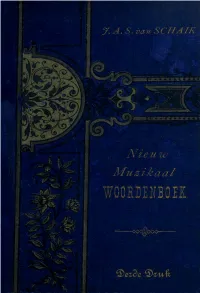
Download Scans
Y. A. S. van SCHAIK yie U w Muzikaal WOORDEN30EK ToZZO, TZAJ-t NIEF\V BERNOPT EN VOLLEDIG JZIKAAL WOORDENBOEK ENEVENS EE OV EE, RZICHT VAN DE Grondbeginselen der Toorikunst. BEWERKT DOOR K. v. M. Met vier Muziektafelen. DERDE DRUK. Om gewerkt en vermeerderd door J. A. S. VAN SCHAIK. en aanbevolen door de lieeren 0. A. IIEINZE, A. WORP, FRANS COENEN, W. F. 0. NICOLAÎ, RTCTIARD HOL, H. A. METJROOS. CULEI\IBORG, BLOM & OLIVIERSE 1891. DRUK VAN MOUTON & Co. DEN HAAG. BEOORDEELING EN AANBEVELING van den eersten druk van dit NIEUW BEKNOPT EN VOLLEDIG MUZIKAAL WOORDENBOEK, BENEVENS EEN OVERZICHT VAN DE GRONDBEGINSELEN DER TOONKUNST. De Ondergeteekende heeft met belangstelling eenige afgedrukte bladen van het Nieuw Beknopt en Volledig Muzikaal Woordenboek enz. leeren kennen, en durft vertrouwen, dat het aan allen, die de toonkunst beoefenen, hoogst welkom zal zijn, vooral daar het, volgens zijn oordeel, de verdiensten bezit van wezenlijk beknopt en volledig te zijn. AMSTERDAM, October 1855. J. J. VAN BREE. Het hier aangeboden werkje Nieuw Beknopt en Volledig Muzikaal Woordenioek enz. is ondanks zijne beknoptheid over het geheel doelmatig bewerkt, bevat vele duidelijke inlichtingen, en zelfs hier en daar zeer gepaste omschrijvingen en uitweidingen. ik voldoe dus gaarne aan het verlangen van den Uitgever met deze mijne bevinding openbaar te maken, en aan onze geachte niuziekwereld dit werkje wegens zijn veelzijdig nut aan te bevelen. AMSTERDAM, October 1855. WILH. SMITS. Na het Nieuw Beknopt en Volledig Muzikaal Woordenboek enz. te hebben doorloopen, kan ik niet nalaten, hetzelve als zeer doelmatig aan Componisten, Executanten, Dilettanten en Muziekscholen aan te bevelen, te meer daar er een dusdanig werk, voor zoo verre mij bekend is, in het Nederduitsch niet bestaat. -

Aristotle Politics
Aristotle On Music Education from Politics 1337b23—1338a37 & 1339a11—1342b35 Translated by Sion M. Honea Revised April 2017 1 Introduction Aristotle’s philosophy of music education as it appears at the end of the Politics is not only a surprisingly thorough conception of music education—which perhaps is not, after all, so surprising considering the author—it is arguably the finest ever formulated given its time and circumstances, which Aristotle tells us we should always consider when making evaluations. In addition to its general excellence, it also provides an argument that serves as the firmest foundation yet articulated for the advocacy of music education, especially in light of research in the fields of psychology and neuroscience. In modern terms, Aristotle argues that training in music produces emotional health and the development of good judgment; further these individuals prove to be better and more responsible members of society. In order fully to understand Aristotle’s thinking in this process, it is necessary to supplement the current text with concepts derived from his Nicomachean Ethics, which appear in the present text in the form of commentary notes and also as an appendix at the end. Considering the obvious need for greater emotional health and improved judgment throughout our society today, it is hoped that this translation and commentary may eventually find readers who will put it to good use, helping to realize the benefits for the individual and society that Aristotle envisioned. I think that it is necessary for me to provide some justification for presenting a new translation of Aristotle’s passage on music education from the Politics when several already exist. -

27 Chapter 2: the Translation Excerpt Number 11 [1337B22] Then These Established Subjects of Learning, As Was Said Earlier
Chapter 2: The Translation Excerpt Number 11 [1337b22] Then these established subjects of learning, as was said earlier, partake of two characters. There are, I believe, four that are customary in education: literacy, gymnastics, music (mousikē) and [25] some say drawing is a fourth: literacy and drawing because they are useful for a livelihood,2 useful for many things indeed; gymnastics as pertaining to manliness, but anyone would be quite at a loss as to music. Most now surely participate in it for the sake of pleasure, but they originally established it in education (paideia) [30] for the reasons that, as many often say, nature itself seeks not only to be active3 correctly but also to be able to be at leisure properly, for this [i.e., “properly”] is the one principle of all, and let us speak about it again. If both are necessary [leisure and activity], leisure is preferable to activity and an end, it is necessary to examine [35] the doing of what [sort of thing] must constitute leisure, it is certainly not playing (paizō), for the purpose of life for us necessarily, [then,] is play (paidia). If this [i.e., the purpose of life as play] is impossible, rather must play be used in activities (for the one who is working requires relaxation, and play is for the sake of relaxation, but activity 1 This translation is based on the Oxford Classical Text, Aritotle, Politica, ed. W. D. Ross (Oxford: Oxford University, 1957) and with some reference to Aristotle, Politica, 3rd ed., ed. Franciscus Susemihl (Leipzig: B.