CUSTOZA Municipality of Sommacampagna Piazza C
Total Page:16
File Type:pdf, Size:1020Kb
Load more
Recommended publications
-

Former Political Prisoners and Exiles in the Roman Revolution of 1848
Loyola University Chicago Loyola eCommons Dissertations Theses and Dissertations 1989 Between Two Amnesties: Former Political Prisoners and Exiles in the Roman Revolution of 1848 Leopold G. Glueckert Loyola University Chicago Follow this and additional works at: https://ecommons.luc.edu/luc_diss Part of the History Commons Recommended Citation Glueckert, Leopold G., "Between Two Amnesties: Former Political Prisoners and Exiles in the Roman Revolution of 1848" (1989). Dissertations. 2639. https://ecommons.luc.edu/luc_diss/2639 This Dissertation is brought to you for free and open access by the Theses and Dissertations at Loyola eCommons. It has been accepted for inclusion in Dissertations by an authorized administrator of Loyola eCommons. For more information, please contact ecommons@luc.edu. This work is licensed under a Creative Commons Attribution-Noncommercial-No Derivative Works 3.0 License. Copyright © 1989 Leopold G. Glueckert BETWEEN TWO AMNESTIES: FORMER POLITICAL PRISONERS AND EXILES IN THE ROMAN REVOLUTION OF 1848 by Leopold G. Glueckert, O.Carm. A Dissertation Submitted to the Faculty of the Graduate School of Loyola University of Chicago in Partial Fulfillment of the Requirements for the Degree of Doctor of Philosophy May 1989 Leopold G. Glueckert 1989 © All Rights Reserved ACKNOWLEDGEMENTS As with any paper which has been under way for so long, many people have shared in this work and deserve thanks. Above all, I would like to thank my director, Dr. Anthony Cardoza, and the members of my committee, Dr. Walter Gray and Fr. Richard Costigan. Their patience and encourage ment have been every bit as important to me as their good advice and professionalism. -
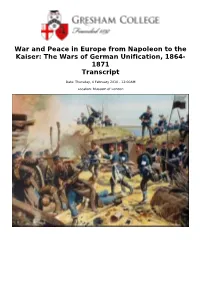
War and Peace in Europe from Napoleon to the Kaiser: the Wars of German Unification, 1864- 1871 Transcript
War and Peace in Europe from Napoleon to the Kaiser: The Wars of German Unification, 1864- 1871 Transcript Date: Thursday, 4 February 2010 - 12:00AM Location: Museum of London The Wars of German Unification 1864-1871 Professor Richard J Evans 4/2/2010 Of all the war that took place in the nineteenth century, perhaps the most effective in gaining their objectives, the most carefully delimited in scope, the best planned, and the most clinically and efficiently executed, were the three wars fought by Prussia in the 1860s, against Denmark, against Austria, and against France. Not all of them went entirely to plan, as we shall see, particularly not the last of the three, but all of them were in nearly all respects classic examples of limited war, of the Prussian military theorist Carl von Clausewitz's dictum that war is politics continued by other means. After the muddle, incompetence and indecisiveness of the Crimean War, the wars of the 1860s seemed to belong to another world. How and why were these three wars fought? I argued in my earlier lectures that the 1848 Revolutions, though they failed in many if not most respects, undermined the international order established at the Congress of Vienna in 1815, opening up the international scene to new initiatives and instabilities. The joker in the pack here was the French Emperor Napoleon III, whose search for foreign glory and foreign victories as a way of legitimating his dictatorial rule at home led him into one military adventure after another, some successful, others less so. It was among other things French military intervention that secured victory for Piedmont-Sardinia over the Austrians in 1859, though the drive for Italian unity then became unstoppable, thanks not least to the activities of the revolutionary nationalist Giuseppe Garibaldi, much to Napoleon III's discomfiture. -
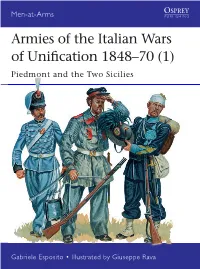
Armies of the Italian Wars of Unification 1848–70 (1)
Men-at-Arms Armies of the Italian Wars of Uni cation 1848–70 (1) Piedmont and the Two Sicilies Gabriele Esposito • Illustrated by Giuseppe Rava GABRIELE ESPOSITO is a researcher into military CONTENTS history, specializing in uniformology. His interests range from the ancient HISTORICAL BACKGROUND 3 Sumerians to modern post- colonial con icts, but his main eld of research is the military CHRONOLOGY 6 history of Latin America, • First War of Unification, 1848-49 especially in the 19th century. He has had books published by Osprey Publishing, Helion THE PIEDMONTESE ARMY, 1848–61 7 & Company, Winged Hussar • Character Publishing and Partizan Press, • Organization: Guard and line infantry – Bersaglieri – Cavalry – and he is a regular contributor Artillery – Engineers and Train – Royal Household companies – to specialist magazines such as Ancient Warfare, Medieval Cacciatori Franchi – Carabinieri – National Guard – Naval infantry Warfare, Classic Arms & • Weapons: infantry – cavalry – artillery – engineers and train – Militaria, Guerres et Histoire, Carabinieri History of War and Focus Storia. THE ITALIAN ARMY, 1861–70 17 GIUSEPPE RAVA was born in • Integration and resistance – ‘the Brigandage’ Faenza in 1963, and took an • Organization: Line infantry – Hungarian Auxiliary Legion – interest in all things military Naval infantry – National Guard from an early age. Entirely • Weapons self-taught, Giuseppe has established himself as a leading military history artist, THE ARMY OF THE KINGDOM OF and is inspired by the works THE TWO SICILIES, 1848–61 20 of the great military artists, • Character such as Detaille, Meissonier, Rochling, Lady Butler, • Organization: Guard infantry – Guard cavalry – Line infantry – Ottenfeld and Angus McBride. Foreign infantry – Light infantry – Line cavalry – Artillery and He lives and works in Italy. -
Ph.D. Dissertation
Women in Arms: Gender in the Risorgimento, 1848–1861 By Benedetta Gennaro B. A., Università degli Studi di Roma “La Sapienza”, 1999 M. A., Miami University, 2002 A Dissertation Submitted in Partial Fulfillment of the Requirements for the Degree of Doctor of Philosophy in the Department of Italian Studies at Brown University Providence, Rhode Island May 2010 c Copyright 2010 by Benedetta Gennaro This dissertation by Benedetta Gennaro is accepted in its present form by the Department of Italian Studies as satisfying the dissertation requirement for the degree of Doctor of Philosophy. Date Suzanne Stewart-Steinberg, Advisor Recommended to the Graduate Council Date Caroline Castiglione, Reader Date Massimo Riva, Reader Date David Kertzer, Reader Approved by the Graduate Council Date Sheila Bonde, Dean of the Graduate School iii VITA Benedetta Gennaro was born in Rome on January 18th, 1975. She grew up in Rome and studied at the University of Rome, “La Sapienza” where she majored in Mass Communication. She wrote her undergraduate thesis on the history of the American Public Broadcasting System (1999), after spending a long and snowy winter in the middle of the Nebraskan plains, interning at NET the Nebraska Educational Televi- sion Network. She went on to receive her M.A. in Mass Communication from Miami University (Oxford, Ohio) in 2002. Her master’s thesis focused on an analysis of gender, race, and class in prime-time television opening credits. She decided to move west, to Portland, Oregon, where she worked for three years for the Northwest Film Center, a branch of the Portland Art Museum, organizing the yearly Portland Inter- national Film Festival. -
© in This Web Service Cambridge University Press
Cambridge University Press 978-0-521-15865-7 - Italy in the Making: January 1st 1848 to November 16th 1848 G. F.-H. & J. Berkeley Index More information INDEX Abercrol'nby, Hon. Ralph, 70 Asola, 122 note Accursi, Michele, 399,400,413 Aso10, 256, 257 Acqui Brigade, 222, 225, 236, 237 Aspiceira, 29 note and note, 363 note Austria, 28, 34, 35, 37, 53, 65, 68, Adam, General Sir Frederick, 56 69, 106, 1I8, 171, 320, 338, 417, Adda, the River, 75, 99 467 (Appendix I); Emperor of, Adige, the River, 117 and note, 118 334; intervention by, 65 note, 199, 200, 204, 208, 216, Austrian anny in Italy, the, 1-5 217, 237 note, 321, 322, 330, et seq.; clashes with population, 356 17-26; insurrection in Venice, Adriatic, the, 402 74-8; the Five Days in Milan, Aldobrandini, J>rince, 153, 157, 78"""96; during the retirement, 160, 168 97-102; position within the Alfieri, Cesare, Marchese di Sos Quadrilateral, 116 et seq.; at the tegno,386 first battle of Goito, 121 et seq.; Allocution, Pius IX's, of April 29th at Pastrengo, 195, 197-215; at 1848, 130, 136, 142, 169, 172, battle of Santa Lucia, 216--240; 177 et seq., 240, 265, 272, 343, (Nugent's column) at Cornuda 413, 450, 467, 468 note. V. also and Vicenza, 242-']0; Radetzky's sub Pius IX swoop: battles of Curtatone, Altieri, Cardinal, 337, 340 Goito, and Vicenza, 287-319; at Alto Consiglio, the, 342, 343, 347, Ferrara, 346; at battle of Custoza, 427 352-83; strength of, at that Amat, Cardinal, 160,286 note, 328 time, 355; at Bologna, 389; note against Garibaldi, 391-4 Amedeo, Pietro, 56 Austrian Empire, the, 37, 73, 244, Ancona, 150, 402 310 Andre, Baron, 3 I note Austrian officer, the, 45 Anelli, Luigi, 379 Austrian Rescript, the, of February Anti-smoking campaign, the, in 22nd 1848, 24 Milan, v. -

The Italian Risorgimento
The Italian Risorgimento HISTORICAL CONNECTIONS Series editors Geoffrey Crossick, University of Essex John Davis, University of Connecticut Joanna Innes, Somerville College, University of Oxford Tom Scott, University of Liverpool Already published The Decline of Industrial Britain 1870–1980 Michael Dintenfass The French Revolution Gwynne Lewis The Rise of Regional Europe Christopher Harvie The Remaking of the British Working Class Michael Savage and Andrew Miles Forthcoming titles Catholic Politics in Europe 1918–1945 Martin Conway The Unification of Germany Michael John Population Policies in Twentieth-Century Dictatorships and Democracies Maria Quine Nationalism in the USSR Stephen Jones Fascism in Italy and Germany HISTORICAL CONNECTIONS iii Alex de Grand Popular Politics in Nineteenth-Century England Rohan McWilliam Environment and History William Beinart and Peter Coates The Italian Risorgimento State, society and national unification Lucy Riall London and New York First published 1994 by Routledge 11 New Fetter Lane, London EC4P 4EE Simultaneously published in the USA and Canada by Routledge 29 West 35th Street, New York, NY 10001 Routledge is an imprint of the Taylor & Francis Group This edition published in the Taylor & Francis e-Library, 2004. © 1994 Lucy Riall All rights reserved. No part of this book may be reprinted or reproduced or utilized in any form or by any electronic, mechanical, or other means, now known or hereafter invented, including photocopying and recording, or in any information storage or retrieval system, without permission in writing from the publishers. British Library Cataloguing in Publication Data A catalogue record for this book is available from the British Library. Library of Congress Cataloguing in Publication Data Riall, Lucy The Italian Risorgimento: state, society, and national unification/Lucy Riall. -
Rome Compiled Background Guide Final Online
Roman Republic (1849) MUNUC 33 ONLINE1 Roman Republic (1849) | MUNUC 33 Online TABLE OF CONTENTS ______________________________________________________ CHAIR LETTER……………………………….………………………….……..…3 CRISIS DIRECTOR LETTER……………………………………………………….5 ANCIENT ROME………………………………………………………………….7 MODERN CONTEXT OF ROME AND THE PAPAL STATES…………………..22 CURRENT ISSUES………………………………………………………………. 36 MAP…………………………………………………………………………….. 39 CHARACTER BIOGRAPHIES…………………………………………………. 40 BIBLIOGRAPHY………………………………………………………………...59 2 Roman Republic (1849) | MUNUC 33 Online CHAIR LETTER ____________________________________________________ Dear Delegates, Welcome to the Roman Republic of 1849! I will be your chair for the weekend of MUNUC, during which time I’ll represent Giuseppe Mazzini. I’m incredibly excited to welcome you to a little-known (and less understood) time in history! The Roman Republic of 1849 represents how people tried to bring ideals of individuality, freedom, and equality to reality. Although the real-world Republic fell to a French invasion, I hope that you can gather your creativity, knowledge, and collaboration to change history and build a Republic that will last. I’m a current senior at the University of Chicago, studying Biology with a specialization in Endocrinology on the pre-medical track. I staff MUNUC, run our collegiate conference ChoMUN as Director-General, and compete on our travel team. Outside of MUN, I do research in a genetic neurobiology lab with fruit flies, volunteer at the UChicago Hospital, and TA for courses such as Organic Chemistry, Genetics, and Core Biology. I also like to write poetry, paint, and perform Shakespeare! If at any point you want to share something or ask a question, on anything from your favorite novel to college life, just reach out to me at kdelong@uchicago.edu. -

Heir of the Month: the Second Year (2014-15)
Heir of the Month: The Second Year (2014-15) www.heirstothethrone-project.net 2 H Preface As we look back on another year of our „Heirs to the Throne“ project, we find that our topic really is a gift that keeps on giving. The members and friends of the St Andrews team have written another dozen “Heir of the Month” essays and the variety of the topics addressed and perspectives chosen has proved to be as colourful as ever. Our monthly offerings have dealt with countries as far-flung as Mexico, Portugal, Greece and Spain – along with old favourites such as France, Prussia, Italy and Britain – and have gazed through analytical lenses as diverse as motor cars, sepulchral monuments, choreographed travel, marriage diplomacy or literary responses to royal topics. We are happy to collate our second clutch of twelve essays into another freely available “Royal Annual” for ease of access and to mark the ongoing commitment of our AHRC- funded venture to communicating our work and our ideas to a wide circle of readers with an interest in the history of the monarchical nineteenth century. We are delighted to take this opportunity to thank the AHRC and the School of History for their continued support of our activities. St Andrews, October 2015 Heidi Mehrkens Frank Lorenz Müller 3 H Essays November 2014 – October 2015 Edward (David) Prince of Wales: Monarchy and Motorcars 04 (Heidi Mehrkens) Amedeo Duca d’Aosta / don Amadeo I of Spain: Mission Impossible: 13 An Italian King in Spain (Maria-Christina Marchi / Richard Meyer Forsting) ‘Distant from the court and all of its influences’: The German Crown Prince at the 25 Prinzenschule in Plön (Frank Lorenz Müller) Albert Edward and Alexandra, Prince and Princess of Wales: The Politics of a Royal 34 Marriage (Charles A. -

Peter Riley a Supplement for Converting Polemos Commandant
Bruderkrieg Peter Riley A supplement for converting Polemos Commandant de Bataille FPW rules for the Austro-Prussian War of 1866 Bruderkrieg A supplement for converting Polemos Commandant de Bataille FPW rules for the Austro Prussia war of 1866 Published in pdf format by: Baccus 6mm Ltd, 2010 Text Copyright: Peter Riley Layout and Design: Baccus 6mm Ltd Photography: Peter Berry Maps: Sven Lugar Baccus 6mm figures painted by Peter Berry All rights reserved. No part of this work may be reproduced or used in any form or by any means without the express written consent of the authors. For more information about the figures and models used in this catalogue, extra sections and add-ons to these rules, as well as the other rules sets in the Polemos series, visit: www.baccus6mm.com A Yahoo group has been set up to allow for discussion of all aspects of playing games using Polemos rules. If you have any questions, are looking for tips and advice or just want to talk to other gamers, you can join by logging on to http://games.groups.yahoo.com/group/polemos Introduction Bruderkrieg 1866 Introduction ii Part One – Setting up the Game Troop Types 4 Part Two – Playing the Game Part Four – Army Generators Tempo Bidding 5 Army Generators 24 5 Bombardment Tables Prussian Army 25 Move Distance Table 6 Italian Army 26 Firing Range Table 6 Austrian Army of the North 27 Firing Procedure Modifiers Table 6 Close Combat Attacks Table 7 Austrian Army of the South 28 Pursuit Modifiers Table 7 Allied Army 29 Army Morale 7 Tyrolean Theatre Army 30 Part Three – Orders -

Visconti and Visual Arts
V A V ISIVE I RT LE E I VO B LOM VISCONTI AND THE VISUAL AISCONTI RTS Editorial Coordination Carlotta Sembenelli Translation Francesca Melli Editorial Consultant Emily Ligniti Graphic Design Orith Kolodny First published for the Seminar: Visconti and the Visual Arts. Milan, Palazzo Visconti September 28th 2006 Supported by ISBN 88-85982-96-4 © 2006 MCF Srl – Edizioni Olivares Via Borgogna, 7 I – 20122 Milan Tel. +39 02 76003602 olivares@edizioniolivares.com www.edizioniolivares.com V A V ISIVE I RT LE E TABLE OF CONTENTS ISCONTI Introduction: Caterina D’Amico Ivo Blom 7 Luchino Visconti and the Visual Arts 8 Intermediality and Visconti 12 Visconti and Painting: Cousins, not Brothers 14 Fattori, Macchiaioli 15 Art and Set Design at Home 20 To Re-invent 23 Seelenlandschaften 24 Painting in Sets 27 Creating Space through Mirrors 30 Color and Light 31 Conclusion Ivo Blom teaches Film and Comparative Arts in the Department of Comparative Arts Studies at the Vrije Universiteit, Amsterdam. After getting his MA in Art History (1986), with a thesis on Luchino Visconti and Painting, he worked in the Restoration Department of the Netherlands Filmmuseum (1989– 1994) and specialized in early cinema (particularly Italian and Dutch), frequently talking at international conferences and publishing with international journals, books, and encyclopedia. In 2000, he received his Ph.D. in Film and Television Studies from the University of Amsterdam, publishing his dissertation Jean Desmet and the Early Dutch Film Trade (University of Amsterdam Press, 2003). Recently, he contributed to biblioVisconti 3 and published on Visconti in the Dutch journals Jong Holland and Skrien and on www.luchinovisconti.net. -

2. German Unification 1849–71 8 3
HISTORY History Historical Investigations and Interpretations Unit AS 1 Option 4: Italy and Germany 1815–71 Content Page Introduction 2 1. Germany 1815–48 3 2. German Unification 1849–71 8 3. Italy 1815–48 16 4. Italian Unification 1849–70 21 HISTORY Introduction In this option, students focus on the unification of Italy and Germany between 1815 and 1871. Students analyse the growth of liberalism, nationalism and cultural movements in the period 1815–48, concentrating, in particular, on the causes and reasons for the failure of the revolutions that broke out in Italy and Germany in 1848. The main focus is on the unification process in both countries. Students examine the contribution of individuals such as Bismarck and Cavour, economic developments and the favourable international situation. This option is assessed in a written examination lasting one hour 30 minutes. Candidates answer two questions. Question 1 is a short response question and candidates answer one question from a choice of two. Question 2 is a source-based question with two parts. In Question 2(a) candidates assess the usefulness of a primary and/or contemporary source to an historian studying a particular historical event or development. In Question 2(b) candidates assess which of two different interpretations of a particular historical event or development they find more convincing. Question 1 targets Assessment Objective AO1: the candidate’s ability to demonstrate, organise and communicate knowledge and understanding to analyse and evaluate the key features related to the periods studied, making substantiated judgements and exploring concepts, as relevant, of cause, consequence, change, continuity, similarity, difference and significance. -

Accadde Per L'italia Tra I Nostri Colli
CICLO DI CONFERENZE - Ore 21 7 Giugno - Prof. Carlo Saletti, “Paesaggio dopo la Battaglia. Luoghi e oggetti Sommacampagna - Municipio - Town hall COMUNE DI del ricordo della guerra del 1866”. SOMMACAMPAGNA 5 Aprile - Prof. Giovanni Bresadola, “The landscape after the battle. Sites and objects “Il quadro politico europeo ed italiano all’epoca remembering the 1866 battle”. della battaglia di Custoza (1866)”. 13 Settembre - Prof.ssa Valentina Catania, “The European political scene and the Italian Le donne del Risorgimento veneto. context at the time of the battle of Custoza (1866)”. “Abbiamo diviso i dolori, i tormenti, le umiliazioni”. 19 Aprile - Nazario Barone, “Women’s role during the Risorgimento”. “24 Giugno 1866. La giornata di Custoza”. 27 Settembre - Archeonaute e Osteoarc, Litofilm per Dettagli Piccoli DI “June 24, 1866: The battle of Custoza”. SAV O “Dai campi di battaglia risorgimentali alla IA E CUSTOZA P O I C E - N 3 Maggio Prof. Stefano Biguzzi, memoria della morte: catalogazione digitale e I D R E P “1866: l’anno delle occasioni perdute”. ricerca scientifica”. M A “1866: a year of lost opportunities”. “From the battlegrounds to the memory of the soldiers that lost their lives: digital catalogues 17 Maggio - Prof. Vasco Senatore Gondola, and scientific research”. “Realtà e problemi di vita quotidiana nella Sommacampagna ottocentesca”. “Facts and problems of everyday life in Somma- - Le conferenze si terranno in lingua italiana. S I The language of the conferences is Italian. T E T E N E N T E G campagna during the 1800s”. F A G N O M E S S A CON IL PATROCINIO E COLLABORAZIONE DI comune di città di comune di CASTELNUOVO DESENZANO comune di BUSSOLENGO del GARDA del GARDA MONZAMBANO comune di comune di comune di città di PESCHIERA comune di comune di VALEGGIO VILLAFRANCA PASTRENGO del GARDA POZZOLENGO SONA sul MINCIO di VERONA CON IL SOSTEGNO DI III GUERRA D'INDIPENDENZA ACCADDE PER L'ITALIA TRA I G.M.