Fake News Outbreak 2021: Can We Stop the Viral Spread?
Total Page:16
File Type:pdf, Size:1020Kb
Load more
Recommended publications
-

Tutorial Blogspot Plus Blogger Templates
Tutorial Blogspot Plus Blogger Templates To Bloggers Everywhere 1 2 Contents Contact Us 25 Cara daftar Gmail 25 Cara daftar Blogger pertama kali 27 Cara login ke blogger pertama kali 28 Kontrol panel blogger (dashboard) 29 Cara posting di blogger 30 Halaman Pengaturan (menu dasar) 31 Banyak malware yang ditemukan google 32 Google ! Mesin pembobol yang menakutkan 32 Web Proxy (Anonymous) 33 Daftar alamat google lengkap 34 Google: tampil berdasarkan Link 37 Oom - Pemenang kontes programming VB6 source code 38 (www.planet-sourc... Oom - Keyboard Diagnostic 2002 (VB6 - Open Source) 39 Oom - Access Siemens GSM CellPhone With Full 40 AT+Command (VB6 - Ope... Oom - How to know speed form access (VB6) 40 Para blogger haus akan link blog 41 Nama blog cantik yang disia-siakan dan apakah pantas nama 41 blog dipe... Otomatisasi firewalling IP dan MAC Address dengan bash script 43 Firewalling IP Address dan MAC Address dengan iptables 44 Meminimalis serangan Denial of Service Attacks di Win Y2K/XP 47 Capek banget hari ini.. 48 3 daftar blog ke search engine 48 Etika dan cara promosi blog 49 Tool posting dan edit text blogger 52 Setting Blog : Tab Publikasi 53 Wordpress plugins untuk google adsense 54 Google meluncurkan pemanggilan META tag terbaru 54 “unavailable after” Setting Blog : Tab Format 55 Melacak posisi keyword di Yahoo 56 Mengetahui page ranking dan posisi keyword (kata kunci) anda 56 pada S... Percantik halaman blog programmer dengan "New Code 57 Scrolling Ticke... 20 Terbaik Situs Visual Basic 58 BEST BUY : 11 CD Full Source Code Untuk Programmer 60 Tips memulai blog untuk pemula 62 Lijit: Alternatif search untuk blogger 62 Berpartisipasi dalam Blog "17 Agustus Indonesia MERDEKA" 63 Trafik di blog lumayan, tapi kenapa masih aja minim komentar? 64 Editor posting compose blogger ternyata tidak "wysiwyg" 65 Google anti jual beli link 65 Tips blogger css validator menggunakan "JavaScript Console" 65 pada Fl.. -
Unconscionability 2.0 and the Ip Boilerplate: a R Evised Doctrine of Unconscionability for the Information
UNCONSCIONABILITY 2.0 AND THE IP BOILERPLATE: A REVISED DOCTRINE OF UNCONSCIONABILITY FOR THE INFORMATION AGE Amit Elazari Bar On† ABSTRACT In the information age, where fewer goods and more innovations are produced, intellectual property law has become the most crucial governing system. Yet, rather than evolving to fit its purpose, it has seemingly devolved—standard form contracts, governing countless creations, have formed an alternative de facto intellectual property regime. The law governing the information society is often prescribed not by legislators or courts, but rather by private entities, using technology and contracts to regulate much of the creative discourse. The same phenomena persist in other emerging areas of information law, such as data protection and cybersecurity laws. This Article offers a new analytical perspective on private ordering in intellectual property (IP) focusing on the rise of IP boilerplate, the standard form contracts that regulate innovations and creations. It distinguishes between contracts drafted by the initial owners of the IP (such as End-User-License-Agreements (EULAs)) and contracts drafted by nonowners (such as platforms’ terms of use), and highlights the ascendancy of the latter in the user- generated content era. In this era, the drafter of the contract owns nothing, yet seeks to regulate the layman adherent’s creations, and sometimes even to redefine the contours of the public domain. Private ordering is expanding its governing role in IP, creating new problems and undermining the rights that legislators bestow on creators and users. While scholars often discuss the problems caused by IP boilerplate, solutions are left wanting. Inter-doctrinal solutions have been unjustly overlooked. -

Fake News Outbreak 2021: Can We Stop the Viral Spread?
SOK: Fake News Outbreak 2021: Can We Stop the Viral Spread? TANVEER KHAN, Tampere University ANTONIS MICHALAS, Tampere University ADNAN AKHUNZADA, Technical University of Denmark Social Networks’ omnipresence and ease of use has revolutionized the generation and distribution of information in today’s world. However, easy access to information does not equal an increased level of public knowledge. Unlike traditional media channels, social networks also facilitate faster and wider spread of disinformation and misinformation. Viral spread of false information has serious implications on the behaviours, attitudes and beliefs of the public, and ultimately can seriously endanger the democratic processes. Limiting false information’s negative impact through early detection and control of extensive spread presents the main challenge facing researchers today. In this survey paper, we extensively analyse a wide range of different solutions for the early detection of fake news in the existing literature. More precisely, we examine Machine Learning (ML) models for the identification and classification of fake news, online fake news detection competitions, statistical outputs as well as the advantages and disadvantages of some of the available data sets. Finally, we evaluate the online web browsing tools available for detecting and mitigating fake news and present some open research challenges. 1 INTRODUCTION The popularity of Online Social Networks (OSNs) has rapidly increased in recent years. Social media has shaped the digital world to an extent it is now an indispensable part of life for most of us [54]. Rapid and extensive adoption of online services is influencing and changing how we access information, how we organize to demand political change and how we find partners. -
Informational Apathy: the Impact of the Information Age
Informational Apathy: The Impact of the Information Age A Research Paper submitted to the Department of Engineering and Society Presented to the Faculty of the School of Engineering and Applied Science University of Virginia • Charlottesville, Virginia In Partial Fulfillment of the Requirements for the Degree Bachelor of Science, School of Engineering Dylan Culfogienis Fall, 2020 On my honor as a University Student, I have neither given nor received unauthorized aid on this assignment as defined by the Honor Guidelines for Thesis-Related Assignments Informational Apathy: The Impact of the Information Age Introduction As the information age progresses, fact-checked, high-quality information and news is increasingly being drowned out by misinformation and disinformation. This rising tide of information disorder manifests as increasing public distrust of news sources, both traditional (news channels), and emerging (social media), despite increasing viewership and readership. (Shearer & Matsa, 2018) Social media companies build their machine learning-driven news feeds around metrics of “meaningfulness” and view time, as opposed to veracity. (Tien, 2018) 24-hour news channels eschew journalistic integrity in favor of fast turn-around time and attention-grabbing headlines. (“How News Has Changed,” 2017) The effects of this public distrust are correlated with a rise in political polarization in the US, and a rise of “echo-chamber” communities such as conspiracy groups and radical political organizations, groups characterized by the exclusion of certain popular assumptions or facts. As public information sources change, it is important to understand how those changes affect the population. At the time of writing, Facebook serves 2.37 billion users, with 1.56 billion reading Facebook daily. -
A Landscape Analysis
The Fight Against Dis- information in the U.S. A Landscape Analysis OCTOBER 2018 Authors Heidi Legg, Director of Special Projects, The Shorenstein Center on Media, Politics and Public Policy, Harvard Kennedy School Joe Kerwin, Harvard College Senior, Dunster House Edited by Grace Greason, Harvard College, Sophomore, Lowell House The views expressed in Shorenstein Center Discussion Papers are those of the author(s) and do not necessarily reflect those of Harvard Kennedy School or of Harvard University. Discussion Papers have not undergone formal review and approval. Such papers are included in this series to elicit feedback and to encourage debate on import- ant issues and challenges in media, politics and public policy. Copyright belongs to the author(s). Papers may be downloaded for personal use only. How is Disinformation Changing Us? The Fight Against Disinformation in the U.S.: A Landscape Analysis is a map of the disinformation initiatives currently in play to undergird newsrooms and improve media literacy at this challenging moment for the free press. Universities, platforms, foundations and private donors are all working to understand how a contagion spreads in this viral digital culture and to discover potential solutions. In an effort to discover who is stepping up, what they are doing and where they are making early headway, the work is organized into four categories: 1. Internal Platform Efforts, 2. Institutional Initiatives, 3. Upstart Initiatives and 4. Leading Funders. The iPhone is 10 years old, Twitter is 12 and Facebook is 14. History has shown that the medium is the message and that cataclysmic changes in how we communicate bring dra- matic shifts in our society. -
U.S. Far-Left Groups
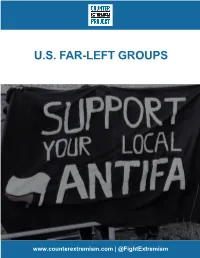
U.S. FAR-LEFT GROUPS www.counterextremism.com | @FightExtremism U.S. FAR-LEFT GROUPS Key Points Far-left groups in the United States in the 20th century largely focused on issue-specific causes such as Puerto Rican independence or environmentalism. Modern far-left groups largely focus on social justice issues such as racial equality and immigration rights. These groups often align with socialist or anti-capitalist values out of protest against wealth inequity. Gun ownership is a central characteristic of far-left groups such as the John Brown Gun Club and Redneck Revolt, which believe they must arm themselves for protection from the far right. These groups appear at protests brandishing firearms and serving as security forces while instructing others on how to use guns. Today’s far-left groups largely do not have hierarchal or even organizational structures like their far-right counterparts. U.S. President Donald Trump has called Antifa a terrorist group, but it is less a cohesive group and more a broad ideological opposition to perceived fascism. Antifa’s lack of a uniform doctrine or organization results in followers presenting sometimes opposing ideals. 1 Far-left extremism in the United States largely centers around the notion of correcting an injustice but is otherwise broad in its ideological catchment. In the 20th century, U.S. left-wing extremism was synonymous with either communism or causes such as environmentalism. In the 1960s and ’70s, the Weather Underground declared war against the U.S. government and carried out a campaign of political violence.1 According to the FBI, far-left extremism in the United States was most active during the period between the 1960s and 1980s. -

Manifestations of Anti- Semitism in the 21St Century
ANTI-SEMITISM RESURGENT: MANIFESTATIONS OF ANTI- ST SEMITISM IN THE 21 CENTURY 1 www.counterextremism.com | @FightExtremism ANTI-SEMITISM RESURGENT: MANIFESTATIONS OF ANTI-SEMITISM IN THE 21ST CENTURY Key Points Modern anti-Semitism is a repackaging of historic tropes. Anti- Semites have adapted conspiracy theories of the blood libel as well as Jewish influence in economic and governmental affairs to fit new circumstances, such as the accusation that Jews are responsible for spreading COVID-19, just as Jews were accused of spreading the plague a millennium ago. Jews have historically been denied political and economic rights, and modern anti-Semitism is an expression of the rejection of Jewish integration into society. While the twentieth century saw the rise of influential Jewish politicians around the world as well as the creation of the Jewish nation-state of Israel, conspiracy theorists continue to accuse Jews of dual loyalties and exerting too much influence in world affairs. Partisan politicians are also increasingly willing to incorporate anti-Semitic tropes into their rhetoric to attack opponents they view as serving other interests. Blatantly anti-Semitic historical legal restrictions on Jewish life have evolved into modern laws restricting basic tenets of Jewish life—e.g., kosher slaughter and circumcision—with support from both the left and the right, who argue they are protecting animal and children’s rights. These laws largely do not specifically target Jews but still have the effect of restricting Jewish practice. 2 Table of Contents Anti-Semitism By The Numbers ............................................................................................ 8 Reviving Anti-Jewish Laws .................................................................................................. 31 Modern Political Anti-Semitism .......................................................................................... 34 Holocaust Denial ................................................................................................................. -
Unconscionability 2.0 and the IP Boilerplate: a Revised Doctrine of Unconscionability for the Information Age
Unconscionability 2.0 and the IP Boilerplate: A Revised Doctrine of Unconscionability for the Information Age By Amit Elazari A dissertation submitted in partial satisfaction of the requirements for the degree of Doctor of the Science of Law in the Graduate Division of the University of California, Berkeley Committee in charge: Professor Steven Davidoff Solomon, Chair Professor Deirdre K. Mulligan Professor Chris Jay Hoofnagle Professor Robert P. Merges Professor Molly Shaffer Van Houweling Fall 2018 Unconscionability 2.0 and the IP Boilerplate: A Revised Doctrine of Unconscionability for the Information Age © 2018 by Amit Elazari Abstract Unconscionability 2.0 and the IP Boilerplate: A Revised Doctrine of Unconscionability for the Information Age by Amit Elazari Doctor of the Science of Law University of California, Berkeley Professor Steven Davidoff Solomon, Chair In the information age, where fewer goods and more innovations are produced, intellectual property law has become the most crucial governing system. Yet, rather than evolving to fit its purpose, it has seemingly devolved—standard form contracts, governing countless creations, have formed an alternative de facto intellectual property regime. The law governing the information society is often prescribed not by legislators or courts, but rather by private entities, using technology and contracts to regulate much of the creative discourse. The same phenomena persist in other emerging areas of information law, such as data protection and cybersecurity laws. This dissertation offers a new analytical perspective on private ordering in intellectual property (IP) focusing on the rise of the IP boilerplate, the standard form contracts that regulate innovations and creations. It distinguishes between contracts drafted by the initial owners of the IP (such as EULAs) and contracts drafted by nonowners (such as platforms’ terms of use), and highlights the ascendancy of the latter in the user-generated content era. -
CYBERSECURITY When Will You Be Hacked?
SUFFOLK ACADEMY OF LAW The Educational Arm of the Suffolk County Bar Association 560 Wheeler Road, Hauppauge, NY 11788 (631) 234-5588 CYBERSECURITY When Will You Be Hacked? FACULTY Victor John Yannacone, Jr., Esq. April 26, 2017 Suffolk County Bar Center, NY Cybersecurity Part I 12 May 2017 COURSE MATERIALS 1. A cybersecurity primer 3 – 1.1. Cybersecurity practices for law firms 5 – 1.2. Cybersecurity and the future of law firms 11 – 2. Information Security 14 – 2.1. An information security policy 33 – 2.2. Data Privacy & Cloud Computing 39 – 2.3. Encryption 47 – 3. Computer security 51 – 3.1. NIST Cybersecurity Framework 77 – 4. Cybersecurity chain of trust; third party vendors 113 – 5. Ransomware 117 – 5.1. Exploit kits 132 – 6. Botnets 137 – 7. BIOS 139 – 7.1. Universal Extensible Firmware Interface (UEFI) 154– 8. Operating Systems 172 – 8.1. Microsoft Windows 197 – 8.2. macOS 236– 8.3. Open source operating system comparison 263 – 9. Firmware 273 – 10. Endpoint Security Buyers Guide 278 – 11. Glossaries & Acronym Dictionaries 11.1. Common Computer Abbreviations 282 – 11.2. BABEL 285 – 11.3. Information Technology Acronymns 291 – 11.4. Glossary of Operating System Terms 372 – 2 Cyber Security Primer Network outages, hacking, computer viruses, and similar incidents affect our lives in ways that range from inconvenient to life-threatening. As the number of mobile users, digital applications, and data networks increase, so do the opportunities for exploitation. Cyber security, also referred to as information technology security, focuses on protecting computers, networks, programs, and data from unintended or unauthorized access, change, or destruction. -

ON RADICAL GROUNDS: a RHETORICAL TAKE on the EMERGENCE of #OCCUPY in TIME, PLACE, and SPACE by MEGHAN MARIE DUNN B.A., Texas
ON RADICAL GROUNDS: A RHETORICAL TAKE ON THE EMERGENCE OF #OCCUPY IN TIME, PLACE, AND SPACE by MEGHAN MARIE DUNN B.A., Texas State University, 2005 M.A., University of Texas, 2008 A thesis submitted to the Faculty of the Graduate School of the University of Colorado in partial fulfillment of the requirement for the degree of Doctor of Philosophy Department of Communication 2015 This thesis entitled: On Radical Grounds: A Rhetorical Take on the Emergence of #Occupy in Time, Place, and Space written by Meghan Marie Dunn has been approved for the Department of Communication (Dr. Gerard A. Hauser) (Dr. Peter Simonson) Date The final copy of this thesis has been examined by the signatories, and we find that both the content and the form meet acceptable presentation standards of scholarly work in the above mentioned discipline. IRB protocol # 15-0064 Dunn, Meghan Marie (Ph.D., Communication) On Radical Grounds: A Rhetorical Take on the Emergence of #Occupy in Time, Place, and Space Thesis directed by Emeritus Professor Gerard A. Hauser This dissertation explores how the Occupy Wall Street (OWS) and the Occupy Movement (OM) writ large generated new forms of rhetorical invention through its emergence in geographical places and virtual spaces across the world. The genesis and development of Occupy on these “radical” grounds provide an empirical grounding to theory on the chora, rhetorical invention, and the vernacular, where the word occupy and the tactic occupation designate vital sites (topoi) of rhetorical activity: seats/sources of local meaning(s) that occupiers used to bring new lines of thought to life. -

Happy Chanukah! Ppha Achay Ch Ap Kanu H H Nuka !H
November 30-December 6, 2018 Published by the Jewish Federation of Greater Binghamton Volume XLVII, Number 48 BINGHAMTON, NEW YORK HappyHaHapppppyCy ChanukahCChhanuknukakah!h! Page 2 - The Reporter November 30-December 6, 2018 Opinion Point/counterpoint Why liberal Jewish women are Women’s March is the wrong demanding more from Women’s target in the fight against March antisemitism By Guila Franklin Siegel of the sinister, untrustworthy, greedy, re- By Daniel Sieradski of conscience purport to care about. (JTA) – On the heels of actress and ac- pulsive Jew. Peddlers of this evil all need (JTA) – The same Jewish liberals who So when, inspired by a president who tivist Alyssa Milano’s remarkable statement to be fought with the same conviction and gave in to efforts by the Jewish right to openly blames prominent liberal Jews for indicating that she plans to boycott the vigor, regardless of where they are on the divide the black and Jewish communities that which white nationalists refer to as upcoming 2019 Women’s March because of political spectrum and how their messages in the ‘70s are back again to divide Jews “white genocide,” a neo-Nazi walks into its leaders’ persistent antisemitic behavior, are packaged. from their would-be allies, and this time a shul and kills a bunch of liberal Jews, there has been a backlash in our own Jewish For decades, and for very ethical, laud- they’re dead set on being the breach in the you’d think that our energy would stay fo- feminist ranks. Jewish women are being able reasons, many Jewish activists have dam that lets the Nazis through. -
References-9781789733624 127..154
REFERENCES Achenbach, J. (2018, May 25). Did the news media, led by Walter Cronkite, lose the war in Vietnam? The Washington Post. Retrieved from https://www.washingtonpost.com/ national/did-the-news-media-led-by-walter-cronkite-lose-the- war-in-vietnam/2018/05/25/a5b3e098-495e-11e8-827e- 190efaf1f1ee_story.html?noredirect5on&utm_term5. 702160dc0c31. Affelt, A. (2015). The accidental data scientist: Big data applications and opportunities for librarians and information professionals. Medford, NJ: Information Today, Inc. Affelt, A. (2017). Fake news: The library imperative. In Library and book trade almanac. Medford, NJ: Information Today, Inc. Allcott, H., Gentzkow, M., & Yu, C. (September 2018). Trends in the diffusion of misinformation on social media. Stanford, CA: Stanford Institute for Economic Policy Research. Retrieved from https://siepr.stanford.edu/system/ files/publications/18-029.pdf. Alvarez, B. (2017, January 11). Public libraries in the age of fake news. Public Libraries Online. Retrieved from http:// publiclibrariesonline.org/2017/01/feature-public-libraries-in- the-age-of-fake-news/. American Libraries. (2018, January/February). Libraries join the fight against fake news. American Libraries. 127 128 References Atleo, S. (2013, November 4). Special bulletin on first nations education. Assembly of First Nations. Retrieved from http:// www.afn.ca/2013/11/04/communique-from-the-national- chief-shawn-atleo-november-4-2013/. Baer, D., & Lebowitz, S. (2015, October 19). 17 books Bill Gates thinks everyone should read. Business Insider. Retrieved from http://www.businessinsider.com/bill-gates- favorite-books-2015-10/#tap-dancing-to-work-warren-buffett- on-practically-everything-1966-2012-by-carol-loomis-1. Banks, M.