Page 01 April 18.Indd
Total Page:16
File Type:pdf, Size:1020Kb
Load more
Recommended publications
-
U.S. Far-Left Groups
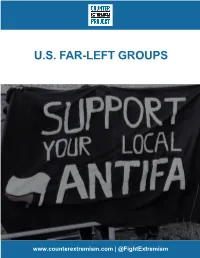
U.S. FAR-LEFT GROUPS www.counterextremism.com | @FightExtremism U.S. FAR-LEFT GROUPS Key Points Far-left groups in the United States in the 20th century largely focused on issue-specific causes such as Puerto Rican independence or environmentalism. Modern far-left groups largely focus on social justice issues such as racial equality and immigration rights. These groups often align with socialist or anti-capitalist values out of protest against wealth inequity. Gun ownership is a central characteristic of far-left groups such as the John Brown Gun Club and Redneck Revolt, which believe they must arm themselves for protection from the far right. These groups appear at protests brandishing firearms and serving as security forces while instructing others on how to use guns. Today’s far-left groups largely do not have hierarchal or even organizational structures like their far-right counterparts. U.S. President Donald Trump has called Antifa a terrorist group, but it is less a cohesive group and more a broad ideological opposition to perceived fascism. Antifa’s lack of a uniform doctrine or organization results in followers presenting sometimes opposing ideals. 1 Far-left extremism in the United States largely centers around the notion of correcting an injustice but is otherwise broad in its ideological catchment. In the 20th century, U.S. left-wing extremism was synonymous with either communism or causes such as environmentalism. In the 1960s and ’70s, the Weather Underground declared war against the U.S. government and carried out a campaign of political violence.1 According to the FBI, far-left extremism in the United States was most active during the period between the 1960s and 1980s. -

Manifestations of Anti- Semitism in the 21St Century
ANTI-SEMITISM RESURGENT: MANIFESTATIONS OF ANTI- ST SEMITISM IN THE 21 CENTURY 1 www.counterextremism.com | @FightExtremism ANTI-SEMITISM RESURGENT: MANIFESTATIONS OF ANTI-SEMITISM IN THE 21ST CENTURY Key Points Modern anti-Semitism is a repackaging of historic tropes. Anti- Semites have adapted conspiracy theories of the blood libel as well as Jewish influence in economic and governmental affairs to fit new circumstances, such as the accusation that Jews are responsible for spreading COVID-19, just as Jews were accused of spreading the plague a millennium ago. Jews have historically been denied political and economic rights, and modern anti-Semitism is an expression of the rejection of Jewish integration into society. While the twentieth century saw the rise of influential Jewish politicians around the world as well as the creation of the Jewish nation-state of Israel, conspiracy theorists continue to accuse Jews of dual loyalties and exerting too much influence in world affairs. Partisan politicians are also increasingly willing to incorporate anti-Semitic tropes into their rhetoric to attack opponents they view as serving other interests. Blatantly anti-Semitic historical legal restrictions on Jewish life have evolved into modern laws restricting basic tenets of Jewish life—e.g., kosher slaughter and circumcision—with support from both the left and the right, who argue they are protecting animal and children’s rights. These laws largely do not specifically target Jews but still have the effect of restricting Jewish practice. 2 Table of Contents Anti-Semitism By The Numbers ............................................................................................ 8 Reviving Anti-Jewish Laws .................................................................................................. 31 Modern Political Anti-Semitism .......................................................................................... 34 Holocaust Denial ................................................................................................................. -

ON RADICAL GROUNDS: a RHETORICAL TAKE on the EMERGENCE of #OCCUPY in TIME, PLACE, and SPACE by MEGHAN MARIE DUNN B.A., Texas
ON RADICAL GROUNDS: A RHETORICAL TAKE ON THE EMERGENCE OF #OCCUPY IN TIME, PLACE, AND SPACE by MEGHAN MARIE DUNN B.A., Texas State University, 2005 M.A., University of Texas, 2008 A thesis submitted to the Faculty of the Graduate School of the University of Colorado in partial fulfillment of the requirement for the degree of Doctor of Philosophy Department of Communication 2015 This thesis entitled: On Radical Grounds: A Rhetorical Take on the Emergence of #Occupy in Time, Place, and Space written by Meghan Marie Dunn has been approved for the Department of Communication (Dr. Gerard A. Hauser) (Dr. Peter Simonson) Date The final copy of this thesis has been examined by the signatories, and we find that both the content and the form meet acceptable presentation standards of scholarly work in the above mentioned discipline. IRB protocol # 15-0064 Dunn, Meghan Marie (Ph.D., Communication) On Radical Grounds: A Rhetorical Take on the Emergence of #Occupy in Time, Place, and Space Thesis directed by Emeritus Professor Gerard A. Hauser This dissertation explores how the Occupy Wall Street (OWS) and the Occupy Movement (OM) writ large generated new forms of rhetorical invention through its emergence in geographical places and virtual spaces across the world. The genesis and development of Occupy on these “radical” grounds provide an empirical grounding to theory on the chora, rhetorical invention, and the vernacular, where the word occupy and the tactic occupation designate vital sites (topoi) of rhetorical activity: seats/sources of local meaning(s) that occupiers used to bring new lines of thought to life. -

Happy Chanukah! Ppha Achay Ch Ap Kanu H H Nuka !H
November 30-December 6, 2018 Published by the Jewish Federation of Greater Binghamton Volume XLVII, Number 48 BINGHAMTON, NEW YORK HappyHaHapppppyCy ChanukahCChhanuknukakah!h! Page 2 - The Reporter November 30-December 6, 2018 Opinion Point/counterpoint Why liberal Jewish women are Women’s March is the wrong demanding more from Women’s target in the fight against March antisemitism By Guila Franklin Siegel of the sinister, untrustworthy, greedy, re- By Daniel Sieradski of conscience purport to care about. (JTA) – On the heels of actress and ac- pulsive Jew. Peddlers of this evil all need (JTA) – The same Jewish liberals who So when, inspired by a president who tivist Alyssa Milano’s remarkable statement to be fought with the same conviction and gave in to efforts by the Jewish right to openly blames prominent liberal Jews for indicating that she plans to boycott the vigor, regardless of where they are on the divide the black and Jewish communities that which white nationalists refer to as upcoming 2019 Women’s March because of political spectrum and how their messages in the ‘70s are back again to divide Jews “white genocide,” a neo-Nazi walks into its leaders’ persistent antisemitic behavior, are packaged. from their would-be allies, and this time a shul and kills a bunch of liberal Jews, there has been a backlash in our own Jewish For decades, and for very ethical, laud- they’re dead set on being the breach in the you’d think that our energy would stay fo- feminist ranks. Jewish women are being able reasons, many Jewish activists have dam that lets the Nazis through. -

Jewish 2.0 the Diffi Cult Road to Internet Innovation
Jewish 2.0 The Diffi cult Road to Internet Innovation Daniel Septimus When it comes to technological innovation, Jewish organizations can’t seem to win. They are criticized for their lack of adaptability and their sluggish integra- tion of new media strategies and tools. Yet when a Jewish organization builds a blog or starts a Twitter stream, they are often criticized for a lack of direction, for embracing technology for its own sake because it seems hip or novel. The digital native versus digital immigrant divide is often cited as a reason why the Jewish community is late to adopt technology. Most Jewish organizations— particularly the largest and most infl uential ones—are run by baby boomers, immigrants in “Internet Land.” Yet this may be too convenient an answer. The president and CEO of the American Red Cross, Gail McGovern, is 58, and her age did not stop her organi- zation from raising unprecedented dollars via text messaging in the wake of the Haiti earthquake. One might argue that Jewish communal leaders are just more conservative and traditionally minded. But perhaps this is appropriate given that we are a small community with many needs. Research & Development (R&D) could be a luxury when there are poor people to feed, Israeli institutions to support, and day school tuitions to subsidize. Of course, some Jewish organizations and start-ups have tried to leverage internet innovation to foster Jewish education and identity. It is worth refl ecting on some of these products—on their successes and challenges—to discover if there are lessons for us as a community going forward. -

Fake News Outbreak 2021: Can We Stop the Viral Spread?
Journal of Network and Computer Applications 190 (2021) 103112 Contents lists available at ScienceDirect Journal of Network and Computer Applications journal homepage: www.elsevier.com/locate/jnca Fake news outbreak 2021: Can we stop the viral spread? Tanveer Khan a,*, Antonis Michalas a,b, Adnan Akhunzada c a Tampere University, Finland b RISE AB c Technical University of Denmark, Denmark ARTICLE INFO ABSTRACT Keywords: Social Networks’ omnipresence and ease of use has revolutionized the generation and distribution of information Fake news in today’s world. However, easy access to information does not equal an increased level of public knowledge. Fact checking Unlike traditional media channels, social networks also facilitate faster and wider spread of disinformation and Machine learning misinformation. Viral spread of false information has serious implications on the behaviours, attitudes and beliefs Tools of the public, and ultimately can seriously endanger the democratic processes. Limiting false information’s Datasets negative impact through early detection and control of extensive spread presents the main challenge facing researchers today. In this survey paper, we extensively analyze a wide range of different solutions for the early detection of fake news in the existing literature. More precisely, we examine Machine Learning (ML) models for the identification and classification of fake news, online fake news detection competitions, statistical outputs as well as the advantages and disadvantages of some of the available data sets. Finally, we evaluate the online web browsing tools available for detecting and mitigating fake news and present some open research challenges. 1. Introduction 2018). In more recent times, examples include the anti-German campaign, German corpse factory in 1917 (Neander and Marlin, 2010) The popularity of Online Social Networks (OSNs) has rapidly and the Reich Ministry of Public Enlightenment and Propaganda increased in recent years. -

Occupy in Deutschland
Lars Geiges Occupy in Deutschland Studien des Göttinger Instituts für Demokratieforschung zur Geschichte politischer und gesellschaftlicher Kontroversen Herausgegeben von Franz Walter | Band 9 Lars Geiges (Dr. disc. pol.), Journalist und Politologe, arbeitet als wissenschaftli- cher Mitarbeiter am Institut für Demokratieforschung der Universität Göttingen. Lars Geiges Occupy in Deutschland Die Protestbewegung und ihre Akteure Dieses Werk ist lizenziert unter der Creative Commons Attribution-NonCom- mercial-NoDerivs 4.0 Lizenz (BY-NC-ND). Diese Lizenz erlaubt die private Nutzung, gestattet aber keine Bearbeitung und keine kommerzielle Nutzung. Weitere Informationen finden Sie unter https://creativecommons.org/licenses/by-nc-nd/4.0/deed.de/. Um Genehmigungen für Adaptionen, Übersetzungen, Derivate oder Wieder- verwendung zu kommerziellen Zwecken einzuholen, wenden Sie sich bitte an rights@transcript-verlag.de © 2014 transcript Verlag, Bielefeld Die Verwertung der Texte und Bilder ist ohne Zustimmung des Verlages ur- heberrechtswidrig und strafbar. Das gilt auch für Vervielfältigungen, Über- setzungen, Mikroverfilmungen und für die Verarbeitung mit elektronischen Systemen. Bibliografische Information der Deutschen Nationalbibliothek Die Deutsche Nationalbibliothek verzeichnet diese Publikation in der Deut- schen Nationalbibliografie; detaillierte bibliografische Daten sind im Internet über http://dnb.d-nb.de abrufbar. Umschlaggestaltung: Kordula Röckenhaus, Bielefeld Druck: Majuskel Medienproduktion GmbH, Wetzlar Print-ISBN 978-3-8376-2946-0