Desert Skies Tucson Amateur Astronomy Association
Total Page:16
File Type:pdf, Size:1020Kb
Load more
Recommended publications
-

Mathématiques Et Espace
Atelier disciplinaire AD 5 Mathématiques et Espace Anne-Cécile DHERS, Education Nationale (mathématiques) Peggy THILLET, Education Nationale (mathématiques) Yann BARSAMIAN, Education Nationale (mathématiques) Olivier BONNETON, Sciences - U (mathématiques) Cahier d'activités Activité 1 : L'HORIZON TERRESTRE ET SPATIAL Activité 2 : DENOMBREMENT D'ETOILES DANS LE CIEL ET L'UNIVERS Activité 3 : D'HIPPARCOS A BENFORD Activité 4 : OBSERVATION STATISTIQUE DES CRATERES LUNAIRES Activité 5 : DIAMETRE DES CRATERES D'IMPACT Activité 6 : LOI DE TITIUS-BODE Activité 7 : MODELISER UNE CONSTELLATION EN 3D Crédits photo : NASA / CNES L'HORIZON TERRESTRE ET SPATIAL (3 ème / 2 nde ) __________________________________________________ OBJECTIF : Détermination de la ligne d'horizon à une altitude donnée. COMPETENCES : ● Utilisation du théorème de Pythagore ● Utilisation de Google Earth pour évaluer des distances à vol d'oiseau ● Recherche personnelle de données REALISATION : Il s'agit ici de mettre en application le théorème de Pythagore mais avec une vision terrestre dans un premier temps suite à un questionnement de l'élève puis dans un second temps de réutiliser la même démarche dans le cadre spatial de la visibilité d'un satellite. Fiche élève ____________________________________________________________________________ 1. Victor Hugo a écrit dans Les Châtiments : "Les horizons aux horizons succèdent […] : on avance toujours, on n’arrive jamais ". Face à la mer, vous voyez l'horizon à perte de vue. Mais "est-ce loin, l'horizon ?". D'après toi, jusqu'à quelle distance peux-tu voir si le temps est clair ? Réponse 1 : " Sans instrument, je peux voir jusqu'à .................. km " Réponse 2 : " Avec une paire de jumelles, je peux voir jusqu'à ............... km " 2. Nous allons maintenant calculer à l'aide du théorème de Pythagore la ligne d'horizon pour une hauteur H donnée. -

Science in the Urantia Papers
Science ¾ Scientific Validation of the UB z By Denver Pearson z By Phil Calabrese ¾ Seraphic Velocities ¾ Astronomy The Scientific Integrity of the Urantia Book by Denver Pearson As scientifically minded readers first peruse the Urantia Book, it soon occurs to them that many of its statements on the natural sciences conflict with currently held data and theories. In the minds of many this gives rise to doubts about the truthfulness of those statements. Wisdom would lead us to realize that nothing short of perfection is perfect, and anything touched by human hands has fingerprints. This should be our guiding thoughts as we contemplate the accuracy of the scientific content of the Urantia Papers. Several years ago, at the first scientific symposium, it was implied by one of the speakers that the revelation contains errors. This implication is alarming. More recently, at the second symposium held in Oklahoma, an interesting publication named "The Science Content of The Urantia Book" was made available (this document is obtainable from the Brotherhood of Man Library). In this publication is an article entitled "Time Bombs" in which the author suggests that the revelators planted certain inaccurate scientific statements in the book in order to prevent it from becoming a fetish. He states "...the revelators incorporated safeguards in the papers that would form The Urantia Book to diminish the tendency to regard it as an object of worship. What safeguards did they use? Suppose they decided to make sure that mortals reading it understood that some cosmological statements in the book would be found to be inaccurate". -

FIXED STARS a SOLAR WRITER REPORT for Churchill Winston WRITTEN by DIANA K ROSENBERG Page 2
FIXED STARS A SOLAR WRITER REPORT for Churchill Winston WRITTEN BY DIANA K ROSENBERG Page 2 Prepared by Cafe Astrology cafeastrology.com Page 23 Churchill Winston Natal Chart Nov 30 1874 1:30 am GMT +0:00 Blenhein Castle 51°N48' 001°W22' 29°‚ 53' Tropical ƒ Placidus 02' 23° „ Ý 06° 46' Á ¿ 21° 15° Ý 06' „ 25' 23° 13' Œ À ¶29° Œ 28° … „ Ü É Ü 06° 36' 26' 25° 43' Œ 51'Ü áá Œ 29° ’ 29° “ àà … ‘ à ‹ – 55' á á 55' á †32' 16° 34' ¼ † 23° 51'Œ 23° ½ † 06' 25° “ ’ † Ê ’ ‹ 43' 35' 35' 06° ‡ Š 17° 43' Œ 09° º ˆ 01' 01' 07° ˆ ‰ ¾ 23° 22° 08° 02' ‡ ¸ Š 46' » Ï 06° 29°ˆ 53' ‰ Page 234 Astrological Summary Chart Point Positions: Churchill Winston Planet Sign Position House Comment The Moon Leo 29°Le36' 11th The Sun Sagittarius 7°Sg43' 3rd Mercury Scorpio 17°Sc35' 2nd Venus Sagittarius 22°Sg01' 3rd Mars Libra 16°Li32' 1st Jupiter Libra 23°Li34' 1st Saturn Aquarius 9°Aq35' 5th Uranus Leo 15°Le13' 11th Neptune Aries 28°Ar26' 8th Pluto Taurus 21°Ta25' 8th The North Node Aries 25°Ar51' 8th The South Node Libra 25°Li51' 2nd The Ascendant Virgo 29°Vi55' 1st The Midheaven Gemini 29°Ge53' 10th The Part of Fortune Capricorn 8°Cp01' 4th Chart Point Aspects Planet Aspect Planet Orb App/Sep The Moon Semisquare Mars 1°56' Applying The Moon Trine Neptune 1°10' Separating The Moon Trine The North Node 3°45' Separating The Moon Sextile The Midheaven 0°17' Applying The Sun Semisquare Jupiter 0°50' Applying The Sun Sextile Saturn 1°52' Applying The Sun Trine Uranus 7°30' Applying Mercury Square Uranus 2°21' Separating Mercury Opposition Pluto 3°49' Applying Venus Sextile -

The Brightest Stars Seite 1 Von 9
The Brightest Stars Seite 1 von 9 The Brightest Stars This is a list of the 300 brightest stars made using data from the Hipparcos catalogue. The stellar distances are only fairly accurate for stars well within 1000 light years. 1 2 3 4 5 6 7 8 9 10 11 12 13 No. Star Names Equatorial Galactic Spectral Vis Abs Prllx Err Dist Coordinates Coordinates Type Mag Mag ly RA Dec l° b° 1. Alpha Canis Majoris Sirius 06 45 -16.7 227.2 -8.9 A1V -1.44 1.45 379.21 1.58 9 2. Alpha Carinae Canopus 06 24 -52.7 261.2 -25.3 F0Ib -0.62 -5.53 10.43 0.53 310 3. Alpha Centauri Rigil Kentaurus 14 40 -60.8 315.8 -0.7 G2V+K1V -0.27 4.08 742.12 1.40 4 4. Alpha Boötis Arcturus 14 16 +19.2 15.2 +69.0 K2III -0.05 -0.31 88.85 0.74 37 5. Alpha Lyrae Vega 18 37 +38.8 67.5 +19.2 A0V 0.03 0.58 128.93 0.55 25 6. Alpha Aurigae Capella 05 17 +46.0 162.6 +4.6 G5III+G0III 0.08 -0.48 77.29 0.89 42 7. Beta Orionis Rigel 05 15 -8.2 209.3 -25.1 B8Ia 0.18 -6.69 4.22 0.81 770 8. Alpha Canis Minoris Procyon 07 39 +5.2 213.7 +13.0 F5IV-V 0.40 2.68 285.93 0.88 11 9. Alpha Eridani Achernar 01 38 -57.2 290.7 -58.8 B3V 0.45 -2.77 22.68 0.57 144 10. -
Culmination of a Constellation
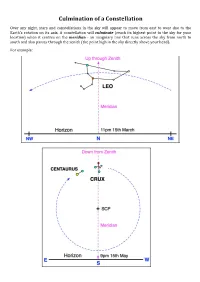
Culmination of a Constellation Over any night, stars and constellations in the sky will appear to move from east to west due to the Earth’s rotation on its axis. A constellation will culminate (reach its highest point in the sky for your location) when it centres on the meridian - an imaginary line that runs across the sky from north to south and also passes through the zenith (the point high in the sky directly above your head). For example: When to Observe Constellations The taBle shows the approximate time (AEST) constellations will culminate around the middle (15th day) of each month. Constellations will culminate 2 hours earlier for each successive month. Note: add an hour to the given time when daylight saving time is in effect. The time “12” is midnight. Sunrise/sunset times are rounded off to the nearest half an hour. Sun- Jan Feb Mar Apr May Jun Jul Aug Sep Oct Nov Dec Rise 5am 5:30 6am 6am 7am 7am 7am 6:30 6am 5am 4:30 4:30 Set 7pm 6:30 6pm 5:30 5pm 5pm 5pm 5:30 6pm 6pm 6:30 7pm And 5am 3am 1am 11pm 9pm Aqr 5am 3am 1am 11pm 9pm Aql 4am 2am 12 10pm 8pm Ara 4am 2am 12 10pm 8pm Ari 5am 3am 1am 11pm 9pm Aur 10pm 8pm 4am 2am 12 Boo 3am 1am 11pm 9pm 7pm Cnc 1am 11pm 9pm 7pm 3am CVn 3am 1am 11pm 9pm 7pm CMa 11pm 9pm 7pm 3am 1am Cap 5am 3am 1am 11pm 9pm 7pm Car 2am 12 10pm 8pm 6pm Cen 4am 2am 12 10pm 8pm 6pm Cet 4am 2am 12 10pm 8pm Cha 3am 1am 11pm 9pm 7pm Col 10pm 8pm 4am 2am 12 Com 3am 1am 11pm 9pm 7pm CrA 3am 1am 11pm 9pm 7pm CrB 4am 2am 12 10pm 8pm Crv 3am 1am 11pm 9pm 7pm Cru 3am 1am 11pm 9pm 7pm Cyg 5am 3am 1am 11pm 9pm 7pm Del -

THE CONSTELLATION HYDRA, WATER SNAKE Hydra Is the Largest of the 88 Modern Constellations, Measuring 1303 Square Degrees
THE CONSTELLATION HYDRA, WATER SNAKE Hydra is the largest of the 88 modern constellations, measuring 1303 square degrees. Also one of the longest at over 100 degrees, its southern end abuts Libra and Centaurus and its northern end borders Cancer. It has a long history, having been included among the 48 constellations listed by the 2nd century astronomer Ptolemy. It is commonly represented as a water snake. It should not be confused with the similarly named constellation of Hydrus. The neighboring constellations are Antlia, Cancer, Canis Minor, Centaurus, Corvus, Crater, Leo, Libra, Lupus, Monoceros, Puppis, Pyxis, Sextans and Virgo. Despite its size, Hydra contains only one reasonably bright star, Alphard, designated Alpha Hydrae. It is an orange giant of magnitude 2.0, 177 light-years from Earth. Its traditional name means "the solitary one". Beta Hydrae is a blue-white star of magnitude 4.3, 365 light-years from Earth. Gamma Hydrae is a yellow giant of magnitude 3.0, 132 light-years from Earth. Hydra has one bright binary star, Epsilon Hydrae, which is difficult to split in amateur telescopes; it has a period of 1000 years and is 135 light-years from Earth. The other main named star in Hydra is Sigma Hydrae, which has the name of Minaruja, from the Arabic for snake's nose. At magnitude 4.54, it is rather dim. The head of the snake corresponds to the Ashlesha nakshatra, a lunar zodiacal constellation in Indian astronomy. Hydra is also home to several variable stars. R Hydrae is a Mira variable star 2000 light-years from Earth; it is one of the brightest Mira variables at its maximum of magnitude 3.5. -

Clusters Nebulae & Galaxies
CLUSTERS, NEBULAE & GALAXIES A NOVICE OBSERVER’S HANDBOOK By: Prof. P. N. Shankar PREFACE In the normal course of events, an amateur who builds or acquires a telescope will use it initially to observe the Moon and the planets. After the thrill of seeing the craters of the Moon, the Galilean moons of Jupiter and its bands, and the rings of Saturn he(*) is usually at a loss as to what to do next; Mars and Venus are usually disappointing as are the stars (they don’t look any bigger!). If the telescope had good resolution one could observe binaries, but alas, this is often not the case. Moreover, at this stage, the amateur is unlikely to be willing to do serious work on variable stars or on planetary observations. What can he do with his telescope that will rekindle his interest and prepare him for serious work? I believe that there is little better for him to do than hunt for the Messier objects; this book is meant as a guide in this exciting adventure. While this book is primarily a guide to the Messier objects, a few other easy clusters and nebulae have also been included. I have tried, while writing this handbook, to keep in mind the difficulties faced by a beginner. Even if one has good star maps, such as those in Norton’s Star Atlas, a beginner often has difficulty in locating some of the Messier objects because he does not know what he is expected to see! A cluster like M29 is a little difficult because it is a sparse cluster in a rich field; M97 is nominally brighter than M76, another planetary, but is more difficult to see; M33 is an approximately 6th magnitude galaxy but is far more difficult than many 9th magnitude galaxies. -

Comet V2 Johnson Takes Center Stage 19 May 2017, by David Dickinson
Comet V2 Johnson takes center stage 19 May 2017, by David Dickinson top out at magnitude +6 in late June, post- perihelion. Part of what's making Comet V2 Johnson favorable is its orbit. With a high inclination of 50 degrees relative to the ecliptic, it's headed down through high northern declinations for a perihelion just outside of Mars' orbit on June 12th. Though Mars is on the opposite side of the sun this summer, we're luckily on the correct side of the sun to enjoy the cometary view. Comet V2 Johnson passed opposition a few weeks ago on April 28th, and will become an exclusively southern hemisphere object in late July as it continues the plunge southward. Comet V2 Johnson from February 21st, 2017. Credit: John Purvis Had your fill of binocular comets? Turns out, 2017 may have saved the best for last. The past few months has seen a steady stream of dirty snowball visitations to the inner solar system, both short term periodic and long term hyperbolic. First, let's run through the cometary roll call for the first part of the year: There's 41P Tuttle-Giacobini-Kresák, 2P/Encke, 45P Honda-Markov-Padjudašáková, C/2015 ER61 PanSTARRS and finally, the latecomer to the party, C/2017 E4 Lovejoy. Next up is a comet with a much easier to pronounce (and type) name, at least to the English- The path of Comet C/2015 V2 Johnson through the inner speaking tongue: C/2015 V2 Johnson. solar system. Credit: NASA/JPL It would seem that we're getting a year's worth of binocular comets right up front in the very first half. -

Milestone Goto-Bino Series .Cdr
Kson MilestoneK Standard Alt/Az GOTO Mount INSTRUCTIONS CONTENT FOR KSON STANDARD ALT/AZ GOTO USER INTRODUCTION.................................................................................1 ACCESSORIES..................................................................................2 ASSEMBLY INSTRUCTIONS.............................................................3 FEATURES.........................................................................5 OPERATION MANUAL FOR SKYTOUCH CONTROLLER............... 6 KEY DESCRIPTION.................................................................................6 STATUS DESCRIPTION...........................................................................6 OPERATION PROCESS...........................................................................7 POWER ON......................................................................................7 WARNING........................................................................................7 ALIGNMENT STATUS........................................................................7 CHANGE THE DATE..................................................................7 CHANGE THE TIME...................................................................8 CHANGE THE SITE...................................................................8 ALIGNMENT.............................................................................9 NAVIGATION STATUS.....................................................................11 MENU STATUS................................................................................11 -
Meteor Activity Outlook for February 15-21, 2020
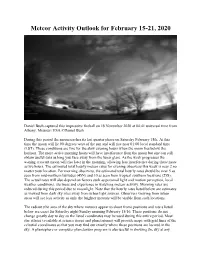
Meteor Activity Outlook for February 15-21, 2020 Daniel Bush captured this impressive fireball on 18 November 2020 at 04:41 universal time from Albany, Missouri USA.©Daniel Bush During this period the moon reaches its last quarter phase on Saturday February 15th. At this time the moon will lie 90 degrees west of the sun and will rise near 01:00 local standard time (LST). These conditions are fine for the slow evening hours when the moon lies below the horizon. The more active morning hours will have interference from the moon but one can still obtain useful data as long you face away from the lunar glare. As the week progresses the waning crescent moon will rise later in the morning, allowing less interference during these more active hours. The estimated total hourly meteor rates for evening observers this week is near 2 no matter your location. For morning observers, the estimated total hourly rates should be near 5 as seen from mid-northern latitudes (45N) and 10 as seen from tropical southern locations (25S). The actual rates will also depend on factors such as personal light and motion perception, local weather conditions, alertness and experience in watching meteor activity. Morning rates are reduced during this period due to moonlight. Note that the hourly rates listed below are estimates as viewed from dark sky sites away from urban light sources. Observers viewing from urban areas will see less activity as only the brighter meteors will be visible from such locations. The radiant (the area of the sky where meteors appear to shoot from) positions and rate s listed below are exact for Saturday night/Sunday morning February 15/16. -

Catálogo Messier Para Observaciones De Cielo Profundo
Catálogo Messier para observaciones de Cielo Profundo ÍNDICE M1 ………………………………………….…3 M28 ……………………………………….38 M2 ……………………………………….…....5 M29 ……………………………………….39 M3 …………………………………………….7 M30 ……………………………………….40 M4 …..………………………………………...9 M31 ……………………………………….41 M5 …..………………………………………..11 M32 ……………………………………….44 M6 …..…………………….………………….13 M33 ……………………………………….46 M7 …..……………………….……………….14 M34 ……………………………………….47 M8 …..………………………….…………….15 M35 ……………………………………….48 M9 …..…………………………….………….16 M36 ……………………………………….50 M10 ….……………………………………….18 M37 ……………………………………….51 M11 ….……………………………………….19 M38 ……………………………………….52 M12 ….……………………………………….20 M39 ……………………………………….53 M13 ….……………………………………….21 M40 ……………………………………….54 M14 ….……………………………………..…22 M41 ……………………………………….55 M15 ….………………………………………..24 M42 ……………………………………….56 M16 ….…………………………………….….26 M43 ……………………………………….58 M17 ….………………………………….….…27 M44 ……………………………………….59 M18 ….………………………………….….…28 M45 ……………………………………….60 M19 ….……………………………………..…29 M46 ……………………………………….63 M20 ….…………………………………….….30 M47 ……………………………………….64 M21 ….…………………………………….….31 M48 ……………………………………….65 M22 ….………………………………….….…32 M49 ……………………………………….66 M23 ….………………………………….….…33 M50 ……………………………………….67 M24 ….………………………………….….…34 M51 ……………………………………….68 M25 ….………………………………….….…35 M52 ……………………………………….69 M26 ….………………………………….….…36 M53 ……………………………………….70 M27 ….……………………………………..…37 M54 ……………………………………….71 1 Catálogo Messier para observaciones de Cielo Profundo M55 …………………………………………....72 M85 ………………………………….………109 M56 ……………………………………………73 M86 ………………………………….………110 M57 ……………………………………………74 M87 ………………………………….………111 -

Star Name Identity SAO HD FK5 Magnitude Spectral Class Right Ascension Declination Alpheratz Alpha Andromedae 73765 358 1 2,06 B
Star Name Identity SAO HD FK5 Magnitude Spectral class Right ascension Declination Alpheratz Alpha Andromedae 73765 358 1 2,06 B8IVpMnHg 00h 08,388m 29° 05,433' Caph Beta Cassiopeiae 21133 432 2 2,27 F2III-IV 00h 09,178m 59° 08,983' Algenib Gamma Pegasi 91781 886 7 2,83 B2IV 00h 13,237m 15° 11,017' Ankaa Alpha Phoenicis 215093 2261 12 2,39 K0III 00h 26,283m - 42° 18,367' Schedar Alpha Cassiopeiae 21609 3712 21 2,23 K0IIIa 00h 40,508m 56° 32,233' Deneb Kaitos Beta Ceti 147420 4128 22 2,04 G9.5IIICH-1 00h 43,590m - 17° 59,200' Achird Eta Cassiopeiae 21732 4614 3,44 F9V+dM0 00h 49,100m 57° 48,950' Tsih Gamma Cassiopeiae 11482 5394 32 2,47 B0IVe 00h 56,708m 60° 43,000' Haratan Eta ceti 147632 6805 40 3,45 K1 01h 08,583m - 10° 10,933' Mirach Beta Andromedae 54471 6860 42 2,06 M0+IIIa 01h 09,732m 35° 37,233' Alpherg Eta Piscium 92484 9270 50 3,62 G8III 01h 13,483m 15° 20,750' Rukbah Delta Cassiopeiae 22268 8538 48 2,66 A5III-IV 01h 25,817m 60° 14,117' Achernar Alpha Eridani 232481 10144 54 0,46 B3Vpe 01h 37,715m - 57° 14,200' Baten Kaitos Zeta Ceti 148059 11353 62 3,74 K0IIIBa0.1 01h 51,460m - 10° 20,100' Mothallah Alpha Trianguli 74996 11443 64 3,41 F6IV 01h 53,082m 29° 34,733' Mesarthim Gamma Arietis 92681 11502 3,88 A1pSi 01h 53,530m 19° 17,617' Navi Epsilon Cassiopeiae 12031 11415 63 3,38 B3III 01h 54,395m 63° 40,200' Sheratan Beta Arietis 75012 11636 66 2,64 A5V 01h 54,640m 20° 48,483' Risha Alpha Piscium 110291 12447 3,79 A0pSiSr 02h 02,047m 02° 45,817' Almach Gamma Andromedae 37734 12533 73 2,26 K3-IIb 02h 03,900m 42° 19,783' Hamal Alpha