Federal Register/Vol. 66, No. 195/Tuesday, October 9, 2001
Total Page:16
File Type:pdf, Size:1020Kb
Load more
Recommended publications
-

Winter 2014-2015 (22:3) (PDF)
Contents NATIVE NOTES Page Fern workshop 1-2 Wavey-leaf basket Grass 3 Names Cacalia 4 Trip Report Sandstone Falls 5 Kate’s Mountain Clover* Trip Report Brush Creek Falls 6 Thank yous memorial 7 WEST VIRGINIA NATIVE PLANT SOCIETY NEWSLETTER News of WVNPS 8 VOLUME 22:3 WINTER 2014-15 Events, Dues Form 9 Judy Dumke-Editor: E-mail-dumke@live.marshall.edu Phone 740-894-6859 Magnoliales 10 e e e visit us at www.wvnps.org e e e . Fern Workshop University of Charleston Charleston WV January 17 2015, bad weather date January 24 2015 If you have thought about ferns, looked at them, puzzled over them or just want to know more about them join the WVNPS in Charleston for a workshop led by Mark Watson of the University of Charleston. The session will start at 10 A.M. with a scheduled end point by 12:30 P.M. A board meeting will follow. The sessions will be held in the Clay Tower Building (CTB) room 513, which is the botany lab. If you have any pressed specimens to share, or to ask about, be sure to bring them with as much information as you have on the location and habitat. Even photographs of ferns might be of interest for the session. If you have a hand lens that you favor bring it along as well. DIRECTIONS From the North: Travel I-77 South or 1-79 South into Charleston. Follow the signs to I-64 West. Take Oakwood Road Exit 58A and follow the signs to Route 61 South (MacCorkle Ave.). -

Vascular Plant Inventory and Ecological Community Classification for Cumberland Gap National Historical Park
VASCULAR PLANT INVENTORY AND ECOLOGICAL COMMUNITY CLASSIFICATION FOR CUMBERLAND GAP NATIONAL HISTORICAL PARK Report for the Vertebrate and Vascular Plant Inventories: Appalachian Highlands and Cumberland/Piedmont Networks Prepared by NatureServe for the National Park Service Southeast Regional Office March 2006 NatureServe is a non-profit organization providing the scientific knowledge that forms the basis for effective conservation action. Citation: Rickie D. White, Jr. 2006. Vascular Plant Inventory and Ecological Community Classification for Cumberland Gap National Historical Park. Durham, North Carolina: NatureServe. © 2006 NatureServe NatureServe 6114 Fayetteville Road, Suite 109 Durham, NC 27713 919-484-7857 International Headquarters 1101 Wilson Boulevard, 15th Floor Arlington, Virginia 22209 www.natureserve.org National Park Service Southeast Regional Office Atlanta Federal Center 1924 Building 100 Alabama Street, S.W. Atlanta, GA 30303 The view and conclusions contained in this document are those of the authors and should not be interpreted as representing the opinions or policies of the U.S. Government. Mention of trade names or commercial products does not constitute their endorsement by the U.S. Government. This report consists of the main report along with a series of appendices with information about the plants and plant (ecological) communities found at the site. Electronic files have been provided to the National Park Service in addition to hard copies. Current information on all communities described here can be found on NatureServe Explorer at www.natureserveexplorer.org. Cover photo: Red cedar snag above White Rocks at Cumberland Gap National Historical Park. Photo by Rickie White. ii Acknowledgments I wish to thank all park employees, co-workers, volunteers, and academics who helped with aspects of the preparation, field work, specimen identification, and report writing for this project. -
1 Supplemental Methods
Supplemental methods for: Geographic range dynamics drove hybridization in a lineage of angiosperms 1 1 1 2 1 R.A. FOLK , C.J. VISGER , P.S. SOLTIS , D.E. SOLTIS , R. GURALNICK 1Florida Museum of Natural History 2Biology, University of Florida 3Author for correspondence: ryanfolk@ufl.edu 1 Sequencing: Sequencing followed previously developed methods1 with the following modifications: library preparation was performed by RAPiD Genomics (Gainesville, FL; using TruSeq-like adapters as in Folk et al. 2015), the targeted insert size was > 200 bp, and sequencing used a 300-cyle (150 bp read) kit for a HiSeq 3000 instrument. The overall outgroup sampling (21 taxa total; Supplementary Table S1) was improved > 5 fold.2 This includes several representatives each of all lineages that have been hypothesized to undergo hybridization in the Heuchera group of genera. For the transcriptomes, reads were assembled against the low-copy nuclear loci from our targeted enrichment experiment, where the targets stripped of intronic sequence but assembly methods otherwise followed a previously developed BWA-based approach1. Transcriptomic reads were also mapped to a Heuchera parviflora var. saurensis chloroplast genome reference1 which was stripped of intronic and intergenic sequence. Assembly methods for target-enriched data followed the BWA-based approach1 directly. In practice, intronic sequence can be recovered from RNAseq data,3 but has consistently lower coverage (pers. obs.); moreover non-coding read dropout can be expected to be high for more divergent outgroups added here. For this reason, only coding reference sequences were used to assemble transcriptomic taxa. For nuclear analyses, reads were assembled with 277 references comprising the gene sequences used for bait design, with intronic sequences stripped. -
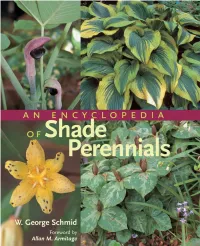
An Encyclopedia of Shade Perennials This Page Intentionally Left Blank an Encyclopedia of Shade Perennials
An Encyclopedia of Shade Perennials This page intentionally left blank An Encyclopedia of Shade Perennials W. George Schmid Timber Press Portland • Cambridge All photographs are by the author unless otherwise noted. Copyright © 2002 by W. George Schmid. All rights reserved. Published in 2002 by Timber Press, Inc. Timber Press The Haseltine Building 2 Station Road 133 S.W. Second Avenue, Suite 450 Swavesey Portland, Oregon 97204, U.S.A. Cambridge CB4 5QJ, U.K. ISBN 0-88192-549-7 Printed in Hong Kong Library of Congress Cataloging-in-Publication Data Schmid, Wolfram George. An encyclopedia of shade perennials / W. George Schmid. p. cm. ISBN 0-88192-549-7 1. Perennials—Encyclopedias. 2. Shade-tolerant plants—Encyclopedias. I. Title. SB434 .S297 2002 635.9′32′03—dc21 2002020456 I dedicate this book to the greatest treasure in my life, my family: Hildegarde, my wife, friend, and supporter for over half a century, and my children, Michael, Henry, Hildegarde, Wilhelmina, and Siegfried, who with their mates have given us ten grandchildren whose eyes not only see but also appreciate nature’s riches. Their combined love and encouragement made this book possible. This page intentionally left blank Contents Foreword by Allan M. Armitage 9 Acknowledgments 10 Part 1. The Shady Garden 11 1. A Personal Outlook 13 2. Fated Shade 17 3. Practical Thoughts 27 4. Plants Assigned 45 Part 2. Perennials for the Shady Garden A–Z 55 Plant Sources 339 U.S. Department of Agriculture Hardiness Zone Map 342 Index of Plant Names 343 Color photographs follow page 176 7 This page intentionally left blank Foreword As I read George Schmid’s book, I am reminded that all gardeners are kindred in spirit and that— regardless of their roots or knowledge—the gardening they do and the gardens they create are always personal. -

Ecological Checklist of the Missouri Flora for Floristic Quality Assessment
Ladd, D. and J.R. Thomas. 2015. Ecological checklist of the Missouri flora for Floristic Quality Assessment. Phytoneuron 2015-12: 1–274. Published 12 February 2015. ISSN 2153 733X ECOLOGICAL CHECKLIST OF THE MISSOURI FLORA FOR FLORISTIC QUALITY ASSESSMENT DOUGLAS LADD The Nature Conservancy 2800 S. Brentwood Blvd. St. Louis, Missouri 63144 dladd@tnc.org JUSTIN R. THOMAS Institute of Botanical Training, LLC 111 County Road 3260 Salem, Missouri 65560 jthomas@botanytraining.com ABSTRACT An annotated checklist of the 2,961 vascular taxa comprising the flora of Missouri is presented, with conservatism rankings for Floristic Quality Assessment. The list also provides standardized acronyms for each taxon and information on nativity, physiognomy, and wetness ratings. Annotated comments for selected taxa provide taxonomic, floristic, and ecological information, particularly for taxa not recognized in recent treatments of the Missouri flora. Synonymy crosswalks are provided for three references commonly used in Missouri. A discussion of the concept and application of Floristic Quality Assessment is presented. To accurately reflect ecological and taxonomic relationships, new combinations are validated for two distinct taxa, Dichanthelium ashei and D. werneri , and problems in application of infraspecific taxon names within Quercus shumardii are clarified. CONTENTS Introduction Species conservatism and floristic quality Application of Floristic Quality Assessment Checklist: Rationale and methods Nomenclature and taxonomic concepts Synonymy Acronyms Physiognomy, nativity, and wetness Summary of the Missouri flora Conclusion Annotated comments for checklist taxa Acknowledgements Literature Cited Ecological checklist of the Missouri flora Table 1. C values, physiognomy, and common names Table 2. Synonymy crosswalk Table 3. Wetness ratings and plant families INTRODUCTION This list was developed as part of a revised and expanded system for Floristic Quality Assessment (FQA) in Missouri. -
Temple Ambler Field Station Species List Figure 1. Animal Groups Identified to Date Through Our Citizen Science Initiatives at T
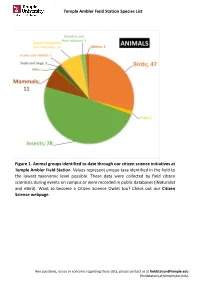
Temple Ambler Field Station Species List Figure 1. Animal groups identified to date through our citizen science initiatives at Temple Ambler Field Station. Values represent unique taxa identified in the field to the lowest taxonomic level possible. These data were collected by field citizen scientists during events on campus or were recorded in public databases (iNaturalist and eBird). Want to become a Citizen Science Owlet too? Check out our Citizen Science webpage. Any questions, issues or concerns regarding these data, please contact us at fieldstation@temple.edu (fieldstation[at}temple[dot]edu) Temple Ambler Field Station Species List Figure 2. Plant diversity identified to date in the natural environments and designed gardens of the Temple Ambler Field Station and Ambler Arboretum. These values represent unique taxa identified to the lowest taxonomic level possible. Highlighted are 14 of the 116 flowering plant families present that include 524 taxonomic groups. A full list can be found in our species database. Cultivated specimens in our Greenhouse were not included here. Any questions, issues or concerns regarding these data, please contact us at fieldstation@temple.edu (fieldstation[at}temple[dot]edu) Temple Ambler Field Station Species List database_title Temple Ambler Field Station Species List last_update 22October2020 description This database includes all species identified to their lowest taxonomic level possible in the natural environments and designed gardens on the Temple Ambler campus. These are occurrence records and each taxon is only entered once. This is an occurrence record, not an abundance record. IDs were performed by senior scientists and specialists, as well as citizen scientists visiting campus. -

Next-Generation Genome Sequencing of Sedum Plumbizincicola Sheds
plants Article Next-Generation Genome Sequencing of Sedum plumbizincicola Sheds Light on the Structural Evolution of Plastid rRNA Operon and Phylogenetic Implications within Saxifragales 1,2, 1, 1 3 1 1 Hengwu Ding y, Ran Zhu y, Jinxiu Dong , De Bi , Lan Jiang , Juhua Zeng , Qingyu Huang 1, Huan Liu 3, Wenzhong Xu 4, Longhua Wu 3,* and Xianzhao Kan 1,2,* 1 The Institute of Bioinformatics, College of Life Sciences, Anhui Normal University, Wuhu 241000, Anhui, China; hengwuding@ahnu.edu.cn (H.D.); zhuran0911@ahnu.edu.cn (R.Z.); jinxiudong@ahnu.edu.cn (J.D.); jianglan@ahnu.edu.cn (L.J.); j.h.zeng@ahnu.edu.cn (J.Z.); yunshancike@ahnu.edu.cn (Q.H.) 2 The Provincial Key Laboratory of the Conservation and Exploitation Research of Biological Resources in Anhui, Wuhu 241000, Anhui, China 3 National Engineering Laboratory of Soil Pollution Control and Remediation Technologies, Institute of Soil Science, Chinese Academy of Sciences, Nanjing 210008, Jiangsu, China; wzy@issas.ac.cn (D.B.); 2016203030@njau.edu.cn (H.L.) 4 Key Laboratory of Plant Resources, Institute of Botany, Chinese Academy of Sciences, Beijing 100093, China; xuwzh@ibcas.ac.cn * Correspondence: lhwu@issas.ac.cn (L.W.); xianzhao@ahnu.edu.cn (X.K.); Tel.: +86-25-8688-1128 (L.W.); +86-139-5537-2268 (X.K.) These authors equally contributed to this work. y Received: 27 August 2019; Accepted: 28 September 2019; Published: 29 September 2019 Abstract: The genus Sedum, with about 470 recognized species, is classified in the family Crassulaceae of the order Saxifragales. Phylogenetic relationships within the Saxifragales are still unresolved and controversial. -

Reproductive Characteristics As Drivers of Alien Plant Naturalization and Invasion
Reproductive characteristics as drivers of alien plant naturalization and invasion Dissertation submitted for the degree of Doctor of Natural Sciences presented by Mialy Harindra Razanajatovo at the Faculty of Sciences Department of Biology Date of the oral examination: 12 February 2016 First referee: Prof. Dr. Mark van Kleunen Second referee: Prof. Dr. Markus Fischer Konstanzer Online-Publikations-System (KOPS) URL: http://nbn-resolving.de/urn:nbn:de:bsz:352-0-324483 Summary Due to human activity and global movements, many plant species have been introduced to non-native regions where they experience novel abiotic and biotic conditions. Some of these alien species manage to establish reproducing naturalized populations, and some naturalized alien species subsequently become invasive. Invasion by alien plant species can negatively affect native communities and ecosystems, but what gives the alien species an advantage under novel conditions is still not clear. Therefore, identifying the drivers of invasions has become a major goal in invasion ecology. Reproduction is crucial in plant invasions, because propagule supply is required for founding new populations, population maintenance and spread in non-native regions. Baker’s Law, referring to the superior advantage of species capable of uniparental reproduction in establishing after long distance dispersal, has received major interest in explaining plant invasions. However, previous findings regarding Baker’s Law are contradicting. Moreover, there has been an increasing interest in understanding the integration of alien plant species into native plant-pollinator networks but few studies have looked at the pollination ecology of successful (naturalized and invasive) and unsuccessful (non-naturalized and non-invasive) alien plant species. -

HIGH ELEVATION ROCKY SUMMIT (TYPIC SUBTYPE) Concept: High
HIGH ELEVATION ROCKY SUMMIT (TYPIC SUBTYPE) Concept: High Elevation Rocky Summits are communities of flat-to-vertical outcrops of fractured rock on ridge tops, upper-to-mid slopes, or other topographically exposed settings, at high elevations, generally above 4000 feet. Vegetation of Rocky Summits is sparse or patchy, with substantial amounts of bare rock, and is generally characterized by a mix of growth forms or by predominantly forbs and sparse woody vegetation. The Typic Subtype covers most examples, lacking the distinctive characteristics of other subtypes. Their substrates range from felsic to mafic but they lack a strong component of flora associated with basic soils or with the highest elevations. Distinguishing Features: High Elevation Rocky Summits are distinguished from forests, shrublands, and grasslands by a structure of sparse vegetation or herbaceous vegetation of moderate cover with extensive bare rock. Patches of shrub cover are generally present on edges or in pockets of deep soil, but large areas of shrub dominance should be considered Heath Balds. High Elevation Rocky Summits are distinguished from High Elevation Granitic Domes by having abundant fractured rock, in contrast to the largely smooth exfoliated bedrock of the domes. Montane Cliff communities generally occur at lower elevation than 4000 feet; they also are distinguished not by steepness but by a more topographically sheltered setting, below mid slope or protected by gorge walls or other topography. High Elevation Rocky Summits are distinguished from Low Elevation Rocky Summits by the general absence of low elevation plants such as Diodia teres, Phemeranthus (Talium) teretifolius, Bryodesma (Selaginella) rupestre, and Quercus montana. High elevation plants that are generally absent in Low Elevation Rocky Summits include Sibbaldiopsis tridentata, Trichophorum cespitosum, Carex brunnescens, Geum radiatum, Liatris helleri, Solidago spithamaea, Houstonia montana, Rhododendron (Menziesia) pilosum, Abies fraseri, Picea rubens, and Sorbus americana. -

INFORMATION to USERS the Quality of This Reproduction Is
INFORMATION TO USERS This manuscript has been reproduced from the microfilm master. UME films the text directly from the original or copy submitted. Thus, some thesis and dissertation copies are in typewriter 6ce, while others may be from any type of computer printer. The quality of this reproduction is dependent upon the quality of the copy submitted. Broken or indistinct print, colored or poor quality illustrations and photographs, print bleedthrough, substandard m ar^s, and improper alignment can adversely afreet reproduction. In the unlikely event that the author did not send UMI a complete manuscript and there are missing pages, these will be noted. Also, if unauthorized copyright material had to be removed, a note will indicate the deletion. Oversize materials (e.g., maps, drawings, charts) are reproduced by sectioning the original, beginning at the upper left-hand comer and continuing from left to right in equal sections with small overlaps. Each original is also photographed in one exposure and is included in reduced form at the back of the book. Photographs included in the original manuscript have been reproduced xerographically in this copy. Higher quality 6” x 9” black and white photographic prints are available for any photographs or illustrations appearing in this copy for an additional charge. Contact UMI directly to order. UMI A Bell & Howell Information Company 300 North Zed) Road, Ann Arbor MI 48106-1346 USA 313/761-4700 800/521-0600 HARDY HERBACEOUS PLANTS IN NINETEENTH-CENTURY NORTHEASTERN UNITED STATES GARDENS AND LANDSCAPES Volume I DISSERTATION Presented in Partial Fulfillment of the Requirements for the Degree Doctor of Philosophy in the Graduate School of The Ohio State University by Denise Wiles Adams, B.S. -
The Vascular Flora of Three Top Mountain Game Land Preserve, Ashe County, North Carolina
THE VASCULAR FLORA OF THREE TOP MOUNTAIN GAME LAND PRESERVE, ASHE COUNTY, NORTH CAROLINA A Thesis by ANDREW PATRICK JENKINS Submitted to the Graduate School Appalachian State University In partial fulfillment of the requirements for the degree of MASTER OF SCIENCE December 2011 Department of Biology THE VASCULAR FLORA OF THREE TOP MOUNTAIN GAME LAND PRESERVE, ASHE COUNTY, NORTH CAROLINA A Thesis by ANDREW PATRICK JENKINS December 2011 APPROVED BY: _____________________________ Dr. Zack E. Murrell Chairperson, Thesis Committee _____________________________ Dr. Gary L. Walker Member, Thesis Committee _____________________________ Dr. John Walker Member, Thesis Committee _____________________________ Dr. Steven W. Seagle Chairperson, Department of Biology _____________________________ Dr. Edelma Huntley Dean, Research and Graduate Studies Copyright by Andrew Patrick Jenkins 2011 All Rights Reserved FORWARD The research detailed in this thesis will be submitted to the journal Castanea, the Journal of the Southern Appalachian Botanical Society, for publication. The thesis and literature cited have been prepared according to their guidelines, which are attached. ABSTRACT The Vascular Flora of Three Top Mountain Game Land Preserve, Ashe County, NC Andrew Patrick Jenkins, B. S., George Mason University M. S., Appalachian State University Thesis Chairperson: Dr. Zack E. Murrell This study documented the flora of a Game Land Preserve on an isolated and rugged massif in Ashe County, North Carolina from Spring 2009 – Summer 2011 over the course of 44 field days. Over 317 taxa from 198 genera and 94 families compose the flora at Three Top Mountain Game Land Preserve. Of these 317 taxa, 22 of them are Central and Southern Appalachian endemics, while 27 taxa are listed as imperiled by the US or North Carolina, including Liatris helleri, Geum radiatum, Houstonia montana, Juncus trifidus, Trichophorum caespitosum, and Campanula rotundifolia. -

Appendix B. All Plant Species Detected
National Park Service U.S. Department of the Interior Natural Resource Stewardship and Science Vegetation Community Monitoring at Kennesaw Mountain National Battlefield Park, 2012 Natural Resource Data Series NPS/SECN/NRDS—2014/712 ON THE COVER The bright pink blossom of quill fameflower (Talinum teritifolium) on a granite outcrop atop Kennesaw Mountain at Kennesaw Mountain National Battlefield Park. Photograph by: Sarah C. Heath, SECN Botanist. Vegetation Community Monitoring at Kennesaw Mountain National Battlefield Park, 2012 Natural Resource Data Series NPS/SECN/NRDS—2014/712 Sarah Corbett Heath1 Michael W. Byrne2 1USDI National Park Service Southeast Coast Inventory and Monitoring Network Cumberland Island National Seashore 101 Wheeler Street Saint Marys, Georgia, 31558 2USDI National Park Service Southeast Coast Inventory and Monitoring Network 135 Phoenix Road Athens, GA 30605 October 2014 U.S. Department of the Interior National Park Service Natural Resource Stewardship and Science Fort Collins, Colorado The National Park Service, Natural Resource Stewardship and Science office in Fort Collins, Colorado, publishes a range of reports that address natural resource topics. These reports are of interest and applicability to a broad audience in the National Park Service and others in natural resource management, including scientists, conservation and environmental constituencies, and the public. The Natural Resource Data Series is intended for the timely release of basic data sets and data summaries. Care has been taken to assure accuracy of raw data values, but a thorough analysis and interpretation of the data has not been completed. Consequently, the initial analyses of data in this report are provisional and subject to change. All manuscripts in the series receive the appropriate level of peer review to ensure that the information is scientifically credible, technically accurate, appropriately written for the intended audience, and designed and published in a professional manner.