Hohenheimer Gärten Samenverzeichnis
Total Page:16
File Type:pdf, Size:1020Kb
Load more
Recommended publications
-

Conservation Status and Protection Measures for the Spanish Endemic Plant Sideritis Borgiae Andrés
International Journal of Geobotanical Research, Vol. nº 2. 2012. pp. 1-12 Conservation status and protection measures for the Spanish endemic plant Sideritis borgiae Andrés Raquel ALONSO-REDONDO, Estrella ALFARO, Elena DE PAZ & Marta E. GARCÍA-GONZÁLEZ Botany Section, Department of Biodiversity and Environmental Management, Faculty of Biological and Environmental Sciences, University of Leon, Vegazana Campus, E-24071 Leon. Abstract Sideritis borgiae is an endemic plant restricted to a small area in the Castilla y León Region of Spain, included in the regional pro- tection catalogue. This paper provides a complete study of the currently known populations, with the aim of assigning the conserva- tion status of the taxon in accordance with IUCN criteria using RAMAS Red List 3.0 software, as well as detecting risk factors and providing appropriate management measures to guarantee survival of the taxon. In addition, the taxonomic status is discussed and we provide chorological, biological and ecological data of interest. Keywords: conservation, IUCN, RAMAS Red List, Sideritis borgiae, Spain.. Introduction Until now, no studies had previously been conducted to determine its area of occupancy or extent of occurren- Sideritis borgiae Andrés is a taxon endemic to Spain ce for cataloguing according to IUCN criteria, and this which is distributed throughout the northwest Iberian article therefore presents the first results obtained for quadrant and has been the subject of various conserva- IUCN cataloguing, using the RAMAS Red List 3.0 pro- tion and taxonomy studies. It was included in the Spa- gramme. To this end, an extensive literature search was nish Red List of Vascular Flora published in 2000, under conducted, considering taxonomy, chorology, biology, the category DD (data deficient) (Domínguez, 2000), due ecology and conservation, and new data was also provi- both to lack of knowledge about its distribution and the ded by the authors of this study. -
Development of Distribution Maps of Grassland Habitats of EUNIS Habitat Classification
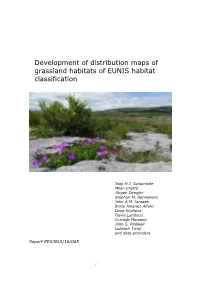
Development of distribution maps of grassland habitats of EUNIS habitat classification Joop H.J. Schaminée Milan Chytrý Jürgen Dengler Stephan M. Hennekens John A.M. Janssen Borja Jiménez-Alfaro Ilona Knollová Flavia Landucci Corrado Marcenò John S. Rodwell Lubomír Tichý and data-providers Report EEA/NSS/16/005 1 Alterra, Institute within the legal entity Stichting Dienst Landbouwkundig Onderzoek Professor Joop Schaminée Stephan Hennekens Partners Professor John Rodwell, Ecologist, Lancaster, UK Professor Milan Chytrý, Masaryk University, Brno, Czech Republic Doctor Ilona Knollová, Masaryk University, Brno, Czech Republic Doctor Lubomír Tichý, Masaryk University, Brno, Czech Republic Date: 07 December 2016 Alterra Postbus 47 6700 AA Wageningen (NL) Telephone: 0317 – 48 07 00 Fax: 0317 – 41 90 00 In 2003 Alterra has implemented a certified quality management system, according to the standard ISO 9001:2008. Since 2006 Alterra works with a certified environmental care system according to the standard ISO 14001:2004. © 2014 Stichting Dienst Landbouwkundig Onderzoek All rights reserved. No part of this document may be reproduced, stored in a retrieval system, or transmitted in any form or by any means - electronic, mechanical, photocopying, recording, or otherwise - without the prior permission in writing of Stichting Dienst Landbouwkundig Onderzoek. 2 TABLE OF CONTENTS 1 Introduction 2 Scope of the project 2.1 Background 2.2 Review of the EUNIS grassland habitat types 3 Indicator species of the revised EUNIS grassland habitat types 3.1 Background -

Plants Used for Making Recreational Tea in Europe: a Review Based on Specific Research Sites Sõukand Et Al
JOURNAL OF ETHNOBIOLOGY AND ETHNOMEDICINE Plants used for making recreational tea in Europe: a review based on specific research sites Sõukand et al. Sõukand et al. Journal of Ethnobiology and Ethnomedicine 2013, 9:58 http://www.ethnobiomed.com/content/9/1/58 Sõukand et al. Journal of Ethnobiology and Ethnomedicine 2013, 9:58 http://www.ethnobiomed.com/content/9/1/58 JOURNAL OF ETHNOBIOLOGY AND ETHNOMEDICINE REVIEW Open Access Plants used for making recreational tea in Europe: a review based on specific research sites Renata Sõukand1*, Cassandra L Quave2, Andrea Pieroni3, Manuel Pardo-de-Santayana4, Javier Tardío5, Raivo Kalle1,6, Łukasz Łuczaj7, Ingvar Svanberg8, Valeria Kolosova9, Laura Aceituno-Mata4,5, Gorka Menendez-Baceta4, Iwona Kołodziejska-Degórska10,11, Ewa Pirożnikow12, Rolandas Petkevičius13, Avni Hajdari14 and Behxhet Mustafa14 Abstract This paper is a review of local plants used in water infusions as aromatic and refreshing hot beverages (recreational tea) consumed in food-related settings in Europe, and not for specific medicinal purposes. The reviewed 29 areas are located across Europe, covering the post-Soviet countries, eastern and Mediterranean Europe. Altogether, 142 taxa belonging to 99 genera and 40 families were reported. The most important families for making herbal tea in all research areas were Lamiaceae and Asteraceae, while Rosaceae was popular only in eastern and central Europe. With regards to botanical genera, the dominant taxa included Mentha, Tilia, Thymus, Origanum, Rubus and Matricaria. The clear favorite was Origanum vulgare L., mentioned in 61% of the regions. Regionally, other important taxa included Rubus idaeus L. in eastern Europe, Chamaemelum nobile (L.) All. in southern Europe and Rosa canina L. -
INDEX SEMINUM 2020 No 20
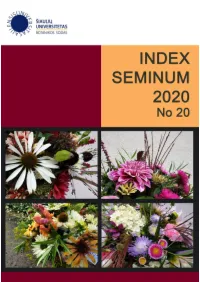
BOTANICAL GARDEN OF ŠIAULIAI UNIVERSITY INDEX SEMINUM 2020 No 20 2020 1 BOTANICAL GARDEN OF ŠIAULIAI UNIVERSITY ______________________________________________________________________________ Phone: +370 659 93748 E-mail: subotanika@su.lt Web: http://bs.su.lt/ Facebook: https://www.facebook.com/SUbotanikossodas/ Authors: Virginija Aleknienė, Martynas Kazlauskas, Rimanta Vainorienė, Žydrūnė Valainytė, Rita Šulskienė. Cover design Karolis Grušas Photos are from the archyve of botanical garden 2 ŠIAULIAI UNIVERSITY BOTANICAL GARDEN ŠIAULIAI AREA. Šiauliai is a city of Northern Lithuania. It counts its years from the Battle of Saulė which took place in 1236. Šiauliai is the fourth largest city by its population. Population: 106 400. HISTORY. Šiauliai University Botanical Garden was established in 1997 at the former site of Agrobiological Station of Šiauliai University. Total area of the garden is 6.54 ha. Since 2003 Botanical Garden of Šiauliai University is a member of Botanic Gardens Conservation International, Planta Europa Network, Association of Botanic Gardens in the Baltic Sea Region, Botanical Gardens of the Baltic Countries and the Association of Lithuanian University Botanic Gardens (LUBSA). Since 2005 the Botanic Garden is a member of International Network of Phenological Gardens of Europe (IPG). There is a Club of Botanic Garden Friends at the Botanical Garden. The Garden exchanges seeds with more than 300 botanical gardens of the world. Director: dr. Martynas Kazlauskas. Fields of research: • research on plant biodiversity ex situ and in situ, • research on introduction and acclimatization of ornamental plants, • phenological observations. Other activities: • ex situ conservation, • educational activities at the Botanical Garden, • organization of events at the Botanical Garden. COLLECTIONS OF THE BOTANICAL GARDEN. -

Threatened Medicinal Plants in Castilla Y León (Spain)
Global Advanced Research Journal of Medicinal Plants (GARJMP) Vol. 1(1) pp. 001-006, December, 2012 Available online http://garj.org/garjmp/index.htm Copyright © 2012 Global Advanced Research Journals Full Length Research Paper Threatened medicinal plants in Castilla y León (Spain) Herrero, B. and Martín-Lobera, C Universidad de Valladolid, Departamento de Ciencias Agroforestales, 34004 Palencia, Spain. Accepted 03 December, 2012 544 vascular plant species are used traditionally as medicinal in Castilla y León. 8 of these species are protected on different scales. Sometimes this protection establishes limits to their harvest, such as: Arnica montana , Gentiana lutea , Nacissus pseudonarcissus , Sideritis hyssopifolia . These species are collected from wild populations with the risk of genetic erosion and loss of populations. Arnica montana and Gentiana lutea are highly demanded, and collected from wild populations in this region. Their distribution habitats in peat bogs and mountain pasture are also affected, diminishing their presence due to different reason. In Castilla y León crops of medicinal and aromatic plants spread over 970 ha, representing 0.03% of the cultivated land. This area has been reduced by 36% in the last few years whereas the demand for such plants has increased by 10%, in the last 15 years. Some protected species are not used traditionally by people to treat their common illnesses. However, high harmful demand comes from drug companies which are carrying out excessive picking. In the region, it is necessary to create crop policies for other species which are not listed as protected but their demand is increasing, such us: Hyssopus officinalis , Jasonia glutinosa , Lavandula latifolia , Origanum vulgare , Salvia lavandulifolia , Satureja montana , Thymus spp. -

Melle BARKA FATIHA Président M
EPUBLIQUE ALGERIENNE DEMOCRATIQUE ET POPULAIRE MINISTERE DE L’ENSEIGNEMENT SUPERIEUR ET DE LA RECHERCHE SCIENTIFIQUE UNIVERSITE ABOU-BEKR BELKAID - TLEMCEN FACULTE DES SCIENCES DE LA NATURE ET DE LA VIE ET DES SCIENCES DE LA TERRE ET DE L’UNIVERS Département des Ressources Forestières THESE DE DOCTORAT EN FORESTERIE Thème Etude des groupements à matorral dans le littoral de la région de Tlemcen. Aspects phytoécologiques et cartographie Présentée par Melle BARKA FATIHA Président M. HADDOUCHE Idriss M.C.AUniversité de Tlemcen Directeur de Thèse M. BOUAZZA Mohamed Profes. Université de Tlemcen Examinateurs M. MAHDADI Zoheir Professeur Université de Sidi Bel Abbes seur M. HASNAOUI Okkacha Profes Université de Saida M. MEDJAHDI Boumediene M.C.Aseur Université de Tlemcen ME M SOUIDI Zahéra M.C.AUniversité de Mascara . Invité M. KAZI Sidi Said Directeur du Parc National de Tlemcen Année universitaire : 2015/2016 DÉDICACES J’ai le plaisir de dédier avec fierté ce modeste travail à : La mémoire de mon défunt père « MOHAMED » qui a su nous transmettre l’essentiel de son énergie morale et matérielle pour réussir ; que Dieu accorde paix et miséricorde éternelles à son âme. Ma mère, qui a été très patiente et qui m'a toujours encouragée et poussée aux études. Mes frères et sœurs : Réda, Benamer, Farouk, Mohamed, Fatima Zohra, Nacéra, Naïma, Kheira et leurs maris Nasr Eddine et Sid Ahmed pour leur compréhension et soutien moral qu’ils ont pu m’apporter tout au long de cet itinéraire. Mes neveux et nièces : Mohamed Salim, Yacine, Riad, Younes, Aya Ceryne, Rania Alaa Hadil, Nassima, et Amina ainsi qu’à toute la famille BARKA. -

European Red List of Medicinal Plants
European Red List of Medicinal Plants Compiled by David Allen, Melanie Bilz, Danna J. Leaman, Rebecca M. Miller, Anastasiya Timoshyna and Jemma Window European Red List of Medicinal Plants Compiled by David Allen, Melanie Bilz, Danna J. Leaman, Rebecca M. Miller, Anastasiya Timoshyna and Jemma Window IUCN Global Species Programme IUCN European Union Representative Office IUCN Species Survival Commission Published by the European Commission. The designation of geographical entities in this book, and the presentation of the material, do not imply the expression of any opinion whatsoever on the part of IUCN or the European Union concerning the legal status of any country, territory, or area, or of its authorities, or concerning the delimitation of its frontiers or boundaries. The views expressed in this publication do not necessarily reflect those of IUCN or the European Union. Citation: Allen, D., Bilz, M., Leaman, D.J., Miller, R.M., Timoshyna, A. and Window, J. 2014. European Red List of Medicinal Plants. Luxembourg: Publications Office of the European Union. Design and layout: Imre Sebestyén jr. / UNITgraphics.com Printed by: Rosseels Printing Picture credits on cover page: Artemisia granatensis is endemic to the mountains of Sierra Nevada, southern Spain. The plant is considered Endangered as a result of population decline and range contraction. ©José Quiles Hoyo / www.florasilvestre.es All photographs used in this publication remain the property of the original copyright holder (see individual captions for details). Photographs should -
Jan Scholten Wonderful Plants Reading Excerpt Wonderful Plants of Jan Scholten Publisher: Alonnissos Verlag
Jan Scholten Wonderful Plants Reading excerpt Wonderful Plants of Jan Scholten Publisher: Alonnissos Verlag http://www.narayana-verlag.com/b14446 In the Narayana webshop you can find all english books on homeopathy, alternative medicine and a healthy life. Copying excerpts is not permitted. Narayana Verlag GmbH, Blumenplatz 2, D-79400 Kandern, Germany Tel. +49 7626 9749 700 Email info@narayana-verlag.com http://www.narayana-verlag.com Table of Contents 0.9.06 Stage-6 40 0.1.1 Publication data 3 0.9.07 Stage-7 40 0.1.2 Table of Contents 13 0.9.08 Stage-8 40 0.1.3 Word of thanks 14 0.9.09 Stage-9 41 0.1.4 Foreword Klein 14 0.9.10 Stage-10 41 0.1.5 Foreword Kuiper 15 0.9.11 Stage-11 41 0.1.6 Introduction 16 0.9.12 Stage-12 42 0.1.7 Introduction use 16 0.9.13 Stage-13 42 0.1.8 Use 17 0.9.14 Stage-14 42 0.2 Goal 18 0.9.15 Stage-15 43 0.3.1 Method 19 0.9.16 Stage-16 43 0.3.2 Element Theory 19 0.9.17 Stage-17 43 0.3.3 Classification of Plants 20 0.9.18 Stage-18 44 0.3.4 Classes 20 000.00 Evolution 44 0.4 Result 21 000.00.00 Kingdom 45 0.4.0 Result 21 000.00.00 Plant Kingdom 47 0.4.1 Phyla and Series 21 000.00.20 Kingdom 49 0.4.2 Classes and Series 22 111.00.00 Archaeoplastidae 51 0.4.3 Subclasses and Series 22 111.02.20 Fucus vesiculosus 51 0.4.4 Orders and Phases 23 111.10.00 Rhodophyta 51 0.4.5 Families and Subphases 23 111.10.13 Helminthochortos 51 0.4.7 Number 23 111.10.20 Chondrus crispus 51 0.5 Discussion 24 111.10.20 Porphyra yezoensis 51 0.5.0 Discussion 24 112.20.00 Glaucophyta 51 0.5.1 Discussion Apg 3 24 210.00.00 Chlorophyta 51 0.5.1 -

(Rbcl) PROTEINS in SOME Sideritis L. (LAMIACEAE) SPECIES: a BIOINFORMATIC APPROACH
UDC 575 https://doi.org/10.2298/GENSR1901069S Original scientific paper COMPARATIVE AND PHYLOGENETIC ANALYSIS OF RUBISCO LARGE SUBUNIT (rbcL) PROTEINS IN SOME Sideritis L. (LAMIACEAE) SPECIES: A BIOINFORMATIC APPROACH Emre SEVİNDİK Faculty of Agriculture, Department of Agricultural Biotechnology, Adnan Menderes University, South Campus, Cakmar, Aydin, Turkey Sevindik E. (2019): Comparative and phylogenetic analysis of rubisco large subunit (rbcl) proteins in some Sideritis L. (Lamiaceae) species: a bioinformatic approach.- Genetika, Vol 51, No.1, 69-80. The large subunits of ribulose-1,5-bisphosphate carboxylase/oxygenase (RuBisCO) protein, which plays an important role in the photosynthesis reaction, are encoded by the chloroplast genome. Sideritis L., a medical and aromatic plant group, belongs to Lamiaceae family. In this study, we performed sequence, physicochemical, phylogenetic and three-dimensional (3D) bioinformatic analyses of RuBisCO large subunit (rbcL) proteins in the Sideritis ssp. using various bioinformatics tools. Physicochemical analyzes were performed by ExPASy - ProtParam. The putative phosphorylation sites of the rbcL proteins were determined by NetPhos 2.0 and NetPhos 3.1. Phylogenetic analyses were performed with the MEGA 6.0 software. To estimate 3D protein structures, PyMol program was used. At the end of the study, it was found that the amino acid number of stilbene synthase proteins ranged between 171 and 456, molecular weight ranged between 19002.67 and 50420.44 Da, instability index ranged between 27.30 to 40.70 and GRAVY values ranged between -0.394 to -0.226. While the highest average amino acid rate in the rbcL proteins was Gly (10.00%), the lowest amino acid ratio (1.4%) was determined as Trp. -
Contribution of Seed Banks Across Europe Towards the 2020 Global Strategy for Plant Conservation Targets, Assessed Through the ENSCONET Database S
Contribution of seed banks across Europe towards the 2020 Global Strategy for Plant Conservation targets, assessed through the ENSCONET database S. RIVIÈRE and J. V. MÜLLER TABLE S1 The 32 families not included in Euro+Med but covered by The Plant List, among others (synonyms according to The Plant List are shown in parentheses). Aizoaceae Anacardiaceae Buxaceae Caprifoliaceae (Dipsacaceae, Velarianaceae) Celastraceae Cistaceae Convolvulaceae Cucurbitaceae Elaeagnaceae Ericaceae (Empetraceae, Pyrolaceae) Frankeniaceae Boraginaceae (Hydrophyllaceae) Lauraceae Linaceae Malvaceae (Tiliaceae) Onagraceae Oxalidaceae Plantaginaceae (Callitrichaceae) Polemoniaceae Polygalaceae Polygonaceae Lythraceae (Punicaceae) Ranunculaceae Rhamnaceae Rubiaceae (Theligonaceae) Rutaceae Sapindaceae (Aceraceae, Hippocastanaceae) Scrophulariaceae (Myoporaceae) Staphyleaceae Tamaricaceae Violaceae Vitaceae TABLE S2 Number of accessions held for each threatened species for targets 8a and 8b of the 2011–2020 Global Strategy for Plant Conservation. Name of threatened species according to Taxonomic status* No. of No. of accessions the IUCN Red List 2015.4 & the 2011 accessions conserved ex situ by European Red List of Vascular Plants conserved ex ENSCONET, & situ by available for recovery ENSCONET and restoration (target 8a) programmes (target 8b) Abies nebrodensis Accepted EPM 0 0 Abies pinsapo Accepted EPM 5 3 Acis nicaeensis Accepted EPM 0 0 Aconitum corsicum Synonym TPL 2 0 Actinocarpus damasonium Synonym TPL 25 2 Adenocarpus ombriosus Accepted EPM 9 9 Aeonium -

Butlletí 83 (2019)
Butlletí de la Institució Catalana d’Història Natural 83 Barcelona 2019 INSTITUCIÓ CATALANA D’HISTÒRIA NATURAL Editor en Cap Juli Pujade-Villar, Universitat de Barcelona, Facultat de Biologia, Departament de Biologia Evolutiva, Ecologia i Ciències Ambientals (Secció invertebrats), Barcelona. Coeditors Joan Pino, Centre de Recerca Ecològica i Aplicacions Forestals (CREAF), Universitat Autònoma de Barcelona, Bellaterra. Eulàlia Comas, Departament de Territori i Sostenibilitat, Generalitat de Catalunya, Barcelona. Llorenç Sáez, Unitat de Botànica, Facultat de Ciències, Universitat Autònoma de Barcelona, Bellaterra. Òscar Alomar, Institut de Recerca i Tecnologia Agroalimentàries (IRTA), Cabrils. Roser Campeny. Minuartia, Sant Celoni. Ignasi Soriano, Universitat de Barcelona, Facultat de Biologia, Departament de Biologia Evolutiva, Ecologia i Ciències Ambientals (Secció de Botànica i Micologia), Barcelona. Delfí Sanuy, Universitat de Lleida, Escola Tècnica Superior d’Engineria Agrària, Lleida. Amador Viñolas, Corsorci del Museu de Ciències Naturals de Barcelona, Laboratori de Natura, Coŀlecció d’artròpodes, Barcelona. L’edició d’aquest Butlletí ha estat possible gràcies al suport de l’Institut d’Estudis Catalans Figura de la portada: Detall de la flor d’Ophrys fusca subsp. bilunulata. Dibuix d’Amador Viñolas. Data de publicació: desembre de 2019 © Els autors dels articles Aquesta edició és propietat de la Institució Catalana d’Història Natural (filial de l’Institut d’Estudis Catalans) Carrer del Carme, 47. 08001 Barcelona Compost per Amador Viñolas Impressió: Limpergraf, SL Dipòsit Legal: B-36.100-74 ISSN: 1133-6889 (print edition) ISSN: 2013-3987 (online edition) Butlletí de la Institució Catalana d’Història Natural, 83: 3-21. 2019 ISSN 2013-3987 (online edition): ISSN: 1133-6889 (print edition)3 GEA, FLORA ET fauna GEA, FLORA ET FAUNA Notes sobre flora aŀlòctona a Catalunya. -

Observation on the Cotyledonary Stomata and Trichomes and Their Ontogeny in Some Genera of Lamiaceae
ZOBODAT - www.zobodat.at Zoologisch-Botanische Datenbank/Zoological-Botanical Database Digitale Literatur/Digital Literature Zeitschrift/Journal: Phyton, Annales Rei Botanicae, Horn Jahr/Year: 1981 Band/Volume: 21_1 Autor(en)/Author(s): Naidu A. C., Shah G. L. Artikel/Article: Observation on the Cotyledonary Stomata and Trichomes and their Ontogeny in some Genera of Lamiaceae. 137-152 ©Verlag Ferdinand Berger & Söhne Ges.m.b.H., Horn, Austria, download unter www.biologiezentrum.at Phyton (Austria) Vol. 21 Fasc. 1 137-152 15. 2. 1981 Observation on the Cotyledonary Stomata and Trichomes and their Ontogeny in some Genera of Lamiaceae A. C. NAIDU and G. L. SHAH *) With 85 Figures (4 plates) Received July 15, 1980 Key words: Stomata, trichomes, cotyledons, Lamiaceae. Summary NAIDU A. C. & SHAH G. L. 1981. Observations on the cotyledonary stomata and trichomes and their ontogeny in some genera of Lamiaceae. — Phyton (Austria) 21 (1): 137—152, 85 figures (4 plates). — English with German Summary. The structure and ontogeny of cotyledonary stomata and trichomes are described in 34 species of Lamiaceae. Stomata are diacytic, anomocytic, hap- locytic, transitional form, tetracytic, paracytic and tricytic, different types often occuring side by side even on the same surface. The most frequent type is diacytic on both surfaces in most of the taxa, but it is anomocytic on adaxial surface or both surfaces in some. Rarely anisocytic, transitional form or haplo- cytic stomata are also dominant types on the adaxial surface. More than one type of ontogenetic patterns are observed on the same surface in different taxa. Anomocytic stomata are perigenous. Other types are mesogenous or meso- perigenous.