Dossier De Presse Karlheinz Stockhausen
Total Page:16
File Type:pdf, Size:1020Kb
Load more
Recommended publications
-

Karlheinz Stockhausen: Works for Ensemble English
composed 137 works for ensemble (2 players or more) from 1950 to 2007. SCORES , compact discs, books , posters, videos, music boxes may be ordered directly from the Stockhausen-Verlag . A complete list of Stockhausen ’s works and CDs is available free of charge from the Stockhausen-Verlag , Kettenberg 15, 51515 Kürten, Germany (Fax: +49 [0 ] 2268-1813; e-mail stockhausen-verlag@stockhausen.org) www.stockhausen.org Karlheinz Stockhausen Works for ensemble (2 players or more) (Among these works for more than 18 players which are usu al ly not per formed by orches tras, but rath er by cham ber ensem bles such as the Lon don Sin fo niet ta , the Ensem ble Inter con tem po rain , the Asko Ensem ble , or Ensem ble Mod ern .) All works which were composed until 1969 (work numbers ¿ to 29) are pub lished by Uni ver sal Edi tion in Vien na, with the excep tion of ETUDE, Elec tron ic STUD IES I and II, GESANG DER JÜNGLINGE , KON TAKTE, MOMENTE, and HYM NEN , which are pub lished since 1993 by the Stock hau sen -Ver lag , and the renewed compositions 3x REFRAIN 2000, MIXTURE 2003, STOP and START. Start ing with work num ber 30, all com po si tions are pub lished by the Stock hau sen -Ver lag , Ket ten berg 15, 51515 Kürten, Ger ma ny, and may be ordered di rect ly. [9 ’21”] = dura tion of 9 min utes and 21 sec onds (dura tions with min utes and sec onds: CD dura tions of the Com plete Edi tion ). -

Ulrich Buch Engl. Ulrich Buch Englisch
Stockhausen-Stiftung für Musik First edition 2012 Published by Stockhausen-Stiftung für Musik 51515 Kürten, Germany (Fax +49-[0] 2268-1813) www.stockhausen-verlag.com All rights reserved. Copying prohibited by law. O c Copyright Stockhausen-Stiftung für Musik 2012 Translation: Jayne Obst Layout: Kathinka Pasveer ISBN: 978-3-9815317-0-1 STOCKHAUSEN A THEOLOGICAL INTERPRETATION BY THOMAS ULRICH Stockhausen-Stiftung für Musik 2012 TABLE OF CONTENTS Preliminary Remark .................................................................................................. VII Preface: Music and Religion ................................................................................. VII I. Metaphysical Theology of Order ................................................................. 3 1. Historical Situation ....................................................................................... 3 2. What is Music? ............................................................................................. 5 3. The Order of Tones and its Theological Roots ............................................ 7 4. The Artistic Application of Stockhausen’s Metaphysical Theology in Early Serialism .................................................. 14 5. Effects of Metaphysical Theology on the Young Stockhausen ................... 22 a. A Non-Historical Concept of Time ........................................................... 22 b. Domination Thinking ................................................................................ 23 c. Progressive Thinking -
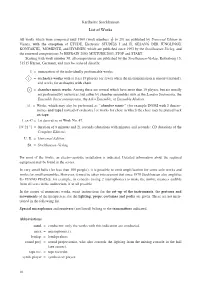
Karlheinz Stockhausen List of Works
Karlheinz Stockhausen List of Works All works which were composed until 1969 (work numbers ¿ to 29) are published by Universal Edition in Vienna, with the exception of ETUDE, Electronic STUDIES I and II, GESANG DER JÜNGLINGE, KONTAKTE, MOMENTE, and HYMNEN, which are published since 1993 by the Stockhausen-Verlag, and the renewed compositions 3x REFRAIN 2000, MIXTURE 2003, STOP and START. Starting with work number 30, all compositions are published by the Stockhausen-Verlag, Kettenberg 15, 51515 Kürten, Germany, and may be ordered directly. 1 = numeration of the individually performable works. r1 = orchestra works with at least 19 players (or fewer when the instrumentation is unconventional), and works for orchestra with choir. o1 = chamber music works. Among these are several which have more than 18 players, but are usually not performed by orchestras, but rather by chamber ensembles such as the London Sinfonietta, the Ensemble Intercontemporain, the Asko Ensemble, or Ensemble Modern. J35 = Works, which may also be performed as “chamber music” (for example INORI with 2 dancer- mimes and tape [instead of orchestra] or works for choir in which the choir may be played back on tape. 1. ex 47 = 1st derivative of Work No. 47. [9’21”] = duration of 9 minutes and 21 seconds (durations with minutes and seconds: CD durations of the Complete Edition). U. E. = Universal Edition. St. = Stockhausen-Verlag. For most of the works, an electro-acoustic installation is indicated. Detailed information about the required equipment may be found in the scores. In very small halls (for less than 100 people), it is possible to omit amplification for some solo works and works for small ensembles. -

Vendredi 10 Février Ensemble Intercontemporain Ensemble In
Roch-Olivier Maistre, Président du Conseil d’administration Laurent Bayle, Directeur général Vendredi 10 février Ensemble intercontemporain Dans le cadre du cycle Des pieds et des mains Du 10 au 12 février Vendredi 10 février 10 Vendredi | Vous avez la possibilité de consulter les notes de programme en ligne, 2 jours avant chaque concert, à l’adresse suivante : www.citedelamusique.fr Ensemble intercontemporain Ensemble intercontemporain Cycle Des pieds et des mains L’Ensemble intercontemporain présente deux concerts dans le cadre du cycle Des pieds et des mains à la Cité de la musique. Inori (un mot japonais qui signie « invocation, adoration ») est une expérience totale. La mimique quasi dansée des deux « solistes » emprunte le code de ses gestes de prière à diverses religions du monde. À chaque mouvement des mains correspond une note : Inori est en 1974 l’une des premières pièces de Stockhausen à se fonder sur une « formule », sorte d’hyper-mélodie qui non seulement est entendue comme telle mais se retrouve pour ainsi dire étirée à l’échelle de l’œuvre dans son entier, dont elle dicte et caractérise les diérentes parties. Enn, chacune des sections d’Inori se concentre sur un aspect du discours musical – dans l’ordre : rythme, dynamique, mélodie, harmonie et polyphonie –, si bien que la partition, selon le compositeur, « se développe comme une histoire de la musique » reparcourue en accéléré, depuis l’origine jusqu’à nos jours. Dans le saisissant Pas de cinq de Mauricio Kagel, composé en 1965, les cinq exécutants, munis d’une canne, parcourent et sillonnent une surface délimitée en forme de pentagone couvert de diérents matériaux. -

Music Theatre
11 Music Theatre In the 1950s, when attention generally was fi xed on musical funda- mentals, few young composers wanted to work in the theatre. Indeed, to express that want was almost enough, as in the case of Henze, to separate oneself from the avant-garde. Boulez, while earning his living as a theatre musician, kept his creative work almost entirely separate until near the end of his time with Jean-Louis Barrault, when he wrote a score for a production of the Oresteia (1955), and even that work he never published or otherwise accepted into his offi cial oeuvre. Things began to change on both sides of the Atlantic around 1960, the year when Cage produced his Theatre Piece and Nono began Intolleranza, the fi rst opera from inside the Darmstadt circle. However, opportunities to present new operas remained rare: even in Germany, where there were dozens of theatres producing opera, and where the new operas of the 1920s had found support, the Hamburg State Opera, under the direction of Rolf Liebermann from 1959 to 1973, was unusual in com- missioning works from Penderecki, Kagel, and others. Also, most com- posers who had lived through the analytical 1950s were suspicious of standard genres, and when they turned to dramatic composition it was in the interests of new musical-theatrical forms that sprang from new material rather than from what appeared a long-moribund tradition. (It was already a truism that no opera since Turandot had joined the regular international repertory. What was not realized until the late 1970s was that there could be a living operatic culture based on rapid obsolescence.) Meanwhile, Cage’s work—especially the piano pieces he 190 Music Theatre 191 had written for Tudor in the 1950s—had shown that no new kind of music theatre was necessary, that all music is by nature theatre, that all performance is drama. -

Karlheinz Stockhausen: BIOGRAPHY English
SHORT BIOG RA PHY Karl heinz Stock hau sen 1928 Born Wednesday, August 22nd in Mödrath near Cologne. 1947 – 51 In Cologne, stud ied at the State Con ser va to ry of Music (piano, music edu ca tion) and at the University of Cologne (Ger man phi lol o gy, phi los o phy, musi col o gy). Since l950 First com po si tions and per for manc es of his own works. (In the fol low ing enumeration, only a few of the more than 370 works and world premières are men tioned.) 1951 Serial Music: KREUZ SPIEL (CROSS-PLAY), FOR MEL (FOR MU LA), etc. Married Doris Andreae; four chil dren with Doris: Suja (1953), Chris tel (1956), Mark us (1957), Majel la (1961). 1952 Point Music: SPIEL (PLAY), KLAVIERSTÜCKE (PIANO PIECES), SCHLAGTRIO (PER CUS SIVE TRIO), PUNK TE (POINTS), KON TRA-PUNK TE (COUN TER- POINTS) etc. Attend ed Olivi er Messiaen’s cours es in rhyth mics and aes thet ics in Paris. Experi ments in the “ musique concrète” group at the French radio in Paris, and real isa tion of an ETUDE ( musique concrète). First syn the sis of sound-spec tra with elec tron ical ly gen er at ed sine tones. Since 1953 Per ma nent col lab o ra tor at the Studio for Elec tron ic Music of the West Ger man Radio in Cologne (artis tic direc tor from 1963–1977, artis tic con sul tant until 1990). Lec tur er at the annu al International Summer Cours es for New Music in Darm stadt from 1953 until 1974, and in 1996. -
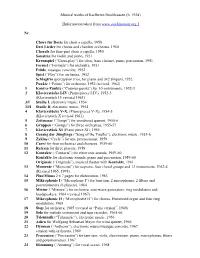
C:\Documents and Settings\Hubert Howe\My Documents\Courses
Musical works of Karlheinz Stockhausen (b. 1928) [Information taken from www.stockhausen.org.] Nr. Chöre für Doris for choir a capella, 1950 Drei Lieder for chorus and chamber orchestra, 1950 Chorale for four-part choir a capella, 1950 Sonatine for violin and piano, 1951 Kreuzspiel (“Cross-play”) for oboe, bass clarinet, piano, percussion, 1951 Formel (“Formula”) for orchestra, 1951 Etüde, musique concrète, 1952 Spiel (“Play”) for orchestra, 1952 Schlagtrio (percussion trio), for piano and 3x2 timpani, 1952 Punkte (“Points”) for orchestra, 1952 (revised, 1962) 1 Kontra-Punkte (“Counter-points”) for 10 instruments, 1952-3 2 Klavierstücke I-IV (Piano pieces I-IV), 1952-3 (Klavierstück IV revised 1961) 3/I Studie I, electronic music, 1954 3/II Studie II, electronic music, 1954 4 Klavierstücke V-X, (Piano pieces V-X), 1954-5 (Klavierstück X revised 1961) 5 Zeitmasze (“Tempi”) for woodwind quintet, 1955-6 6 Gruppen (“Groups”) for three orchestras, 1955-57 7 Klavierstück XI (Piano piece XI), 1956 8 Gesang der Jünglinge (“Song of the Youths”), electronic music, 1955-6 9 Zyklus (“Cycle”) for one percussionist, 1959 10 Carré for four orchestras and choruses, 1959-60 11 Refrain for three players, 1959 12 Kontakte (“Contacts”) for electronic sounds, 1959-60 Kontakte for electronic sounds, piano and percussion, 1959-60 Originale (“Originals”), musical theater with Kontakte, 1961 13 Momente (“Moments”) for soprano, four choral groups and 13 instruments, 1962-4 (Revised 1965, 1998) 14 Plus/Minus 2 x 7 pages for elaboration, 1963 15 Mikrophonie I (“Microphony -

8425549.PDF (3.718Mb)
INFORMATION TO USERS This reproduction was made from a copy of a document sent to us for microfilming. While the most advanced teciinoiogy lias been used to photograph and reproduce this document, the quality of the reproduction is heavily dependent upon the quality of the material submitted. The following explanation of techniques is provided to help clarify markings or notations which may appear on this reproduction. 1. The sign or “target” for pages apparently lacking from the document photographed is “Missing Page(s)”. If it was possible to obtain the missing page(s) or section, they are spliced into the film along with adjacent pages. This may have necessitated cutting througli an image and duplicating adjacent pages to assure complete continuity. 2. When an image on the film is obliterated with a round black mark, it is an indication of either blurred copy because of movement during exposure, duplicate copy, or copyrighted materials that should not have been filmed. For blurred pages, a good image of the page can be found in the adjacent frame. If copyrighted materials were deleted, a target note will appear listing the pages in the adjacent frame. 3. When a map, drawing or chart, etc., is part of the material being photographed, a definite method of “sectioning” the material has been followed. It is customary to begin filming at the upper left hand comer of a large sheet and to continue from left to right in equal sections with small overlaps. If necessary, sectioning is continued again—beginning below the first row and continuing on until complete. -

Karlheinz Stockhausen's Stage Cycle Licht. Musical Theatre of the World
Interdisciplinary Studies in Musicology 8,2009 © Department o f Musicology, Adam Mickiewicz University, Poznan, Poland AGNIESZKA DRAUS (Krakow) Karlheinz Stockhausen’s stage cycle Licht. Musical theatre of the world ABSTRACT: The main idea of the paper is a presentation of the stage cycle Licht, ab sorbing the composer for over one-third of his active creative life. The question arises as to the generic affiliation of Stockhausen’s opus magnum: close to operatic works by Luciano Berio and Mauricio Kagel or to pop productions of works by Philip Glass? Analysing the subject matter and content of Licht, as well as its message and the means of expression employed, it is difficult not to discern the unification, within a single work, of what might appear to be contrasting musical genres and kinds of thea tre (mystery play, expressionist drama, happening). It is worth remembering that the composer himself does not employ any specific generic term except for Opernzyklus. He often, however, refers to the forms and genres of theatre, cultivated in many differ ent parts of the world, which have inspired him (e.g. in Malaysia, Japan, Bali, the USA), and he admits to the evolution of his views on faith. Can the substance of Licht be reduced to a common denominator? Can the heptalogy be called ‘sacred’ theatre? Or - on the contrary - an extremely profane, ‘pagan’ avant-garde spectacle? KEYWORDS: pitch, Karlheinz Stockhausen, stage-cycle, Licht, world-theatre, The Urantia Book, Michael, Eva, Lucifer, formula-composition, Hans Urs von Balthasar Karlheinz Stockhausen composed a total of around 360 works, minor and monumental, vocal and instrumental, in a variety of forms and genres. -

2016 Performances 2009 Performance Update
Stock hau sen Aufführungen / Per for manc es 2016 Friday, Jan. 8th, 8 pm Amsterdam, Muziekgebouw aan’t Ij (Information: https://www.muziekgebouw.nl/agenda/?datum=2016-01-08) KLAVIERSTÜCKE (PIANO PIECES ) IX, XI Saturday, Jan. 16th, 12:30 pm Den Bosch, Azijnfabriek (Information: http://podiumazijnfabriek.nl/programma/lunchconcert-4/) LAUB UND REGEN (LEAVES AND RAIN) for clarinet and basset-horn Saturday, Jan. 16th, 8 pm Berlin, Konzerthaus Berlin (Information: http://www.konzerthaus.de/programm/musik-am-draht-teil-i/3107) KONTAKTE (CONTACTS) electronic music with piano and percussion Thursday, Jan. 21st, 7:30 pm London, the Priory Church of St Bartholomew the Great (Information: http://www.dreamswisdominnocence.com/) TIERKREIS (ZODIAC) for soprano and harpsichord Saturday, Jan. 23rd Hamburg, Christianskirche (Information: <Friedrich.Gauwerky(at)t-online.de>) VIOLONCELLO for violoncello and electronic music Friday, January 29th, 8:30 pm Paris, Salle des concerts - Cité de la musique - Philharmonie 2 (Information: http://philharmoniedeparis.fr/fr/activite/concert/15218-mantra) MANTRA for 2 pianists Saturday, Jan. 30th, 8:30 pm Paris, Salle des concerts - Cité de la musique - Philharmonie 2 (Information: http://philharmoniedeparis.fr/fr/activite/concert/15219-gruppen) GROUPEN (GROUPS) for 3 orchestras Sunday, Jan. 31st, 3 pm Paris, Salle de répétition - Philharmonie 1 (Information: http://philharmoniedepa- ris.fr/fr/activite/musique-de-chambre/15480-tokyo-1966) SOLO for flute with feedback TELEMUSIK (TELEMUSIC) Electronic Music SOLO for trombone with feedback ADIEU for woodwind quintet Sunday, Jan. 31st, 4:30 pm Paris, Amphithéâtre - Cité de la musique - Philharmonie 2 (Information: http://philharmoniedeparis.fr/fr/activite/recital-piano/15221-klavierstucke-stockhausen) PIANO PIECES Sunday, Jan. -

Deutsch Stockhausen Werverz
KURZBIOGRAPHIE Karlheinz Stockhausen 1928 Geboren am Mittwoch, den 22. August in Mödrath bei Köln. 1947 – 51 Studium in Köln an der Staatlichen Hochschule für Musik (Klavier, Schulmusik) und Universität (Germanistik, Philosophie, Musikwissenschaft). Seit 1950 Erste Kompositionen und Aufführungen eigener Werke. (In folgender Aufzählung werden nur einige der 376 Werke und Uraufführungen genannt.) 1951 Serielle Musik: KREUZSPIEL, FORMEL usw. Vermählung mit Doris Andreae; aus der Ehe gingen 4 Kinder hervor: Suja (1953), Christel (1956), Markus (1957), Majella (1961). 1952 Punktuelle Musik: SPIEL, KLAVIERSTÜCKE, SCHLAGTRIO, PUNKTE, KONTRA-PUNKTE usw. Kurse für Rhythmik und Ästhetik bei Olivier Messiaen in Paris; Experimente in der Gruppe ‘musique concrète’ des französischen Rundfunks, Paris, und Realisation einer ETUDE (Konkrete Musik). Erste Synthese von Klangspektren mit elektronischen Sinus-Tönen. Seit 1953 ständiger Mitarbeiter im Studio für Elektronische Musik des WDR Köln (1963 – 1977 künstlerischer Leiter, bis 1990 künstlerischer Berater); Dozent der jährlichen Internationalen Ferienkurse für Neue Musik in Darmstadt von 1953 bis 1974 und 1996. Erste Kompositionen Elektronischer Musik: Elektronische STUDIEN I und II, GESANG DER JÜNG- LINGE (Beginn der Raum-Musik und der Aleatorischen Musik). 1954 – 56 Parallel zur Forschung und Komposition im WDR Studio für Elektronische Musik Studium der Phonetik und Kommunikationsforschung bei Werner Meyer-Eppler an der Universität Bonn. 1954 – 59 Mitherausgeber der Schriften über serielle Musik » die Reihe«, Universal Edition (Wien). 1956 Uraufführungen von ZEITMASZE in Paris und GESANG DER JÜNGLINGE in Köln. 1957 Uraufführung KLAVIERSTÜCK XI (Variable Musik) in New York. 1958 Experimente neuer elektronischer Klangsynthesen und Raumprojektionen für KONTAKTE. 32 ‘concert-lectures’ an amerikanischen Universitäten; seitdem re gelmäßig längere Tourneen als Dirigent und Interpret eigener Werke (seit 1959 mit kleineren Solisten-Gruppen). -

Kursen-Broschure English
Nine Concerts: July 11 th to 19 th 2015 Courses Stock hau sen Concerts Thursday, July 16 th , 8 p.m., Sülztalhalle Faculty and works which will be taught in master INORI-gestures (Instructor: Alain Louafi ) Saturday, July 11 th , 5 p.m. classes Due to the special significance given to the synthesis of and Courses Kürten 2015 Festive opening of the courses at the ROSA MYSTICA (from SCENTS – SIGNS) music and gesture in Stockhausen’s works, the gestures for tenor und synthesizer Suzanne Stephens (clarinet, basset-horn, bass clarinet) from the composition INORI (1973–74) are rehearsed in Karlheinz-Stockhausen-Platz . MICHAEL’S CALL th th and Kathinka Pasveer (flute, alto flute, piccolo) this course. The course takes place each morning before from July 11 to July 19 for 4 trumpets will open and close the ceremony and will be teach ing all Stock hau sen works com posed for their the master classes and other events of the courses and is nd 2 participants’ concert respec tive instru ments. open to all interested participants. “Sometimes music vibrates beyond the clouds, and we can Saturday, July 11 th , 8 p.m., Sülztalhalle no longer hear its echo. Very rarely is it truly infinite; then Sound projection (Instructors: Kathinka Pasveer, sound Marco Blaauw (trumpet, piccolo trumpet, flugelhorn): it makes us forget the Earth. The great masters sense that TELEMUSIK (TELEMUSIC) electronic music projectionist; Igor Kavulek, sound engineer) th ARIES, TIERKREIS, IN FREUNDSCHAFT, DONNERSTAGS- they have one last thing to say, and that life is coming to an Friday, July 17 , 8 p.m., Sülztalhalle In the context of the daily rehearsals and concerts with MICHAELs REISE (MICHAEL’S JOURNEY) GRUSS, MICHAELS-RUF, MICHAELs REISE UM DIE ERDE, HALT, end –.