Japan in Winter – Winter Birding at Its Best 2016 Trip Report
Total Page:16
File Type:pdf, Size:1020Kb
Load more
Recommended publications
-

PDF Download
Once in a Year Departure Date: April 27, 2022 (Wednesday) Special price:$5298up+198tax Including 23 meals in the entire trip Air Routing: Vancouver – Tokyo – Tottori // Fukuoka – Tokyo – Hong Kong – Vancouver Highlight: Tottori Sand Dunes: The dunes have existed for over 100,000 years. New normal style, maximum group size Uradome Coast: UNESCO geological experts listed it as the world geological park. up to 22 people Mount Daisen: Looks like Mt Fuji, so called as Mt Fuji in Tottori prefecture. Yuushien Garden: Features 250 types of Japanese Peony in full bloom. Adachi Museum of Art: Have been ranked at #1Japanese Garden for 18 Consecutive years. Istukushima Shrine: The Island of Gods, well known for its floating shrine and Otorii UNESCO site Kitakyuchu Kawachi Fuji-en: Two fantasy dream-like wisteria tunnel, 22kinds of wisteria in full bloom together. Tochigi Ashikaga Flower Park: World‟s most beautiful and the largest wisteria flower in purple, white & yellow color. Fuji Shibazakura Festival: The 10th years, about 800,000 Shibazakura or “moss phlox” bloom at base of Mt. Fuji. Day 1 (Apr 27) Vancouver Tokyo Narita Meet at ANA counter at Vancouver International Airport before 3 hours of departure. Take flight to Tokyo. Day 2 (Apr 28) Tokyo Narita (D) Hotel: ANA Crown Plaza, Narita or similar Arrival Tokyo Narita. Transfer to hotel and rest after Dinner. Day 3 (Apr 29) Haneda Tottori – Uradome Coast – Sand Dunes – Sand Museum (B/L/D) Hotel: Misasakan Hotspring or similar Go to Haneda airport after breakfast, flight to Tottori. We will take a pleasure boat touring around Uradome Coast. -

Wetlands, Biodiversity and the Ramsar Convention
Wetlands, Biodiversity and the Ramsar Convention Wetlands, Biodiversity and the Ramsar Convention: the role of the Convention on Wetlands in the Conservation and Wise Use of Biodiversity edited by A. J. Hails Ramsar Convention Bureau Ministry of Environment and Forest, India 1996 [1997] Published by the Ramsar Convention Bureau, Gland, Switzerland, with the support of: • the General Directorate of Natural Resources and Environment, Ministry of the Walloon Region, Belgium • the Royal Danish Ministry of Foreign Affairs, Denmark • the National Forest and Nature Agency, Ministry of the Environment and Energy, Denmark • the Ministry of Environment and Forests, India • the Swedish Environmental Protection Agency, Sweden Copyright © Ramsar Convention Bureau, 1997. Reproduction of this publication for educational and other non-commercial purposes is authorised without prior perinission from the copyright holder, providing that full acknowledgement is given. Reproduction for resale or other commercial purposes is prohibited without the prior written permission of the copyright holder. The views of the authors expressed in this work do not necessarily reflect those of the Ramsar Convention Bureau or of the Ministry of the Environment of India. Note: the designation of geographical entities in this book, and the presentation of material, do not imply the expression of any opinion whatsoever on the part of the Ranasar Convention Bureau concerning the legal status of any country, territory, or area, or of its authorities, or concerning the delimitation of its frontiers or boundaries. Citation: Halls, A.J. (ed.), 1997. Wetlands, Biodiversity and the Ramsar Convention: The Role of the Convention on Wetlands in the Conservation and Wise Use of Biodiversity. -

Geochemical Composition of Beach Sands from Tottori Prefecture, Japan
島根大学地球資源環境学研究報告 30, 65~72 ページ(2011 年 12 月) Geoscience Rept. Shimane Univ., 30, p.65~72(2011) Article Geochemical composition of beach sands from Tottori Prefecture, Japan Bah Mamadou Lamine Malick*, Erika Sano* and Hiroaki Ishiga* Abstract Fifteen sand samples were collected from ten beaches along the shoreline of Tottori Prefecture to determine their geochemical compositions, using X-ray fluorescence analysis. Two main river systems (Tenjin and Sendai Rivers) supply sediments to the shoreline from the Chūgoku Mountains. Beach parameters, such as the radius of the approximated circle and radian (ℓ/r), were used to describe beach forms: ℓ/R < 1 describes a short and concave pocket beach. Sands from the eight beaches investigated in the area contained more than 70 wt% SiO2, and are predominantly composed of quartz and feldspar. This was reflected in their geochemical compositions, with significant SiO2, Al2O3 and Na2O contents of the beach sand samples further indicating that quartz and feldspar are the main constituents. Detritus was derived from quartz-rich sources, and quartz dilution strongly influences the bulk chemistry of the beach sands. Positive correlation of most elements with Al2O3 and negative correlation with SiO2 suggests quartz dilution is the main control on chemistry. The sediments were derived from relatively felsic source rocks. Key words: Chūgoku Mountains, Tottori Prefecture, beach sand, geochemistry, quartz, feldspar area is thus needed. Introduction The purpose of this study is to describe the geochemical The compositions of coastal sediments are influenced by compositions of fifteen beach sand samples collected from numerous components and processes, including source ten sites along the shoreline of Tottori Prefecture in the area composition, sorting, climate, relief, long shore drift, and where the Sendai and Tenjin Rivers supply sediments. -

Satoyama Landscapes and Their Change in a River Basin Context: Lessons for Sustainability
Issues in Social Science ISSN 2329-521X 2016, Vol. 5, No. 1 Satoyama Landscapes and Their Change in A River Basin context: Lessons for Sustainability Shamik Chakraborty (Corresponding author) Institute for the Advanced Study of Sustainability (IAS), United Nations University 5-53-70 Jingumae, Shibuya-ku, Tokyo, 150-8925, Japan Tel: 81-3-5467-1212 E-mail: chakraborty@unu.edu Abhik Chakraborty Center for Tourism Research, Wakayama University 930 Sakaedani, Wakayama city, Wakayama, 649-8441, Japan Tel: 81-73-456-7025 Email: abhichkro@gmail.com Received: March 10, 2017 Accepted: April 6, 2017 Published: June 14, 2017 doi:10.5296/iss.v5i1.10892 URL: http://dx.doi.org/10.5296/iss.v5i1.10892 Abstract 'Satoyama' denotes a mosaic of different landscape-types that has sustained agrarian societies for millennia in Japan. These landscapes have undergone degradation during the past few decades. While satoyama is a consistently referred term in landscape management in Japan, little attention is given to how such landscapes undergo change in large spatial units such as river basins. This study, based on documents and interviews, reviews how watershed level changes affect the functioning of such socioecological systems in the Kuma River Basin in Kyushu. Watershed properties of the Kuma River Basin changed during pre-modern and modern times and each phase left a lasting legacy on the landscape. The article analyzes how ecological connectivity became fragmented by identifying changes in ecosystem services, and concludes that while socio-ecological landscapes have a long history of human use; the human component cannot outgrow the fundamental biophysical processes that maintain ecosystem services and system resilience; these systems can undergo swift and irreversible degradation when ecological connectivity is fragmented. -

Flood Loss Model Model
GIROJ FloodGIROJ Loss Flood Loss Model Model General Insurance Rating Organization of Japan 2 Overview of Our Flood Loss Model GIROJ flood loss model includes three sub-models. Floods Modelling Estimate the loss using a flood simulation for calculating Riverine flooding*1 flooded areas and flood levels Less frequent (River Flood Engineering Model) and large- scale disasters Estimate the loss using a storm surge flood simulation for Storm surge*2 calculating flooded areas and flood levels (Storm Surge Flood Engineering Model) Estimate the loss using a statistical method for estimating the Ordinarily Other precipitation probability distribution of the number of affected buildings and occurring disasters related events loss ratio (Statistical Flood Model) *1 Floods that occur when water overflows a river bank or a river bank is breached. *2 Floods that occur when water overflows a bank or a bank is breached due to an approaching typhoon or large low-pressure system and a resulting rise in sea level in coastal region. 3 Overview of River Flood Engineering Model 1. Estimate Flooded Areas and Flood Levels Set rainfall data Flood simulation Calculate flooded areas and flood levels 2. Estimate Losses Calculate the loss ratio for each district per town Estimate losses 4 River Flood Engineering Model: Estimate targets Estimate targets are 109 Class A rivers. 【Hokkaido region】 Teshio River, Shokotsu River, Yubetsu River, Tokoro River, 【Hokuriku region】 Abashiri River, Rumoi River, Arakawa River, Agano River, Ishikari River, Shiribetsu River, Shinano -

Keys to the Flesh Flies of Japan, with the Description of a New Genus And
〔Med. Entomol. Zool. Vol. 66 No. 4 p. 167‒200 2015〕 167 reference DOI: 10.7601/mez.66.167 Keys to the esh ies of Japan, with the description of a new genus and species from Honshu (Diptera: Sarcophagidae) Hiromu Kurahashi*, 1) and Susumu Kakinuma2) * Corresponding author: MLB15110@nifty.com 1) Department of Medical Entomology, National Institute of Infectious Diseases, Toyama 1‒23‒1, Shinjuku-ku, Tokyo 162‒8640 Japan 2) IDD Yamaguchi Lab., Aobadai 11‒22, Yamaguchi-shi, Yamaguchi 753‒0012 Japan (Received: 9 June 2015; Accepted: 2 October 2015) Abstract: A new genus and species of the Japanese Sarcophagidae, Papesarcophaga kisarazuensis gen. & sp. nov. is described and illustrated from Honshu, Japan. Practical keys to the Japanese 43 genera and 122 species are provided including this new species. A check list and data of specimens examined are also provided. Key words: Diptera, flesh flies, new species, new genus, Sarcophagidae, Japan INTRODUCTION The collection of Sarcophagidae made by the first author was studied during the course of the taxonomical studies on the calypterate muscoid flies from Japan since 1970 (Kurahashi, 1970). This was a revision of the subfamily Miltogramatinae dealing with seven genera and 14 species. Before this, Takano (1950) recorded seven genera and nine species of Japanese Sarcophagidae. Many investigation on the Japanese flesh flies made by Drs. K. Hori, R. Kano and S. Shinonaga beside the present authors. The results of these authors were published in the part of Sacophagidae, Fauna Japanica (Insecta: Diptera) and treated 23 genera and 65 species of the subfamilies of Sarcophaginae and Agriinae (=Paramacronychiinae), but the subfamily Miltogrammatinae was not included (Kano et al., 1967). -
FY2017 Results of the Radioactive Material Monitoring in the Water Environment
FY2017 Results of the Radioactive Material Monitoring in the Water Environment March 2019 Ministry of the Environment Contents Outline .......................................................................................................................................................... 5 1) Radioactive cesium ................................................................................................................... 6 (2) Radionuclides other than radioactive cesium .......................................................................... 6 Part 1: National Radioactive Material Monitoring Water Environments throughout Japan (FY2017) ....... 10 1 Objective and Details ........................................................................................................................... 10 1.1 Objective .................................................................................................................................. 10 1.2 Details ...................................................................................................................................... 10 (1) Monitoring locations ............................................................................................................... 10 1) Public water areas ................................................................................................................ 10 2) Groundwater ......................................................................................................................... 10 (2) Targets .................................................................................................................................... -

INDEX of Records of the U. S. Strategic Bombing Survey; Entry 55, Carrier-Based Navy and Marine Corps Aircraft Action Reports, 1944-1945
INDEX of Records of the U. S. Strategic Bombing Survey; Entry 55, Carrier-Based Navy and Marine Corps Aircraft Action Reports, 1944-1945 (1) Task Group 12.4 Action Report of Task Group 12.4 against Wake Island, 13 June 1945 through 20 June 1945 ※Commander Task Group 12.4 (Commander Carrier Division 11). (2) Task Group 38.1 Report of Operations of Task Group 38.1 against the Japanese Empire 1 July 1945 to 15 August 1945 ※Commander Task Group 38.1 (Commander Carrier Division 3 - Rear Admiral T. L. Sprague, USN, USS Bennington, Flagship). (3) Task Group 38.4 Action Report, Commander Task Group 38.4, 2 July to 15 August 1945, Strikes against Japanese Home Islands ※Commander Task Group 38.4 (Commander Carrier Division 6, Rear Admiral A. W. Radford, US Navy, USS Yorktown, Flagship). (4) Task Group 52.1.1 Report of Capture of Okinawa Gunto, Phases I and II, 24 May 1945 to 24 June 1945 ※Commander Task Unit 52.1.1(24 May to 28 May), Commander Task Unit 32.1.1. Action Report, Capture of Okinawa Gunto, Phases 1 and 2 - 21 March 1945 to 24 May 1945 ※Commander Task Unit 52.1.1 (Support Carrier Unit 1) from 9 March 1945 to 10 May 1945 and CTG Task Unit 52.1.1 from 17 May to 24 May 1945 (Commander Carrier Division 26). (5) Task Group 52.1.2 Action Report - Capture of Okinawa Gunto, Phases 1 and 2, 21 March to 29 April 1945 ※Commander Task Unit 52.1.2 (21 March - 29 April, incl) and Commander Task Unit 51.1.2 (21-25 March, inclusive) (Commander Car-rier Division 24). -

Distributions of a Halophilous and a Riparian Species of Harvestmen Along Sendai River, Tottori City, with the First Records of Harvestmen in Tottori Sand Dunes
Acta Arachnologica, 69 (2): 95–103, December 20, 2020 Distributions of a halophilous and a riparian species of harvestmen along Sendai River, Tottori City, with the first records of harvestmen in Tottori Sand Dunes Nobuo Tsurusaki1, 2*, Minako Kawaguchi2,3, Yamato Funakura2,4, Toru Matsumoto2,5 & Yuito Obae6 1 Laboratory of Animal Taxonomy, Faculty of Agriculture, Tottori University, Tottori 680-8551, Japan 2Department of Regional Environment, Faculty of Regional Sciences, Tottori University, Tottori 680-8551, Japan and 6Faculty of Environmental Studies, Tottori University of Environmental Studies, Wakabadai-kita 1-1-1, 689-1111, Japan E-mail: ntsuru@tottori-u.ac.jp, *Corresponding author Abstract ― Distributions of a maritime harvestman, Psathyropus tenuipes and a riparian harvestman Paraum- bogrella pumilio were investigated along the Sendai River, Tottori City, Honshu, Japan. Psathyropus tenuipes was found from the mouth of the river to the site 4 km upstream where slight salinity (0.1 PPT) was detected in the river. On the other hand, no specimens were found from the upstream sites where no salinity was detect- ed. This indicates that the species needs at least a slight salinity for its occurrence. Paraumbogrella pumilio was found at five sites from the dry riverbed near the Shobu floodgate to a site on the right bank of Sendai River just upstream of Yachiyo Bridge. Occurrence of this species seems to be related to presence of open ground covered with lower grasses on the banks. Recently, the both species were also found from the right bank of the river mouth of Sendai River that is also a part of Tottori Sand Dunes. -

Japan in Winter January 13–25, 2018
JAPAN IN WINTER JANUARY 13–25, 2018 Japanese (Red-crowned) Cranes dancing. Photo: S. Hilty LEADERS: KAZ SHINODA & STEVE HILTY with KOJI NIIYA one morning on HOKKAIDO LIST COMPILED BY: STEVE HILTY VICTOR EMANUEL NATURE TOURS, INC. 2525 WALLINGWOOD DRIVE, SUITE 1003 AUSTIN, TEXAS 78746 WWW.VENTBIRD.COM JAPAN IN WINTER: A CRANE & SEA-EAGLE SPECTACLE! By Steve Hilty One of the top highlights mentioned by most members of the group was a Ural Owl sleeping in a large, picturesque tree hollow. It was, in fact, an image that could have been plucked straight from an illustrated book of fairy tales from the Middle Ages. A male Eurasian Bullfinch in beautiful morning light also garnered top honors and, surprisingly, so did the diminutive Japanese Pygmy Woodpecker. For several of us, a large flock of Rooks eluding repeated prey- capture attempts by a Peregrine Falcon (the Rooks being more capable and wily than they might appear) over a large expanse of rice paddies was a trip highlight. Also prized were more than a dozen Stellar’s and White-tailed sea-eagles perched on a forested Hokkaido hillside during a snowstorm. The arrival of a Blakiston’s Fish-Owl at a small pool resulted in a mass exodus from our rather sedate and stylized Japanese dinner. And yes, then there were the Japanese Cranes, lumps of black and white fluff standing in a frigid river as steamy mists from the thermally- heated river water rose around them—a surreal and unforgettable setting. Surprisingly, perhaps, the Mandarin Ducks received not a single nod at the end—perhaps because they were a little distant—although they generated much excitement the morning we saw them, and the image of a stately pair cruising steadily across a mirror-smooth lake in early morning light, their narrow wake line trailing behind, will not likely be forgotten. -

The Birds of the Wenyu
The Birds of the Wenyu Beijing’s Mother River Steve Bale 史進 1 Contents Introduction Page 3 The Status, The Seasons, The Months Page 9 The Birds Page 10 Finding Birds on the Wenyu Page 172 The List of the ‘New’ Birds for the Wenyu Page 178 Special Thanks Page 186 Free to Share… Page 187 References Page 188 2 Introduction In the meeting of the Zoological Society of London on the 22nd November 1842, John Gould (1804-81) presented what was described in the Society’s proceedings as a “new species of Parrot” 1. The impressively marked bird had been collected on the Marquesas Islands – a remote spot of the Pacific Ocean that would become part of French Polynesia. The members of the Society present at that meeting would have undoubtedly been impressed by yet another of the rare, exotic gems that Gould had a habit of pulling out of his seemingly bottomless hat. Next up in this Victorian frontiers-of-ornithology ‘show and tell’ was Hugh Edwin Strickland (1811-53). The birds he spoke about2 were quite a bit closer to home, although many were every bit as exotic as Gould’s Polynesian parrot. Strickland, instead of sourcing his specimens from the far corners of the Earth, had simply popped across London to Hyde Park Corner with his note book. There, causing quite a stir, was an exhibition of "Ten Thousand Chinese Things", displayed in a purpose-built “summer house” whose design was, according to The Illustrated London News3, “usual in the gardens of the wealthy, in the southern provinces of China”. -
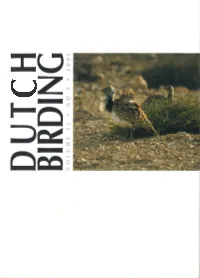
Identification and Ageing of Yellow-Breasted Bunting and Separation from Chestnut Bunting
Identification and ageing of Yellow-breasted Bunting and separation from Chestnut Bunting Jari Peltomäki & Jukka Jantunen ellow-breasted Emberiza aureola and Chest- Poland (5), Spain (1) and Sweden (24+). Chestnut Y nut Buntings E rutila are two species of Bunting is a much rarer vagrant in Europe and its which the breeding and wintering areas are pre- occurrence is clouded by the possibility of dominantly situated in the Eastern Palearctic. The escaped birds. The adult male being a colourful breeding areas of Yellow-breasted Bunting, how- bird, Chestnut Bunting is a popular cagebird and, ever, extend well into the Western Palearctic, therefore, most records from Europe are general- covering large parts of Russia and reaching into ly thought to concern escapes. There are, how- Finland, whereas Chestnut Bunting’s breeding ever, a few records of immature birds ‘at the right areas extend just west of Lake Baikal in Russia. time and the right place’. These autumn occur- Yellow-breasted and Chestnut Buntings are long- rences of first-winter birds, suggestive of genuine distance migrants and winter in south-eastern vagrancy, have been in the Netherlands (5 No- Asia and both species occur as vagrants in (west- vember 1937), Norway (13-15 October 1974), ern) Europe. Yellow-breasted Bunting is a regular Malta (November 1983) and former Yugoslavia vagrant in Europe outside its breeding area with (10 October 1987). Although Vinicombe & Cot- annual records in Britain (mainly on the northern tridge (1996) list Chestnut Bunting as an Eastern isles of