Katherine A. Decker Education Teaching Experience
Total Page:16
File Type:pdf, Size:1020Kb
Load more
Recommended publications
-

An Analysis of Honegger's Cello Concerto
AN ANALYSIS OF HONEGGER’S CELLO CONCERTO (1929): A RETURN TO SIMPLICITY? Denika Lam Kleinmann, B.M., M.M. Dissertation Prepared for the Degree of DOCTOR OF MUSICAL ARTS UNIVERSITY OF NORTH TEXAS May 2014 APPROVED: Eugene Osadchy, Major Professor Clay Couturiaux, Minor Professor David Schwarz, Committee Member Daniel Arthurs, Committee Member John Holt, Chair of the Division of Instrumental Studies James Scott, Dean of the School of Music Mark Wardell, Dean of the Toulouse Graduate School Kleinmann, Denika Lam. An Analysis of Honegger’s Cello Concerto (1929): A Return to Simplicity? Doctor of Musical Arts (Performance), May 2014, 58 pp., 3 tables, 28 examples, 33 references, 15 titles. Literature available on Honegger’s Cello Concerto suggests this concerto is often considered as a composition that resonates with Les Six traditions. While reflecting currents of Les Six, the Cello Concerto also features departures from Erik Satie’s and Jean Cocteau’s ideal for French composers to return to simplicity. Both characteristics of and departures from Les Six examined in this concerto include metric organization, thematic and rhythmic development, melodic wedge shapes, contrapuntal techniques, simplicity in orchestration, diatonicism, the use of humor, jazz influences, and other unique performance techniques. Copyright 2014 by Denika Lam Kleinmann ii TABLE OF CONTENTS Page LIST OF TABLES………………………………………………………………………………..iv LIST OF MUSICAL EXAMPLES………………………………………………………………..v CHAPTER I: INTRODUCTION………..………………………………………………………...1 CHAPTER II: HONEGGER’S -
Repertoire List
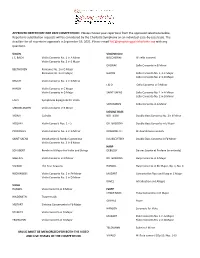
APPROVED REPERTOIRE FOR 2022 COMPETITION: Please choose your repertoire from the approved selections below. Repertoire substitution requests will be considered by the Charlotte Symphony on an individual case-by-case basis. The deadline for all repertoire approvals is September 15, 2021. Please email YAC@symphonyguildcharlotte.org with any questions. VIOLIN VIOLINCELLO J.S. BACH Violin Concerto No. 1 in A Minor BOCCHERINI All cello concerti Violin Concerto No. 2 in E Major DVORAK Cello Concerto in B Minor BEETHOVEN Romance No. 1 in G Major Romance No. 2 in F Major HAYDN Cello Concerto No. 1 in C Major Cello Concerto No. 2 in D Major BRUCH Violin Concerto No. 1 in G Minor LALO Cello Concerto in D Minor HAYDN Violin Concerto in C Major Violin Concerto in G Major SAINT-SAENS Cello Concerto No. 1 in A Minor Cello Concerto No. 2 in D Minor LALO Symphonie Espagnole for Violin SCHUMANN Cello Concerto in A Minor MENDELSSOHN Violin Concerto in E Minor DOUBLE BASS MONTI Czárdás BOTTESINI Double Bass Concerto No. 2in B Minor MOZART Violin Concerti Nos. 1 – 5 DITTERSDORF Double Bass Concerto in E Major PROKOFIEV Violin Concerto No. 2 in G Minor DRAGONETTI All double bass concerti SAINT-SAENS Introduction & Rondo Capriccioso KOUSSEVITSKY Double Bass Concerto in F# Minor Violin Concerto No. 3 in B Minor HARP SCHUBERT Rondo in A Major for Violin and Strings DEBUSSY Danses Sacrée et Profane (in entirety) SIBELIUS Violin Concerto in D Minor DITTERSDORF Harp Concerto in A Major VIVALDI The Four Seasons HANDEL Harp Concerto in Bb Major, Op. -

Cello Concerto in B Minor, Op. 104 ANTONÍN DVORÁK
I believe Prokofiev is the most imaginative orchestrator of all time. He uses the percussion and the special effects of the strings in new and different ways; always tasteful, never too much of any one thing. His Symphony No. 5 is one of the best illustrations of all of that. JANET HALL, NCS VIOLIN Cello Concerto in B Minor, Op. 104 ANTONÍN DVORÁK BORN September 8, 1841, near Prague; died May 1, 1904, in Prague PREMIERE Composed 1894-1895; first performance March 19, 1896, in London, conducted by the composer with Leo Stern as soloist OVERVIEW During the three years that Dvořák was teaching at the National Conservatory of Music in New York City, he was subject to the same emotions as most other travelers away from home for a long time: invigoration and homesickness. America served to stir his creative energies, and during his stay, from 1892 to 1895, he composed some of his greatest scores: the “New World” Symphony, the Op. 96 Quartet (“American”), and the Cello Concerto. He was keenly aware of the new musical experiences to be discovered in the land far from his beloved Bohemia when he wrote, “The musician must prick up his ears for music. When he walks he should listen to every whistling boy, every street singer or organ grinder. I myself am often so fascinated by these people that I can scarcely tear myself away.” But he missed his home and, while he was composing the Cello Concerto, looked eagerly forward to returning. He opened his heart in a letter to a friend in Prague: “Now I am finishing the finale of the Cello Concerto. -
Rep List 1.Pub
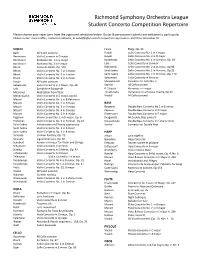
Richmond Symphony Orchestra League Student Concerto Competition Repertoire Please choose your repertoire from the approved selections below. Guitar & percussion students are welcome to participate; Please contact Anne Hoffler, contest coordinator, at aahoffle@vcu.edu for repertoire approval no later than November 30. VIOLIN Faure Elegy, Op. 24 Bach All Violin concerti Haydn Cello Concerto No. 1 in C major Beethoven Violin Concerto in D major Haydn Cello Concerto No. 2 in D major Beethoven Romance No. 1 in G major Kabalevsky Cello Concerto No. 1 in G minor, Op. 49 Beethoven Romance No. 2 in F major Lalo Cello Concerto in D minor Bériot Scéne de Ballet, Op. 100 Rubinstein Cello Concerto No. 2 in D minor, Op.96 Bériot Violin Concerto No. 7 in G major Saint-Saëns Cello Concerto No. 1 in A minor, Op.33 Bériot Violin Concerto No. 9 in A minor Saint-Saëns Cello Concerto No. 2 in D minor, Op. 119 Bruch Violin Concerto No. 1 in G minor Schumann Cello Concerto in A minor Haydn All Violin concerti Shostakovich Concerto for Cello No. 1 Kabalevsky Violin Concerto in C Major, Op. 48 Stamitz All Cello concerti Lalo Symphonie Espagnole R. Strauss Romanze in F major Massenet Méditation from Thaïs Tchaikovsky Variations on a Rococo Theme, Op.33 Mendelssohn Violin Concerto in E minor, Op.64 Vivaldi All Cello concerti Mozart Violin Concerto No. 1 in B-flat major Mozart Violin Concerto No. 2 in D major BASS Mozart Violin Concerto No. 3 in G major Bottesini Double Bass Concerto No.2 in B minor Mozart Violin Concerto No. -

Season 2012-2013
27 Season 2012-2013 Thursday, December 13, at 8:00 The Philadelphia Orchestra Friday, December 14, at 8:00 Saturday, December 15, Gianandrea Noseda Conductor at 8:00 Alisa Weilerstein Cello Borodin Overture to Prince Igor Elgar Cello Concerto in E minor, Op. 85 I. Adagio—Moderato— II. Lento—Allegro molto III. Adagio IV. Allegro—Moderato—[Cadenza]—Allegro, ma non troppo—Poco più lento—Adagio—Allegro molto Intermission Tchaikovsky Symphony No. 3 in D major, Op. 29 (“Polish”) I. Introduzione ed allegro: Moderato assai (tempo di marcia funebre)—Allegro brillante II. Alla tedesca: Allegro moderato e semplice III. Andante elegiaco IV. Scherzo: Allegro vivo V. Finale: Allegro con fuoco (tempo di polacca) This program runs approximately 1 hour, 55 minutes. The December 14 concert is sponsored by Medcomp. 228 Story Title The Philadelphia Orchestra Jessica Griffin Renowned for its distinctive vivid world of opera and Orchestra boasts a new sound, beloved for its choral music. partnership with the keen ability to capture the National Centre for the Philadelphia is home and hearts and imaginations Performing Arts in Beijing. the Orchestra nurtures of audiences, and admired The Orchestra annually an important relationship for an unrivaled legacy of performs at Carnegie Hall not only with patrons who “firsts” in music-making, and the Kennedy Center support the main season The Philadelphia Orchestra while also enjoying a at the Kimmel Center for is one of the preeminent three-week residency in the Performing Arts but orchestras in the world. Saratoga Springs, N.Y., and also those who enjoy the a strong partnership with The Philadelphia Orchestra’s other area the Bravo! Vail Valley Music Orchestra has cultivated performances at the Mann Festival. -

Bernard Rands Cello Concerto No. 1
PROGRAM NOTES by Phillip Huscher Bernard Rands Born March 2, 1934, Sheffield, England. Currently resides in Boston, Massachusetts, and Chicago, Illinois. Cello Concerto No. 1 Rands composed this cello concerto in 1996, on a commission from the Boston Symphony Orchestra for the seventieth birthday of Mstislav Rostropovich, to whom it is dedicated. The first performances were given by Rostropovich and the Boston Symphony, with Seiji Ozawa conducting, on April 3, 4, and 5, 1997, at Symphony Hall in Boston. The orchestra consists of three flutes, two alto flutes and piccolo, two oboes and english horn, two clarinets and bass clarinet, two bassoons and contrabassoon, four horns, three trumpets, three trombones and tuba, two harps, piano, timpani, percussion (vibraphone, marimba, xylophone, glockenspiel, tubular bells, bongos, triangle, medium and large tam-tams, bass drum, almglocken), and strings. Performance time is approximately twenty-seven minutes. Concertos are often written for a particular performer. Sometimes that player is the composer himself, writing for his own instrument—Mozart, Beethoven, Liszt, Brahms, Bartók, and Stravinsky, for example, all composed piano concertos which they introduced themselves. Many concertos were written for virtuoso soloists—Brahms’s Violin Concerto was composed for Joseph Joachim and Elgar’s for Fritz Kreisler; Copland’s Clarinet Concerto was designed with Benny Goodman in mind; Ravel’s Left-Hand Piano Concerto was written on a commission from Paul Wittgenstein, who had lost his right arm in World War I. Like Britten’s Symphony for Cello and Orchestra and Shostakovich’s First Cello Concerto, this cello concerto by Bernard Rands was composed for Mstislav Rostropovich, one of the most formidable performers of our time. -
Audition Repertoire, Please Contact the Music Department at 812.941.2655 Or by E-Mail at AUDITION REQUIREMENTS for VARIOUS DEGREE CONCENTRATIONS
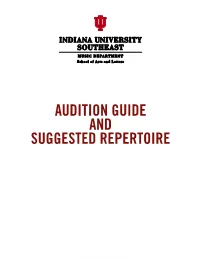
1 AUDITION GUIDE AND SUGGESTED REPERTOIRE 1 2 TABLE OF CONTENTS AUDITION REQUIREMENTS AND GUIDE . 3 SUGGESTED REPERTOIRE Piano/Keyboard . 5 STRINGS Violin . 6 Viola . 7 Cello . 8 String Bass . 10 WOODWINDS Flute . 12 Oboe . 13 Bassoon . 14 Clarinet . 15 Alto Saxophone . 16 Tenor Saxophone . 17 BRASS Trumpet/Cornet . 18 Horn . 19 Trombone . 20 Euphonium/Baritone . 21 Tuba/Sousaphone . 21 PERCUSSION Drum Set . 23 Xylophone-Marimba-Vibraphone . 23 Snare Drum . 24 Timpani . 26 Multiple Percussion . 26 Multi-Tenor . 27 VOICE Female Voice . 28 Male Voice . 30 Guitar . 33 2 3 The repertoire lists which follow should be used as a guide when choosing audition selections. There are no required selections. However, the following lists illustrate Students wishing to pursue the Instrumental or Vocal Performancethe genres, styles, degrees and difficulty are strongly levels encouraged of music that to adhereis typically closely expected to the of repertoire a student suggestionspursuing a music in this degree. list. Students pursuing the Sound Engineering, Music Business and Music Composition degrees may select repertoire that is slightly less demanding, but should select compositions that are similar to the selections on this list. If you have semusic@ius.edu questions about. this list or whether or not a specific piece is acceptable audition repertoire, please contact the Music Department at 812.941.2655 or by e-mail at AUDITION REQUIREMENTS FOR VARIOUS DEGREE CONCENTRATIONS All students applying for admission to the Music Department must complete a performance audition regardless of the student’s intended degree concentration. However, the performance standards and appropriaterequirements audition do vary repertoire.depending on which concentration the student intends to pursue. -

In Short Tortheater in Vienna
Cello Concerto in C major, Hob. VIIb:1 Joseph Haydn t is more than a little ironic that Haydn’s deposited in the National Museum of Prague. Isplendid Cello Concerto in C major, which The parts were uncovered there by musicol- is today one his most popular concertos, lay ogist Oldřich Pulkert as recently as 1961. in oblivion for almost two centuries. Haydn In the first movement, this work unrolls at did enter it in his Entwurf-Katalog (Draft a spacious pace, without calling attention to Catalogue), an inventory he began around the considerable virtuosity required for its ex- 1765, so the piece must have been written by ecution. Pairs of oboes and horns add body to that year at the latest. This was therefore a the tutti sections, although Haydn limits the work of the composer’s first years at the Es- accompaniment to a string orchestra when terházy Court, which makes sense given the the cello is playing. The wisdom of his deci- prominent solo-cello writing he employed sion to keep the textures light is confirmed in some of his other pieces of that time; the by later cello concertos (by other composers) well-known Symphonies Nos. 6–8 come im- in which the soloist can be seen playing but mediately to mind, as well as the Sympho- can scarcely be heard. Of course, problems nies Nos. 13, 31, 36, and 72 — all, despite their of balance between soloist and orchestra are eventual numbering, from 1765 or earlier. considerably reduced when the “symphonic” The cellist all these works were meant to forces are hardly larger than a chamber group spotlight was Joseph Franz Weigl, one of — as they were when this piece was new. -

Kenneth Woods- Repertoire
Kenneth Woods- Conductor Orchestral Repertoire Operatic repertoire follows below Adam, Adolpe: Giselle (complete ballet staged) Adams, John Violin Concerto Arnold, Malcolm: Serenade for Guitar and Strings Concerto for Guitar Scottish Dances Applebaum, Edward: Symphony No. 4 Bach, J.S.: St. John Passion St. Matthew Passion Christmas Oratorio Magnificat Cantata Wachet auf, ruft uns die Stimme BWV 140 Brandenberg Concerti, No.’s 1, 3, 4 and 5 Violin Concerti in A minor and E major Concerto for Two Violins Concerto for Violin and Oboe Orchestral Suite No. 2 in B minor Bacewicz, Grażyna Concerto for String Orchestra Barber, Samuel: Prayer of Kirkegarde Overture to “The School for Scandal” Adagio for Strings Violin Concerto Cello Concerto First Essay Medea’s Meditation and Dance of Vengeance Bartók, Bela: Divertimento for Strings Concerto for Orchestra Two Portraits Violin Concerto No. 2 Piano Concerti No.’s 2 and 3 Viola Concerto Miraculous Mandarin (Complete and Suite) Beethoven, Ludwig van: Symphonies No.’s 1-9 Mass in C Major Overtures: Coriolan, Leonore 1, 2 and 3, Fidelio, Egmont, Creatures of Prometheus, King Stephen Incidental Music to “Egmont” Piano Concerti No.’s 1-5 Kenneth Woods- conductor www.kennethwoods.net Violin Concerto Triple Concerto String Quartet in F minor op. 95, “Serioso,” arr. Gustav Mahler Leonore Overture No. 3 arr. Gustav Mahler Berg, Alban: Three Orchestra Pieces Kammerkonzert Violin Concerto Berio, Luciano: Folk Songs Serenata I for Flute and 14 Intruments Berlioz, Hector: Harold in Italy Symphonie Fantastique Damnation of Faust Overtures: Benvenuto Cellini, Roman Carnival, Corsaire, Beatrice and Benedict Te Deum Bernstein, Leonard: Overture to Candide Symphonic Dances from West Side Story Symphony No. -

Norfolk Chamber Music Festival Also Has an Generous and Committed Support of This Summer’S Season
Welcome To The Festival Welcome to another concerts that explore different aspects of this theme, I hope that season of “Music you come away intrigued, curious, and excited to learn and hear Among Friends” more. Professor Paul Berry returns to give his popular pre-concert at the Norfolk lectures, where he will add depth and context to the theme Chamber Music of the summer and also to the specific works on each Friday Festival. Norfolk is a evening concert. special place, where the beauty of the This summer we welcome violinist Martin Beaver, pianist Gilbert natural surroundings Kalish, and singer Janna Baty back to Norfolk. You will enjoy combines with the our resident ensemble the Brentano Quartet in the first two sounds of music to weeks of July, while the Miró Quartet returns for the last two create something truly weeks in July. Familiar returning artists include Ani Kavafian, magical. I’m pleased Melissa Reardon, Raman Ramakrishnan, David Shifrin, William that you are here Purvis, Allan Dean, Frank Morelli, and many others. Making to share in this their Norfolk debuts are pianist Wendy Chen and oboist special experience. James Austin Smith. In addition to I and the Faculty, Staff, and Fellows are most grateful to Dean the concerts that Blocker, the Yale School of Music, the Ellen Battell Stoeckel we put on every Trust, the donors, patrons, volunteers, and friends for their summer, the Norfolk Chamber Music Festival also has an generous and committed support of this summer’s season. educational component, in which we train the most promising Without the help of so many dedicated contributors, this festival instrumentalists from around the world in the art of chamber would not be possible. -

DVOŘÁK Cello Concerto in B Minor, Op
CONCERT PROGRAM Friday, October 14, 2016, 8:00pm Saturday, October 15, 2016, 8:00pm Sunday, October 16, 2016, 3:00pm Hannu Lintu, conductor Alban Gerhardt, cello LUTOSŁAWSKI Chain 3 (1986) (1913-1994) DVOŘÁK Cello Concerto in B minor, op. 104 (1895) (1841-1904) Allegro Adagio, ma non troppo Finale: Allegro moderato Alban Gerhardt, cello INTERMISSION STRAVINSKY Petrushka (1947 version) (1882-1971) The Shrove-Tide Fair— Petrushka— The Moor— The Shrove-Tide Fair and the Death of Petrushka Peter Henderson, piano 23 ACKNOWLEDGMENTS These concerts are part of the Wells Fargo Advisors Orchestral Series. Hannu Lintu is the Essman Family Foundation Guest Artist. Alban Gerhardt is the Jean L. Rainwater Guest Artist. The concert of Friday, October 14, is underwritten in part by a generous gift from Margaret P. Gilleo and Charles J. Guenther, Jr. The concert of Saturday, October 15, is underwritten in part by a generous gift from Mr. and Mrs. Walter J. Galvin. The concert of Sunday, October 16, is underwritten in part by a generous gift from Ted and Robbie Beaty, in memory of Derek S. Beaty. Pre-Concert Conversations are sponsored by Washington University Physicians. Large print program notes are available through the generosity of the Delmar Gardens Family, and are located at the Customer Service table in the foyer. 24 CONCERT CALENDAR For tickets call 314-534-1700, visit stlsymphony.org, or use the STL Symphony free mobile app available on iTunes or android. SYMPHONIC DANCES: Fri, Oct 21, 8:00pm Sat, Oct 22, 8:00pm | Sun, Oct 23, 3:00pm Cristian Macelaru, conductor; Orli Shaham, piano BALAKIREV Islamey BEETHOVEN Piano Concerto No. -

Oboe Audition Repertoire and Orchestral Excerpts Master of Music (Orchestral Performance)
oboe audition repertoire and orchestral excerpts Master of Music (Orchestral Performance) Audition work Mozart: Oboe Concerto in C major, K. 314, first movement with cadenza Composer Work Page bartok Concerto for Orchestra Excerpt 1 3 brahms Variations on a theme of Haydn Excerpt 1 4 dvořák Cello Concerto Excerpt 1 5 dvořák Symphony no. 7 Excerpt 1 5 mussorgsky/ravel Pictures at an Exhibition Excerpt 1 6 ravel Daphnis and Chloé Excerpt 1 7 Excerpt 2 8 Excerpt 3 9 rossini La Scala di Seta: Overture Excerpt 1 10 smetana The Bartered Bride: Overture Excerpt 1 11 tchaikovsky Romeo and Juliet: Fantasy Overture Excerpt 1 12 Cor anglais excerpts*: dvořák Symphony no. 9 Excerpt 1 13 ravel Piano Concerto in G major Excerpt 1 14 rossini William Tell: Overture Excerpt 1 15 * Cor anglais excerpts are not compulsory. However, candidates may opt to strengthen their application by performing all of the excerpts associated with a secondary instrument. Page intentionally blank 2 bartók Concerto for Orchestra Second Movement (Presentando le coppie) excerpt 1 AlleGretto scherzando (q = 74) 3 brahms Variations on a Theme by Haydn, op. 56a Theme excerpt 1 Andante ( q = 56) 4 dvořák Cello Concerto in B minor, op. 104 Second movement excerpt 1 AdaGio ma non troppo (e = 108) dvořák Symphony no. 7 in D minor, op. 70 Oboe 2 Second movement excerpt 1 Poco adaGio (q = 52) 5 mussorgsky/ravel Pictures at an Exhibition Oboe 2 V. Ballet des Poussins dans leurs Coques excerpt 1 Scherzino, vivo leGGiero (h = 92) ☞ ] 6 ravel Daphnis and Chloé Oboe 2 excerpt 1: q = 200 ☞ [ 7 excerpt 2: q = 160 ☞ 8 excerpt 3: h = 144 ☞ ] ☞ ] 9 rossini La Scala di Seta: Overture excerpt 1 AlleGro vivace h = 138 [ ] [ ] 10 smetana The Bartered Bride: Overture excerpt 1 h = 152 [ ] [ ] [ ] [ ] 11 tchaikovsky Romeo and Juliet Fantasy Overture excerpt 1 h = 60 12 dvořák Symphony no.