Big Chetac and Birch Lakes, Sawyer/Washburn County
Total Page:16
File Type:pdf, Size:1020Kb
Load more
Recommended publications
-

Natural Heritage Program List of Rare Plant Species of North Carolina 2016
Natural Heritage Program List of Rare Plant Species of North Carolina 2016 Revised February 24, 2017 Compiled by Laura Gadd Robinson, Botanist John T. Finnegan, Information Systems Manager North Carolina Natural Heritage Program N.C. Department of Natural and Cultural Resources Raleigh, NC 27699-1651 www.ncnhp.org C ur Alleghany rit Ashe Northampton Gates C uc Surry am k Stokes P d Rockingham Caswell Person Vance Warren a e P s n Hertford e qu Chowan r Granville q ot ui a Mountains Watauga Halifax m nk an Wilkes Yadkin s Mitchell Avery Forsyth Orange Guilford Franklin Bertie Alamance Durham Nash Yancey Alexander Madison Caldwell Davie Edgecombe Washington Tyrrell Iredell Martin Dare Burke Davidson Wake McDowell Randolph Chatham Wilson Buncombe Catawba Rowan Beaufort Haywood Pitt Swain Hyde Lee Lincoln Greene Rutherford Johnston Graham Henderson Jackson Cabarrus Montgomery Harnett Cleveland Wayne Polk Gaston Stanly Cherokee Macon Transylvania Lenoir Mecklenburg Moore Clay Pamlico Hoke Union d Cumberland Jones Anson on Sampson hm Duplin ic Craven Piedmont R nd tla Onslow Carteret co S Robeson Bladen Pender Sandhills Columbus New Hanover Tidewater Coastal Plain Brunswick THE COUNTIES AND PHYSIOGRAPHIC PROVINCES OF NORTH CAROLINA Natural Heritage Program List of Rare Plant Species of North Carolina 2016 Compiled by Laura Gadd Robinson, Botanist John T. Finnegan, Information Systems Manager North Carolina Natural Heritage Program N.C. Department of Natural and Cultural Resources Raleigh, NC 27699-1651 www.ncnhp.org This list is dynamic and is revised frequently as new data become available. New species are added to the list, and others are dropped from the list as appropriate. -
Biological Evaluation for US Trunk Highway 2 Passing Lane and Turn Lane Improvements
Draft Biological Evaluation for US Trunk Highway 2 Passing Lane and Turn Lane Improvements Prepared by: Minnesota Department of Transportation Prepared for: US Forest Service, Chippewa National Forest Minnesota Department of Natural Resources May 2014 US Highwy 2 Passing Lane and Turn Lane Improvements Biological Evaluation This Biological Evaluation was prepared pursuant to the National Environmental Policy Act, National Forest Management Act, and other applicable laws and regulations. For additional information, please contact the team leader for the US Trunk Highway 2 Passing Lane and Turn Lane Improvements Project. Ms. Christine Brown Chippewa National Forest Address: 200 Ash Avenue NW Cass Lake, MN 56633 Phone: (218) 335-8600 TTY: (218) 335-8632 FAX: (218)335-8637 Prepared by: ______________________________________ _______________ Antony Randazzo, HDR Engineering, Inc. Date Reviewed by: ______________________________________ _______________ Kirk W. Larson, U.S. Forest Service Date Chippewa National Forest Reviewed by: ______________________________________ _______________ Cory Mlodik, U.S. Forest Service Date Chippewa National Forest May 2014 Signature Page Page i US Highwy 2 Passing Lane and Turn Lane Improvements Biological Evaluation Table of Contents 1.0 Introduction ............................................................................................................................ 1-1 1.1 Purpose of this Report .............................................................................................................................. -

State of New York City's Plants 2018
STATE OF NEW YORK CITY’S PLANTS 2018 Daniel Atha & Brian Boom © 2018 The New York Botanical Garden All rights reserved ISBN 978-0-89327-955-4 Center for Conservation Strategy The New York Botanical Garden 2900 Southern Boulevard Bronx, NY 10458 All photos NYBG staff Citation: Atha, D. and B. Boom. 2018. State of New York City’s Plants 2018. Center for Conservation Strategy. The New York Botanical Garden, Bronx, NY. 132 pp. STATE OF NEW YORK CITY’S PLANTS 2018 4 EXECUTIVE SUMMARY 6 INTRODUCTION 10 DOCUMENTING THE CITY’S PLANTS 10 The Flora of New York City 11 Rare Species 14 Focus on Specific Area 16 Botanical Spectacle: Summer Snow 18 CITIZEN SCIENCE 20 THREATS TO THE CITY’S PLANTS 24 NEW YORK STATE PROHIBITED AND REGULATED INVASIVE SPECIES FOUND IN NEW YORK CITY 26 LOOKING AHEAD 27 CONTRIBUTORS AND ACKNOWLEGMENTS 30 LITERATURE CITED 31 APPENDIX Checklist of the Spontaneous Vascular Plants of New York City 32 Ferns and Fern Allies 35 Gymnosperms 36 Nymphaeales and Magnoliids 37 Monocots 67 Dicots 3 EXECUTIVE SUMMARY This report, State of New York City’s Plants 2018, is the first rankings of rare, threatened, endangered, and extinct species of what is envisioned by the Center for Conservation Strategy known from New York City, and based on this compilation of The New York Botanical Garden as annual updates thirteen percent of the City’s flora is imperiled or extinct in New summarizing the status of the spontaneous plant species of the York City. five boroughs of New York City. This year’s report deals with the City’s vascular plants (ferns and fern allies, gymnosperms, We have begun the process of assessing conservation status and flowering plants), but in the future it is planned to phase in at the local level for all species. -

HABITAT MANAGEMENT PLAN Green Bay and Gravel Island
HABITAT MANAGEMENT PLAN Green Bay and Gravel Island National Wildlife Refuges October 2017 Habitat Management Plans provide long-term guidance for management decisions; set forth goals, objectives, and strategies needed to accomplish refuge purposes; and, identify the Fish and Wildlife Service’s best estimate of future needs. These plans detail program planning levels that are sometimes substantially above current budget allocations and as such, are primarily for Service strategic planning and program prioritization purposes. The plans do not constitute a commitment for staffing increases, operational and maintenance increases, or funding for future land acquisition. The National Wildlife Refuge System, managed by the U.S. Fish and Wildlife Service, is the world's premier system of public lands and waters set aside to conserve America's fish, wildlife, and plants. Since the designation of the first wildlife refuge in 1903, the System has grown to encompass more than 150 million acres, 556 national wildlife refuges and other units of the Refuge System, plus 38 wetland management districts. This page intentionally left blank. Habitat Management Plan for Green Bay and Gravel Island National Wildlife Refuges EXECUTIVE SUMMARY This Habitat Management Plan (HMP) provides vision and specific guidance on enhancing and managing habitat for the resources of concern (ROC) at the refuge. The contributions of the refuge to ecosystem- and landscape-scale wildlife and biodiversity conservation, specifically migratory waterfowl, are incorporated into this HMP. The HMP is intended to provide habitat management direction for the next 15 years. The HMP is also needed to ensure that the refuge continues to conserve habitat for migratory birds in the context of climate change, which affects all units of the National Wildlife Refuge System. -

Natural Heritage Program List of Rare Plant Species of North Carolina 2012
Natural Heritage Program List of Rare Plant Species of North Carolina 2012 Edited by Laura E. Gadd, Botanist John T. Finnegan, Information Systems Manager North Carolina Natural Heritage Program Office of Conservation, Planning, and Community Affairs N.C. Department of Environment and Natural Resources 1601 MSC, Raleigh, NC 27699-1601 Natural Heritage Program List of Rare Plant Species of North Carolina 2012 Edited by Laura E. Gadd, Botanist John T. Finnegan, Information Systems Manager North Carolina Natural Heritage Program Office of Conservation, Planning, and Community Affairs N.C. Department of Environment and Natural Resources 1601 MSC, Raleigh, NC 27699-1601 www.ncnhp.org NATURAL HERITAGE PROGRAM LIST OF THE RARE PLANTS OF NORTH CAROLINA 2012 Edition Edited by Laura E. Gadd, Botanist and John Finnegan, Information Systems Manager North Carolina Natural Heritage Program, Office of Conservation, Planning, and Community Affairs Department of Environment and Natural Resources, 1601 MSC, Raleigh, NC 27699-1601 www.ncnhp.org Table of Contents LIST FORMAT ......................................................................................................................................................................... 3 NORTH CAROLINA RARE PLANT LIST ......................................................................................................................... 10 NORTH CAROLINA PLANT WATCH LIST ..................................................................................................................... 71 Watch Category -
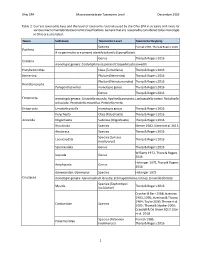
Ohio EPA Macroinvertebrate Taxonomic Level December 2019 1 Table 1. Current Taxonomic Keys and the Level of Taxonomy Routinely U
Ohio EPA Macroinvertebrate Taxonomic Level December 2019 Table 1. Current taxonomic keys and the level of taxonomy routinely used by the Ohio EPA in streams and rivers for various macroinvertebrate taxonomic classifications. Genera that are reasonably considered to be monotypic in Ohio are also listed. Taxon Subtaxon Taxonomic Level Taxonomic Key(ies) Species Pennak 1989, Thorp & Rogers 2016 Porifera If no gemmules are present identify to family (Spongillidae). Genus Thorp & Rogers 2016 Cnidaria monotypic genera: Cordylophora caspia and Craspedacusta sowerbii Platyhelminthes Class (Turbellaria) Thorp & Rogers 2016 Nemertea Phylum (Nemertea) Thorp & Rogers 2016 Phylum (Nematomorpha) Thorp & Rogers 2016 Nematomorpha Paragordius varius monotypic genus Thorp & Rogers 2016 Genus Thorp & Rogers 2016 Ectoprocta monotypic genera: Cristatella mucedo, Hyalinella punctata, Lophopodella carteri, Paludicella articulata, Pectinatella magnifica, Pottsiella erecta Entoprocta Urnatella gracilis monotypic genus Thorp & Rogers 2016 Polychaeta Class (Polychaeta) Thorp & Rogers 2016 Annelida Oligochaeta Subclass (Oligochaeta) Thorp & Rogers 2016 Hirudinida Species Klemm 1982, Klemm et al. 2015 Anostraca Species Thorp & Rogers 2016 Species (Lynceus Laevicaudata Thorp & Rogers 2016 brachyurus) Spinicaudata Genus Thorp & Rogers 2016 Williams 1972, Thorp & Rogers Isopoda Genus 2016 Holsinger 1972, Thorp & Rogers Amphipoda Genus 2016 Gammaridae: Gammarus Species Holsinger 1972 Crustacea monotypic genera: Apocorophium lacustre, Echinogammarus ischnus, Synurella dentata Species (Taphromysis Mysida Thorp & Rogers 2016 louisianae) Crocker & Barr 1968; Jezerinac 1993, 1995; Jezerinac & Thoma 1984; Taylor 2000; Thoma et al. Cambaridae Species 2005; Thoma & Stocker 2009; Crandall & De Grave 2017; Glon et al. 2018 Species (Palaemon Pennak 1989, Palaemonidae kadiakensis) Thorp & Rogers 2016 1 Ohio EPA Macroinvertebrate Taxonomic Level December 2019 Taxon Subtaxon Taxonomic Level Taxonomic Key(ies) Informal grouping of the Arachnida Hydrachnidia Smith 2001 water mites Genus Morse et al. -

Dytiscidae and Noteridae of Wisconsin (Coleoptera). VI
The Great Lakes Entomologist Volume 28 Number 1 - Spring 1995 Number 1 - Spring 1995 Article 1 April 1995 Dytiscidae and Noteridae of Wisconsin (Coleoptera). VI. Distribution, Habitat, Life Cycle, and Identification of Species of Hydroporus Clairville Sensu Lato (Hydroporinae) William L. Hilsenhoff University of Wisconsin Follow this and additional works at: https://scholar.valpo.edu/tgle Part of the Entomology Commons Recommended Citation Hilsenhoff, William L. 1995. "Dytiscidae and Noteridae of Wisconsin (Coleoptera). VI. Distribution, Habitat, Life Cycle, and Identification of Species of Hydroporus Clairville Sensu Lato (Hydroporinae)," The Great Lakes Entomologist, vol 28 (1) Available at: https://scholar.valpo.edu/tgle/vol28/iss1/1 This Peer-Review Article is brought to you for free and open access by the Department of Biology at ValpoScholar. It has been accepted for inclusion in The Great Lakes Entomologist by an authorized administrator of ValpoScholar. For more information, please contact a ValpoScholar staff member at scholar@valpo.edu. Hilsenhoff: Dytiscidae and Noteridae of Wisconsin (Coleoptera). VI. Distribut 1995 THE GREAT LAKES ENTOMOlOGIST DYTISCIDAE AND NOTERIDAE OF WISCONSII\J (COLEOPTERA). VI. DISTRIBUTION, HABITAT, LIFE CYCLE, AND IDENTIFICATION OF SPECIES OF HYDROPORUS CLAIRVILLE SENSU LATO! (HYDROPORINAE) William L. Hilsenhoff2 ABSTRACT Thirty-four species ofHydroporus s.l. were collected in Wisconsin over the past 32 years, including 20 of Hydroporus s.s., 7 of Neoporus, 4 of Hydroporus oblitus-group, 2 of Heterosternuta, and 1 of Sanfilippodytes. Species keys and notes on identification are provided for adults of species that occur or may occur in Wisconsin. Information on distribution and abundance in Wisconsin, habitat, and life cycle is provided for each species based on a study of 27,310 adults. -

DE Wildlife Action Plan
DelawareDelaware WildlifeWildlife ActionAction PlanPlan Keeping Today’s Wildlife from Becoming Tomorrow’s Memory Delaware Department of Natural Resources and Environmental Control Division of Fish and Wildlife 89 King Highway Dover, Delaware 19901 www.dnrec@delaware.gov Delaware Wildlife Action Plan 2007 - 2017 Submitted to: U.S. Fish and Wildlife Service 300 Westgate Center Drive Hadley, MA 01035-9589 September, 2006 Submitted by: Olin Allen, Biologist Brianna Barkus, Outreach Coordinator Karen Bennett, Program Manager Cover Photos by: Chris Bennett, Chuck Fullmer, Mike Trumabauer, DE Div. of Fish & Wildlife Delaware Natural Heritage and Endangered Species Program Delaware Division of Fish and Wildlife Delaware Department of Natural Resources and Environmental Control 89 Kings Highway Dover DE 19901 Delaware Wildlife Action Plan Acknowledgements This project was funded, in part, through grants from the Delaware Division of Fish & Wildlife with funding from the Division of Federal Assistance, United States Fish & Wildlife Service under the State Wildlife Grants Program; and the Delaware Coastal Programs with funding from the Office of Ocean and Coastal Resource Management, National Oceanic and Atmospheric Administration under award number NA17OZ2329. We gratefully acknowledge the participation of the following individuals: Jen Adkins Sally Kepfer NV Raman Chris Bennett Gary Kreamer Ken Reynolds Melinda Carl Annie Larson Ellen Roca John Clark Wayne Lehman Bob Rufe Rick Cole Jeff Lerner Tom Saladyga Robert Coxe Rob Line Craig Shirey Janet -

Delaware's Wildlife Species of Greatest Conservation Need
CHAPTER 1 DELAWARE’S WILDLIFE SPECIES OF GREATEST CONSERVATION NEED CHAPTER 1: Delaware’s Wildlife Species of Greatest Conservation Need Contents Introduction ................................................................................................................................................... 7 Regional Context ........................................................................................................................................... 7 Delaware’s Animal Biodiversity .................................................................................................................... 10 State of Knowledge of Delaware’s Species ................................................................................................... 10 Delaware’s Wildlife and SGCN - presented by Taxonomic Group .................................................................. 11 Delaware’s 2015 SGCN Status Rank Tier Definitions................................................................................. 12 TIER 1 .................................................................................................................................................... 13 TIER 2 .................................................................................................................................................... 13 TIER 3 .................................................................................................................................................... 13 Mammals .................................................................................................................................................... -

Species Diversity Report George Washington National Forest Draft EIS April 2011
Appendix F - Species Diversity Report George Washington National Forest Draft EIS April 2011 U.S. Department of Agriculture Forest Service Southern Region Species Diversity Report George Washington National Forest April 2011 Appendix F - Species Diversity Report George Washington National Forest Draft EIS April 2011 Table of Contents Table of Contents ........................................................................................................................... i 1.0 Introduction ............................................................................................................................ 5 2.0 Species Diversity..................................................................................................................... 5 2.1 Ecosystem Context for Species ............................................................................................ 5 2.2 Identification and Screening of Species ............................................................................... 6 3.0 Threatened and Endangered Species ................................................................................... 7 3.1 Threatened and Endangered Species List ............................................................................ 7 3.2 Threatened and Endangered Species Descriptions and Plan Components .......................... 8 3.2.1 Indiana Bat ........................................................................................................................ 8 3.2.2 Virginia Big-Eared Bat .................................................................................................. -

Wisconsin's Strategy for Wildlife Species of Greatest Conservation Need
Prepared by Wisconsin Department of Natural Resources with Assistance from Conservation Partners Natural Resources Board Approved August 2005 U.S. Fish & Wildlife Acceptance September 2005 Wisconsin’s Strategy for Wildlife Species of Greatest Conservation Need Governor Jim Doyle Natural Resources Board Gerald M. O’Brien, Chair Howard D. Poulson, Vice-Chair Jonathan P Ela, Secretary Herbert F. Behnke Christine L. Thomas John W. Welter Stephen D. Willet Wisconsin Department of Natural Resources Scott Hassett, Secretary Laurie Osterndorf, Division Administrator, Land Paul DeLong, Division Administrator, Forestry Todd Ambs, Division Administrator, Water Amy Smith, Division Administrator, Enforcement and Science Recommended Citation: Wisconsin Department of Natural Resources. 2005. Wisconsin's Strategy for Wildlife Species of Greatest Conservation Need. Madison, WI. “When one tugs at a single thing in nature, he finds it attached to the rest of the world.” – John Muir The Wisconsin Department of Natural Resources provides equal opportunity in its employment, programs, services, and functions under an Affirmative Action Plan. If you have any questions, please write to Equal Opportunity Office, Department of Interior, Washington D.C. 20240. This publication can be made available in alternative formats (large print, Braille, audio-tape, etc.) upon request. Please contact the Wisconsin Department of Natural Resources, Bureau of Endangered Resources, PO Box 7921, Madison, WI 53707 or call (608) 266-7012 for copies of this report. Pub-ER-641 2005 -

Phylogenetic Relationships and Larval Morphology of the Recently Described Diving Beetle Genus Laccomimus (Coleoptera: Dytiscidae: Laccophilinae)
Eur. J. Entomol. 112(4): 831–843, 2015 doi: 10.14411/eje.2015.085 ISSN 1210-5759 (print), 1802-8829 (online) Phylogenetic relationships and larval morphology of the recently described diving beetle genus Laccomimus (Coleoptera: Dytiscidae: Laccophilinae) MARIANO C. MICHAT 1 and MARIO TOLEDO 2 1 IBBEA, CONICET-UBA, Laboratory of Entomology, DBBE-FCEN, University of Buenos Aires, Argentina; e-mail: marianoide@gmail.com 2 Museo di Storia Naturale, Università di Parma, via Farini 90, 43100 Parma, Italy; e-mail: toledo.pinguicula.mario3@gmail.com Key words. Coleoptera, Dytiscidae, Laccophilini, Laccomimus, larva, morphometry, chaetotaxy, ground plan, phylogeny Abstract. The larvae of the diving beetle genus Laccomimus Toledo & Michat, 2015 (Laccophilinae) are studied for the first time, based on detailed descriptions and illustrations of all instars of L. distinctus Toledo & Michat, 2015, with particular emphasis on mor- phometry and chaetotaxy. The phylogenetic relationships of this genus within the tribe Laccophilini are analyzed cladistically. Lac- comimus is recovered as part of a clade that includes the genera Australphilus Watts, 1978, Neptosternus Sharp, 1882 and Laccophilus Leach, 1815 and is characterized by the presence of natatory setae on the tibia and tarsus, and within this clade it is a sister to the other genera. Third-instar larvae of Laccomimus and Africophilus Guignot, 1948 share the mediodistal insertion of the seta CO7 on the meso- and metacoxa, a short and spine-like seta TI6 on the metatibia, a ventrally sclerotized abdominal segment V and a short urogom- phus. These characters are considered plesiomorphic and indicate a basal position of both genera within the Laccophilini.