Asia and the World Economy in Historical Perspective
Total Page:16
File Type:pdf, Size:1020Kb
Load more
Recommended publications
-

The International History Bee and Bowl Asian Division Study Guide!
The International History Bee and Bowl Asian Division Study Guide Welcome to the International History Bee and Bowl Asian Division Study Guide! To make the Study Guide, we divided all of history into 5 chapters: Middle Eastern and South Asian History, East and Southeast Asian History, US American History, World History (everything but American and Asian) to 1789, and World History from 1789-present. There may also be specific questions about the history of each of the countries where we will hold tournaments. A list of terms to be familiar with for each country is included at the end of the guide, but in that section, just focus on the country where you will be competing at your regional tournament (at least until the Asian Championships). Terms that are in bold should be of particular focus for our middle school division, though high school competitors should be familiar with these too. This guide is not meant to be a complete compendium of what information may come up at a competition, but it should serve as a starting off point for your preparations. Certainly there are things that can be referenced at a tournament that are not in this guide, and not everything that is in this guide will come up. At the end of the content portion of the guide, some useful preparation tips are outlined as well. Finally, we may post additional study materials, sample questions, and guides to the website at www.ihbbasia.com over the course of the year. Should these become available, we will do our best to notify all interested schools. -

Colonial Transformation and Asian Religions in Modern History
Colonial Transformation and Asian Religions in Modern History Colonial Transformation and Asian Religions in Modern History Edited by David W. Kim Colonial Transformation and Asian Religions in Modern History Edited by David W. Kim This book first published 2018 Cambridge Scholars Publishing Lady Stephenson Library, Newcastle upon Tyne, NE6 2PA, UK British Library Cataloguing in Publication Data A catalogue record for this book is available from the British Library Copyright © 2018 by David W. Kim and contributors All rights for this book reserved. No part of this book may be reproduced, stored in a retrieval system, or transmitted, in any form or by any means, electronic, mechanical, photocopying, recording or otherwise, without the prior permission of the copyright owner. ISBN (10): 1-5275-0559-6 ISBN (13): 978-1-5275-0559-9 CONTENTS List of Tables and Figures ......................................................................... vii Acknowledgements .................................................................................... ix Preface ........................................................................................................ xi Introduction ................................................................................................. 1 Part One: South Asia Chapter One ............................................................................................... 10 From Colony to Post-Colony: Animal Baiting and Religious Festivals in South Punjab, Pakistan Muhammad Amjad Kavesh Chapter Two ............................................................................................. -

History of Asia Collection.Pdf
The Asia Collection, University of Hawaii at Manoa: a History of its Chinese, Japanese, and Korean Collections By Allen J. Riedy, in collaboration with Tokiko Y. Bazzell, Kuang-Tien Yao, and Daniel C. Kane * Introduction to Asia Collection From the earliest decades following the arrival of Captain Cook in 1778 to its shores, Hawaii became a land connected to Asia. By the late 18 th century merchants and traders from New England, Russia and Europe were using the islands as a convenient stopover on their way to the mythically fabulous China market. Later Hawaii’s sandalwood forests became a stock in trade for the China market. The sandalwood forests disappeared; whalers arrived and Hawaii became a center of East-West commerce. By the mid-19 th century with whaling in decline and the ancient Hawaii land system dismantled, the descendants of the earliest American missionaries to the Islands, turned the land into a vast plantation. Hungry for labor, they imported an army of agricultural laborers from China, Japan, Korea, and the Philippines. By the turn of the century Hawaii’s population was 75% Asian. As the descendants of immigrant plantation workers migrated to town, the demand for education to compete for jobs increased. Public schools and an extensive system of religious and ethnic private schools both integrated the recent arrivals’ children into the larger society giving them needed skills to compete in an urban economy and helped preserve the heritage of the homeland. By the late 19 th century demands for schooling beyond the secondary level became insistent, and in 1907, despite the objections of the more benighted of the planter class, “…that we already have too much education for our cosmopolitan children and, that these children are educated away from labor,” the College of Hawaii was founded, as an agricultural college initially. -

He Ideals of the Eas Ith Special Refereno O The
HE I DEALS OF THE EAS I TH SPECI AL REFERENO O THE A R T O F J A PA N " 11 7 3 2. BY KAKUZO O KAKURA L O N D O N J O HN URRAY ALBE ARLE S TREET M , M 1905 PRE FATO RY NO TE wishes to point ou t tha t this book is wr i tten in by a na i a n t ve qf J ap . CO N TE N TS I NTRODUCTI O N THE RANGE O F I DEALS THE PRI MITI VE A RT O F J APAN CON FUCIANI S M NO RTHERN CH I NA LAO I S M AND TAO I S M — S O UTH ERN CH I NA BUDD H I S M AND INDIAN ART — THE AS UKA PERI OD ( 5 5 0 700 A .D .) — 1 08 THE NARA PE RI OD (700 8 00 A .O .) - 1 28 THE HEIAN PERIOD (8 00 900 AD .) W — THE FUJ I ARA PE RIOD (900 1200 A.D .) K K 1 2 - 40 A D THE AMA URA PERIOD ( 00 1 0 . .) 1 4 0- 1 w AS HI KAGA PERI OD ( 0 600 .) Vll C ONTENTS PAGE TOYOTO MI AN D EARLY TO KUGAWA — PERI OD ( 1 600 1 700 A n.) LATER TO KU GAWA PERIOD ( 1 700. 1 8 5 0 A .D .) THE M EIJI PERI OD ( 1 8 5 0 TO THE PRESE NT DAY ) THE V I STA I N T R O D U C T I O N K A KUZ O K A KURA t his O , the author of work on Japanese A r t Ideals— and the t future au hor, as we hope , of a longer and completely illustrated book on the same subject— has been long known to his own people and to others as the foremost living authority on Oriental Archaeology and Art . -

A History of Asia
GLOBAL EDITION A History of Asia SEVENTH EDITION Rhoads Murphey Head of Learning Asset Acquisition, Global Managing Editor: Denise Forlow Edition: Laura Dent Senior Operations Supervisor: Mary Fischer Editor in Chief: Ashley Dodge Operations Specialist: Mary Ann Gloriande Acquisitions Editor, Global Edition: Sandhya Ghoshal Cover Image: © bitan310/Shutterstock Project Editor, Global Edition: Daniel Luiz Digital Media Project Manager: Tina Gagliostro Senior Manufacturing Controller, Production, Full-Service Project Management and Composition: Global Edition: Trudy Kimber Mohinder Singh/Aptara®, Inc. Credits and acknowledgments borrowed from other sources and reproduced, with permission, in this textbook appear on appropriate page within text. Pearson Education Limited Edinburgh Gate Harlow Essex CM20 2JE England and Associated Companies throughout the world Visit us on the World Wide Web at: www.pearsonglobaleditions.com © Pearson Education Limited 2015 The rights of Rhoads Murphey to be identified as the author of this work have been asserted by him in accordance with the Copyright, Designs and Patents Act 1988. Authorized adaptation from the United States edition, entitled A History of Asia, 7th edition, ISBN 978-0-205-16855-2, by Rhoads Murphey, published by Pearson Education © 2014. All rights reserved. No part of this publication may be reproduced, stored in a retrieval system, or transmitted in any form or by any means, electronic, mechanical, photocopying, recording or otherwise, without either the prior written permission of the publisher or a license permitting restricted copying in the United Kingdom issued by the Copyright Licensing Agency Ltd, Saffron House, 6–10 Kirby Street, London EC1N 8TS. All trademarks used herein are the property of their respective owners. -

From Small States to Universalism in the Pre-Islamic Near East
REVOLUTIONIZING REVOLUTIONIZING Mark Altaweel and Andrea Squitieri and Andrea Mark Altaweel From Small States to Universalism in the Pre-Islamic Near East This book investigates the long-term continuity of large-scale states and empires, and its effect on the Near East’s social fabric, including the fundamental changes that occurred to major social institutions. Its geographical coverage spans, from east to west, modern- day Libya and Egypt to Central Asia, and from north to south, Anatolia to southern Arabia, incorporating modern-day Oman and Yemen. Its temporal coverage spans from the late eighth century BCE to the seventh century CE during the rise of Islam and collapse of the Sasanian Empire. The authors argue that the persistence of large states and empires starting in the eighth/ seventh centuries BCE, which continued for many centuries, led to new socio-political structures and institutions emerging in the Near East. The primary processes that enabled this emergence were large-scale and long-distance movements, or population migrations. These patterns of social developments are analysed under different aspects: settlement patterns, urban structure, material culture, trade, governance, language spread and religion, all pointing at population movement as the main catalyst for social change. This book’s argument Mark Altaweel is framed within a larger theoretical framework termed as ‘universalism’, a theory that explains WORLD A many of the social transformations that happened to societies in the Near East, starting from Andrea Squitieri the Neo-Assyrian period and continuing for centuries. Among other infl uences, the effects of these transformations are today manifested in modern languages, concepts of government, universal religions and monetized and globalized economies. -

The Truth About China and Japan Books by Putnam Weale
miRUTH d£out . CHINA and , B.L.PUTNAM WEAVE Qforttell lIlttiucrBita Slihratg Htljata, SJevu Snrfe CHARLES WILLIAM WASON COLLECTION CHINA AND THE CHINESE THE GIFT OF CHARLES WlLLfAM WASON CLASS OF 1876 )9ie ^''TiiiiiiiiiJIli.a&SHJ China ana 3 1924 023 039 120 The original of tiiis bool< is in tine Cornell University Library. There are no known copyright restrictions in the United States on the use of the text. http://www.archive.org/details/cu31924023039120 THE TRUTH ABOUT CHINA AND JAPAN BOOKS BY PUTNAM WEALE Political Manchu akd Moscovite The Ee-Shapiks of the Fae East (2 volumes) The Tbdce in the East akd Its Afteb- MATH The Coming Stbuggle in Eastern Asia The Conflict op Colour The Fight fob the Republic in China The Tbcth About China and Japan Romantic Indiscbeet Lettebs feom Peking The Forbidden Boundabt The Human Cobweb The Unknown God The Romance of a Few Days The Revolt The Eternal Pbiestess The Altar Fire THE TRUTH ABOUT CHINA AND JAPAN BY B. L. PUTNAM WEALE NEW YORK DODD, MEAD AND COMPANY 1919 COPTKIOHT. 1919, By DODD, MBAD AND COMPANY, IHO. PEEFACE The present volume carries the writer's studies regarding the problem of the Far East one step further. It has been written primarily to allow the ordinary reader to see at a glance what the position really is to-day in Eastern Asia, and to explain precisely why there should be conflict between China and Japan. The essential point—which the writer first insisted upon at great length in 'The Fight for the Republic in China'—is that Japan has a double policy, one policy for the East and another for the West; that she uses military power and secret loans to advance the first, and diplomacy and publicity the second; and that this intricate matter can be understood only by exploring the history of the remote past. -

The Diary of a Manchu Soldier in Seventeenth-Century China: “My
THE DIARY OF A MANCHU SOLDIER IN SEVENTEENTH-CENTURY CHINA The Manchu conquest of China inaugurated one of the most successful and long-living dynasties in Chinese history: the Qing (1644–1911). The wars fought by the Manchus to invade China and consolidate the power of the Qing imperial house spanned over many decades through most of the seventeenth century. This book provides the first Western translation of the diary of Dzengmeo, a young Manchu officer, and recounts the events of the War of the Three Feudatories (1673–1682), fought mostly in southwestern China and widely regarded as the most serious internal military challenge faced by the Manchus before the Taiping rebellion (1851–1864). The author’s participation in the campaign provides the close-up, emotional perspective on what it meant to be in combat, while also providing a rare window into the overall organization of the Qing army, and new data in key areas of military history such as combat, armament, logistics, rank relations, and military culture. The diary represents a fine and rare example of Manchu personal writing, and shows how critical the development of Manchu studies can be for our knowledge of China’s early modern history. Nicola Di Cosmo joined the Institute for Advanced Study, School of Historical Studies, in 2003 as the Luce Foundation Professor in East Asian Studies. He is the author of Ancient China and Its Enemies (Cambridge University Press, 2002) and his research interests are in Mongol and Manchu studies and Sino-Inner Asian relations. ROUTLEDGE STUDIES -

The Rise of Asia in Global History and Perpective : 150 Years of Gandhi, Will It Bring Peace, Justice and Non-Violence to the World ? Darwis Khudori
The rise of Asia in global history and perpective : 150 years of Gandhi, will it bring peace, justice and non-violence to the world ? Darwis Khudori To cite this version: Darwis Khudori. The rise of Asia in global history and perpective : 150 years of Gandhi, will it bring peace, justice and non-violence to the world ?. 2019, A4, 48 p., text and photos. hal-02530095 HAL Id: hal-02530095 https://hal.archives-ouvertes.fr/hal-02530095 Submitted on 2 Apr 2020 HAL is a multi-disciplinary open access L’archive ouverte pluridisciplinaire HAL, est archive for the deposit and dissemination of sci- destinée au dépôt et à la diffusion de documents entific research documents, whether they are pub- scientifiques de niveau recherche, publiés ou non, lished or not. The documents may come from émanant des établissements d’enseignement et de teaching and research institutions in France or recherche français ou étrangers, des laboratoires abroad, or from public or private research centers. publics ou privés. THE RISE OF ASIA IN GLOBAL HISTORY AND PERSPECTIVE LA MONTEE DE L ’ ASIE EN HISTOIRE ET PERSPECTIVE GLOBALES 150 YEARS OF GANDHI: will it bring peace , justice and non - violence to the world? 150 ANS DE GANDHI : va t - elle amener la paix, la justice et la non - violence au monde ? International and Multidisciplinary Conference UNIVERSITE PARIS 1 PANTHEON - CHAC (Centre d ’ Histoire de l ’ Asie Contemporaine) SORBONNE Univerist é Paris 1 Panth é on - March 13, 2019 Sorbonne, France UNIVERSITE LE HAVRE NORMANDIE GRIC (Groupe de Recherches March 14 -
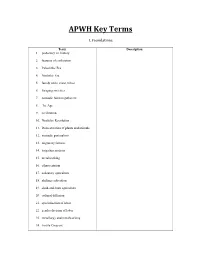
APWH Key Terms
APWH Key Terms I. Foundations Term Description 1. prehistory vs. history 2. features of civilization 3. Paleolithic Era 4. Neolithic Era 5. family units, clans, tribes 6. foraging societies 7. nomadic hunters/gatherers 8. Ice Age 9. civilization 10. Neolithic Revolution 11. Domestication of plants and animals 12. nomadic pastoralism 13. migratory farmers 14. irrigation systems 15. metalworking 16. ethnocentrism 17. sedentary agriculture 18. shifting cultivation 19. slash-and-burn agriculture 20. cultural diffusion 21. specialization of labor 22. gender division of labor 23. metallurgy and metalworking 24. Fertile Crescent 25. Gilgamesh 26. Hammurabi’s Law Code 27. Egypt 28. Egyptian Book of the Dead 29. pyramids 30. hieroglyphics 31. Indus valley civilization 32. early China 33. the Celts 34. the Hittites and iron weapons 35. the Assyrians and cavalry warfare 36. The Persian Empire 37. The Hebrews and monotheism 38. the Phoenicians and the alphabet 39. the Lydians and coinage 40. Greek city-states 41. democracy 42. Persian Wars 43. Peloponnesian War 44. Alexander the Great 45. Hellenism 46. Homer 47. Socrates and Plato 48. Aristotle 49. Western scientific thought 50. Roman Republic 51. plebians vs. patricians 52. Punic Wars 53. Julius Caesar 54. Roman Empire 55. Qin, Han, Tang Dynasties 56. Shi Huangdi 57. Chinese tributary system 58. the Silk Road 59. Nara and Heian Japan 60. the Fujiwara clan 61. Lady Murasaki and “The Tale of Genji 62. Central Asia and Mongolia 63. the Aryan invasion of India 64. Dravidians 65. Indian caste system 66. Ashoka 67. Constantinople/Byzantine Empire 68. Justinian 69. early Medieval Europe “Dark Ages” 70. -

The History of Asia in the 20Th Century – the Origins of Prosperity and Stability –
The History of Asia in the 20th Century – The Origins of Prosperity and Stability – The History of Asia in the 20th Century – The Origins of Prosperity and Stability – Akihiko Tanaka President, National Graduate Institute for Policy Studies Abstract Looking back from our 21st century vantage point, we must re-examine and re-think the history of Asia in the 20th century. Asia today, and East Asia in particular, enjoys relatively peaceful international relations and economic prosperity. The region has two major characteristics politically: a great diversity in political systems, and no failed states. To analyze these features by examining 20th century Asian history, the two concepts of nation building and international relations will be important. The absence of failed states in Asia means the state-building process in East Asia, including countries with a colonial past, has proceeded relatively smoothly. Individual countries have undergone their own historical development through interactions involving the state, society and markets within the context of dynamically changing international relations. s President Nogami has explained, this symposium is being held under the aegis of the Joint International Research Project on History consigned to the Japan Institute of International Affairs by the government of Japan. This project was launched in July 2016 as a very ambitious attempt to re-examine and re-think the history of Asia in the A20th century. Needless to say, a very large body of research on 20th century history of Asia already exists thanks to many decades of exhaustive research. We nevertheless believe that it is now necessary to revisit the history of Asia in the 20th century. -

Final Social Studies
Minnesota Department of Education May 15, 2004, 9:45 p.m. Minnesota Academic Standards in History and Social Studies HISTORY AND SOCIAL STUDIES If a nation expects to be ignorant and free, in a state of civilization, it expects what never was and never will be . .I know of no safe depository of the ultimate powers of the society but the people themselves. And if we think them not enlightened enough to exercise their control with wholesome discretion, the remedy is not to take it from them, but to inform their discretion by education. - Thomas Jefferson Public education in Minnesota must help students gain the knowledge and skills that are necessary to, in Jefferson’s view, protect and maintain freedom. The Social Studies Standards on the following pages attempt to do just this by specifying the particular knowledge and skills that Minnesota students will be required to learn in the disciplines of U.S. History, World History, Geography, Economics and Civics as required by Minnesota statutes. These standards are written with the recognition that additional academic disciplines, Psychology, Sociology, and Anthropology, have strong traditions of instruction in Minnesota schools. Schools may choose to continue teaching in these academic disciplines as local traditions, interest, and school priorities dictate. 1 Minnesota Department of Education May 15, 2004, 9:45 p.m. Minnesota Academic Standards in History and Social Studies HISTORY What is History? The study of History (Minnesota, U.S., and World) helps students to see how people in other times and places have grappled with the fundamental questions of truth, justice, and personal responsibility, to understand that ideas have real consequences, and to realize that events are shaped both by ideas and the actions of individuals.