“BLOOD MONEY Ed ALICE” by Pasquale Boffoli
Total Page:16
File Type:pdf, Size:1020Kb
Load more
Recommended publications
-

La Réédition Des Sept Premiers Albums De Tom
PÉRIODES À ses débuts, l’auteur- compositeur proposait déjà une musique aussi intemporelle que parfois anachronique, mais toujours novatrice. Tom WaiTs L’invitation au bLues La réédition des sept premiers albums de Tom Waits nous ramène vers la période jazz-blues de ce magicien des sons, farouchement atypique, mû par la seule obsession de rester toujours au plus près de lui-même. Pour mieux nous enchanter. Par Alain Gouvrion. Photographie de Jess Dylan To m Wa i Ts n le croyait à jamais brouillé avec son passé, cette image de bluesman Jones, et son pote le chanteur et composi - HORS DU TEMPS titubant sous un réverbère au son moelleux d’une contrebasse de jazz et d’un sax teur Chuck E. Weiss, futur héros de “Chuck “À 20 ans, je réfutais la culture hippie... Et c’est ténor. Celle de The Heart of Saturday Night et autres galettes gravées au mitan E’s in Love”, le premier succès de Jones. Tom toujours le cas...” des années 70, lorsque Tom Waits surgit de nulle part pour nous ensorceler de et Chuck forment un étrange binôme qui ses ténébreuses romances, sublimement anachroniques : “Tom Traubert’s Blues”, n’est pas sans rappeler celui de Jack Kerouac “Invitation to the Blues”, “Waltzing Matilda” ou l’inusable “Blue Valentine”. Lancé et de Neal Cassady, le chien fou de On the Odans des aventures sonores beaucoup plus audacieuses depuis trente-cinq ans, Road. Des années plus tôt, Waits a été litté- (Swordfishtrombones, 1983), Waits semblait n’éprouver aucune nostalgie – contrairement à ralement foudroyé par Kerouac et les nombre de ses fans – pour le (bon vieux) temps où il passa de l’anonymat des clubs de écrivains beat, qu’il a découverts via son Los Angeles au statut d’artiste culte vénéré par nombre de musiciens, tels que Bruce idole Bob Dylan. -

Clangxboomxstea ... Vxtomxwaitsxxlxterxduo.Pdf
II © Karl-Kristian Waaktaar-Kahrs 2012 Clang Boom Steam – en musikalsk lesning av Tom Waits’ låter Forsidebilde: © Massimiliano Orpelli (tillatelse til bruk er innhentet) Konsertbilde side 96: © Donna Meier (tillatelse til bruk er innhentet) Trykk: Reprosentralen, Universitetet i Oslo III IV Forord Denne oppgaven hadde ikke vært mulig uten støtten fra noen flotte mennesker. Først av alt vil jeg takke min veileder, Stan Hawkins, for gode innspill og råd. Jeg vil også takke ham for å svare på alle mine dumme (og mindre dumme) spørsmål til alle døgnets tider. Spesielt i den siste hektiske perioden har han vist stor overbærenhet med meg, og jeg har mottatt hurtige svar selv sene fredagskvelder! Jeg skulle selvfølgelig ha takket Tom Waits personlig, men jeg satser på at han leser dette på sin ranch i «Nowhere, California». Han har levert et materiale som det har vært utrolig morsomt og givende å arbeide med. Videre vil jeg takke samboeren min og mine to stadig større barn. De har latt meg sitte nede i kjellerkontoret mitt helg etter helg, og all arbeidsroen jeg har hatt kan jeg takke dem for. Jeg lover dyrt og hellig å gjengjelde tjenesten. Min mor viste meg for noen år siden at det faktisk var mulig å fullføre en masteroppgave, selv ved siden av en krevende fulltidsjobb og et hektisk familieliv. Det har gitt meg troen på prosjektet, selv om det til tider var slitsomt. Til sist vil jeg takke min far, som gikk bort knappe fire måneder før denne oppgaven ble levert. Han var alltid opptatt av at mine brødre og jeg skulle ha stor frihet til å forfølge våre interesser, og han skal ha mye av æren for at han til slutt endte opp med tre sønner som alle valgte musikk som sin studieretning. -

“THE SIREN TEARS the NIGHT in HALF” Tom Waits, the Uncanny and the American Gothic
“THE SIREN TEARS THE NIGHT IN HALF” Tom Waits, the Uncanny and the American Gothic Word count: 16,904 Tuur Vandeborne Student number: 01510970 Supervisor: Prof. Dr. Gert Buelens A dissertation submitted to Ghent University in partial fulfillment of the requirements for the degree of Advanced Masters in American Studies Academic year: 2017-2018 Oh, that city music Oh, that city sound Oh, how you're pulling my heart strings and Oh, let's go downtown Kevin Morby, “City Music” I would like to express my infinite gratitude to Professor Gert Buelens, without whom this thesis would have never existed. I would like to thank my parents for their support and for allowing me to finish this degree. Last but not least I would like to thank my friends for their support, their encouragement and for putting up with me through thesis-times. 2 Introduction ........................................................................................................... 4 Chapter 1: Uncanny Influences ............................................................................. 10 The Urban Gothic ............................................................................................................................................. 10 Edward Hopper: Sinister Sentimentalism ............................................................................................ 14 Jack Kerouac: Haunted by Nostalgia ........................................................................................................ 22 “Small Change (Got Rained on by his own .38)” ................................................................................ -

Eastern Progress' Unofficial Board Game of at Six O'clock Tuesday Night "It Will Open up More Alcohol Relat- the Votes Were Tallied
Will the world end on the stroke of midnight Dec. 31? Find TTfc Theme Easterneastern out what two professors have to say about millenni- um predic- Progress^^ www.progress.eku.edu tions/Bl week Phase II changes announced BY SHAWM Howawt ommended approval for all but ments. criteria in program were not recommended program or the aviation faculty. News editor four of the 21 changes to the orga- Major changes recommended making each for departments, largely because "Aviation is a very good pro- nization of the university that by Marsden are the merger of decision: of the number of faculty involved. gram, and it's growing," Marsden Vice president for academic were asked for by colleges and speech communication faculty whether the Hnd out what Marsden said that a faculty need- said. affairs and provost Michael departments. with the department of mass com- change bet- stMhstv ed to reach critical mass before it James Moreton, chair of Marsden released his recommen- Marsden did not recommend munication faculty to create a new ter served panada! became a department. He also speech and theatre arts, said that dations for the second phase of moving the department of com- department of communication students, fac- Faculty Eastern's reorganization Monday, said he thought there was an effi- he expected the department sta- puter science to the college of that would be located in the col- ulty and the m/A8 ciency problem with trying to ful- tus would be turned down. Not everyone got what they asked business and technology, estab- lege of business and technology, university. -

Tom Waits 07.12.2019 22:06-24:00 Uhr ======Musikredaktion Und Moderation: Andreas Müller-Crepon
Late Night Jazz: Schon 70!? Tom Waits 07.12.2019 22:06-24:00 Uhr =============================================================================================== Musikredaktion und Moderation: Andreas Müller-Crepon Seine Stimme ist unverwechselbar - schon als er noch als Singer-Songwriter in der Nachfolge von Frank Sinatra operierte, war die Vorliebe für rauhe Töne und schräge Stoffe mit Händen zu greifen. Vom jazzigen Lounge-Stil hat er sich zum urwüchsigen Rockmusiker gemausert, um sich dann aber handkehrum dem Musiktheater mit Avantgarde-Einschlag zuzuwenden. Ganz zu schweigen von herzergreifenden Country- und Soul-Episoden. Einer der vielseitigsten, sperrigsten und einflussreichsten Musiker zwischen allen Stilen hat Geburtstag - wir feiern bis Mitternacht mit einer Auslese seiner Stücke. Titel: Komponist Interpreten Label CD-Titel I WISH I WAS IN NEW Tom Waits JERRY YESTER Asylum 1976 Small Change ORLEANS GET BEHIND THE MULE Tom Waits Tom Waits Anti Epita 1999 Tom Waits: Mule variations JESUS Lou Reed David Sanborn Elektra 1991 Another hand LITTLE BOY BLUE Tom Waits HOLLY COLE Metro Blue 1995 Temptation SHORE LEAVE Tom Waits Tom Waits Island Twin Tom Waits: Rain dogs / Swordfishtrombones UNDERGROUND Tom Waits Island Reco Swordfishtrombones JOCKEY FULL OF Tom Waits Ulf Wakenius Act + Vision Voyage BOURBON DOROTHY Mac Rebennack Dr. John Deomon 1981 Dr. John plays Mac Rebennack EGGS AND SAUSAGE Tom Waits Tom Waits Asylum 1975 Nighthawks At The Diner ROCKIN' CHAIR Tom Waits Tom Waits Bizarre 1971 Tom Waits: The Early Years ROCKIN' CHAIR Hoagy Carmichael Hoagy Carmichael Pacific Jazz 1956 Hoagy Sings Camichael Lazy River Hoagy Carmichael Hoagy Carmichael Pacific Jazz 1956 Hoagy Sings Camichael Georgia Lee Tom Waits Tom Waits Anti, Epita 1998 Tom Waits: Mule variations TRAMPLED ROSE Tom Waits Carolina Chocolate Drops Nonesuch Carolina Chocolate Drops: Geniune negro jig HARLEM NOCTURNE Earle Hagen Lounge Lizards EG 1980 The Lounge Lizards (CD 1/01: Incident on South Street). -

Introduzione Nuova Per L'inserto Sul Manifesto
ARTICOLI DEL BULLA SU TOM WAITS Introduzione nuova per l’inserto sul Manifesto (recensione di Mule Variations e presentazione di Tom Waits) A sei anni di distanza dall’ultimo disco, torna in questi giorni Tom Waits con una raccolta di brani originali, Mule Variations, pubblicata dalla Epitaph, piccola etichetta indipendente californiana specializzata soprattutto in gruppi punk-rock. Nel periodo intercorso fra il precedente The Black Rider e l’attuale lavoro discografico, Waits – da vero mulo, come insinua autobiograficamente il titolo dell’album – non si è concesso pause, però ha convogliato la sua multiforme attività in svariate direzioni. Ha recitato in diversi film importanti (Short Cuts di Altman, per citare solo il più noto), ha firmato interamente o in parte molte colonne sonore (due suoi brani figurano nella soundtrack di Dead Man Walking, altrettanti in quella di The End of Violence di Wim Wenders; sua è la colonna sonora del cartone animato Bunny che, per l’incontenibile gioia del suo vecchio amico Roberto Benigni, ha recentemente ottenuto un Oscar). Tom Waits, nato a Pomona, California, il 7 dicembre del 1949 (ottavo anniversario, come gli piace ripetere, del bombardamento di Pearl Harbour), è uno straordinario mutante. Pur godendo di un’altissima stima presso i suoi colleghi, non è mai divenuto un fenomeno di massa. Colto e provocatore, ha sempre compiuto scelte selettive ed eccentriche. Partito da un country-blues di buona fattura, Waits s’è poi fatto assertore, nell’America reaganiana che la nostra mitologia provinciale voleva ‘edonistica’, di una visione particolarmente contorta e oscura del blues e di una sorta di estetica della sgradevolezza. -

50-02 Tom Waits Musik
Swend’s Bluesband celebrating Musik Swend’s Bluesband celebrating Discography Closing Time (Marts, 1973) 1. Ol' '55 2. I Hope That I Don't Fall In Love With You 3. Virginia Avenue 4. Old Shoes (& Picture Postcards) 5. Midnight Lullaby 6. Martha 7. Rosie 8. Lonely 9. Ice Cream Man 10. Little Trip To Heaven (On the Wings Of Your Love) 11. Grapefruit Moon 12. Closing Time (instrumental) The Heart Of Saturday Night (Oktober, 1974) 1. New Coat Of Paint 2. San Diego Serenade 3. Semi Suite 4. Shiver Me Timbers 5. Diamonds On My Windshield 6. (Looking For) The Heart Of Saturday Night 7. Fumblin' With The Blues 8. Please Call Me Baby 9. Depot Depot 10. Drunk On The Moon 11. The Ghosts Of Saturday Night (After Hours At Napoleone's Pizza House) Nighthawks At The Diner (October, 1975) 1. Opening Intro 2. Emotional Weather Report 3. Intro 4. On A Foggy Night 5. Intro 6. Eggs And Sausage (In A Cadillac With Susan Michelson) 7. Intro 8. Better Off Without A Wife 9. Nighthawk Postcards (From Easy Street) 10. Intro 11. Warm Beer And Cold Women 12. Intro 13. Putnam County 14. Spare Parts 1 (A Nocturnal Emission) 15. Nobody 16. Intro 17. Big Joe And Phantom 309 18. Spare Parts 2 And Closing (spoken word) Swend’s Bluesband celebrating Discography Small Change (September, 1976) 1. Tom Traubert's Blues (Four Sheets To The Wind In Copenhagen) 2. Step Right Up 3. Jitterbug Boy 4. I Wish I Was In New Orleans 5. The Piano Has Been Drinking Not Me 6. -
Sampling in the Work of Nick Zammuto, Tom Waits, and Paul D
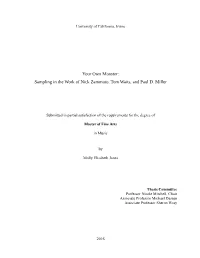
University of California, Irvine Your Own Monster: Sampling in the Work of Nick Zammuto, Tom Waits, and Paul D. Miller Submitted in partial satisfaction of the requirements for the degree of Master of Fine Arts in Music by Molly Elisabeth Jones Thesis Committee Professor Nicole Mitchell, Chair Associate Professor Michael Dessen Associate Professor Sheron Wray 2016 © 2016 Molly Jones Table of Contents Introduction...................................................................1 Philosophies of Sound...................................................3 Composition..................................................................6 Multimedia Performance.............................................11 Creating Meaning........................................................12 Conclusion..................................................................15 Works Cited................................................................16 ii Abstract Your Own Monster: Sampling in the Work of Nick Zammuto, Tom Waits, and Paul D. Miller by Molly Jones Master of Fine Arts in Music University of California, Irvine, 2016 Nicole Mitchell, Chair Nick Zammuto of The Books, Tom Waits, and Paul D. Miller a.k.a. DJ Spooky compose using strategies developed through their experiences of sampling. Despite their diverse artistic backgrounds and output, all three participate in sampling culture by drawing on and remixing a wide variety of sound sources into "[their] own monster." They allude to different eras and genres by drawing on historical and contemporary production -

Linjer I Tom Waits' Sanglyrikk
What’s he building in there? Linjer i Tom Waits’ sanglyrikk © Anton Corbijn Av Anlaug Færevåg Masteroppgave i allmenn litteraturvitenskap Institutt for litteratur, områdestudier og europeiske språk Det humanistiske fakultet Veiledet av Hans H. Skei UNIVERSITETET I OSLO November 2010 II Sammendrag Denne avhandlingen undersøker det sanglyriske forfatterskapet til den amerikanske artisten Tom Waits, med det mål å finne særtrekk ved, og skaffe kunnskap om, Waits’ skrivemåte og lyrikk. Samfunnets skyggeliv har hele tiden vært et gjennomgående tema hos Waits. Min hypotese er at disse skildringene gjerne er sentimentale, nostalgiske og romantiserende tidlig i karrieren, men at det etter hvert utvikles et rikere og mørkere tekstunivers, preget av tapte illusjoner. For å få fram flere trekk ved tekstene er oppgavens hoveddel, lesningen, delt inn i tre innfallsvinkler. Ett kapittel undersøker et av motivene som går igjen gjennom hele karrieren: månen. Det undersøkes hvordan motivet brukes, om det har en statisk eller vekslende betydning, og om det kan det sies å binde sammen forfatterskapet. Ett kapittel ser på historien om og utviklingen til “Frank”, karakteren som opptrådte første gang i sangen “Frank's Wild Years” på albumet Swordfishtrombones, og som deretter ble til musikalen og albumet Franks Wild Years. Det siste lesningskapitlet tar for seg albumet Blood Money, som består av låter skrevet til Robert Wilsons oppsetning av Georg Büchners Woyzeck. Hvordan forholder sangtekstene seg til historien de er skrevet til, og hvordan leses de utenfor denne? Skiller skrivemåten seg ut på dette albumet, eller har den gjenkjennelige trekk? Det leses til sammen ni tekster i avhandlingen, tre for hver innfallsvinkel. -

Were-Waitsing: Gothic Elements in the Musical Imagery of Tom Waits
MASARYK UNIVERSITY FACULTY OF EDUCATION Department of English Language and Literature Were-Waitsing: Gothic Elements in the Musical Imagery of Tom Waits Master’s Thesis Brno 2019 Supervisor: Author: Mgr. Pavla Buchtová Bc. Jakub Jiaxis Svoboda Abstract This thesis focuses on the musical imagery in the songs of American singer- songwriter Tom Waits, with special attention paid to Gothic elements in Waits’ music, as well as in his on and off-stage presence. As Waits himself eludes critical efforts to be labelled – his art and music is described in an array of genres as wide as blues, jazz, vaudeville, industrial and experimental – this thesis undertakes to present him as a Gothic artist, a view which has so far been academically neglected. The thesis analyses two key notions of the gothic genre, as portrayed and manifested by the artist, primarily the wound-healing duality and the notion of shape-shifting as a form of code-switching between personas and genres, thus showing that for Waits the Gothic is a medium through which he can confront the intact American discourse with the disfigured, peripheral socio-cultural domains. Key words Tom Waits, American Gothic, Southern Gothic, wound, healing, shape-shifting, liminality 2 Anotace Diplomová práce se zaměřuje na obraznost v tvorbě amerického písničkáře Toma Waitse, se zvláštním ohledem na gotické motivy ve Waitsově hudbě, stejně jako na umělcovu sebeprezentaci na pódiu a mimo něj. Waits samotný uniká snahám o škatulkování – jeho tvorba spadá často do širokého spektra žánrů jako je blues, jazz, vaudeville, industrialní či experimentální hudba – tato práce jej však představuje jako gotického umělce, tedy z pohledu který byl v rámci akademického diskurzu opomíjen. -

What's He Building in There? What the Hell Is He Building in There? I Heard He Has an Ex-Wife in Some Place Called Mayor’S Income, Tennessee
42 Aether: The Journal of Media Geography • Winter 2011 What’s He Building in There? The Existential Geography of Tom Waits Michael W. Pesses Antelope Valley College Abstract The growl of Tom Waits is unmistakable. The music is theatrical in nature; it tells the tales of assorted characters and uses the mellow plucking of a banjo or a cacophony of mismatched instruments to invoke the right mood for the story. His earlier albums evoke images of American working class men and women; his later evoke images of the surreal and the exotic. In this paper I argue that through these latter images, Waits is making art that is overtly geographic and covertly commenting on modernity, being, dwelling, and the existentialist networks that connect the world. Through my own interpretation of the 1999 album Mule Variations I pull forth examples of existential space and place and attempt to map its soundscapes discovering a sorrowful ambivalence towards fixity and flow. “Well, I got it all in me. I love melody. I also like dissonance and factory noise.” –Tom Waits, interviewed in 1999 Introduction Music is inextricable from the experience of modernity. Through my computer as I work and through my car stereo as I drive, music is tied to my spaces of mobility and places of identity. I cannot separate it from capitalism, nor do I feel I should. Music is not simply about the sounds, but connections with places and people of my past and present. It is a small element of the greater scene. So it really didn’t shock me that somewhere on the highway between Phoenix and Tucson, Arizona, Tom Waits started speaking to me about modernity and experience. -

Diplomarbeit
DIPLOMARBEIT Titel der Diplomarbeit “Protagonists and worldview in the work of Tom Waits“ Verfasser Emanuel Riedmann angestrebter akademischer Grad Magister der Philosophie (Mag.phil.) Wien, 2013 Studienkennzahl lt. Studienblatt: A 343 Studienrichtung lt. Studienblatt: Diplomstudium der Anglistik Betreuerin: Ao. Univ.-Prof. Dr. Mag. Eva Zettelmann 2 Acknowledgements Special thanks to Alba, my family and friends (you know who you are). F and the gang. M and S for lending me their netbook when my own computer went down only a few weeks before deadline. The Alter Rhein Crew. El Equipo del CNB. Thanks to L, for introducing me to French existentialism while getting lost on a Spanish highway. I would also like to thank my supervisor, Ao. Univ.-Prof. Mag. Dr. Eva Zettelmann from the University of Vienna, and Dr. Jordi Coral from the Universitat Autònoma de Barcelona for their much appreciated help and support. Last but not least, many thanks to St. After reading one of my short stories about ten years ago, your comment, “This kind of reminds me of Tom Waits... Do you know that guy?” sent me off on quite a ride. 3 Table of contents Introduction ......................................................................................................................... 5 1.Outline of theoretical framework ..................................................................................... 8 2. Tom Waits ..................................................................................................................... 15 2.1. A short biography of