The United States and Japan in the Postwar World
Total Page:16
File Type:pdf, Size:1020Kb
Load more
Recommended publications
-
2013-JCIE-Annual-Report.Pdf
Table of Contents 2011–2013 in Retrospect .................................................................................................................................3 Remembering Tadashi Yamamoto ............................................................................................................6 JCIE Activities: April 2011–March 2013 ........................................................................................................9 Global ThinkNet 13 Policy Studies and Dialogue .................................................................................................................... 14 Strengthening Nongovernmental Contributions to Regional Security Cooperation The Vacuum of Political Leadership in Japan and Its Future Trajectory ASEAN-Japan Strategic Partnership and Regional Community Building An Enhanced Agenda for US-Japan Partnership East Asia Insights Forums for Policy Discussion ........................................................................................................................ 19 Trilateral Commission UK-Japan 21st Century Group Japanese-German Forum Korea-Japan Forum Preparing Future Leaders .............................................................................................................................. 23 Azabu Tanaka Juku Seminar Series for Emerging Leaders Facilitation for the Jefferson Fellowship Program Political Exchange Programs 25 US-Japan Parliamentary Exchange Program ......................................................................................26 -

Peace and Prosperity in Northeast Asia Volume I Exploring the European Experience Peace & Prosperity in Northeast Asia [Vol
Peace and Prosperity in Northeast Asia Volume I Exploring the European Experience Peace & Prosperity in Northeast Asia [Vol. I] Exploring the European Experience Copyright © 2008 by International Peace Foundation, Jeju Special Self- Governing Province, East Asia Foundation, Jeju Free International City Development Center and Ministry of Foreign Affairs and Trade No part of this publication may be reproduced or transmitted in any form or by any means without the written permission of the aforementioned copyright holders. Published by the JPI Press 2572 Jungmun-dong, Seogwipo City, Jeju Special Self-Governing Province, 697-120, Korea Tel: (82-64)735-6500 Fax: (82-64)735-6512 E-mail: jejupeace@jpi.or.kr http://www.jpi.or.kr ISBN 978-89-959470-3-6 Printed and bounded in Seoul, Korea Jeju Peace Institute Research Series [ 4 ] Peace and Prosperity in Northeast Asia Exploring the European Experience The 4th Jeju Peace Forum Vol. I 5 Preface Since its launch in 2001, the Jeju Peace Forum has established itself as one of Korea’s most important international conferences drawing key political, business, media, and academic leaders from throughout Northeast Asia and around the world. With the full support of the Korean government and a tremendously successful history, we have been trying hard to institutionalize the Forum as a crucial regional venue for distinguished experts to discuss and carve out a new blue- print for Northeast Asian peace and prosperity. This volume is a collection of papers and essays presented at the 4th Jeju Peace Forum, which was held from June 21 - June 23, 2007, in Jeju, South Korea as a continuation of the previous 2001, 2003 and 2005 Forums. -

Macarthur Foundation Asia Security Initiative (MASI) Demonstrates Increasing Cooperation in Other Important Areas
Table of Contents Table of Contents Conference Statement Agenda Annual Meeting Outline Memo Presentation Paper List of Participants Participants’ Biographies General Information Institutes’ Achievements & Future Plans List of Contact Persons for ASI Grantees 3 The East Asia Institute Australia, Indonesia, and South Korea will play stronger roles, while rising powers like China and India will take on new regional and global responsibilities. with support from It is clear that the role of Asia is now more profound than ever before, but the future of the East Asian Community remains uncertain. Therefore, enhancing regional cooperation remains as the main challenge to overcome inherited suspicion and lasting The John D. and Catherine T. MacArthur Foundation mistrust. While issues such as the Cheonan incident reveal differences in the Asian states’ approaches toward North Korea, their unity in implementing sanctions against Pyongyang presents in the wake of its nuclear test in May 2009 implies a growing effort in security cooperation. On the economic front, the signing of the India-ASEAN Free Trade Agreement MacArthur Foundation Asia Security Initiative (MASI) demonstrates increasing cooperation in other important areas. The next stage will be to 2010 Annual Meeting transform these contacts into a wider and deeper cooperative network. At the same time, July 7-9, 2010 questions need to be addressed on the identity, scope, and purpose of a regional Westin Chosun, Seoul, Korea community. The challenges for the region are so complex and vast that they often involve more The second Annual Meeting of the MacArthur Foundation Asia Security Initiative comes than one country. In this new order, nations can no longer tackle problems unilaterally. -

Peace and Prosperity in Northeast Asia Volume II Exploring the European Experience Peace & Prosperity in Northeast Asia [Vol
Peace and Prosperity in Northeast Asia Volume II Exploring the European Experience Peace & Prosperity in Northeast Asia [Vol. II] Exploring the European Experience Copyright © 2008 by International Peace Foundation, Jeju Special Self- Governing Province, East Asia Foundation, Jeju Free International City Development Center and Ministry of Foreign Affairs and Trade No part of this publication may be reproduced or transmitted in any form or by any means without the written permission of the aforementioned copyright holders. Published by the JPI Press 2572 Jungmun-dong, Seogwipo City, Jeju Special Self-Governing Province, 697-120, Korea Tel: (82-64)735-6500 Fax: (82-64)735-6512 E-mail: jejupeace@jpi.or.kr http://www.jpi.or.kr ISBN 978-89-959470-4-3 Printed and bounded in Seoul, Korea Jeju Peace Institute Research Series [ 5 ] Peace and Prosperity in Northeast Asia Exploring the European Experience The 4th Jeju Peace Forum Vol. II 5 Preface Since its launch in 2001, the Jeju Peace Forum has established itself as one of Korea’s most important international conferences drawing key political, business, media, and academic leaders from throughout Northeast Asia and around the world. With the full support of the Korean government and a tremendously successful history, we have been trying hard to institutionalize the Forum as a crucial regional venue for distinguished experts to discuss and carve out a new blue- print for Northeast Asian peace and prosperity. This volume is a collection of papers and essays presented at the 4th Jeju Peace Forum, which was held from June 21 - June 23, 2007, in Jeju, South Korea as a continuation of the previous 2001, 2003 and 2005 Forums. -

The World and Japan's Foreign Policy in the Future: Prospects in 20 Years
Preface This report summarizes the research findings of a research project conducted by the Japan Institute of International Affairs in fiscal 2010 titled “The World and Japan’s Foreign Policy in the Future: Prospects in 20 Years.” The guarantee of security through the Japan-US Security Treaty enabled Japan to achieve reconstruction and economic growth in the aftermath of the Second World War. As a major economic power, Japan has maintained its influence in international politics. In 2010, however, Japan lost its status as the world’s second largest economic power, as China overtook Japan in terms of gross domestic product. In addition, the Japan-US alliance, which forms the foundation of Japan’s security, carries with it daunting challenges, as evidenced by controversy over the relocation of the Marine Corps Air Station Futenma in Okinawa. Moving forward, with what identity and diplomatic strategy should Japan face the international community? This research project aims to make recommendations regarding the path and policies Japan should take in the future by looking back on Japan’s postwar diplomacy and planning the scenarios of the international situation in 20 years or so. The expected challenges Japan must tackle when considering the international situation surrounding the nation in 20 years’ time can largely be separated into the following two groups. The first group of challenges is characterized by changes in the balance of power. The rise of emerging nations such as China is expected to diminish the influence of the world’s only superpower, the United States, in relative terms. Such shift in power is expected to significantly change the framework of today’s international order. -
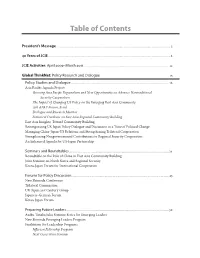
Table of Contents
Table of Contents President’s Message .......................................................................................................................................5 40 Years of JCIE .................................................................................................................................................8 JCIE Activities: April 2009–March 2011 ..................................................................................................... 12 Global ThinkNet: Policy Research and Dialogue 15 Policy Studies and Dialogue .................................................................................................................... 16 Asia Pacific Agenda Project Growing Asia Pacific Regionalism and New Opportunities to Advance Nontraditional Security Cooperation The Impact of Changing US Policy on the Emerging East Asia Community 15th APAP Forum, Seoul Dialogue and Research Monitor Statistical Database on East Asia Regional Community Building East Asia Insights: Toward Community Building Reinvigorating US-Japan Policy Dialogue and Discussion in a Time of Political Change Managing China-Japan-US Relations and Strengthening Trilateral Cooperation Strengthening Nongovernmental Contributions to Regional Security Cooperation An Enhanced Agenda for US-Japan Partnership Seminars and Roundtables ...........................................................................................................................24 Roundtable on the Role of China in East Asia Community Building Joint Seminar on North Korea -

Edited by Makoto Iokibe Tosh Minohara
THE HISTORY O F USJAPAN RELATIONS From Perry to the Present EDITED BY MAKOTO IOKIBE English translation edited by TOSH MINOHARA The History of US-Japan Relations Makoto Iokibe Editor Tosh Minohara English translation editor The History of US-Japan Relations From Perry to the Present Editor: English translation Editor: Makoto Iokibe Tosh Minohara Prefectural University of Kumamoto Kobe University Kumamoto-ken, Japan Kobe, Japan ISBN 978-981-10-3183-0 ISBN 978-981-10-3184-7 (eBook) DOI 10.1007/978-981-10-3184-7 Library of Congress Control Number: 2017930259 © The Editor(s) (if applicable) and The Author(s) 2017 This work is subject to copyright. All rights are solely and exclusively licensed by the Publisher, whether the whole or part of the material is concerned, specifically the rights of translation, reprinting, reuse of illustrations, recitation, broadcasting, reproduction on microfilms or in any other physical way, and transmission or information storage and retrieval, electronic adaptation, computer software, or by similar or dissimilar methodology now known or hereafter developed. The use of general descriptive names, registered names, trademarks, service marks, etc. in this publication does not imply, even in the absence of a specific statement, that such names are exempt from the relevant protective laws and regulations and therefore free for general use. The publisher, the authors and the editors are safe to assume that the advice and information in this book are believed to be true and accurate at the date of publication. Neither the pub- lisher nor the authors or the editors give a warranty, express or implied, with respect to the material contained herein or for any errors or omissions that may have been made. -

Perceptionsjournal of International Affairs
PERCEPTIONSJOURNAL OF INTERNATIONAL AFFAIRS US Foreign Policy towards Northeast Asia Joel R. CAMPBELL Japan’s Security Policy towards East Asia Kaseda YOSHINORI Russia’s East Asia Policy: New Opportunities and Challenges Anna KIREEVA Recent Political Developments in Taiwan: Facing Beijing and Washington Wan-Chin TAI Security Conditions and Regional Competition in East Asia: A South Korean Perspective Chong Jin OH Turkey’s East Asian Policy: From Security Concerns to Trade Partnership Selçuk ÇOLAKOĞLU Turkey’s Search for a “New” Subjectivity in World Politics and US- Turkish Relations Ali ASLAN Turkish Foreign Policy and the KRG Marianna CHAROUNTAKI Afghanistan: Human Cost of Armed Conflict since the Soviet Invasion Imtiyaz Gul KHAN Book Reviews Winter2012 Volume XVII - Number 4 ISSN 1300-8641 PERCEPTIONS Editor in Chief Bülent Aras Deputy Editors Şaban Kardaş • Mesut Özcan • Murat Yeşiltaş Book Review Editor Şule Toktaş Managing Editor Engin Karaca International Advisory Board Nuri Yurdusev Middle East Technical University Fuat Keyman Sabancı University Talip Küçükcan Marmara University Ayşe Kadıoğlu Sabancı University Mustafa Kibaroğlu Okan University Pınar Bilgin Bilkent University Burhanettin Duran Istanbul Şehir University Selçuk Çolakoğlu Yıldırım Beyazıt University Tuncay Kardaş Sakarya University Oktay Tanrısever Middle East Technical University Şaban Kardaş TOBB-ETU Mesut Özcan Center for Strategic Research Homepage: http://www.sam.gov.tr The Center for Strategic Research (Stratejik Araştırmalar Merkezi- SAM) conducts research on Turkish foreign policy, regional studies and international relations, and makes scholarly and scientific assessments of relevant issues. It is a consultative body of the Turkish Ministry of Foreign Affairs providing strategic insights, independent data and analysis to decision makers in government. -

Historical Dictionary of United States-Japan
American History • U.S. Diplomatic History Historical Dictionaries of U.S. Diplomacy, No. 4 SANT VAN SUGITA MAUCH HISTORICAL DICTIONARY OF “This is a superb, authoritative, and comprehensive guide and dictionary, indis- pensable for pivotal individuals, as well as for events, treaties, even debates in the extraordinary—and extraordinarily revealing—150 years of relations between Japan and the United States.” —Walter LaFeber, Tisch University Professor, Cornell University, Ithaca, New York T HISTORICAL he most important bilateral relationship in Asia since the end of World DICTIONARY War II is assuredly between the United States and Japan, the world’s two largest OF economies. Despite the geographical and cultural differences between the nations, as well as bitterness lingering from the war, they have developed an amicable and STATES– UNITED prosperous relationship. As the 21st century progresses, continuing goodwill is of the utmost importance, as the peace and stability of the Asia–Pacific region depends on cooperation and efforts to contain destabilizing factors in the area. RELATIONS Historical Dictionary of United States–Japan Relations traces this 150-year rela- JAPAN tionship through a chronology, an introduction, appendixes, a bibliography, and cross-referenced dictionary entries on key people, places, events, institutions, and organizations. Covering everything from Walt Whitman’s poem "A Broadway Pageant" to zaibatsu, this reference is an excellent starting point for the study of Japan’s dealings with the U.S. UNITED JOHN VAN SANT is associate professor of history at the University of Alabama– Birmingham. PETER MAUCH is a post-doctoral fellow at Kyoto University, Kyoto, Japan. YONEYUKI SUGITA is associate professor of American history at Osaka STATES–JAPAN University of Foreign Studies, Osaka, Japan, and author of Pitfall or Panacea: The Irony of US Power in Occupied Japan, 1945–1952 (2004). -

Eitan Oren Abridged Thesis
博士論文 Military Threat Perception in Postwar Japan: the Soviet Union, China and North Korea (戦後日本における軍事脅威認識:ソ連、中国、北朝鮮) オレン エイタン © [2016] Eitan Oren ALL RIGHTS RESERVED 論文の内容の要旨 論文題目 Military Threat Perception in Postwar Japan: the Soviet Union, China and North Korea (戦後日本における軍事脅威認識:ソ連、中国、北朝鮮) 氏名 オレン エイタン Threat perceptions are of crucial importance to international security yet they remain understudied both generally among political scientists and particularly among Japan scholars. The few studies that did tackle the phenomenon of Japan’s perceptions of threat as a dependent variable suffer from weaknesses such as poor conceptualization of ‘threat-perception’ as well as limited methodology and data. This study aims to fill this gap by employing an eclectic approach which combines different methods and analyzes both macro and micro data. I examined postwar perceptions of military threats associated with the Soviet Union, China and North Korea across five decades and four units of analysis: the defense and political establishments, the media and the general public. The empirical findings of this study indicate that contrary to earlier findings, both the Soviet Union and China were perceived by some domestic actors in Japan as significant military threats during the postwar period (1950 - 1991), although with fluctuations over time, context, intensity and distribution. This study also finds that while both the Soviet Union and China were not fully securitized as military threats among the general public and the mainstream political leadership in the postwar period, North Korea was securitized successfully as a military threat in the late 1990s. Based on the evaluation of the empirical record, I argue that the observer’s pre-existing attitude toward security shapes to a large extent the process of threat- assessment. -

OFFICE of the HISTORIAN: Records, 1981-1989
DEPARTMENT OF STATE: OFFICE OF THE HISTORIAN: Records, 1981-1989 OFFICE DESCRIPTION The Department of State is the senior executive department of the United States Government. It was established by (1 Stat. 28) act on July 27, 1789 as the Department of Foreign Affairs and was renamed the Department of State by (1 Stat. 68) on September 15, 1789. The duties of the Department of State in the field of foreign affairs have not changed significantly in scope since the early years of the United States but have become far more detailed as the country has grown and its international commitments have multiplied. The Department of State advises the President in the formulation and execution of foreign policy. As Chief Executive, the President has overall responsibility for the foreign policy of the United States. The primary objective of the Department of State in the conduct of foreign relations is to promote the long-range security and well-being of the United States. The Department determines and analyzes the facts relating to American overseas interests, makes recommendations on policy and future action, and takes the necessary steps to carry out established policy. In carrying out these functions, the Department engages in continuous consultations with the American public, the Congress, other United States departments and agencies, and foreign governments. The Department of State negotiates treaties and agreements with foreign nations, speaks for the United States in the United Nations, and in the major international organizations in which the United States participates. The Department of State represents the United States at international conferences annually.