Cyprinodontiformes) En La Mesa Central De México
Total Page:16
File Type:pdf, Size:1020Kb
Load more
Recommended publications
-

The Evolution of the Placenta Drives a Shift in Sexual Selection in Livebearing Fish
LETTER doi:10.1038/nature13451 The evolution of the placenta drives a shift in sexual selection in livebearing fish B. J. A. Pollux1,2, R. W. Meredith1,3, M. S. Springer1, T. Garland1 & D. N. Reznick1 The evolution of the placenta from a non-placental ancestor causes a species produce large, ‘costly’ (that is, fully provisioned) eggs5,6, gaining shift of maternal investment from pre- to post-fertilization, creating most reproductive benefits by carefully selecting suitable mates based a venue for parent–offspring conflicts during pregnancy1–4. Theory on phenotype or behaviour2. These females, however, run the risk of mat- predicts that the rise of these conflicts should drive a shift from a ing with genetically inferior (for example, closely related or dishonestly reliance on pre-copulatory female mate choice to polyandry in conjunc- signalling) males, because genetically incompatible males are generally tion with post-zygotic mechanisms of sexual selection2. This hypoth- not discernable at the phenotypic level10. Placental females may reduce esis has not yet been empirically tested. Here we apply comparative these risks by producing tiny, inexpensive eggs and creating large mixed- methods to test a key prediction of this hypothesis, which is that the paternity litters by mating with multiple males. They may then rely on evolution of placentation is associated with reduced pre-copulatory the expression of the paternal genomes to induce differential patterns of female mate choice. We exploit a unique quality of the livebearing fish post-zygotic maternal investment among the embryos and, in extreme family Poeciliidae: placentas have repeatedly evolved or been lost, cases, divert resources from genetically defective (incompatible) to viable creating diversity among closely related lineages in the presence or embryos1–4,6,11. -
The Etyfish Project © Christopher Scharpf and Kenneth J
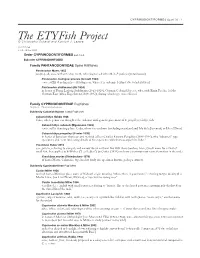
CYPRINODONTIFORMES (part 3) · 1 The ETYFish Project © Christopher Scharpf and Kenneth J. Lazara COMMENTS: v. 3.0 - 13 Nov. 2020 Order CYPRINODONTIFORMES (part 3 of 4) Suborder CYPRINODONTOIDEI Family PANTANODONTIDAE Spine Killifishes Pantanodon Myers 1955 pan(tos), all; ano-, without; odon, tooth, referring to lack of teeth in P. podoxys (=stuhlmanni) Pantanodon madagascariensis (Arnoult 1963) -ensis, suffix denoting place: Madagascar, where it is endemic [extinct due to habitat loss] Pantanodon stuhlmanni (Ahl 1924) in honor of Franz Ludwig Stuhlmann (1863-1928), German Colonial Service, who, with Emin Pascha, led the German East Africa Expedition (1889-1892), during which type was collected Family CYPRINODONTIDAE Pupfishes 10 genera · 112 species/subspecies Subfamily Cubanichthyinae Island Pupfishes Cubanichthys Hubbs 1926 Cuba, where genus was thought to be endemic until generic placement of C. pengelleyi; ichthys, fish Cubanichthys cubensis (Eigenmann 1903) -ensis, suffix denoting place: Cuba, where it is endemic (including mainland and Isla de la Juventud, or Isle of Pines) Cubanichthys pengelleyi (Fowler 1939) in honor of Jamaican physician and medical officer Charles Edward Pengelley (1888-1966), who “obtained” type specimens and “sent interesting details of his experience with them as aquarium fishes” Yssolebias Huber 2012 yssos, javelin, referring to elongate and narrow dorsal and anal fins with sharp borders; lebias, Greek name for a kind of small fish, first applied to killifishes (“Les Lebias”) by Cuvier (1816) and now a -

Endangered Species
FEATURE: ENDANGERED SPECIES Conservation Status of Imperiled North American Freshwater and Diadromous Fishes ABSTRACT: This is the third compilation of imperiled (i.e., endangered, threatened, vulnerable) plus extinct freshwater and diadromous fishes of North America prepared by the American Fisheries Society’s Endangered Species Committee. Since the last revision in 1989, imperilment of inland fishes has increased substantially. This list includes 700 extant taxa representing 133 genera and 36 families, a 92% increase over the 364 listed in 1989. The increase reflects the addition of distinct populations, previously non-imperiled fishes, and recently described or discovered taxa. Approximately 39% of described fish species of the continent are imperiled. There are 230 vulnerable, 190 threatened, and 280 endangered extant taxa, and 61 taxa presumed extinct or extirpated from nature. Of those that were imperiled in 1989, most (89%) are the same or worse in conservation status; only 6% have improved in status, and 5% were delisted for various reasons. Habitat degradation and nonindigenous species are the main threats to at-risk fishes, many of which are restricted to small ranges. Documenting the diversity and status of rare fishes is a critical step in identifying and implementing appropriate actions necessary for their protection and management. Howard L. Jelks, Frank McCormick, Stephen J. Walsh, Joseph S. Nelson, Noel M. Burkhead, Steven P. Platania, Salvador Contreras-Balderas, Brady A. Porter, Edmundo Díaz-Pardo, Claude B. Renaud, Dean A. Hendrickson, Juan Jacobo Schmitter-Soto, John Lyons, Eric B. Taylor, and Nicholas E. Mandrak, Melvin L. Warren, Jr. Jelks, Walsh, and Burkhead are research McCormick is a biologist with the biologists with the U.S. -

Extinction Rates in North American Freshwater Fishes, 1900–2010 Author(S): Noel M
Extinction Rates in North American Freshwater Fishes, 1900–2010 Author(s): Noel M. Burkhead Source: BioScience, 62(9):798-808. 2012. Published By: American Institute of Biological Sciences URL: http://www.bioone.org/doi/full/10.1525/bio.2012.62.9.5 BioOne (www.bioone.org) is a nonprofit, online aggregation of core research in the biological, ecological, and environmental sciences. BioOne provides a sustainable online platform for over 170 journals and books published by nonprofit societies, associations, museums, institutions, and presses. Your use of this PDF, the BioOne Web site, and all posted and associated content indicates your acceptance of BioOne’s Terms of Use, available at www.bioone.org/page/terms_of_use. Usage of BioOne content is strictly limited to personal, educational, and non-commercial use. Commercial inquiries or rights and permissions requests should be directed to the individual publisher as copyright holder. BioOne sees sustainable scholarly publishing as an inherently collaborative enterprise connecting authors, nonprofit publishers, academic institutions, research libraries, and research funders in the common goal of maximizing access to critical research. Articles Extinction Rates in North American Freshwater Fishes, 1900–2010 NOEL M. BURKHEAD Widespread evidence shows that the modern rates of extinction in many plants and animals exceed background rates in the fossil record. In the present article, I investigate this issue with regard to North American freshwater fishes. From 1898 to 2006, 57 taxa became extinct, and three distinct populations were extirpated from the continent. Since 1989, the numbers of extinct North American fishes have increased by 25%. From the end of the nineteenth century to the present, modern extinctions varied by decade but significantly increased after 1950 (post-1950s mean = 7.5 extinct taxa per decade). -

Description of Girardinichthys Ireneae Sp.N. from Zacapu, Michoacan, Mexico with Remarks on the Genera Girardinichthys BLEEKER
ZOBODAT - www.zobodat.at Zoologisch-Botanische Datenbank/Zoological-Botanical Database Digitale Literatur/Digital Literature Zeitschrift/Journal: Annalen des Naturhistorischen Museums in Wien Jahr/Year: 2003 Band/Volume: 104B Autor(en)/Author(s): Radda Alfred C., Meyer M.K. Artikel/Article: Description of Girardinichthys ireneae sp.n.. 5-9 ©Naturhistorisches Museum Wien, download unter www.biologiezentrum.at Ann. Naturhist. Mus. Wien 104 B 5-9 Wien, März 2003 Description of Girardinichthys ireneae sp.n. from Zacapu, Michoacan, Mexico with remarks on the genera Girardinichthys BLEEKER, 1860 and Hubbsina DE BUEN, 1941 (Goodeidae, Pisces) Alfred C. Radda* & Manfred K. Meyer** Summary After some remarks on systematics and taxonomy of the genera Girardinichthys BLEEKER, 1860 and Hubbsina DE BUEN, 1941 a new species Girardinichthys (Hubbsina) ireneae from Zacapu, Michoacan, Mexico, is described. Zusammenfassung Nach einigen Anmerkungen zur Systematik und Taxonomie der Gattungen Girardinichthys BLEEKER, 1860 und Hubbsina DE BUEN, 1941 wird eine neue Art, Girardinichthys (Hubbsina) ireneae von Zacapu, Michoacan, Mexiko beschrieben. Resumen Despues de algunas observaciones acerca de la sistematica y taxonomia del genero Girardinichthys BLEEKER, 1860 y Hubbsina DE BUEN, 1941 se puede describir una nueva especie, Girardinichthys (Hubbsina) ireneae de Zacapu, Michoacan, Mexico. Remarks on Girardinichthys BLEEKER, 1860 and Hubbsina DE BUEN, 1941 Until today two species of the genus Girardinichthys and one species of Hubbsina have been described: Girardinichthys -

Reproductive Aspects of Yellow Fish Girardinichthys Multiradiatus (Meek, 1904) (Pisces: Goodeidae) in the Huapango Reservoir, State of Mexico, Mexico
American Journal of Life Sciences 2013; 1(5): 189-194 Published online September 10, 2013 (http://www.sciencepublishinggroup.com/j/ajls) doi: 10.11648/j.ajls.20130105.11 Reproductive aspects of yellow fish Girardinichthys multiradiatus (Meek, 1904) (Pisces: Goodeidae) in the Huapango Reservoir, State of Mexico, Mexico Cruz-Gómez Adolfo *, Rodríguez-Varela Asela del Carmen, Vázquez-López Horacio Laboratorio de Ecología de Peces, Facultad de Estudios Superiores Iztacala, UNAM, Av. De Los Barrios, No. 1, Los Reyes Iztacala, Tlalnepantla, Estado de México, México, C. P. 54090 Email address: adolfocg@servidor.unam.mx(A. Cruz-Gómez), asela@servidor.unam. mx(A. del C. Rodríguez-Varela), hvazquez@campus.iztacala.unam.mx(H. Vázquez-López) To cite this article: Cruz-Gómez Adolfo, Rodríguez-Varela Asela del Carmen, Vázquez-López Horacio. Reproductive Aspects of Yellow Fish Girardinichthys Multiradiatus (Meek, 1904) (Pisces: Goodeidae) in the Huapango Reservoir, State of Mexico, Mexico. American Journal of Life Sciences, Vol. 1, No. 5, 2013, pp. 189-194. doi: 10.11648/j.ajls.20130105.11 Abstract: The sexual maturity, age at first maturation and fecundity in females of the yellow fish Girardinichthys multiradiatus were analyzed in the Huapango reservoir located in the State of Mexico, Mexico. From July 2007 to May 2008 bimonthly samplings were carried out and, using a bait well net, 407 individuals were collected (245 females and 162 males). Overall, the sex ratio between females/males was 1.51:1 ( P <0.05). The age of first maturation in the females was 33 mm of standard length. The spawning period occurred in July and accounted for the highest values in the gonadosomatic index. -
2016-01 Catalog of Fishes. Online Version: (2016): 72 Records
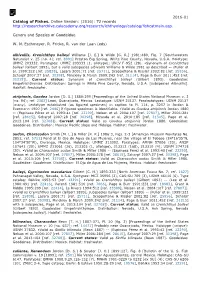
2016-01 Catalog of Fishes. Online Version: (2016): 72 records http://researcharchive.calacademy.org/research/ichthyology/catalog/fishcatmain.asp. Genera and Species of Goodeidae W. N. Eschmeyer, R. Fricke, R. van der Laan (eds) albivallis, Crenichthys baileyi Williams [J. E.] & Wilde [G. R.] 1981:489, Fig. 7 [Southwestern Naturalist v. 25 (no. 4); ref. 8991] Preston Big Spring, White Pine County, Nevada, U.S.A. Holotype: UMMZ 203332. Paratypes: UMMZ 203333 (1, allotype); UNLV F-952 (28). •Synonym of Crenichthys baileyi (Gilbert 1893), but a valid subspecies albivallis Williams & Wilde 1981 as described -- (Fuller et al. 1999:322 [ref. 25838], Lazara 2001:71 [ref. 25711], Scoppettone & Rissler 2002:82 [ref. 25956], Scharpf 2007:27 [ref. 30398], Minckley & Marsh 2009:243 [ref. 31114], Page & Burr 2011:452 [ref. 31215]). Current status: Synonym of Crenichthys baileyi (Gilbert 1893). Goodeidae: Empetrichthyinae. Distribution: Springs in White Pine County, Nevada, U.S.A. [subspecies Albivallis]. Habitat: freshwater. atripinnis, Goodea Jordan [D. S.] 1880:299 [Proceedings of the United States National Museum v. 2 (no. 94); ref. 2382] Leon, Guanajuato, Mexico. Lectotype: USNM 23137. Paralectotypes: USNM 23137 (many). Lectotype established (as figured specimen) in caption to Pl. 114, p. 3257 in Jordan & Evermann 1900 [ref. 2446] if figured specimen is identifiable. •Valid as Goodea atripinnis Jordan 1880 -- (Espinosa Pérez et al. 1993:41 [ref. 22290], Nelson et al. 2004:107 [ref. 27807], Miller 2006:281 [ref. 28615], Scharpf 2007:28 [ref. 30398], Miranda et al. 2010:185 [ref. 31345], Page et al. 2013:104 [ref. 32708]). Current status: Valid as Goodea atripinnis Jordan 1880. Goodeidae: Goodeinae. -

UNIVERSIDAD MICHOACANA DE SAN NICOLÁS DE HIDALGO Patrones De Riqueza, Endemismo Y Diversidad Beta Para La Conservación De
UNIVERSIDAD MICHOACANA DE SAN NICOLÁS DE HIDALGO Facultad de Biología Coordinación de Estudios de Posgrado Programa Institucional de Maestría en Ciencias Biológicas Ecología y Conservación Patrones de riqueza, endemismo y diversidad beta para la conservación de las especies y linajes de peces del centro de México TESIS Para obtener el grado de Maestra en Ciencias Biológicas Que presenta: BIOL. ANA BERENICE GARCÍA ANDRADE TUTOR: DR. OMAR DOMÍNGUEZ DOMÍNGUEZ Morelia Michoacán, marzo de 2017 “Nuestra lealtad es para las especies y el planeta. Nuestra obligación de sobrevivir no es sólo para nosotros mismos sino también para ese cosmos, antiguo y vasto, del cual derivamos” Carl Sagan (1934-1996) Conservación de la ictiofauna del centro de México AGRADECIMIENTOS Quiero agradecer a mi tutor, el Dr. Omar Domínguez, quien me ha permitido incursionar en un área distinta, retarme, confiar en mí y sobre todo por permitirme ser quien soy. Agradezco a las instituciones que apoyaron o financiaron parcialmente este proyecto de investigación; en la Universidad Michoacana de San Nicolás de Hidalgo (UMSNH), a la Coordinación de la Investigación Científica, la facultad de Biología y al laboratorio de Biología Acuática “J. Javier Alvarado Díaz”. Además, a la National Science Foundation para la Southeastern Louisiana University y el proyecto financiano por el Ministerio de Economia y Competitividad de España (CGL2013-41375-P). Personalmente agradezco al Consejo Nacional de Ciencia y Tecnología por la beca otorgada para la realización de mi maestría, además del apoyo adicional para mi estancia en el extranjero. Así como los apoyos otorgados por la Jefatura de la división de estudios de Posgrado, el Programa de Fortalecimiento a la Calidad Educativa (P/PROFOCIE-2015-16MSU0014T- 09) y el Programa Institucional de Maestría en Ciencias Biologícas de la UMSNH para la realización de estancias y la asistencia a congresos, dentro y fuera de México. -

Extinction Rates in North American Freshwater Fishes, 19002010
Extinction Rates in North American Freshwater Fishes, 1900–2010 Author(s): Noel M. Burkhead Reviewed work(s): Source: BioScience, Vol. 62, No. 9 (September 2012), pp. 798-808 Published by: University of California Press on behalf of the American Institute of Biological Sciences Stable URL: http://www.jstor.org/stable/10.1525/bio.2012.62.9.5 . Accessed: 21/09/2012 12:59 Your use of the JSTOR archive indicates your acceptance of the Terms & Conditions of Use, available at . http://www.jstor.org/page/info/about/policies/terms.jsp . JSTOR is a not-for-profit service that helps scholars, researchers, and students discover, use, and build upon a wide range of content in a trusted digital archive. We use information technology and tools to increase productivity and facilitate new forms of scholarship. For more information about JSTOR, please contact support@jstor.org. University of California Press and American Institute of Biological Sciences are collaborating with JSTOR to digitize, preserve and extend access to BioScience. http://www.jstor.org Articles Articles Extinction Rates in North American Freshwater Fishes, 1900–2010 NOEL M. BURKHEAD Widespread evidence shows that the modern rates of extinction in many plants and animals exceed background rates in the fossil record. In the present article, I investigate this issue with regard to North American freshwater fishes. From 1898 to 2006, 57 taxa became extinct, and three distinct populations were extirpated from the continent. Since 1989, the numbers of extinct North American fishes have increased by 25%. From the end of the nineteenth century to the present, modern extinctions varied by decade but significantly increased after 1950 (post-1950s mean = 7.5 extinct taxa per decade). -

REPRODUCTIVE BIOLOGY of Goodea Atripinnis (JORDAN, 1880) (CYPRINODONTIFORMES: GOODEIDAE) UNDER CONTROLLED CONDITIONS
Journal of Experimental Biology and Agricultural Sciences, April - 2016; Volume – 4(2) Journal of Experimental Biology and Agricultural Sciences http://www.jebas.org ISSN No. 2320 – 8694 REPRODUCTIVE BIOLOGY OF Goodea atripinnis (JORDAN, 1880) (CYPRINODONTIFORMES: GOODEIDAE) UNDER CONTROLLED CONDITIONS Joao Roberto Silva-Santos1, Ma. Consolación Martínez-Saldaña2, Roberto Rico-Martínez3, José Luis Gómez-Márquez4 and José Luis Arredondo-Figueroa5,* 1 Doctoral Program in Biological Science, Basic Sciences Center, Autonomous University of Aguascalientes, Aguascalientes, Mexico 2 Department of Morphology, Basic Sciences Center, Autonomous University of Aguascalientes, Aguascalientes, Mexico 3 Department of Chemistry, Basic Sciences Center, Autonomous University of Aguascalientes, Aguascalientes, Mexico 4 Department of Biology, Faculty of Higher Education, Zaragoza, National Autonomous University of México, Federal District, Mexico 5 Department of Zootecnia, Agronomy Sciences Center, Autonomous University of Aguascalientes, Aguascalientes, Mexico Received – February 25, 2016; Revision – March 09, 2016; Accepted – April 15, 2016 Available Online – April 25, 2016 DOI: http://dx.doi.org/10.18006/2016.4(2).180.193 KEYWORDS ABSTRACT Reproduction The study was conducted to investigate the reproductive biology of Goodea atripinnis under controlled conditions in the Aguascalientes state. Fifty wild brooders were collected, acclimatized and reared to Goodea atripinnis obtain two F1 that were cultured until reaching sexual maturation. Then, two males and one female were placed in 40-L aquariums maintained at an average water temperature of 24.4 ± 0.37°C under a 14 h Goodeidae light: 10 h dark photoperiod. The courtships description was obtained by observations and digital Culture photographs. Furthermore, the gestation period, fertility, total weight (TW, g) and total length (TL, mm) of the both F1 offspring were recorded. -

Conservation Status of Imperiled North American Freshwater And
FEATURE: ENDANGERED SPECIES Conservation Status of Imperiled North American Freshwater and Diadromous Fishes ABSTRACT: This is the third compilation of imperiled (i.e., endangered, threatened, vulnerable) plus extinct freshwater and diadromous fishes of North America prepared by the American Fisheries Society’s Endangered Species Committee. Since the last revision in 1989, imperilment of inland fishes has increased substantially. This list includes 700 extant taxa representing 133 genera and 36 families, a 92% increase over the 364 listed in 1989. The increase reflects the addition of distinct populations, previously non-imperiled fishes, and recently described or discovered taxa. Approximately 39% of described fish species of the continent are imperiled. There are 230 vulnerable, 190 threatened, and 280 endangered extant taxa, and 61 taxa presumed extinct or extirpated from nature. Of those that were imperiled in 1989, most (89%) are the same or worse in conservation status; only 6% have improved in status, and 5% were delisted for various reasons. Habitat degradation and nonindigenous species are the main threats to at-risk fishes, many of which are restricted to small ranges. Documenting the diversity and status of rare fishes is a critical step in identifying and implementing appropriate actions necessary for their protection and management. Howard L. Jelks, Frank McCormick, Stephen J. Walsh, Joseph S. Nelson, Noel M. Burkhead, Steven P. Platania, Salvador Contreras-Balderas, Brady A. Porter, Edmundo Díaz-Pardo, Claude B. Renaud, Dean A. Hendrickson, Juan Jacobo Schmitter-Soto, John Lyons, Eric B. Taylor, and Nicholas E. Mandrak, Melvin L. Warren, Jr. Jelks, Walsh, and Burkhead are research McCormick is a biologist with the biologists with the U.S. -

CARES Exchange April 2017 2 GS CD 4-16-17 1
The CARES Exchange Volume I Number 2 CARESCARES AreaArea ofof ConcernConcern LakeLake MalawiMalawi April 2017 CARESCARES ClubClub DataData SubmissionSubmission isis AprilApril 30th!30th! TheThe DirectoryDirectory ofof AvailableAvailable CARESCARES SpeciesSpecies NewestNewest AdditionsAdditions toto thethe CARESCARES TeamTeam NewNew EnglandEngland CichlidCichlid AssociationAssociation CARESCARES 2 Welcome to the The CARES Exchange. The pri- CARES, review the ‘CARES Startup’ tab on the web- mary intent of this publication is to make available a site CARESforfish.org, then contact Klaus Steinhaus listing of CARES fish from the CARES membership at klaus@CARESforfish.org. to those that may be searching for CARES species. ___________________________________________ This issue of The Exchange was release to coincide It is important to understand that all transactions are with the due date for CARES Member Clubs to make between the buyer and seller and CARES in no way your data submissions. All submissions must be sub- moderates any exchanges including shipping prob- mitted by April 30th in the new file format. Learn lems, refunds, or bad blood between the two parties. more on page 7. This directory merely provides an avenue to which CARES fish may be located. As with all sales, be cer- Pam Chin explains the stressors affecting Lake Ma- tain that all the elements of the exchange are worked lawi. Pay close attention to what is going on there! out before purchasing or shipping. Take your CARES role seriously. Without your ef- forts, the fish we enjoy today might not be around to- No hybrids will knowingly be listed. morrow, There is no cost to place a for sale ad.