Insects of the Nebraska Sandhills
Total Page:16
File Type:pdf, Size:1020Kb
Load more
Recommended publications
-

Ants As Prey for the Endemic and Endangered Spanish Tiger Beetle Cephalota Dulcinea (Coleoptera: Carabidae) Carlo Polidori A*, Paula C
Annales de la Société entomologique de France (N.S.), 2020 https://doi.org/10.1080/00379271.2020.1791252 Ants as prey for the endemic and endangered Spanish tiger beetle Cephalota dulcinea (Coleoptera: Carabidae) Carlo Polidori a*, Paula C. Rodríguez-Flores b,c & Mario García-París b aInstituto de Ciencias Ambientales (ICAM), Universidad de Castilla-La Mancha, Avenida Carlos III, S/n, 45071, Toledo, Spain; bDepartamento de Biodiversidad y Biología Evolutiva, Museo Nacional de Ciencias Naturales (MNCN-CSIC), Madrid, 28006, Spain; cCentre d’Estudis Avançats de Blanes (CEAB-CSIC), C. d’Accés Cala Sant Francesc, 14, 17300, Blanes, Spain (Accepté le 29 juin 2020) Summary. Among the insects inhabiting endorheic, temporary and highly saline small lakes of central Spain during dry periods, tiger beetles (Coleoptera: Carabidae: Cicindelinae) form particularly rich assemblages including unique endemic species. Cephalota dulcinea López, De la Rosa & Baena, 2006 is an endemic, regionally protected species that occurs only in saline marshes in Castilla-La Mancha (Central Spain). Here, we report that C. dulcinea suffers potential risks associated with counter-attacks by ants (Hymenoptera: Formicidae), while using them as prey at one of these marshes. Through mark–recapture methods, we estimated the population size of C. dulcinea at the study marsh as of 1352 individuals, with a sex ratio slightly biased towards males. Evident signs of ant defensive attack by the seed-harvesting ant Messor barbarus (Forel, 1905) were detected in 14% of marked individuals, sometimes with cut ant heads still grasped with their mandibles to the beetle body parts. Ant injuries have been more frequently recorded at the end of adult C. -

Rare Native Animals of RI
RARE NATIVE ANIMALS OF RHODE ISLAND Revised: March, 2006 ABOUT THIS LIST The list is divided by vertebrates and invertebrates and is arranged taxonomically according to the recognized authority cited before each group. Appropriate synonomy is included where names have changed since publication of the cited authority. The Natural Heritage Program's Rare Native Plants of Rhode Island includes an estimate of the number of "extant populations" for each listed plant species, a figure which has been helpful in assessing the health of each species. Because animals are mobile, some exhibiting annual long-distance migrations, it is not possible to derive a population index that can be applied to all animal groups. The status assigned to each species (see definitions below) provides some indication of its range, relative abundance, and vulnerability to decline. More specific and pertinent data is available from the Natural Heritage Program, the Rhode Island Endangered Species Program, and the Rhode Island Natural History Survey. STATUS. The status of each species is designated by letter codes as defined: (FE) Federally Endangered (7 species currently listed) (FT) Federally Threatened (2 species currently listed) (SE) State Endangered Native species in imminent danger of extirpation from Rhode Island. These taxa may meet one or more of the following criteria: 1. Formerly considered by the U.S. Fish and Wildlife Service for Federal listing as endangered or threatened. 2. Known from an estimated 1-2 total populations in the state. 3. Apparently globally rare or threatened; estimated at 100 or fewer populations range-wide. Animals listed as State Endangered are protected under the provisions of the Rhode Island State Endangered Species Act, Title 20 of the General Laws of the State of Rhode Island. -

This Work Is Licensed Under the Creative Commons Attribution-Noncommercial-Share Alike 3.0 United States License
This work is licensed under the Creative Commons Attribution-Noncommercial-Share Alike 3.0 United States License. To view a copy of this license, visit http://creativecommons.org/licenses/by-nc-sa/3.0/us/ or send a letter to Creative Commons, 171 Second Street, Suite 300, San Francisco, California, 94105, USA. THE TIGER BEETLES OF ALBERTA (COLEOPTERA: CARABIDAE, CICINDELINI)' Gerald J. Hilchie Department of Entomology University of Alberta Edmonton, Alberta T6G 2E3. Quaestiones Entomologicae 21:319-347 1985 ABSTRACT In Alberta there are 19 species of tiger beetles {Cicindela). These are found in a wide variety of habitats from sand dunes and riverbanks to construction sites. Each species has a unique distribution resulting from complex interactions of adult site selection, life history, competition, predation and historical factors. Post-pleistocene dispersal of tiger beetles into Alberta came predominantly from the south with a few species entering Alberta from the north and west. INTRODUCTION Wallis (1961) recognized 26 species of Cicindela in Canada, of which 19 occur in Alberta. Most species of tiger beetle in North America are polytypic but, in Alberta most are represented by a single subspecies. Two species are represented each by two subspecies and two others hybridize and might better be described as a single species with distinct subspecies. When a single subspecies is present in the province morphs normally attributed to other subspecies may also be present, in which case the most common morph (over 80% of a population) is used for subspecies designation. Tiger beetles have always been popular with collectors. Bright colours and quick flight make these beetles a sporting and delightful challenge to collect. -

Status and Conservation of an Imperiled Tiger Beetle Fauna in New York State, USA
J Insect Conserv (2011) 15:839–852 DOI 10.1007/s10841-011-9382-y ORIGINAL PAPER Status and conservation of an imperiled tiger beetle fauna in New York State, USA Matthew D. Schlesinger • Paul G. Novak Received: 29 October 2010 / Accepted: 17 January 2011 / Published online: 15 February 2011 Ó Springer Science+Business Media B.V. 2011 Abstract New York has 22 documented species of tiger Introduction beetles (Coleoptera: Cicindelidae). Over half of these species are considered rare, at risk, or potentially extirpated Tiger beetles (Coleoptera: Cicindelidae) are strikingly from the state. These rare species specialize on three sandy patterned, predatory insects that have captured the attention habitat types under threat from human disturbance: bea- of entomologists and collectors for centuries. Beyond their ches, pine barrens, and riparian cobble bars. In 2005, we intrinsic interest, tiger beetles can serve as model organ- began a status assessment of eight of New York’s rarest isms or indicator species to enable broad conclusions about tiger beetles, examining museum records, searching the a region or ecosystem’s biodiversity (Pearson and Cassola literature, and conducting over 130 field surveys of his- 1992; Pearson and Vogler 2001). Tiger beetles are threa- torical and new locations. Significant findings included (1) tened by habitat destruction and modification, alteration of no detections of four of the eight taxa; (2) no vehicle-free natural processes like fire and flooding, and overcollection; beach habitat suitable for reintroducing Cicindela dorsalis across the United States, approximately 15% of taxa are dorsalis; (3) C. hirticollis at only 4 of 26 historical loca- threatened with extinction (Pearson et al. -

Gibson's Big Sand Tiger Beetle,Cicindela Formosa Gibsoni
COSEWIC Assessment and Status Report on the Gibson’s Big Sand Tiger Beetle Cicindela formosa gibsoni in Canada THREATENED 2012 COSEWIC status reports are working documents used in assigning the status of wildlife species suspected of being at risk. This report may be cited as follows: COSEWIC. 2012. COSEWIC assessment and status report on the Gibson’s Big Sand Tiger Beetle Cicindela formosa gibsoni in Canada. Committee on the Status of Endangered Wildlife in Canada. Ottawa. ix + 42 pp. (www.registrelep-sararegistry.gc.ca/default_e.cfm). Production note: COSEWIC would like to acknowledge Robert Foster and Allan Harris for writing the status report on the Gibson’s Big Sand Tiger Beetle, Cicindela formosa gibsoni, in Canada, prepared under contract with Environment Canada. This report was overseen and edited by Dr. Paul Catling, Co-chair of the COSEWIC Arthropods Specialist Subcommittee. For additional copies contact: COSEWIC Secretariat c/o Canadian Wildlife Service Environment Canada Ottawa, ON K1A 0H3 Tel.: 819-953-3215 Fax: 819-994-3684 E-mail: COSEWIC/COSEPAC@ec.gc.ca http://www.cosewic.gc.ca Également disponible en français sous le titre Ếvaluation et Rapport de situation du COSEPAC sur la Cicindèle à grandes taches de Gibson (Cicindela formosa gibsoni) au Canada. Cover illustration/photo: Gibson’s Big Sand Tiger Beetle — Photo by Brian Ratcliff. Her Majesty the Queen in Right of Canada, 2013. Catalogue No. CW69-14/660-2013E-PDF ISBN 978-1-100-22122-9 Recycled paper COSEWIC Assessment Summary Assessment Summary – November 2012 Common name Gibson’s Big Sand Tiger Beetle Scientific name Cicindela formosa gibsoni Status Threatened Reason for designation This very restricted subspecies, with most of its populations in Canada, requires open sand dune areas. -

Hypoxia Tolerance in Adult and Larval Cicindela Tiger Beetles Varies by Life History but Not Habitat Association
University of Nebraska - Lincoln DigitalCommons@University of Nebraska - Lincoln Entomology Papers from Other Sources Entomology Collections, Miscellaneous 2009 Hypoxia Tolerance in Adult and Larval Cicindela Tiger Beetles Varies by Life History but Not Habitat Association Mathew L. Brust Chadron State College, mbrust@csc.edu W. Wyatt Hoback University of Nebraska-Kearney, whoback@okstate.edu Follow this and additional works at: https://digitalcommons.unl.edu/entomologyother Part of the Entomology Commons Brust, Mathew L. and Hoback, W. Wyatt, "Hypoxia Tolerance in Adult and Larval Cicindela Tiger Beetles Varies by Life History but Not Habitat Association" (2009). Entomology Papers from Other Sources. 1. https://digitalcommons.unl.edu/entomologyother/1 This Article is brought to you for free and open access by the Entomology Collections, Miscellaneous at DigitalCommons@University of Nebraska - Lincoln. It has been accepted for inclusion in Entomology Papers from Other Sources by an authorized administrator of DigitalCommons@University of Nebraska - Lincoln. ECOLOGY AND POPULATION BIOLOGY Hypoxia Tolerance in Adult and Larval Cicindela Tiger Beetles Varies by Life History but Not Habitat Association 1 2 MATHEW L. BRUST AND W. WYATT HOBACK Ann. Entomol. Soc. Am. 102(3): 462Ð466 (2009) ABSTRACT Flooding exposes terrestrial organisms to severe hypoxia. Among the best-studied insects that are frequently exposed to ßooding are tiger beetle (Coleoptera: Cicindelidae) larvae. In previous studies with a limited number of species, a correlation was found between habitat and hypoxia tolerance. In the current study, we examined hypoxia tolerance among third instars of six Cicindela species that vary in habitat association; we also tested adult survival of these species. -
Appendix 1A, B, C, D, E, F
Appendix 1a, b, c, d, e, f Table of Contents Appendix 1a. Rhode Island SWAP Data Sources ....................................................................... 1 Appendix 1b. Rhode Island Species of Greatest Conservation Need .................................... 19 Appendix 1c. Regional Conservation Needs-Species of Greatest Conservation Need ....... 48 Appendix 1d. List of Rare Plants in Rhode Island .................................................................... 60 Appendix 1e: Summary of Rhode Island Vertebrate Additions and Deletions to 2005 SGCN List ....................................................................................................................................................... 75 Appendix 1f: Summary of Rhode Island Invertebrate Additions and Deletions to 2005 SGCN List ....................................................................................................................................................... 78 APPENDIX 1a: RHODE ISLAND WAP DATA SOURCES Appendix 1a. Rhode Island SWAP Data Sources This appendix lists the information sources that were researched, compiled, and reviewed in order to best determine and present the status of the full array of wildlife and its conservation in Rhode Island (Element 1). A wide diversity of literature and programs was consulted and compiled through extensive research and coordination efforts. Some of these sources are referenced in the Literature Cited section of this document, and the remaining sources are provided here as a resource for users and implementing -

List of Rare, Threatened, and Endangered Animals of Maryland
List of Rare, Threatened, and Endangered Animals of Maryland December 2016 Maryland Wildlife and Heritage Service Natural Heritage Program Larry Hogan, Governor Mark Belton, Secretary Wildlife & Heritage Service Natural Heritage Program Tawes State Office Building, E-1 580 Taylor Avenue Annapolis, MD 21401 410-260-8540 Fax 410-260-8596 dnr.maryland.gov Additional Telephone Contact Information: Toll free in Maryland: 877-620-8DNR ext. 8540 OR Individual unit/program toll-free number Out of state call: 410-260-8540 Text Telephone (TTY) users call via the Maryland Relay The facilities and services of the Maryland Department of Natural Resources are available to all without regard to race, color, religion, sex, sexual orientation, age, national origin or physical or mental disability. This document is available in alternative format upon request from a qualified individual with disability. Cover photo: A mating pair of the Appalachian Jewelwing (Calopteryx angustipennis), a rare damselfly in Maryland. (Photo credit, James McCann) ACKNOWLEDGMENTS The Maryland Department of Natural Resources would like to express sincere appreciation to the many scientists and naturalists who willingly share information and provide their expertise to further our mission of conserving Maryland’s natural heritage. Publication of this list is made possible by taxpayer donations to Maryland’s Chesapeake Bay and Endangered Species Fund. Suggested citation: Maryland Natural Heritage Program. 2016. List of Rare, Threatened, and Endangered Animals of Maryland. Maryland Department of Natural Resources, 580 Taylor Avenue, Annapolis, MD 21401. 03-1272016-633. INTRODUCTION The following list comprises 514 native Maryland animals that are among the least understood, the rarest, and the most in need of conservation efforts. -
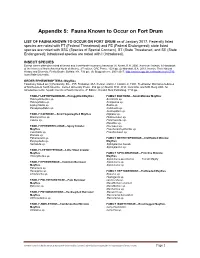
Appendix 5: Fauna Known to Occur on Fort Drum
Appendix 5: Fauna Known to Occur on Fort Drum LIST OF FAUNA KNOWN TO OCCUR ON FORT DRUM as of January 2017. Federally listed species are noted with FT (Federal Threatened) and FE (Federal Endangered); state listed species are noted with SSC (Species of Special Concern), ST (State Threatened, and SE (State Endangered); introduced species are noted with I (Introduced). INSECT SPECIES Except where otherwise noted all insect and invertebrate taxonomy based on (1) Arnett, R.H. 2000. American Insects: A Handbook of the Insects of North America North of Mexico, 2nd edition, CRC Press, 1024 pp; (2) Marshall, S.A. 2013. Insects: Their Natural History and Diversity, Firefly Books, Buffalo, NY, 732 pp.; (3) Bugguide.net, 2003-2017, http://www.bugguide.net/node/view/15740, Iowa State University. ORDER EPHEMEROPTERA--Mayflies Taxonomy based on (1) Peckarsky, B.L., P.R. Fraissinet, M.A. Penton, and D.J. Conklin Jr. 1990. Freshwater Macroinvertebrates of Northeastern North America. Cornell University Press. 456 pp; (2) Merritt, R.W., K.W. Cummins, and M.B. Berg 2008. An Introduction to the Aquatic Insects of North America, 4th Edition. Kendall Hunt Publishing. 1158 pp. FAMILY LEPTOPHLEBIIDAE—Pronggillled Mayflies FAMILY BAETIDAE—Small Minnow Mayflies Habrophleboides sp. Acentrella sp. Habrophlebia sp. Acerpenna sp. Leptophlebia sp. Baetis sp. Paraleptophlebia sp. Callibaetis sp. Centroptilum sp. FAMILY CAENIDAE—Small Squaregilled Mayflies Diphetor sp. Brachycercus sp. Heterocloeon sp. Caenis sp. Paracloeodes sp. Plauditus sp. FAMILY EPHEMERELLIDAE—Spiny Crawler Procloeon sp. Mayflies Pseudocentroptiloides sp. Caurinella sp. Pseudocloeon sp. Drunela sp. Ephemerella sp. FAMILY METRETOPODIDAE—Cleftfooted Minnow Eurylophella sp. Mayflies Serratella sp. -

Ecology of the Larvae of Holarctic Tiger- Beetles (Family Cicindelidae)
STUDIES ON THE MORPHOLOGY, TAXONOMY, AND ECOLOGY OF THE LARVAE OF HOLARCTIC TIGER- BEETLES (FAMILY CICINDELIDAE). By Clyde C. Hamilton, Associate Entomologist, University of Maryland. INTRODUCTION. Larvae of the Cicindelidae were first noted in literature as early as 1798. The first work of importance is that of J. C. Schiodte : De Metamorphosi Eleutheratorum observationes, Carabi. in 1867. His observations, descriptions, and figures of Cicindela hyhrida and C. cajupestris are excellent. George H. Horn, in 1878, gave a detailed description of a larva from each of the four genera occuring in the United States. His descriptions are too general to be of much morphological or taxonomical value. During the same year and several succeeding years F. G. Schaupp published a number of notes on tiger-beetle larvae. From this time until 1905 very little attention was given to the study of the larvae. In 1907 Dr. V. E. Shelford published in the Biological Bulletin an excellent account of the habits and distribu- tion of a number of the species occurring in the vicinity of Chicago, Illinois. The following year he published on the life history and habits of these same species and considered their relation to hiberna- tion, depth of burrow, moisture, temperature, etc. In later papers he has made detailed comparisons of the ecology of the larvae of the same species and of different species from widely separated regions. During 1907 and 1910 Norman Criddle published in the Canadian Entomologist excellent accounts of the habits and life histories of a number of the species occuring in Manitoba, Canada. Some of the more interesting facts he pointed out are the increased depth of the burrow, the smaller size of the species and the lengthening of the life history, due to the long severe winters and short summers. -

The Clcindelidae of Illinois
Eastern Illinois University The Keep Insect Population Studies Research Projects 1980 The lcC indelidae of Illinois Ron Garner Eastern Illinois University Follow this and additional works at: http://thekeep.eiu.edu/insect_populations Part of the Entomology Commons Recommended Citation Garner, Ron, "The lcC indelidae of Illinois" (1980). Insect Population Studies. 4. http://thekeep.eiu.edu/insect_populations/4 This Article is brought to you for free and open access by the Research Projects at The Keep. It has been accepted for inclusion in Insect Population Studies by an authorized administrator of The Keep. For more information, please contact tabruns@eiu.edu. The Clcindelidae of Illinois ABSTrlJ\C·T: Twenty-one species of Cicindelidae occur in Illinois. J\m:-:ing these are two species of Tetrecha ( carolina � virginica), 8-nd nineteen species of Cicindela ( forr::.osa, purpurea, 11mbal1 s, splend1da, duodecimguttata, renanda, hirticollis, tranauebarica, scutellaris, sexguttata, patruela, J;illnctt1lata, rufiventris, celeripes, curisitans, uniuunctuta, cuprascens, macra and lepida). The species named are identified by use of a key. Illinois distributio�al records are liste� for each species. The Cicindelidae of Illinois Purpose: The purpose of this paper is to give a simple listing of the species found in Illinois and to clarify previous work, making it easier to identify Illinois specimens. Historical Background: Vuch work has been done on North Aner icRn Cicindelids. Leng (1902) revised the Cicindelids of Bor eal .Arierica. Nicola,y and ileiss (1932) clarified the purpurea group and listed a few Illinois localities. Vaurie (1951) ele vated a. �acra Lee. to specific rank. Freitag (1965) revised the Q. mar�tima group and listed many Illinois localities for .Q. -
Bulletin Number / Numéro 2 Entomological Society of Canada Société D’Entomologie Du Canada June / Juin 2020
............................................................ .......................................................... Volume 52 Bulletin Number / numéro 2 Entomological Society of Canada Société d’entomologie du Canada June / juin 2020 Published quarterly by the Entomological Society of Canada Publication trimestrielle par la Société d’entomologie du Canada ........................................................................................................... .......................................................................................................................................................... .......................................................................................................................................................... ................................................................................................................... ............................................................... .......................................................................... List of Contents / Table des matières Volume 52(2), June / juin 2020 Up front / Avant-propos ..........................................................................................................81 Joint Annual Meeting 2020 / Reunion annuelle conjointe 2020..............................................84 STEP Corner / Le coin de la relève...........................................................................................85 News from the Regions / Nouvelles des régions.................................................................87