Federal Register/Vol. 72, No. 187/Thursday, September 27
Total Page:16
File Type:pdf, Size:1020Kb
Load more
Recommended publications
-

Adenostoma Fasciculatum Profile to Postv2.Xlsx
I. SPECIES Adenostoma fasciculatum Hooker & Arnott NRCS CODE: ADFA Family: Rosaceae A. f. var. obtusifolium, Ron A. f. var. fasciculatum., Riverside Co., A. Montalvo, RCRCD Vanderhoff (Creative Order: Rosales Commons CC) Subclass: Rosidae Class: Magnoliopsida A. Subspecific taxa 1. Adenostoma fasciculatum var. fasciculatum Hook. & Arn. 1. ADFAF 2. A. f. var. obusifolium S. Watson 2. ADFAO 3. A. f. var. prostratum Dunkle 3. (no NRCS code) B. Synonyms 1. A. f. var. densifolium Eastw. 2. A. brevifolium Nutt. 3. none. Formerly included as part of A. f. var. f. C. Common name 1. chamise, common chamise, California greasewood, greasewood, chamiso (Painter 2016) 2. San Diego chamise (Calflora 2016) 3. prostrate chamise (Calflora 2016) Phylogenetic studies using molecular sequence data placedAdenostoma closest to Chamaebatiaria and D. Taxonomic relationships Sorbaria (Morgan et al. 1994, Potter et al. 2007) and suggest tentative placement in subfamily Spiraeoideae, tribe Sorbarieae (Potter et al. 2007). E. Related taxa in region Adenostoma sparsifolium Torrey, known as ribbon-wood or red-shanks is the only other species of Adenostoma in California. It is a much taller, erect to spreading shrub of chaparral vegetation, often 2–6 m tall and has a more restricted distribution than A. fasciculatum. It occurs from San Luis Obispo Co. south into Baja California. Red-shanks produces longer, linear leaves on slender long shoots rather than having leaves clustered on short shoots (lacks "fascicled" leaves). Its bark is cinnamon-colored and in papery layers that sheds in long ribbons. F. Taxonomic issues The Jepson eFlora and the FNA recognize A. f. var. prostratum but the taxon is not recognized by USDA PLANTS (2016). -

Ceanothus Crassifolius Torrey NRCS CODE: Family: Rhamnaceae (CECR) Order: Rhamnales Subclass: Rosidae Class: Magnoliopsida
I. SPECIES Ceanothus crassifolius Torrey NRCS CODE: Family: Rhamnaceae (CECR) Order: Rhamnales Subclass: Rosidae Class: Magnoliopsida Lower right: Ripening fruits, two already dehisced. Lower center: Longitudinal channeling in stems of old specimen, typical of obligate seeding Ceanothus (>25 yr since last fire). Note dark hypanthium in center of white flowers. Photos by A. Montalvo. A. Subspecific taxa 1. C. crassifolius Torr. var. crassifolius 2. C. crassifolius Torr. var. planus Abrams (there is no NRCS code for this taxon) B. Synonyms 1. C. verrucosus Nuttal var. crassifolius K. Brandegee (Munz & Keck 1968; Burge et al. 2013) 2. C. crassifolius (in part, USDA PLANTS 2019) C. Common name 1. hoaryleaf ceanothus, sometimes called thickleaf ceanothus or thickleaf wild lilac (Painter 2016) 2. same as above; flat-leaf hoary ceanothus and flat-leaf snowball ceanothus are applied to other taxa (Painter 2016) D. Taxonomic relationships Ceanothus is a diverse genus with over 50 taxa that cluster in to two subgenera. C. crassifolius has long been recognized as part of the Cerastes group of Ceanothus based on morphology, life-history, and crossing studies (McMinn 1939a, Nobs 1963). In phylogenetic analyses based on RNA and chloroplast DNA, Hardig et al. (2000) found C. crassifolius clustered into the Cerastes group and in each analysis shared a clade with C. ophiochilus. In molecular and morphological analyses, Burge et al. (2011) also found C. crassifolius clustered into Cerastes. Cerastes included over 20 taxa and numerous subtaxa in both studies. Eight Cerastes taxa occur in southern California (see I. E. Related taxa in region). E. Related taxa in region In southern California, the related Cerastes taxa include: C. -

Vascular Flora of the Liebre Mountains, Western Transverse Ranges, California Steve Boyd Rancho Santa Ana Botanic Garden
Aliso: A Journal of Systematic and Evolutionary Botany Volume 18 | Issue 2 Article 15 1999 Vascular flora of the Liebre Mountains, western Transverse Ranges, California Steve Boyd Rancho Santa Ana Botanic Garden Follow this and additional works at: http://scholarship.claremont.edu/aliso Part of the Botany Commons Recommended Citation Boyd, Steve (1999) "Vascular flora of the Liebre Mountains, western Transverse Ranges, California," Aliso: A Journal of Systematic and Evolutionary Botany: Vol. 18: Iss. 2, Article 15. Available at: http://scholarship.claremont.edu/aliso/vol18/iss2/15 Aliso, 18(2), pp. 93-139 © 1999, by The Rancho Santa Ana Botanic Garden, Claremont, CA 91711-3157 VASCULAR FLORA OF THE LIEBRE MOUNTAINS, WESTERN TRANSVERSE RANGES, CALIFORNIA STEVE BOYD Rancho Santa Ana Botanic Garden 1500 N. College Avenue Claremont, Calif. 91711 ABSTRACT The Liebre Mountains form a discrete unit of the Transverse Ranges of southern California. Geo graphically, the range is transitional to the San Gabriel Mountains, Inner Coast Ranges, Tehachapi Mountains, and Mojave Desert. A total of 1010 vascular plant taxa was recorded from the range, representing 104 families and 400 genera. The ratio of native vs. nonnative elements of the flora is 4:1, similar to that documented in other areas of cismontane southern California. The range is note worthy for the diversity of Quercus and oak-dominated vegetation. A total of 32 sensitive plant taxa (rare, threatened or endangered) was recorded from the range. Key words: Liebre Mountains, Transverse Ranges, southern California, flora, sensitive plants. INTRODUCTION belt and Peirson's (1935) handbook of trees and shrubs. Published documentation of the San Bernar The Transverse Ranges are one of southern Califor dino Mountains is little better, limited to Parish's nia's most prominent physiographic features. -

Rhamnus Crocea Nutt
I.SPECIES Rhamnus crocea Nutt. and Rhamnus ilicifolia Kellogg NRCS CODE: Family: Rhamnaceae 1. RHCR Order: Rhamnales 2. RHIL Subclass: Rosidae Class: Magnoliopsida Rhamnus crocea, San Bernardino Co., 5 June 2015, A. Montalvo Rhamnus ilicifolia, Riverside Co., Rhamnus ilicifolia, Riverside Co. Note the finely serrulate leaf 10 June 2015. A. Montalvo margins. 7 March 2008. A. Montalvo A. Subspecific taxa 1. None recognized by Sawyer (2012b) or in 2019 Jepson e-Flora whereas R. pilosa is recognized as R. c. 1. RHCR Nutt. subsp. pilosa (Trel.) C.B. Wolf in the PLANTS database (USDA PLANTS 2018). 2. RHIL 2. None B. Synonyms 1. RHCR 1 . Rhamnus croceus (spelling variant noted by FNA 2018) 2. RHIL 2. Rhamnus crocea Nutt. subsp. ilicifolia (Kellogg) C.B. Wolf; R. c. Nutt. var. ilicifolia (Kellogg) Greene (USDA PLANTS 2018) last modified: 3/4/2020 RHCR RHIL, page 1 printed: 3/10/2020 C. Common name The name red-berry, redberry, redberry buckthorn, California red-berry, evergreen buckthorn, spiny buckthorn, and hollyleaf buckthorn have been used for multiple taxa of Rhamnus (Painter 2016 a,b) 1. RHCR 1. Spiny redberry (Sawyer 2012a); also little-leaved redberry (Painter 2016a) 2. RHIL 2. Hollyleaf redberry (Sawyer 2012b); also holly-leaf buckthorn, holly-leaf coffeeberry (Painter 2016b) D. Taxonomic relationships There are about 150 species of Rhamnus worldwide and 14 in North America, 6 of which were introduced from other continents (Nesom & Sawyer 2018, FNA). This is after splitting the genus into Rhamnus (buckthorns and redberries) and Frangula (coffeeberries) based on a combination of fruit, leaf venation, and flower traits (Johnston 1975, FNA). -

Vegetation Alliances of Western Riverside County, California
Vegetation Alliances of Western Riverside County, California By Anne Klein and Julie Evens California Native Plant Society 2707 K Street, Suite 1 Sacramento CA, 95816 Final report prepared for The California Department of Fish and Game Habitat Conservation Division Contract Number: P0185404 August 2005 (Revised April 2006) TABLE OF CONTENTS INTRODUCTION ................................................................................................................................................1 METHODS .......................................................................................................................................................1 Study area.................................................................................................................................................1 Figure 1. Study area in Western Riverside County within Southern California, showing ecological subsections...............................................................................................................................................3 Sampling...................................................................................................................................................4 Figure 2. Locations of field surveys within Western Riverside County.....................................................5 Existing Literature Review ........................................................................................................................7 Cluster analyses for vegetation classification...........................................................................................7 -

Tribe Species Secretory Structure Compounds Organ References Incerteae Sedis Alphitonia Sp. Epidermis, Idioblasts, Cavities
Table S1. List of secretory structures found in Rhamanaceae (excluding the nectaries), showing the compounds and organ of occurrence. Data extracted from the literature and from the present study (species in bold). * The mucilaginous ducts, when present in the leaves, always occur in the collenchyma of the veins, except in Maesopsis, where they also occur in the phloem. Tribe Species Secretory structure Compounds Organ References Epidermis, idioblasts, Alphitonia sp. Mucilage Leaf (blade, petiole) 12, 13 cavities, ducts Epidermis, ducts, Alphitonia excelsa Mucilage, terpenes Flower, leaf (blade) 10, 24 osmophores Glandular leaf-teeth, Flower, leaf (blade, Ceanothus sp. Epidermis, hypodermis, Mucilage, tannins 12, 13, 46, 73 petiole) idioblasts, colleters Ceanothus americanus Idioblasts Mucilage Leaf (blade, petiole), stem 74 Ceanothus buxifolius Epidermis, idioblasts Mucilage, tannins Leaf (blade) 10 Ceanothus caeruleus Idioblasts Tannins Leaf (blade) 10 Incerteae sedis Ceanothus cordulatus Epidermis, idioblasts Mucilage, tannins Leaf (blade) 10 Ceanothus crassifolius Epidermis; hypodermis Mucilage, tannins Leaf (blade) 10, 12 Ceanothus cuneatus Epidermis Mucilage Leaf (blade) 10 Glandular leaf-teeth Ceanothus dentatus Lipids, flavonoids Leaf (blade) (trichomes) 60 Glandular leaf-teeth Ceanothus foliosus Lipids, flavonoids Leaf (blade) (trichomes) 60 Glandular leaf-teeth Ceanothus hearstiorum Lipids, flavonoids Leaf (blade) (trichomes) 60 Ceanothus herbaceus Idioblasts Mucilage Leaf (blade, petiole), stem 74 Glandular leaf-teeth Ceanothus -

Acmispon Glaber Var
Finding Balance: Considering Species' Traits, Species Distribution Models, and Climate Forecasting in Seed Sourcing Decisions Arlee M. Montalvo Nov. 15, 2016 Do No Harm Workshop, Davis, CA Acknowledgements: My collaborators! Erin C. Riordan- the modeling and maps Jan L. Beyers- editing, profile assistance Thanks to USFS Pacific Southwest Research Station and RCRCD for funding and UCR and UCLA for logistical support! California shrublands occupy a diverse landscape: Ecological Sections and Subsections Goudey and Smith (1994) updated with ECOMAP (2007) Parent geology continental influence topography ocean influence Precipitation and temperature Ecological Sections can be diverse and contain many contrasting Subsections Elevation: 300 to 11,500 ft Precipitation: 6 to 40 inches Temperature: 40° to 70°F Goudey & Smith 1994 Growing Season: 150 to 300 days Environmental diversity supports amazing biological diversity California shrublands and their foundation plant taxa are diverse protecting, supporting, managing native biodiversity chaparral alluvial scrub coastal sage scrub Many foundation species of shrubs are distributed across multiple Ecological Sections and plant communities Plant Community Plant Community Scientific Name Life Form‡ ALSC CHAP CSS MIX Scientific Name Life Form‡ ALSC CHAP CSS MIX Acmispon glaber var. brevialatus† suffr subshr X X Eriodictyon trichocalyx var. lanatum suffr subshr X X Acmispon glaber var. glaber † Forsuffr subshreachX ofX 36X shrubsX E. t. var &. trichocalyx subshrubs: suffr subshr X X X Adenostoma fasciculatum shrub X X X Eriogonum fasciculatum var. Arctostaphylos glandulosa (3 subsp) shrub X fasciculatum subshrub X X Artemisia californica subshrub X X X E. f. var. foliolosum subshrub X X X X E. f. var. polifolium subshrub X X Ceanothus crassifolius var. -

Draft Vegetation Communities of San Diego County
DRAFT VEGETATION COMMUNITIES OF SAN DIEGO COUNTY Based on “Preliminary Descriptions of the Terrestrial Natural Communities of California” prepared by Robert F. Holland, Ph.D. for State of California, The Resources Agency, Department of Fish and Game (October 1986) Codes revised by Thomas Oberbauer (February 1996) Revised and expanded by Meghan Kelly (August 2006) Further revised and reorganized by Jeremy Buegge (March 2008) March 2008 Suggested citation: Oberbauer, Thomas, Meghan Kelly, and Jeremy Buegge. March 2008. Draft Vegetation Communities of San Diego County. Based on “Preliminary Descriptions of the Terrestrial Natural Communities of California”, Robert F. Holland, Ph.D., October 1986. March 2008 Draft Vegetation Communities of San Diego County Introduction San Diego’s vegetation communities owe their diversity to the wide range of soil and climatic conditions found in the County. The County encompasses desert, mountainous and coastal conditions over a wide range of elevation, precipitation and temperature changes. These conditions provide niches for endemic species and a wide range of vegetation communities. San Diego County is home to over 200 plant and animal species that are federally listed as rare, endangered, or threatened. The preservation of this diversity of species and habitats is important for the health of ecosystem functions, and their economic and intrinsic values. In order to effectively classify the wide variety of vegetation communities found here, the framework developed by Robert Holland in 1986 has been added to and customized for San Diego County. To supplement the original Holland Code, additions were made by Thomas Oberbauer in 1996 to account for unique habitats found in San Diego and to account for artificial habitat features (i.e., 10,000 series). -

Adenostoma Fasciculatum Hooker & Arnott NRCS CODE: ADFA Family: Rosaceae A
I. SPECIES Adenostoma fasciculatum Hooker & Arnott NRCS CODE: ADFA Family: Rosaceae A. f. var. obtusifolium, Ron A. f. var. fasciculatum., Riverside Co., A. Montalvo, RCRCD Vanderhoff (Creative Order: Rosales Commons CC) Subclass: Rosidae Class: Magnoliopsida A. Subspecific taxa 1. Adenostoma fasciculatum var. fasciculatum Hook. & Arn. 1. ADFAF 2. A. f. var. obusifolium S. Watson 2. ADFAO 3. A. f. var. prostratum Dunkle 3. (no NRCS code) B. Synonyms 1. A. f. var. densifolium Eastw. 2. A. brevifolium Nutt. 3. none. Formerly included as part of A. f. var. f. C. Common name 1. chamise, common chamise, California greasewood, greasewood, chamiso (Painter 2016) 2. San Diego chamise (Calflora 2016) 3. prostrate chamise (Calflora 2016) Phylogenetic studies using molecular sequence data placedAdenostoma closest to Chamaebatiaria and D. Taxonomic relationships Sorbaria (Morgan et al. 1994, Potter et al. 2007) and suggest tentative placement in subfamily Spiraeoideae, tribe Sorbarieae (Potter et al. 2007). E. Related taxa in region Adenostoma sparsifolium Torrey, known as ribbon-wood or red-shanks is the only other species of Adenostoma in California. It is a much taller, erect to spreading shrub of chaparral vegetation, often 2–6 m tall and has a more restricted distribution than A. fasciculatum. It occurs from San Luis Obispo Co. south into Baja California. Red-shanks produces longer, linear leaves on slender long shoots rather than having leaves clustered on short shoots (lacks "fascicled" leaves). Its bark is cinnamon-colored and in papery layers that sheds in long ribbons. F. Taxonomic issues The Jepson eFlora and the FNA recognize A. f. var. prostratum but the taxon is not recognized by USDA PLANTS (2016). -
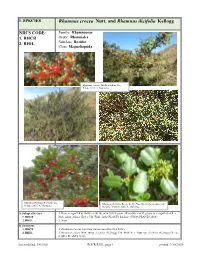
Rhamnus Crocea Nutt. and Rhamnus Ilicifolia Kellogg
I.SPECIES Rhamnus crocea Nutt. and Rhamnus ilicifolia Kellogg NRCS CODE: Family: Rhamnaceae 1. RHCR Order: Rhamnales 2. RHIL Subclass: Rosidae Class: Magnoliopsida Rhamnus crocea, San Bernardino Co., 5 June 2015, A. Montalvo Rhamnus ilicifolia, Riverside Co., Rhamnus ilicifolia, Riverside Co. Note the finely serrulate leaf 10 June 2015. A. Montalvo margins. 7 March 2008. A. Montalvo A. Subspecific taxa 1. None recognized by Sawyer (2012b) or in 2019 Jepson e-Flora whereas R. pilosa is recognized as R. c. 1. RHCR Nutt. subsp. pilosa (Trel.) C.B. Wolf in the PLANTS database (USDA PLANTS 2018). 2. RHIL 2. None B. Synonyms 1. RHCR 1 . Rhamnus croceus (spelling variant noted by FNA 2018) 2. RHIL 2. Rhamnus crocea Nutt. subsp. ilicifolia (Kellogg) C.B. Wolf; R. c. Nutt. var. ilicifolia (Kellogg) Greene (USDA PLANTS 2018) last modified: 3/4/2020 RHCR RHIL, page 1 printed: 3/10/2020 C. Common name The name red-berry, redberry, redberry buckthorn, California red-berry, evergreen buckthorn, spiny buckthorn, and hollyleaf buckthorn have been used for multiple taxa of Rhamnus (Painter 2016 a,b) 1. RHCR 1. Spiny redberry (Sawyer 2012a); also little-leaved redberry (Painter 2016a) 2. RHIL 2. Hollyleaf redberry (Sawyer 2012b); also holly-leaf buckthorn, holly-leaf coffeeberry (Painter 2016b) D. Taxonomic relationships There are about 150 species of Rhamnus worldwide and 14 in North America, 6 of which were introduced from other continents (Nesom & Sawyer 2018, FNA). This is after splitting the genus into Rhamnus (buckthorns and redberries) and Frangula (coffeeberries) based on a combination of fruit, leaf venation, and flower traits (Johnston 1975, FNA). -

Planting a Hedgerow for the Socal Inland Region
Planting a Hedgerow for the SoCal Inland Region What is a Hedgerow? A hedgerow is a row of shrubs and/or trees bordering a field, road or as part of a buffer, for a conservation purpose. Hedgerows provide many ecosystem services: • Filter water and air to improve their quality • Foster pollinators and pollination • Provide habitat for beneficial insects that help control pests, thus reducing dependence on pesticides • Provide habitat for wildlife and the biological control of rodents, rather than using rodenticides • Reduce noise and improve aesthetic value. Find inside a list of species for the inland valley areas of western Riverside and San Bernardino Counties for below 3,000 feet elevation. Besides shrubs, the list includes native grasses and herbaceous (non-woody) native plants, which are attractive to a variety of beneficial insects. By planting a variety of flowering plants, a hedgerow will provide flower blooms from late winter through summer. Grassy hedgerows do not need to be mowed, so they are less maintenance and use less water. Flowering plants provide pollen and nectar to a variety of pollinating insects, primarily bees. For native bees, leave some area of the hedgerow un-mulched to provide habitat for ground-nesting bees, important pollinators of many agricultural crops. Providing nesting sites and nourishment for pollinating insects has become crucial due to extensive pollinator decline. Pollinator decline is attributed to a variety ONTALVO M LEE of things, especially loss of natural habitat, pesticide use, and R A BY disease. HOTO P VED R Hedgerows are more likely to provide important ESE R conservation services when they are established with native IGHTS R LL A . -

Vegetation Alliances of the San Dieguito River Park Region, San Diego County, California
Vegetation alliances of the San Dieguito River Park region, San Diego County, California By Julie Evens and Sau San California Native Plant Society 2707 K Street, Suite 1 Sacramento CA, 95816 In cooperation with the California Natural Heritage Program of the California Department of Fish and Game And San Diego Chapter of the California Native Plant Society Final Report August 2005 TABLE OF CONTENTS Introduction...................................................................................................................................... 1 Methods ........................................................................................................................................... 2 Study area ................................................................................................................................... 2 Existing Literature Review........................................................................................................... 2 Sampling ..................................................................................................................................... 2 Figure 1. Study area including the San Dieguito River Park boundary within the ecological subsections color map and within the County inset map............................................................ 3 Figure 2. Locations of the field surveys....................................................................................... 5 Cluster analyses for vegetation classification ............................................................................