Cepf Final Project Completion Report
Total Page:16
File Type:pdf, Size:1020Kb
Load more
Recommended publications
-

Indian and Madagascan Cichlids
FAMILY Cichlidae Bonaparte, 1835 - cichlids SUBFAMILY Etroplinae Kullander, 1998 - Indian and Madagascan cichlids [=Etroplinae H] GENUS Etroplus Cuvier, in Cuvier & Valenciennes, 1830 - cichlids [=Chaetolabrus, Microgaster] Species Etroplus canarensis Day, 1877 - Canara pearlspot Species Etroplus suratensis (Bloch, 1790) - green chromide [=caris, meleagris] GENUS Paretroplus Bleeker, 1868 - cichlids [=Lamena] Species Paretroplus dambabe Sparks, 2002 - dambabe cichlid Species Paretroplus damii Bleeker, 1868 - damba Species Paretroplus gymnopreopercularis Sparks, 2008 - Sparks' cichlid Species Paretroplus kieneri Arnoult, 1960 - kotsovato Species Paretroplus lamenabe Sparks, 2008 - big red cichlid Species Paretroplus loisellei Sparks & Schelly, 2011 - Loiselle's cichlid Species Paretroplus maculatus Kiener & Mauge, 1966 - damba mipentina Species Paretroplus maromandia Sparks & Reinthal, 1999 - maromandia cichlid Species Paretroplus menarambo Allgayer, 1996 - pinstripe damba Species Paretroplus nourissati (Allgayer, 1998) - lamena Species Paretroplus petiti Pellegrin, 1929 - kotso Species Paretroplus polyactis Bleeker, 1878 - Bleeker's paretroplus Species Paretroplus tsimoly Stiassny et al., 2001 - tsimoly cichlid GENUS Pseudetroplus Bleeker, in G, 1862 - cichlids Species Pseudetroplus maculatus (Bloch, 1795) - orange chromide [=coruchi] SUBFAMILY Ptychochrominae Sparks, 2004 - Malagasy cichlids [=Ptychochrominae S2002] GENUS Katria Stiassny & Sparks, 2006 - cichlids Species Katria katria (Reinthal & Stiassny, 1997) - Katria cichlid GENUS -
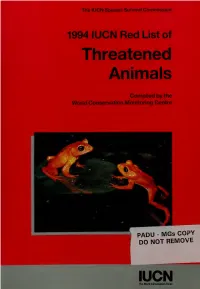
1994 IUCN Red List of Threatened Animals
The lUCN Species Survival Commission 1994 lUCN Red List of Threatened Animals Compiled by the World Conservation Monitoring Centre PADU - MGs COPY DO NOT REMOVE lUCN The World Conservation Union lo-^2^ 1994 lUCN Red List of Threatened Animals lUCN WORLD CONSERVATION Tile World Conservation Union species susvival commission monitoring centre WWF i Suftanate of Oman 1NYZ5 TTieWlLDUFE CONSERVATION SOCIET'' PEOPLE'S TRISr BirdLife 9h: KX ENIUNGMEDSPEaES INTERNATIONAL fdreningen Chicago Zoulog k.J SnuicTy lUCN - The World Conservation Union lUCN - The World Conservation Union brings together States, government agencies and a diverse range of non-governmental organisations in a unique world partnership: some 770 members in all, spread across 123 countries. - As a union, I UCN exists to serve its members to represent their views on the world stage and to provide them with the concepts, strategies and technical support they need to achieve their goals. Through its six Commissions, lUCN draws together over 5000 expert volunteers in project teams and action groups. A central secretariat coordinates the lUCN Programme and leads initiatives on the conservation and sustainable use of the world's biological diversity and the management of habitats and natural resources, as well as providing a range of services. The Union has helped many countries to prepare National Conservation Strategies, and demonstrates the application of its knowledge through the field projects it supervises. Operations are increasingly decentralised and are carried forward by an expanding network of regional and country offices, located principally in developing countries. I UCN - The World Conservation Union seeks above all to work with its members to achieve development that is sustainable and that provides a lasting Improvement in the quality of life for people all over the world. -

Proceedings of the Biological Society of Washington 115(3):546-563
PROCEEDINGS OF THE BIOLOGICAL SOCIETY OF WASHINGTON 115(3):546-563. 2002. Paretroplus dambabe, a new cichlid fish (Teleostei: Cichlidae) from northwestern Madagascar, with a discussion on the status of P. petiti John S. Sparks Division of Vertebrate Zoology, American Museum of Natural History, Central Park West at 79th Street, New York, NY 10024-5192, U.S.A., e-mail: jsparks@amnh.org Abstract. —Paretroplus dambabe, n. sp., is described from Lake Kinkony, northwestern Madagascar. The new species is distinguished from congeners in Hfe and preservation by light yellowish-oUve body coloration in combination with a series of 6-7 vertical charcoal bars on the flanks, a blunt head profile, body depth not exceeding 57.1%SL, and uniform dark charcoal-gray or black fins. Paretroplus dambabe is further distinguished from P. petiti, a species to which it has been mistakenly referred for decades, by overall pigmentation pattern (light yellow-olive vs. dark brown), the presence of bright red pigmen- tation on the flanks in life, a prominent vertical barring pattern, and a shallower body. Paretroplus Bleeker, 1868, the most spe- pelvic axillary scale, and well-developed ciose cichlid genus in Madagascar, com- ridges of scales ("scale sheathing" of Cich- prises nine described species, excluding the ocki, 1976) extending over, but not fused new taxon (Table 1). Paretroplus is endem- to, both the dorsal- and anal-fin bases. A ic to Madagascar, and members are distrib- number of additional features diagnostic of uted throughout the northwestern part of the both Etroplinae and Paretroplus, as well as island (8 species) and in eastern drainages a species-level phylogenetic analysis, are (1 species), where the range of P. -

THE STATUS and DISTRIBUTION of Freshwater Biodiversity in Madagascar and the Indian Ocean Islands Hotspot
THE THE STATUs aNd dISTRIBUtION OF STAT U Freshwater biodIversIty in MadagasCar s a N aNd the INdIaN OCeaN IslaNds hOtspOt d d I STR Edited by Laura Máiz-Tomé, Catherine Sayer and William Darwall IUCN Freshwater Biodiversity Unit, Global Species Programme IBU t ION OF F OF ION RESHWATER N ds a BIO I N d I ar ar VERS d C N I TY IN IN sla Madagas I N C ar a ar N ea d the I the d d the I the d C N N d Madagas a O I a N O C ea N I sla N IUCN h ds Rue Mauverney 28 CH-1196 Gland O Switzerland tsp Tel: + 41 22 999 0000 Fax: + 41 22 999 0015 O www.iucn.org/redlist t the IUCN red list of threatened speciestM www.iucnredlist.org THE STATUS AND DISTRIBUTION OF freshwater biodiversity in Madagascar and the Indian Ocean islands hotspot Edited by Laura Máiz-Tomé, Catherine Sayer and William Darwall IUCN Freshwater Biodiversity Unit, Global Species Programme The designation of geographical entities in this book, and the presentation of the material, do not imply the expression of any opinion whatsoever on the part of IUCN concerning the legal status of any country, territory, or area, or of its authorities, or concerning the delimitation of its frontiers or boundaries. The views expressed in this publication do not necessarily reflect those of IUCN, or other participating organisations. This publication has been made possible by funding from The Critical Ecosystem Partnership Fund. Published by: IUCN Cambridge, UK in collaboration with IUCN Gland, Switzerland Copyright: © 2018 IUCN, International Union for Conservation of Nature and Natural Resources Reproduction of this publication for educational or other non-commercial purposes is authorised without prior written permission from the copyright holder provided the source is fully acknowledged. -

Informații Despre Acvariu
Informații despre acvariu în 99 de pagini, actualizat la 28. mai. 2011 Cuprins Animalia. Arthropoda. Crustacea. Palaemonidae 1 Family description....................................................................................................................................................................................................................................1 Palaemonetes spp. Ghost Shrimp...........................................................................................................................................................................................................2 Animalia. Arthropoda. Crustacea. Cambaridae 4 Family description....................................................................................................................................................................................................................................4 Cambarellus patzcuarensis.....................................................................................................................................................................................................................5 Animalia. Mollusca. Gastropoda. Neritidae 6 Family description....................................................................................................................................................................................................................................6 Neritina natalensis sp. "Zebra". Zebra Nerite Snail.................................................................................................................................................................................7 -

SAVING FRESHWATER FISHES and HABITATS Newsletter of the IUCN SSC/WI Freshwater Fish Specialist Group
SAVING FRESHWATER FISHES AND HABITATS Newsletter of the IUCN SSC/WI Freshwater Fish Specialist Group Issue 4 • March 2014 IN THIS ISSUE: • FFSG welcomes new Global Chair • NEW Global Freshwater Fish BioBlitz • Introducing FFSG South America region • In search of the Mangarahara cichlid • Killifishes on the edge • And more....... CONTENTS FFSG UPDATE 3 Message from the FFSG Global Chair 4 Welcome to the new Global Chair, Dr Richard Sneider Editor-in-chief by Katalin Csatádi Ian Harrison 5 Changes to the FFSG Secretariat 6 Professor Gordon McGregor Reid awarded the IUCN SSC Chair’s Citation of Excellence by Suzanne Turnock Editor 7 New Global Freshwater Fish BioBlitz to Monitor Fish Species with Help of ‘Citizen Scientists’ Katalin Csatádi and by Suzanne Turnock Suzanne Turnock 9 Introducing FFSG Regions: South America by Roberto E. Reis Design Katalin Csatádi and NEWS FROM AROUND THE WORLD Suzanne Turnock 14 IUCN Red List assessments of freshwater fishes of the Tropical Andes by Marcelo Tognelli and Neil Cox 15 Brazilian Action Plans for freshwater fishes by Carla Polaz 16 U.K.’s rarest freshwater fish ‘reappears’ by Ian J. Winfield and Andrew R.D. Gowans 17 In search of the Mangarahara cichlid by Brian Zimmerman 23 A community-led fish sanctuary initiative on Hainan Island, China by Bosco P.L. Chan 26 Killifishes on the edge by Jörg Freyhof 26 What to do if there is no more water? Conservation of Aphanius sirhani, the Azraq Killifish by Nashat Hamidan 28 Tilting at windmills: Conservation of Valencia hispanica by Matt Ford 29 A Critically -

Endangered Fish Species of the World–A Review
AACL BIOFLUX Aquaculture, Aquarium, Conservation & Legislation International Journal of the Bioflux Society Endangered fish species of the world – a review 1,2Radu Hărșan, 1,3,4I. Valentin Petrescu-Mag 1 Department of Aquaculture, Faculty of Animal Husbandry, University of Agricultural Sciences and Veterinary Medicine, Cluj-Napoca, Romania, EU; 2 Faculty of Veterinary Medicine, University of Agricultural Sciences and Veterinary Medicine, Cluj-Napoca, Romania, EU; 3 SC Bioflux SRL, Cluj-Napoca, Romania, EU; 4 SC 3M AGC SRL, Cluj- Napoca, Romania, EU. Corresponding author: R. Hărșan, harsan_radu@yahoo.com Abstract. The present paper summarizes a large part of the endangered and critically endangered fish species of the world. The list was constructed using the comprehensive IUCN Red List of Threatened Species (available in December 2008) and the well elaborated FISHBASE (available on the official website, in 2008) for taxonomy and accepted scientific names of the species. To these two important sources, many scientific papers and communications were added when recent and useful reports were found. However, there is a long way from the fish species list of this review to the world’s complete list of endangered and critically endangered fish species. In our list were not included subspecies, populations, varieties, or species having a debatable taxonomic status. The scope of this review was not to inventorize all the fishes included in these two categories, but to make possible drawing some general conclusions regarding most important possible causes of fish species extinction and to make suggestions concerning fish species conservation possibilities through aquaculture. Key Words: endangered fish species, critically endangered, causes, population trend. -
The Teleost Ichthyofauna from the Late Cretaceous of Madagascar: Systematics, Distributions, and Implications for Gondwanan Biogoegraphy
THE TELEOST ICHTHYOFAUNA FROM THE LATE CRETACEOUS OF MADAGASCAR: SYSTEMATICS, DISTRIBUTIONS, AND IMPLICATIONS FOR GONDWANAN BIOGOEGRAPHY By Summer A. Ostrowski A DISSERTATION Submitted to Michigan State University in partial fulfillment of the requirements for the degree of DOCTOR OF PHILOSOPHY Geological Sciences 2012 ABSTRACT THE TELEOST ICHTHYOFAUNA FROM THE LATE CRETACEOUS OF MADAGASCAR: SYSTEMATICS, DISTRIBTUTIONS, AND IMPLICATIONS FOR GONDWANAN BIOGEOGRAPHY By Summer A. Ostrowski Madagascar is known for its highly endemic Recent fauna. However, the full deep-time temporal context of Madagascar’s endemicity is not completely understood, due to the patchy fossil record of the island. The Upper Cretaceous deposits of the Maevarano Formation in northwestern Madagascar provide insight into this issue due to their rich vertebrate fauna, including dinosaurs, crocodylians, frogs, turtles, snakes, mammals, and fishes. The Maevarano Formation consists of fluvial and alluvial deposits and accompanying debris flows, and exhibits excellent fossil preservation. Fossil fishes from the formation represent coastal marine and freshwater taxa, some of which have been identified in earlier reports. This study focuses on identifying teleosts present within the Maevarano Formation, and the resulting implications for Gondwanan biogeography. The teleosts are first identified to the most precise taxonomic unit possible, and their distributions during the Late Cretaceous are analyzed. Several of the fish taxa present extend the known temporal and/or geographic -
Bayesian Node Dating Based on Probabilities of Fossil Sampling Supports Trans-Atlantic Dispersal of Cichlid Fishes
Supporting Information Bayesian Node Dating based on Probabilities of Fossil Sampling Supports Trans-Atlantic Dispersal of Cichlid Fishes Michael Matschiner,1,2y Zuzana Musilov´a,2,3 Julia M. I. Barth,1 Zuzana Starostov´a,3 Walter Salzburger,1,2 Mike Steel,4 and Remco Bouckaert5,6y Addresses: 1Centre for Ecological and Evolutionary Synthesis (CEES), Department of Biosciences, University of Oslo, Oslo, Norway 2Zoological Institute, University of Basel, Basel, Switzerland 3Department of Zoology, Faculty of Science, Charles University in Prague, Prague, Czech Republic 4Department of Mathematics and Statistics, University of Canterbury, Christchurch, New Zealand 5Department of Computer Science, University of Auckland, Auckland, New Zealand 6Computational Evolution Group, University of Auckland, Auckland, New Zealand yCorresponding author: E-mail: michaelmatschiner@mac.com, remco@cs.auckland.ac.nz 1 Supplementary Text 1 1 Supplementary Text Supplementary Text S1: Sequencing protocols. Mitochondrial genomes of 26 cichlid species were amplified by long-range PCR followed by the 454 pyrosequencing on a GS Roche Junior platform. The primers for long-range PCR were designed specifically in the mitogenomic regions with low interspecific variability. The whole mitogenome of most species was amplified as three fragments using the following primer sets: for the region between position 2 500 bp and 7 300 bp (of mitogenome starting with tRNA-Phe), we used forward primers ZM2500F (5'-ACG ACC TCG ATG TTG GAT CAG GAC ATC C-3'), L2508KAW (Kawaguchi et al. 2001) or S-LA-16SF (Miya & Nishida 2000) and reverse primer ZM7350R (5'-TTA AGG CGT GGT CGT GGA AGT GAA GAA G-3'). The region between 7 300 bp and 12 300 bp was amplified using primers ZM7300F (5'-GCA CAT CCC TCC CAA CTA GGW TTT CAA GAT GC-3') and ZM12300R (5'-TTG CAC CAA GAG TTT TTG GTT CCT AAG ACC-3'). -

Report: Status and Distribution of Freshwater Biodiversity in The
THE tat THE statUs aNd dIstrIBUtION OF s U Freshwater BIOdIversIty IN MadagasCar s a N aNd the INdIaN OCeaN IslaNds hOtspOt d d I s Edited by Laura Máiz-Tomé, Catherine Sayer and William Darwall tr IUCN Freshwater Biodiversity Unit, Global Species Programme I BU t I ON OF F OF ON r eshwater s N d a BIO r I N d I a ve d rs C N I t la y IN Madagas IN s I N C a a the I the r a r N e d d the I the C N N d a Madagas O I a N O C e a N I s la N IUCN d s h s Rue Mauverney 28 CH-1196 Gland O Switzerland t Tel: + 41 22 999 0000 sp Fax: + 41 22 999 0015 O www.iucn.org/redlist t the IUCN red list of threatened speciestM www.iucnredlist.org Madagascar Covers.indd 1 07/02/2018 16:56:06 THE STATUS AND DISTRIBUTION OF FRESHwATER BIODIvERSITy IN MADAgAScAR AND THE INDIAN OcEAN ISlANDS HOTSpOT Edited by Laura Máiz-Tomé, Catherine Sayer and William Darwall IUCN Freshwater Biodiversity Unit, Global Species Programme Madagascar Report Prelims.indd 1 07/02/2018 16:47:59 The designation of geographical entities in this book, and the presentation of the material, do not imply the expression of any opinion whatsoever on the part of IUCN concerning the legal status of any country, territory, or area, or of its authorities, or concerning the delimitation of its frontiers or boundaries. -
Annotated Checklist of the Fishes of Madagascar, Southwestern Indian Ocean, with 158 New Records
FishTaxa (2018) 3(1): 1-432 E-ISSN: 2458-942X Journal homepage: www.fishtaxa.com © 2018 FISHTAXA. All rights reserved Annotated checklist of the fishes of Madagascar, southwestern Indian Ocean, with 158 new records Ronald FRICKE*1, Jamal MAHAFINA2, Faustinato BEHIVOKE2, Henitsoa JAONALISON2, 3, Marc LÉOPOLD3, Dominique PONTON4 1Im Ramstal 76, 97922 Lauda-Königshofen, Germany. 2Institut Halieutique et des Sciences Marines, Jeune Équipe Associée à l’IRD ACOM, Université de Toliara, Route du Port Mahavatse II, Toliara 601, Madagascar. 3ENTROPIE, IRD-Université de La Réunion-CNRS, Laboratoire d’Excellence CORAIL, Institut Halieutique et des Sciences Marines, Route du Port Mahavatse II, Toliara 601, Madagascar . 4ENTROPIE, IRD-Université de La Réunion-CNRS, Laboratoire d’Excellence CORAIL, c/o Hydrô Réunion Station Marine, Port ouest, Magasin 10, 97420 Le Port, La Réunion, France. Corresponding author: *E-mail: ronfricke@web.de Abstract An annotated checklist of the fish species of the Madagascar EEZ (southwestern Indian Ocean) comprises a total of 1,798 species in 247 families. 158 species are recorded from Madagascar for the first time. The majority of the species is autochthonous; 28 species have been introduced, mainly in freshwater habitats. The fish fauna is mostly marine (95.4% of the total number of native fish species), with the Gobiidae, Labridae, Serranidae, Pomacentridae and Apogonidae being the families with most representatives; among the 90 native freshwater fish species (adults mainly occurring in freshwater), the Cichlidae are the dominating family, but there are also two endemic families, the Bedotiidae (16 species) and Anchariidae (6 species). The fish fauna at Madagascar is typical for offshore, high islands in the southwestern Indian Ocean. -
Supplemental Table 1: Taxa Sampled for the Phylogenetic Analysis and Corresponding Genbank Accession Numbers
Supplemental Table 1: Taxa sampled for the phylogenetic analysis and corresponding GenBank accession numbers. Terminal Analyzed 16S COI 4C4 H3 Polymixia lowei AY538966 AY662744 AY539382 AY539175 Hoplostethus mediterraneus AY538968 AY662745 AY539384 AY539177 Abudefduf saxatilis AF285942 AY662765 AY662815 N/A Amblyphidodon leucogaster N/A AY662764 AY662813 N/A Amphiprion polymnus AY666170 N/A AY662814 AY662889 Badis badis AY662699 AY662746 AY662799 AY662875 Calamus penna AY662700 AY662747 AY662800 AY662876 Calloplesiops altivelis AY662701 AY662748 AY662801 AY662877 Cetoscarus bicolor AY662707 AY662758 AY662807 AY662883 Ctenopoma acutirostre AY662702 AY662749 AY662802 AY662878 Cymatogaster aggregata AY662711 AY662762 AY662811 AY662887 Diplectrum formosum AY539048 AY662750 AY539456 AY539257 Embiotoca jacksoni AY662712 AY662763 AY662812 AY662888 Gramma loreto AY539053 AY662751 AY539461 AY539268 Haemulon plumieri AY539057 AY662752 A539465 AY539266 Haletta semifasciata AY662708 AY662759 AY662808 AY662884 Hermosilla azurea AY662703 N/A AY662803 AY662879 Lachnolaimus maximus AY662709 AY662760 AY662809 AY662885 Micrometrus minimus EU888021 N/A U70346 EU888022 Monocirrhus polyacanthus A662704 AY662753 AY662804 AY662880 Morone saxatilis AY538941 AY662754 AY539454 AY539255 Perca flavescens AY539055 AY662755 AY539463 AY539264 Polycentropsis abbreviata AY662705 AY662756 AY662805 AY662881 Pristolepis fasciata AY662706 AY662757 AY662806 AY662882 Tautoga onitis AY662710 AY662761 AY662810 AY662886 Family Cichlidae Subfamily Etroplinae Etroplus canarensis