Cimbex Quadrimaculata (Müller, 1766), HYMENOPTERA: CIMBICIDAE
Total Page:16
File Type:pdf, Size:1020Kb
Load more
Recommended publications
-
Technical Series, No
' ' Technical Series, No. 20, Part II. U. S. DEPARTMENT OF AGRICULTURE, BXJRE^TJ OK' TClSrTOM:OIL.OG^Y. L, 0. HOWARD, Entomologist and Chief of Bureau. TECHNICAL PAPERS ON MISCELLANEOUS .FOREST INSECTS. II. THE GENOTYPES OF THE SAWFLIES AND WOODWASPS, OR THE SUPERFAMILY TENTHKEDINOIDEA. S. A. ROHWER, Agent and Expert. Issued M.\rch 4, 1911. WASHINGTON: GOVERNMENT PRINTING OFFICE. 1911. Technical Series, No. 20, Part II. U. S. DEPARTMENT OF AGRICULTURE. L. 0. HOWARD, Entomologist and Chief of Bureau. TECHNICAL PAPERS ON MISCELLANEOUS FOREST INSECTS. II. THE GENOTYPES OF THE SAWFLIES AND WOODWASPS, OR THE SUPERFAMILY TENTHREDINOIDEA. BY S. A. ROHWER, Agent and Expert. Issued Makch 4, 1911. WASHINGTON: GOVERNMENT PRINTING OFFICE. 1911. B UREA U OF ENTOMOLOGY. L. O. Howard, Entomologist and Chief of Bureau. C. L. Marlatt, Entomologist and Acting Chief in Absence of Chief. R. S. Clifton, Executive Assistant. W. F. Tastet, Chief Clerk. F. H. Chittenden, in charge of truck crop and stored product insect investigations. A. D. Hopkins, in charge offorest insect investigations. W. D. Hunter, in charge of southern field crop insect investigations. F. M. Webster, in charge of cereal and forage insect investigations. A. L. Quaintance, in charge of deciduous fruit insect investigations. E. F. Phillips, in charge of bee culture. D. M. Rogers, in charge of preventing spread of moths, field -work. RoLLA P. Currie, in charge of editorial work. Mabel Colcord, librarian. , Forest Insect Investigations. A. D. Hopkins, in charge. H. E. Burke, J. L. Webb, Josef Brunner, S. A. Rohwer, T. E. Snyder, W. D. Edmonston, W. B. Turner, agents and experts. -

Butterflies of North America
Insects of Western North America 7. Survey of Selected Arthropod Taxa of Fort Sill, Comanche County, Oklahoma. 4. Hexapoda: Selected Coleoptera and Diptera with cumulative list of Arthropoda and additional taxa Contributions of the C.P. Gillette Museum of Arthropod Diversity Colorado State University, Fort Collins, CO 80523-1177 2 Insects of Western North America. 7. Survey of Selected Arthropod Taxa of Fort Sill, Comanche County, Oklahoma. 4. Hexapoda: Selected Coleoptera and Diptera with cumulative list of Arthropoda and additional taxa by Boris C. Kondratieff, Luke Myers, and Whitney S. Cranshaw C.P. Gillette Museum of Arthropod Diversity Department of Bioagricultural Sciences and Pest Management Colorado State University, Fort Collins, Colorado 80523 August 22, 2011 Contributions of the C.P. Gillette Museum of Arthropod Diversity. Department of Bioagricultural Sciences and Pest Management Colorado State University, Fort Collins, CO 80523-1177 3 Cover Photo Credits: Whitney S. Cranshaw. Females of the blow fly Cochliomyia macellaria (Fab.) laying eggs on an animal carcass on Fort Sill, Oklahoma. ISBN 1084-8819 This publication and others in the series may be ordered from the C.P. Gillette Museum of Arthropod Diversity, Department of Bioagricultural Sciences and Pest Management, Colorado State University, Fort Collins, Colorado, 80523-1177. Copyrighted 2011 4 Contents EXECUTIVE SUMMARY .............................................................................................................7 SUMMARY AND MANAGEMENT CONSIDERATIONS -

Studii Şi Comunicări
http://www.studiisicomunicaribacau.ro / https://biblioteca-digitala.ro STUDII ŞI COMUNICĂRI The scientific journal „Studii şi Comunicări” of the „Ion Borcea” Natural Sciences Museum Complex, Bacău was founded in 1968 and publishes original articles of botany, zoology, geology, paleontology, notes and anniversaries, book reviews and obituaries of personalities from natural sciences domain. Vol. 27, 2018 ISSN 1584-3416 Editor-in-chief Dr. Gabriela Gurău – Manager of the „Ion Borcea” Natural Sciences Museum Complex Editorial Board Acad. Prof. dr. Constantin Toma – University „Al.I.Cuza” of Jassy Prof. dr. Gheorghe Mustaţă - University „Al.I.Cuza” of Jassy Prof. dr. Neculai Barabaş – University of Bacău Editorial Secretary Dr. Lăcrămioara Zaharia - „Ion Borcea” Natural Sciences Museum Complex Dr. Bogdan Tomozii - „Ion Borcea” Natural Sciences Museum Complex Type-Setter Eng. Bogdan Barabaş - „Ion Borcea” Natural Sciences Museum Complex Bussiness Corespondence Orders for subscription and exchange agreements should be sent to: „Ion Borcea” Natural Sciences Museum Complex, OP. 1, CP.102, Aleea Parcului, no. 9, code 600043, Bacău, ROMANIA e-mail: muzstnatbc@yahoo.com Website http://www.studiisicomunicaribacau.ro The authors are responsable for the content of the papers. Cover design: Dr. Lăcrămioara Zaharia, Sorin Roşu, Dr. Bogdan Tomozii - „Ion Borcea” Natural Sciences Museum Complex http://www.studiisicomunicaribacau.ro / https://biblioteca-digitala.ro Complexul Muzeal de Ştiinţele Naturii „Ion Borcea” Bacău STUDII ŞI COMUNICĂRI 2018 27 Editura -
Hymenoptera: Symphyta): Evidence for Multiple Increases in Sperm Bundle Size
J. HYM. RES. Vol. 10(Z), 2001, pp. 119-125 Spermatodesmata of the Sawflies (Hymenoptera: Symphyta): Evidence for Multiple Increases in Sperm Bundle Size NATHAN SCHIFF, ANTHONY J. FLEMMINC, AND DONALD L. J. QUICKE (NS) U.S. Forest Service, Southern Research Station, Center for Bottomland Hardwoods Research, P.O. Box 227, Stoneville, MS 38776, USA; (AJF) Department of Biology, Imperial College at Silwood Park, Ascot, Berkshire SL5 7PY, U.K.; (DLJQ) Unit of Parasitoid Systematics, Department of Biology, Imperial College at Silwood Park, Ascot, Berkshire SL5 7PY, UK, and Department of Entomology, The Natural History Museum, London SW7 5BD, UK Abstract.-We present the first survey of spermatodesmata (bundles of spermatozoa connected at the head by an extracellular ‘gelatinous’ matrix) across the sawfly superfamilies. Spermatodes- mata occur in all examined taxa within the sawfly grade (Xyelidae-Orussidae inclusive), but are not found in the Apocrita. Using DAPI staining, the numbers of individual sperm per sperma- todesm were calculated and the values obtained are mapped on to the current phylogenetic hy- pothesis. The plesiomorphic spermatodesm in the Hymenoptera, based on that observed in the putatively basal family Xyelidae, contains relatively few sperm, approximately 16. However, in the Tenthredinoidea and in the Siricidae, far larger numbers are found, reaching up to 256 in the Cimbicidae. In many insects, mature sperm released Until now, spermatodesmata have only from testicular follicles are neither free in- been characterised in a few sawflies, al- dividuals nor packaged into variously most entirely as part of ultrastructural in- complex spermatophores, but are ar- vestigations using transmission electron ranged in organised bundles with their microscopy (Quicke et al. -

Liste Systématique Des Hyménoptères Symphytes De France
Université de Mons-Hainaut Laboratoire de zoologie Rapport d’étude dans le cadre du DEA de Biologie Liste Systématique des Hyménoptères Symphytes de France par Thierry NOBLECOURT Office National des Forêts Cellule d’Etudes Entomologiques 2 rue Charles Péguy F-11500 Quillan Tel : 00 (33) 4 68 20 06 75 Fax : 00 (33) 4 68 20 92 21 Thierry.Noblecourt@onf.fr Mai 2004 (mis à jour le18 avril 2007) Avant propos : Nous proposons ci-après la liste des Hyménoptères Symphytes de France classés par ordre systématique. Ce travail est inédit car aucune liste des Symphytes de France n’a jamais été publiée. Nous avons appliqué pour ce travail les travaux les plus récents, notamment ceux de notre collègue français Jean LACOURT qui a fortement fait évoluer la classification des Tenthredinidae. Dans cette liste, nous avons éliminé les espèces anciennement citées (avant 1950) sans localités ni dates précises et qui n’ont pas été retrouvées dans les collections des différents musées français mais nous avons inclus les espèces nouvelles pour la France ou pour la science, dont les publications sont en cours ou sous presse. Enfin, nous dressons en fin du document la liste des travaux sur lesquels nous nous sommes appuyés pour la réalisation de ce travail. Référence à utiliser pour ce document : Noblecourt T., 2004. Liste systématique des Hyménoptères Symphytes de France. Rapport d'étude dans le cadre du DEA de Biologie de l'Université de Mons-Hainaut, Laboratoire de Zoologie. Quillan: Office National des Forêts, Cellule d'études entomologiques. Mai 2004, 80 p 1 2 Liste systématique et synonymique des Hyménoptères Symphytes de France CEPHOIDEA CEPHIDAE Cephinae Calameuta sp. -

Cimbex Connatus (Schrank, 1776) (Cimbicidae, Hymenoptera) – First Finding for the Entomofauna of Serbia
Arch. Biol. Sci., Belgrade, 59 (4), 69P-70P, 2007 DOI:10.2298/ABS070469PN CIMBEX CONNATUS (SCHRANK, 1776) (CIMBICIDAE, HYMENOPTERA) – FIRST FINDING FOR THE ENTOMOFAUNA OF SERBIA. Z. Nikolić, M. M. Brajković, S. B. Ćurčić, and Tamara Milivojević. Institute of Zoology, Faculty of Biology, University of Belgrade, 11000 Belgrade, Serbia Key words: Hymenoptera, Cimbicidae, Cimbex connatus, entomofauna, Serbia udc 595.79(497.11):591.4 The family Cimbicidae includes large and medium sized saw- Dipsacaceae ( B o l t o n and G a u l d , 1988). flies with body length fluctuating from 9 to 28 mm. The anten- nae end in a club and have six or seven segments. There is This small family of the superfamily Tenthredinoidea no hippostomal bridge on the head, but sometimes there is a is divided into four subfamilies — one Neotropic and three hypostomal membrane. The pronotum is short, with a convex Holarctic. There are around 50 European species, belonging to back line. The front tibias have two simple claws, but claws are seven genera (Q u i n l a n and G a u l d , 1981) absent on the middle tibias. During study on the sawfly fauna of Belgrade in April The abdomen is laterally concave, dorsally convex, and of 2007, one female specimen of the species Cimbex connatus ventrally flattened. The sawsheath is slightly longer than the (Schrank, 1776) (Fig. 1) was caught in Surčin, nr. Belgrade. This tip of the abdomen. Male genitalia are of the strophandrial is the first finding of the given species for the entomofauna of type. -

Scope: Munis Entomology & Zoology Publishes a Wide
_____________Mun. Ent. Zool. Vol. 6, No. 2, June 2011__________ 779 CHECK-LIST OF THE FAMILY CIMBICIDAE OF TURKEY AND SOME BIOLOGICAL OBSERVATIONS (HYMENOPTERA: SYMPHYTA) Önder Çalmaşur* Atatürk University, Faculty of Agriculture, Department of Plant Protection, 25240, Erzurum, TURKEY. E-mails: calmasur@atauni.edu.tr and ondercal1@hotmail.com [Çalmaşur, Ö. 2011. Check-list of the family Cimbicidae of Turkey and some biological observations (Hymenoptera: Symphyta). Munis Entomology & Zoology, 6 (2): 779-784] ABSTRACT: A total of 17 species in six genera of the sawfly family Cimbicidae were found in Turkey. The material was collected in various provinces, mainly in the eastern part of the country, during 1987-2009. The paper gave an updated list of species together with distribution records from own observations and literature. Five species are reported as new to Turkey, namely Cimbex femoratus (Linné, 1758), Corynis crassicornis (Rossi, 1790), Corynis orientalis (Konow, 1898), Corynis similis (Mocsáry, 1880) and Trichiosoma latreillii Leach, 1817. New localities are added for previously known species. KEY WORDS: Cimbicidae, Symphyta, sawfly, fauna, new records, Turkey. The suborder Symphyta includes those Hymenoptera, which are structurally primitive, most families and superfamilies are relatively small taxa containing, world-wide, about 8755 species (Taeger & Blank, 2008). Symphytans may be recognized by the absence of a marked constriction between the first and second abdominal segments, and by the possession of at least one closed anal cell in the forewing. The larvae have well-developed head capsule and most have thoracic legs; the majority of free-feeding larvae are caterpillar-like with abdominal prolegs. With the exception of the Orussidae the larvae are phytophagous (Gauld & Bolton, 1988; Goulet & Huber, 1993). -
Suppressed Under the Plenary Powers for the Purposes of Rell, 1884, C.R
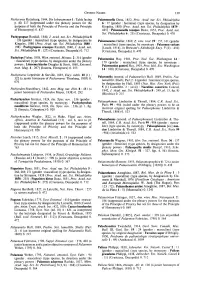
GENERIC NAMES 139 Pachyceras Ratzeburg, 1844, Die Ichneumonen 1: Table facing Palaemonella Dana, 1852, Proc. Acad. nat. Sci. Philadelphia p. 40, 217 (suppressed under the plenary powers for the 6 : 17 (gender : feminine) (type species, by designation by purposes of both the Principle of Priority and the Principle Kingsley, 1880 (Proc. Acad. nat. Sci. Philadelphia 1879 : of Homonymy) 0. 437 425) : Palaemonella tenuipes Dana, 1852, Proc. Acad. nat. Sci. Philadelphia 6 : 25) (Crustacea, Decapoda) 0. 470 Pachygrapsus Randall, 1840, J. Acad. nat. Sci. Philadelphia 8 : 126 (gender : masculine) (type species, by designation by Palaemonetes Heller, 1869, Z. wiss. zool. 19 : 157, 161 (gender Kingsley, 1880 (Proc. Acad. nat. Sci. Philadelphia 1880 : : masculine) (type species, by monotypy : Palaemon varians 198) : Pachygrapsus crassipes Randall, 1840, J. Acad. nat. [Leach, 1814], in Brewster's Edinburgh Ency. 7 (2) : 432) Sci. Philadelphia 8 : 127) (Crustacea, Decapoda) 0. 712 (Crustacea, Decapoda) 0. 470 Pachylops Fieber, 1858, Wien. entomol. Monats. 2:314 (gender Palaemonias Hay, 1901, Proc. biol. Soc. Washington 14 : : masculine) (type species, by designation under the plenary 179 (gender : masculine) (type species, by monotypy : powers : Litosoma bicolor Douglas & Scott, 1868, Entomol. Palaemonias ganteri Hay, 1901, Proc. biol. Soc. Washington mon. Mag. 4 : 267) (Insecta, Hemiptera) 0. 253 14 : 180) (Crustacea, Decapoda) 0. 470 Pachymerus Lepeletier & Serville, 1825, Ency. m'eth. 10 (1) : Palaeoneilo (emend, of Palaeaneilo) Hall, 1869, Prelim. Not. 322 (a junior homonym of Pachymerus Thunberg, 1805) 0. lamellibr. Shells, Part 2 : 6 (gender : feminine) (type species, 676 by designation by Hall, 1885 (Nat. Hist. New York (Pal.) 5 (1) Lamellibr. 2 : xxvii) : Nuculites constricta Conrad, Pachyodon Stutchbury, 1842, Ann. -

A Generic Classification of the Nearctic Sawflies (Hymenoptera, Symphyta)
THE UNIVERSITY OF ILLINOIS LIBRARY rL_L_ 5 - V. c_op- 2 CD 00 < ' sturn this book on or before the itest Date stamped below. A arge is made on all overdue oks. University of Illinois Library UL28: .952 &i;g4 1952 %Po S IQ";^ 'APR 1 1953 DFn 7 W54 '•> d ^r-. ''/./'ji. Lit]—H41 Digitized by tine Internet Arciiive in 2011 with funding from University of Illinois Urbana-Champaign http://www.archive.org/details/genericclassific15ross ILLINOIS BIOLOGICAL MONOGRAPHS Vol. XV No. 2 Published by the University of Illinois Under the Auspices of the Graduate School Ukbana, Illinois 1937 EDITORIAL COMMITTEE John Theodore Buchholz Fred Wilbur Tanner Harley Jones Van Cleave UNIVERSITY OF ILLINOIS 1000—7-37—11700 ,. PRESS A GENERIC CLASSIFICATION OF THE NEARCTIC SAWFLIES (HYMENOPTERA, SYMPHYTA) WITH SEVENTEEN PLATES BY Herbert H. Ross Contribution No. 188 from the Entomological Laboratories of the University of Illinois, in Cooperation with the Illinois State Natural History Survey CONTENTS Introduction 7 Methods 7 Materials 8 Morphology 9 Head and Appendages 9 Thorax and Appendages 22 Abdomen and Appendages 29 Phylogeny 33 The Superfamilies of Sawflies 33 Family Groupings 34 Hypothesis of Genealogy .... 35 Larval Characters 45 - Biology 46 Summary of Phylogeny 48 Taxonomy 50 Superfamily Tenthredinoidea 51 Superfamily Megalodontoidea 106 Superfamily Siricoidea 110 Superfamily Cephoidea 114 Bibliography 117 Plates 127 Index 162 ACKNOWLEDGMENT This monograph is an elaboration of a thesis sub- mitted in partial fulfillment for the degree of Doctor of Philosophy in Entomology in the Graduate School of the University of Illinois in 1933. The work was done under the direction of Dr. -
Appendix 5: Fauna Known to Occur on Fort Drum
Appendix 5: Fauna Known to Occur on Fort Drum LIST OF FAUNA KNOWN TO OCCUR ON FORT DRUM as of January 2017. Federally listed species are noted with FT (Federal Threatened) and FE (Federal Endangered); state listed species are noted with SSC (Species of Special Concern), ST (State Threatened, and SE (State Endangered); introduced species are noted with I (Introduced). INSECT SPECIES Except where otherwise noted all insect and invertebrate taxonomy based on (1) Arnett, R.H. 2000. American Insects: A Handbook of the Insects of North America North of Mexico, 2nd edition, CRC Press, 1024 pp; (2) Marshall, S.A. 2013. Insects: Their Natural History and Diversity, Firefly Books, Buffalo, NY, 732 pp.; (3) Bugguide.net, 2003-2017, http://www.bugguide.net/node/view/15740, Iowa State University. ORDER EPHEMEROPTERA--Mayflies Taxonomy based on (1) Peckarsky, B.L., P.R. Fraissinet, M.A. Penton, and D.J. Conklin Jr. 1990. Freshwater Macroinvertebrates of Northeastern North America. Cornell University Press. 456 pp; (2) Merritt, R.W., K.W. Cummins, and M.B. Berg 2008. An Introduction to the Aquatic Insects of North America, 4th Edition. Kendall Hunt Publishing. 1158 pp. FAMILY LEPTOPHLEBIIDAE—Pronggillled Mayflies FAMILY BAETIDAE—Small Minnow Mayflies Habrophleboides sp. Acentrella sp. Habrophlebia sp. Acerpenna sp. Leptophlebia sp. Baetis sp. Paraleptophlebia sp. Callibaetis sp. Centroptilum sp. FAMILY CAENIDAE—Small Squaregilled Mayflies Diphetor sp. Brachycercus sp. Heterocloeon sp. Caenis sp. Paracloeodes sp. Plauditus sp. FAMILY EPHEMERELLIDAE—Spiny Crawler Procloeon sp. Mayflies Pseudocentroptiloides sp. Caurinella sp. Pseudocloeon sp. Drunela sp. Ephemerella sp. FAMILY METRETOPODIDAE—Cleftfooted Minnow Eurylophella sp. Mayflies Serratella sp. -
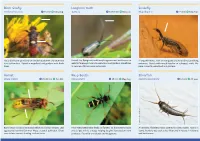
Intriguing Insects Miniguide
Birch Sawfly Longhorn moth Snakefly S M S M S M Cimbex femoratus 25 mm May-Aug. Adela sp. 14-18 mm May-Jun. Rhapidioptera 15 mm May Sep. Has a distinctive pale band on the dark abdomen and antennae A small day-flying moth with very long antennae and bronze or A long thin insect, with an elongated prothorax (neck) and long have yellow tips. Found in woodland and gardens with Birch metallic forewings. Found in woodland and gardens, sometimes antennae. Stands with raised head in an s-shaped, snake-like trees. in swarms of 20 or more individuals. pose. Found in woodland and gardens. Hornet Wasp Beetle Silverfish S M S M S M Vespa crabro 25-35 mm Apr-Oct. Clytus arietis 16 mm May-Aug. Lepisma saccharina 12 mm All year. 0 . 3 A S - Y B C C r e h c s i F n a ti s i r h C © Body has an obvious waist and yellow and brown stripes. Less A harmless beetle that feeds on flowers. Its distinctive colours A harmless, flightless insect covered in silvery scales. Found in aggressive than the Common Wasp, a useful pollinator. Often and stripes mimic a wasp, helping to give it protection from damp, humid areas such as leaf litter and in houses in kitchens seen in late summer feeding on fruit trees. predators. Found in woodlands and hedgerows. and bathrooms. Varied Carpet Beetle Western Conifer Seed Bug Intriguing S M S M Anthrenus verbasci 3 mm May-Aug. Leptoglossus occidentalis 20 mm All year. -
Symphyta (Sawflies)
SCOTTISH INVERTEBRATE SPECIES KNOWLEDGE DOSSIER Hymenoptera: Symphyta (Sawflies) A. NUMBER OF SPECIES IN UK: 527 B. NUMBER OF SPECIES IN SCOTLAND: 401 (including 1 introduced) C. EXPERT CONTACTS Please contact scotland@buglife.org.uk for details. D. SPECIES OF CONSERVATION CONCERN Listed species None – insufficient data. Other species Amauronematus abnormis . An arctic species known from only two sites in the Cairngorms Plateau. The host plant, Salix herbacea is widespread, and so the limiting factor is almost certainly climatic. A. abnormis requires very cold climatic conditions that ensure snow patches lie until late summer. This species is likely to be effected by warming climatic conditions. No other species are known to be of conservation concern based upon the limited information available. Conservation status will be more thoroughly assessed as more information is gathered. Host plants Many species of sawfly are monophagous, with several high altitude speces relying on single Salix species such as S. arbuscula , S. lapponum and S, myrsinites , which have suffered serious declines in range and density since recording began 150 years ago. These declines have probably been caused by increased grazing pressure. In many cases, the rarity of the sawfly is therefore already determined by the rarity of its host plant. 1 E. LIST OF SPECIES KNOWN FROM SCOTLAND (* indicates species that are restricted to Scotland in UK context) Cephidae Calameuta pallipes Hartigia xanthostoma Pamphiliidae Acantholyda erythrocephala Acantholyda posticalis Cephalcia