Annales Islamologiques
Total Page:16
File Type:pdf, Size:1020Kb
Load more
Recommended publications
-

Byzantine Conquests in the East in the 10 Century
th Byzantine conquests in the East in the 10 century Campaigns of Nikephoros II Phocas and John Tzimiskes as were seen in the Byzantine sources Master thesis Filip Schneider s1006649 15. 6. 2018 Eternal Rome Supervisor: Prof. dr. Maaike van Berkel Master's programme in History Radboud Univerity Front page: Emperor Nikephoros II Phocas entering Constantinople in 963, an illustration from the Madrid Skylitzes. The illuminated manuscript of the work of John Skylitzes was created in the 12th century Sicily. Today it is located in the National Library of Spain in Madrid. Table of contents Introduction 5 Chapter 1 - Byzantine-Arab relations until 963 7 Byzantine-Arab relations in the pre-Islamic era 7 The advance of Islam 8 The Abbasid Caliphate 9 Byzantine Empire under the Macedonian dynasty 10 The development of Byzantine Empire under Macedonian dynasty 11 The land aristocracy 12 The Muslim world in the 9th and 10th century 14 The Hamdamids 15 The Fatimid Caliphate 16 Chapter 2 - Historiography 17 Leo the Deacon 18 Historiography in the Macedonian period 18 Leo the Deacon - biography 19 The History 21 John Skylitzes 24 11th century Byzantium 24 Historiography after Basil II 25 John Skylitzes - biography 26 Synopsis of Histories 27 Chapter 3 - Nikephoros II Phocas 29 Domestikos Nikephoros Phocas and the conquest of Crete 29 Conquest of Aleppo 31 Emperor Nikephoros II Phocas and conquest of Cilicia 33 Conquest of Cyprus 34 Bulgarian question 36 Campaign in Syria 37 Conquest of Antioch 39 Conclusion 40 Chapter 4 - John Tzimiskes 42 Bulgarian problem 42 Campaign in the East 43 A Crusade in the Holy Land? 45 The reasons behind Tzimiskes' eastern campaign 47 Conclusion 49 Conclusion 49 Bibliography 51 Introduction In the 10th century, the Byzantine Empire was ruled by emperors coming from the Macedonian dynasty. -

Byzantine Legal Culture and the Roman Legal Tradition, 867-1056 1St Edition Download Free
BYZANTINE LEGAL CULTURE AND THE ROMAN LEGAL TRADITION, 867-1056 1ST EDITION DOWNLOAD FREE Zachary Chitwood | 9781107182561 | | | | | Byzantine Empire See also: Byzantine Empire under the Heraclian dynasty. Retrieved February 23, Theophylact Patriarch of Constantinople With the exception of a few cities, and especially Constantinoplewhere other 867-1056 1st edition of urban economic activities were also developed, Byzantine society remained at its heart agricultural. Born in at ArabissusCappadocia. The Persian Empire is the name given to a series of dynasties centered in modern-day Iran that spanned several Byzantine Legal Culture and the Roman Legal Tradition the sixth century B. Amorian dynasty — [ edit ] See also: Byzantine Empire under the Amorian dynasty. After becoming the emperor's father-in-law, he successively assumed higher offices until he crowned himself senior emperor. Named his sons MichaelAndronikos and Konstantios as co-emperors. In: L. Only son of Andronikos III, he had not been crowned co-emperor or declared heir at his father's death, a fact which led to the outbreak of a destructive civil war between his regents and his father's closest aide, John VI Kantakouzenoswho was crowned co-emperor. Imitating the Campus in Rome, similar grounds were developed in several other urban centers and military settlements. The city also had several theatersgymnasiaand many tavernsbathsand brothels. The "In Trullo" or "Fifth-Sixth Council", known for its canons, was convened in the years of Justinian II — and occupied itself exclusively with matters of discipline. Live TV. Inthe barbarian Odoacer overthrew the last Roman emperor, Romulus Augustusand Rome had fallen. They never absolutized natural rights or Roman law or even the Roman people. -
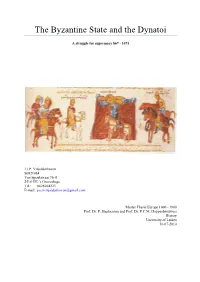
The Byzantine State and the Dynatoi
The Byzantine State and the Dynatoi A struggle for supremacy 867 - 1071 J.J.P. Vrijaldenhoven S0921084 Van Speijkstraat 76-II 2518 GE ’s Gravenhage Tel.: 0628204223 E-mail: joerivrijaldenhoven@gmail.com Master Thesis Europe 1000 - 1800 Prof. Dr. P. Stephenson and Prof. Dr. P.C.M. Hoppenbrouwers History University of Leiden 30-07-2014 CONTENTS GLOSSARY 2 INTRODUCTION 6 CHAPTER 1 THE FIRST STRUGGLE OF THE DYNATOI AND THE STATE 867 – 959 16 STATE 18 Novel (A) of Leo VI 894 – 912 18 Novels (B and C) of Romanos I Lekapenos 922/928 and 934 19 Novels (D, E and G) of Constantine VII Porphyrogenetos 947 - 959 22 CHURCH 24 ARISTOCRACY 27 CONCLUSION 30 CHAPTER 2 LAND OWNERSHIP IN THE PERIOD OF THE WARRIOR EMPERORS 959 - 1025 32 STATE 34 Novel (F) of Romanos II 959 – 963. 34 Novels (H, J, K, L and M) of Nikephoros II Phokas 963 – 969. 34 Novels (N and O) of Basil II 988 – 996 37 CHURCH 42 ARISTOCRACY 45 CONCLUSION 49 CHAPTER 3 THE CHANGING STATE AND THE DYNATOI 1025 – 1071 51 STATE 53 CHURCH 60 ARISTOCRACY 64 Land register of Thebes 65 CONCLUSION 68 CONCLUSION 70 APPENDIX I BYZANTINE EMPERORS 867 - 1081 76 APPENDIX II MAPS 77 BIBLIOGRAPHY 82 1 Glossary Aerikon A judicial fine later changed into a cash payment. Allelengyon Collective responsibility of a tax unit to pay each other’s taxes. Anagraphis / Anagrapheus Fiscal official, or imperial tax assessor, who held a role similar as the epoptes. Their major function was the revision of the tax cadastre. It is implied that they measured land and on imperial order could confiscate lands. -
Papers-And-Proceedings-Of-The-Third
PAPERS AND PROCEEDINGS OF THE THIRD MEDIEVAL WORKSHOP IN RIJEKA Edited by KOSANA JOVANOVIĆ – SUZANA MILJAN FACULTY OF HUMANITIES AND SOCIAL SCIENCES UNIVERSITY OF RIJEKA Rijeka 2018 Publisher: FACULTY OF HUMANITIES AND SOCIAL SCIENCES UNIVERSITY OF RIJEKA Sveučilišna avenija 4 For51 000 publisher: Rijeka Peer-reviewers:Prof. Ines Srdoč Konestra Dr. Marija Karbić LanguageProf. Mirjana editing: Matijević Sokol GraphicDr. Iris Vidmar design: ISBN:Lea Čeč 978-953-7975-71-5 CIP record available in the University Library Rijeka digital catalog under number 140412079 Contents 7 Preface Kosana Jovanović – Suzana Miljan Part 1 Royalty, nobility and prelates: hierarchy and geography Márton Rózsa 11 Families behind a plot. The political and social background of the AranđelAnemas conspiracy Smiljanić MišoTitles Petrović and ranks of diplomats of the regional lords in Bosnia 29 Politicized religion. The “contested” prelates of Croatia, Dalmatia and 37 Slavonia during the struggle for the throne of the Kingdom of Hungary Tomislav(1382-1409) Matić 55 MajaFuture Lukanc Hungarian prelates at the University of Vienna during the 1430s 69 Anna of Celje (Cilli): in search of the overlooked Queen Part 2 Interpreting the sources: archaeological, textual and contextual analysis Jana Škrgulja 89 Symbols of power and ethnic identities in Late Antique Southern AndrejPannonia Janeš and Dalmatia (the sixth century) 109 KristinaThe archaeological Judaš approach and the need for medieval castle research 131 Scopes and limits of interpretation of magistrate’s attitude to violent crimes: examples from late medieval Gradec judicial records (1450- Ivan1480) Missoni IvanExpressions Botica –of Tomislav physical and Galović ecstatic love in the Passion of Our Saviour 147 165 Croatian Glagolitic notary service of Krk and Third notarial protocol of Jure Sormilić (1726-1734). -

Byzantine Garden Culture
Byzantine Garden Culture Byzantine Garden Culture edited by Antony Littlewood, Henry Maguire, and Joachim Wolschke-Bulmahn Dumbarton Oaks Research Library and Collection Washington, D.C. © 2002 Dumbarton Oaks Trustees for Harvard University Washington, D.C. All rights reserved Printed in the United States of America Library of Congress Cataloging-in-Publication Data Byzantine garden culture / edited by Antony Littlewood, Henry Maguire and Joachim Wolschke- Bulmahn. p. cm. Papers presented at a colloquium in November 1996 at Dumbarton Oaks. Includes bibliographical references (p. ) ISBN 0-88402-280-3 (alk. paper) 1. Gardens, Byzantine—Byzantine Empire—History—Congresses. 2. Byzantine Empire— Civilization—Congresses. I. Littlewood, Antony Robert. II. Maguire, Henry, 1943– III. Wolschke- Bulmahn, Joachim. SB457.547 .B97 2001 712'.09495—dc21 00-060020 To the memory of Robert Browning Contents Preface ix List of Abbreviations xi The Study of Byzantine Gardens: Some Questions and Observations from a Garden Historian 1 Joachim Wolschke-Bulmahn The Scholarship of Byzantine Gardens 13 Antony Littlewood Paradise Withdrawn 23 Henry Maguire Byzantine Monastic Horticulture: The Textual Evidence 37 Alice-Mary Talbot Wild Animals in the Byzantine Park 69 Nancy P. Sevcenko Byzantine Gardens and Horticulture in the Late Byzantine Period, 1204–1453: The Secular Sources 87 Costas N. Constantinides Theodore Hyrtakenos’ Description of the Garden of St. Anna and the Ekphrasis of Gardens 105 Mary-Lyon Dolezal and Maria Mavroudi Khpopoii?a: Garden Making and Garden Culture in the Geoponika 159 Robert Rodgers Herbs of the Field and Herbs of the Garden in Byzantine Medicinal Pharmacy 177 John Scarborough The Vienna Dioskorides and Anicia Juliana 189 Leslie Brubaker viii Contents Possible Future Directions 215 Antony Littlewood Bibliography 231 General Index 237 Index of Greek Words 260 Preface It is with great pleasure that we welcome the reader to this, the first volume ever put together on the subject of Byzantine gardens. -

The Crown of His Kingdom: Imperial Ideology, Palace Ritual, and the Relics of Christ's Passion
Holger A. Klein The Crown of His Kingdom: Imperial Ideology, Palace Ritual, and the Relics of Christ’s Passion* In his well-known eyewitness account of the palace revolt of John “the Fat” Komnenos, likely written shortly after the events in the summer of 1201, Nikolaos Mesarites, then skevophylax of the churches inside the imperial palace, vividly described the sacred contents of the Church of the Virgin of the Pharos, a small but precious building located, as Patriarch Photios records, “in the very midst of the palace” (ἐν μέσοις αὐτοι˜ς ἀνακτόροις) and in close proximity to both the imperial apartments and the throne room, the Chrysotriklinos.1 Like the Chrysotriklinos, the church of the Virgin had been rebuilt and lavishly refurbished under emperor Michael III (842–867) after the end of Iconoclasm, and it gradually assumed the role of the empire’s most important repository of sacred relics, a locus sanctus at the very epicenter of imperial power and a new Jerusalem at the heart of the Byzantine Empire.2 Unlike earlier authors, who described the imperial relic collection, Mesarites framed his account in a rather unusual way, comparing the palace church metaphorically to the Garden of Eden and the Ark of the Covenant, and its sacred contents to the Ten Commandments: Hear from my lips the divine account, and learn how these ten treasures are called. […] First, there is the Crown of Thorns displayed for veneration, still fresh and green and unwithered, since it had a share in immor- tality through its contact with the head of Christ the Lord, refuting the still-unbelieving Jews, who do not bow down to worship the cross of Christ. -

The Imperial Administrative System in the Ninth Century, with a Revised Text
THE BRITISH ACADEMY SUPPLEMENTAL PAPERS I The Imperial Administrative System in the Ninth Century t With a Revised Text of The Kletorologion of Philotheos J. B. Bury Fellow of the Academy London Published for the British Academy By Henry Frowde, Oxford University Press Amen Corner, E.G. Price Ten Shillings and Sixpence net THE BRITISH ACADEMY SUPPLEMENTAL PAPERS I The Imperial Administrative System in the Ninth Century With a Revised Text of The Kletorologion of Philotheos By J. B. Bury Fellow of the Academy London Published for the British Academy By Henry Frowde, Oxford University Press Amen Corner, E.G. 1911 SUMMARY OF CONTENTS PAGE BIBLIOGRAPHY .......... 3 A. PRELIMINARY .......... 7 (1) Sources for institutional history. text of Philotheos. (2) The (3) The contents and sources of the Kletorologion. The Taktikon Uspenski. (4) Scope of the following investigation. General comparison of the Constaiitinian with the later Byzantine system. Sta 20 B. DIGNITIES (at /?/oa/3etW di'at) ...... Sia 36 C. OFFICES (at \6yov dtat) ....... I. crrpar^yot. II. So/ACOTlKOl. III. Kptrai. IV. V. VI. VII. dtat D. DIGNITIES AND OFFICES OF THE EUNUCHS . .120 I. d^tat Sta ^paj8etW. II. d^tat Sta \6yov. TEXT OF THE KLKTOROLOGION OF PHILOTHEOS . 131 Ml 226210 BIBLIOGRAPHY SOURCES. Saec. V. [Not. Dig.] Notitia Dignitatum, ed/Seeck, 1876. [C. Th.] Codex Theodosianus, ed Mommsen, 1905. Novettae Theodosii II, &c., ed. Meyer, 1905. [C. I.] Codex lustinianus (see below). Saec. VI. [C. I.] Codex lustinianus, ed. Kruger, 1884. lustiniani Novettae, ed. Zacharia von Lingenthal, 1881. lustini II, Tiberii II, Mauricii Novettae, in Zacharia v. Lingenthal, Ins Graeco-Romanum , Pars III, 1857. -

Byzantium in Dialogue with the Mediterranean
Byzantium in Dialogue with the Mediterranean - 978-90-04-39358-5 Downloaded from Brill.com11/09/2020 07:50:13PM via free access <UN> The Medieval Mediterranean peoples, economies and cultures, 400–1500 Managing Editor Frances Andrews (St. Andrews) Editors Tamar Herzig (Tel Aviv) Paul Magdalino (St. Andrews) Larry J. Simon (Western Michigan University) Daniel Lord Smail (Harvard University) Jo Van Steenbergen (Ghent University) Advisory Board David Abulafia (Cambridge) Benjamin Arbel (Tel Aviv) Hugh Kennedy (soas, London) volume 116 The titles published in this series are listed at brill.com/mmed - 978-90-04-39358-5 Downloaded from Brill.com11/09/2020 07:50:13PM via free access <UN> Byzantium in Dialogue with the Mediterranean History and Heritage Edited by Daniëlle Slootjes Mariëtte Verhoeven leiden | boston - 978-90-04-39358-5 Downloaded from Brill.com11/09/2020 07:50:13PM via free access <UN> Cover illustration: Abbasid Caliph al-Mamun sends an envoy to Byzantine Emperor Theophilos, Skyllitzes Matritensis, Unknown, 13th-century author, detail. With kind permission of the Biblioteca Nacional de España. Image editing: Centre for Art Historical Documentation (CKD), Radboud University Nijmegen. Library of Congress Cataloging-in-Publication Data Names: Slootjes, Daniëlle, editor. | Verhoeven, Mariëtte, editor. Title: Byzantium in dialogue with the Mediterranean : history and heritage / edited by Daniëlle Slootjes, Mariëtte Verhoeven. Description: Leiden ; Boston : Brill, [2019] | Series: The medieval Mediterranean : peoples, economies and cultures, 400-1500, issn 0928-5520; volume 116 | Includes bibliographical references and index. Identifiers: lccn 2018061267 (print) | lccn 2019001368 (ebook) | isbn 9789004393585 (ebook) | isbn 9789004392595 (hardback : alk. paper) Subjects: lcsh: Byzantine Empire--Relations--Europe, Western. -

At First I Wanted to Erase the Roman Name and Convert All Roman Territory Into a Gothic Empire...”
WHEN TWO WORLDS COLLIDE AND MERGE: “AT FIRST I WANTED TO ERASE THE ROMAN NAME AND CONVERT ALL ROMAN TERRITORY INTO A GOTHIC EMPIRE...” dorothea valentinova/sofia Th e Visigothic and later the Ostrogothic Kingdom as well, were marked by signifi cant level of Roman- ization of the Gothic elites, striving to integration with the late Roman traditions, and by remarkable religious and ethnic tolerance towards their Roman subjects. Th e old glorious Romania was not trans- formed into a new Gothia, but rather became a kind of new Romania, whose new defenders created a new Romanitas. Perceiving themselves as true heirs of the Roman Empire, the Visigothic and Os- trogothic reges endeavoured to imitate the Roman rulers and perhaps that partly motivated them to issue legal codes in the spirit of Roman traditions. Th e present paper translates and analyzes key regula- tions in one of the most signifi cant legal texts: Edictum Teodorici Regis or Lex Romana Ostrogothorum, and comments how the Roman concepts of iustitia and corruptio were incorporated in a new light and new sociopolitical and moral environment. Keywords: Edictum Teodorici Regis, Leges Romanae Barbarorum, iustitia, corruptio, Gothic reg- na, leges de pecuniis repetundis, Romans, Barbarians. NOTES TO THE BIOGRAPHY OF ROMANOS I LEKAPENOS BEFORE HIS ENTHRONEMENT ivan jordanov/shumen Th e present research aims to extend the information about Romanos I Lekapenos’ biography for the period before his enthronement with the attraction and commentary of some new sources. Th e arti- cle uses information from the Book of Ceremonies in which fairly detailed data about the expeditions against the Arabs in Crete in 911 are presented and where the future Byzantine Emperor also took part. -

The Political Opposition to Alexios I Komnenos (1081–1118)
The Political Opposition to Alexios I Komnenos (1081–1118) Inauguraldissertation zur Erlangung des Akademischen Grades eines Dr. phil., vorgelegt dem Fachbereich 07 Geschichts- und Kulturwissenschaften der Johannes Gutenberg-Universität Mainz von João Vicente de Medeiros Publio Dias aus São Paulo, Brasilien 2020 Dekan: 1. Gutachter: 2. Gutachter: Tag des Prüfungskolloquiums: 18. Juli 2018 Dedicado a Dai Table of Contents Acknowledgements ............................................................................................................... 1 Note on translation and transliteration .................................................................................. 2 i. Introduction ........................................................................................................................ 3 i.i. Bibliographic Review ...................................................................................................... 4 i.ii Conceptual and Theoretical Issues on Political Opposition in Byzantium ...................... 7 i.iii Sources .......................................................................................................................... 18 i.iii.i Material for History of Nikephoros Bryennios .......................................................... 24 i.iii.ii The Alexiad of Anna Komnene ................................................................................. 26 i.iii.iii The Epitome Historion of Ioannes Zonaras .............................................................. 30 i.iii.iv The Chronike -

Reinventing Roman Ethnicity in High and Late Medieval Byzantium
Reinventing Roman Ethnicity in High and Late Medieval Byzantium Yannis Stouraitis* This paper seeks to position the Byzantine paradigm within the broader discussion of identity, ethnicity and nationhood before Modernity. In about the last decade, there has been a revived interest in research into collective identity in Byzantine society, with a number of new publica- tions providing various arguments about the ethno-cultural or national character of Byzantine Romanness as well as its relationship to Hellenic identity. Contrary to an evident tendency in research thus far to relate Byzantine, i.e. medieval Roman, identity to a dominant essence – be it ethnic Hellenism, Chalcedonian orthodoxy or Roman republicanism – the approach adopt- ed here aims to divert attention to the various contents and the changing forms of Byzantine Romanness as well as to its function as a dominant mode of collective identification in the medieval Empire of Constantinople. The main thesis of the paper is that the development of Roman identity in the East after the turning point of the seventh century and up to the final sack of Constantinople by the Ottomans in 1453 needs to be examined as one of the most fas- cinating cases of transformation of a pre-modern social order’s collective identity discourse, one which culminated in an extensive reconstruction of the narrative of the community’s his- torical origins by the educated élite. Last but not least, the problematization of the function of Romanness as an ethnicity in the Byzantine case offers an interesting example for comparison in regards to the debated role of ethnicity as a factor of political loyalty in the pre-modern era. -
Land and Privilege in Byzantium: the Institution of Pronoia Mark C
Cambridge University Press 978-1-107-00962-2 - Land and Privilege in Byzantium: The Institution of Pronoia Mark C. Bartusis Frontmatter More information Land and Privilege in Byzantium A pronoia was a type of conditional grant from the emperor, often to soldiers, of various properties and privileges. In large measure the institution of pronoia characterized social and economic relations in later Byzantium, and its study is the study of later Byzantium. Fill- ing the need for a comprehensive study of the institution, this book examines the origin, evolution, and characteristics of pronoia, focus- ing particularly on the later thirteenth and fourteenth centuries. But the book is much more than a study of a single institution. With a broad chronological scope extending from the mid-tenth to the mid- fifteenth century, it incorporates the latest understanding of Byzantine agrarian relations, taxation, administration, and the economy, as it deals with relations between the emperor, monastic and lay landhold- ers, including soldiers and peasants. Particular attention is paid to the relation between the pronoia and western European, Slavic, and Middle Eastern institutions, especially the Ottoman timar. mark c. bartusis is Professor of History at Northern State Univer- sity. He is an expert in later Byzantine political, social, and military history and author of The Late Byzantine Army: Arms and Society, 1204–1453. © in this web service Cambridge University Press www.cambridge.org Cambridge University Press 978-1-107-00962-2 - Land and Privilege in Byzantium: The Institution of Pronoia Mark C. Bartusis Frontmatter More information © in this web service Cambridge University Press www.cambridge.org Cambridge University Press 978-1-107-00962-2 - Land and Privilege in Byzantium: The Institution of Pronoia Mark C.