Beloniformes: Hemiramphidae), Along Odisha Coast
Total Page:16
File Type:pdf, Size:1020Kb
Load more
Recommended publications
-

Pacific Plate Biogeography, with Special Reference to Shorefishes
Pacific Plate Biogeography, with Special Reference to Shorefishes VICTOR G. SPRINGER m SMITHSONIAN CONTRIBUTIONS TO ZOOLOGY • NUMBER 367 SERIES PUBLICATIONS OF THE SMITHSONIAN INSTITUTION Emphasis upon publication as a means of "diffusing knowledge" was expressed by the first Secretary of the Smithsonian. In his formal plan for the Institution, Joseph Henry outlined a program that included the following statement: "It is proposed to publish a series of reports, giving an account of the new discoveries in science, and of the changes made from year to year in all branches of knowledge." This theme of basic research has been adhered to through the years by thousands of titles issued in series publications under the Smithsonian imprint, commencing with Smithsonian Contributions to Knowledge in 1848 and continuing with the following active series: Smithsonian Contributions to Anthropology Smithsonian Contributions to Astrophysics Smithsonian Contributions to Botany Smithsonian Contributions to the Earth Sciences Smithsonian Contributions to the Marine Sciences Smithsonian Contributions to Paleobiology Smithsonian Contributions to Zoo/ogy Smithsonian Studies in Air and Space Smithsonian Studies in History and Technology In these series, the Institution publishes small papers and full-scale monographs that report the research and collections of its various museums and bureaux or of professional colleagues in the world cf science and scholarship. The publications are distributed by mailing lists to libraries, universities, and similar institutions throughout the world. Papers or monographs submitted for series publication are received by the Smithsonian Institution Press, subject to its own review for format and style, only through departments of the various Smithsonian museums or bureaux, where the manuscripts are given substantive review. -

Estuarine Fish Diversity of Tamil Nadu, India
Indian Journal of Geo Marine Sciences Vol. 46 (10), October 2017, pp. 1968-1985 Estuarine fish diversity of Tamil Nadu, India H.S. Mogalekar*, J. Canciyal#, P. Jawahar, D.S. Patadiya, C. Sudhan, P. Pavinkumar, Prateek, S. Santhoshkumar & A. Subburaj Department of Fisheries Biology and Resource Management, Fisheries College & Research Institute, (Tamil Nadu Fisheries University), Thoothukudi-628 008, India. #ICAR-National Academy of Agricultural Research Management, Rajendranagar, Hyderabad-500 030, Telangana, India. *[E-Mail: mogalekar.hs10@gmail.com] Received 04 February 2016 ; revised 10 August 2017 Systematic and updated checklist of estuarine fishes contains 330 species distributed under 205 genera, 95 families, 23 orders and two classes. The most diverse order was perciformes with 175 species, 100 genera and 43 families. The top four families with the highest number of species were gobidae (28 species), carangidae (23 species), engraulidae (15 species) and lutjanidae (14 species). Conservation status of all taxa includes one species as endangered, five species as vulnerable, 14 near threatened, 93 least concern and 16 data deficient. As numbers of commercial, sports, ornamental and cultivable fishes are high, commercial and recreational fishing could be organized. Seed production by selective breeding is recommended for aquaculture practices in estuarine areas of Tamil Nadu. [Keywords: Estuarine fishes, updated checklist, fishery and conservation status, Tamil Nadu] Introduction significant component of coastal ecosystem due to The total estuarine area of Tamil Nadu their immense biodiversity values in aquatic was estimated to be 56000 ha, which accounts ecology. The fish fauna inhabiting the estuarine 3.88 % of the total estuarine area of India 1. -

Bioinvasions in the Mediterranean Sea 2 7
Metamorphoses: Bioinvasions in the Mediterranean Sea 2 7 B. S. Galil and Menachem Goren Abstract Six hundred and eighty alien marine multicellular species have been recorded in the Mediterranean Sea, with many establishing viable populations and dispersing along its coastline. A brief history of bioinvasions research in the Mediterranean Sea is presented. Particular attention is paid to gelatinous invasive species: the temporal and spatial spread of four alien scyphozoans and two alien ctenophores is outlined. We highlight few of the dis- cernible, and sometimes dramatic, physical alterations to habitats associated with invasive aliens in the Mediterranean littoral, as well as food web interactions of alien and native fi sh. The propagule pressure driving the Erythraean invasion is powerful in the establishment and spread of alien species in the eastern and central Mediterranean. The implications of the enlargement of Suez Canal, refl ecting patterns in global trade and economy, are briefl y discussed. Keywords Alien • Vectors • Trends • Propagule pressure • Trophic levels • Jellyfi sh • Mediterranean Sea Brief History of Bioinvasion Research came suddenly with the much publicized plans of the in the Mediterranean Sea Saint- Simonians for a “Canal de jonction des deux mers” at the Isthmus of Suez. Even before the Suez Canal was fully The eminent European marine naturalists of the sixteenth excavated, the French zoologist Léon Vaillant ( 1865 ) argued century – Belon, Rondelet, Salviani, Gesner and Aldrovandi – that the breaching of the isthmus will bring about species recorded solely species native to the Mediterranean Sea, migration and mixing of faunas, and advocated what would though mercantile horizons have already expanded with be considered nowadays a ‘baseline study’. -
APORTACION5.Pdf
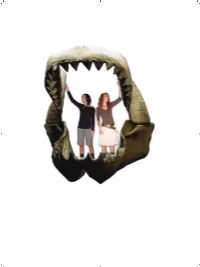
Ⓒ del autor: Domingo Lloris Ⓒ mayo 2007, Generalitat de Catalunya Departament d'Agricultura, Alimentació i Acció Rural, per aquesta primera edició Diseño y producción: Dsignum, estudi gràfic, s.l. Coordinación: Lourdes Porta ISBN: Depósito legal: B-16457-2007 Foto página anterior: Reconstrucción de las mandíbulas de un Megalodonte (Carcharocles megalodon) GLOSARIO ILUSTRADO DE ICTIOLOGÍA PARA EL MUNDO HISPANOHABLANTE Acuariología, Acuarismo, Acuicultura, Anatomía, Autoecología, Biocenología, Biodiver- sidad, Biogeografía, Biología, Biología evolutiva, Biología conservativa, Biología mole- cular, Biología pesquera, Biometría, Biotecnología, Botánica marina, Caza submarina, Clasificación, Climatología, Comercialización, Coro logía, Cromatismo, Ecología, Ecolo- gía trófica, Embriología, Endocri nología, Epizootiología, Estadística, Fenología, Filoge- nia, Física, Fisiología, Genética, Genómica, Geografía, Geología, Gestión ambiental, Hematología, Histolo gía, Ictiología, Ictionimia, Merística, Meteorología, Morfología, Navegación, Nomen clatura, Oceanografía, Organología, Paleontología, Patología, Pesca comercial, Pesca recreativa, Piscicultura, Química, Reproducción, Siste mática, Taxono- mía, Técnicas pesqueras, Teoría del muestreo, Trofismo, Zooar queología, Zoología. D. Lloris Doctor en Ciencias Biológicas Ictiólogo del Instituto de Ciencias del Mar (CSIC) Barcelona PRÓLOGO En mi ya lejana época universitaria se estudiaba mediante apuntes recogidos en las aulas y, más tarde, según el interés transmitido por el profesor y la avidez de conocimiento del alumno, se ampliaban con extractos procedentes de diversos libros de consulta. Así descubrí que, mientras en algunas disciplinas resultaba fácil encontrar obras en una lengua autóctona o traducida, en otras brillaban por su ausen- cia. He de admitir que el hecho me impresionó, pues ponía al descubierto toda una serie de oscuras caren- cias que marcaron un propósito a seguir en la disciplina que me ha ocupado durante treinta años: la ictiología. -

Along River Ganga
Impact assessment of coal transportation through barges along the National Waterway No.1 (Sagar to Farakka) along River Ganga Project Report ICAR-CENTRAL INLAND FISHERIES RESEARCH INSTITUTE (INDIAN COUNCIL OF AGRICULTURAL RESEARCH) BARRACKPORE, KOLKATA 700120, WEST BENGAL Impact assessment of coal transportation through barges along the National Waterway No.1 (Sagar to Farakka) along River Ganga Project Report Submitted to Inland Waterways Authority of India (Ministry of Shipping, Govt. of India) A 13, Sector 1, Noida 201301, Uttar Pradesh ICAR – Central Inland Fisheries Research Institute (Indian Council of Agricultural Research) Barrackpore, Kolkata – 700120, West Bengal Study Team Scientists from ICAR-CIFRI, Barrackpore Dr. B. K. Das, Director & Principal Investigator Dr. S. Samanta, Principal Scientist & Nodal Officer Dr. V. R. Suresh, Principal Scientist & Head, REF Division Dr. A. K. Sahoo, Scientist Dr. A. Pandit, Principal Scientist Dr. R. K. Manna, Senior Scientist Dr. Mrs. S. Das Sarkar, Scientist Ms. A. Ekka, Scientist Dr. B. P. Mohanty, Principal Scientist & Head, FREM Division Sri Roshith C. M., Scientist Dr. Rohan Kumar Raman, Scientist Technical personnel from ICAR-CIFRI, Barrackpore Mrs. A. Sengupta, Senior Technical Officer Sri A. Roy Chowdhury, Technical Officer Cover design Sri Sujit Choudhury Response to the Query Points of Expert Appraisal Committee POINT NO. 1. Long term, and a minimum period of one year continuous study shall be conducted on the impacts of varying traffic loads on aquatic flora and fauna with particular reference to species composition of different communities, abundance of selective species of indicator value, species richness and diversity and productivity Answered in page no. 7 – 12 (methodology) and 31 – 71 (results) of the report POINT NO.2. -
Lernaeenicus Sprattae (Crustacea: Copepoda) on Hemiramphus Far
Middle-East Journal of Scientific Research 11 (9): 1212-1215, 2012 ISSN 1990-9233 © IDOSI Publications, 2012 DOI: 10.5829/idosi.mejsr.2012.11.09.64157 Lernaeenicus sprattae (Crustacea: Copepoda) on Hemiramphus far Ganapathy Rameshkumar and Samuthirapandian Ravichandran Centre of Advanced Study in Marine Biology, Faculty of Marine Science, Annamalai University, Parangipettai-608 502, Tamil Nadu, India Abstract: Copepod parasite Lernaeenicus sprattae were collected from the body surface regions and there root was found from the kidney of the host fish Hemiramphus far. Lernaeenicus sprattae is a blood-feeding copepod parasite and has a particularly serious effect at the site of infection: its feeding has a severe effect on the fish. L. sprattae damages their hosts directly by their attachment mechanism and by their feeding activities. The observed length of L. sprattae was ranged from 48mm to 52mm. The prevalence of L. sprattae infection was 12.3% and intensity of infection was 3. Attachment on the skin of fishes can cause pressure necrosis and the host tissue responses can include swelling, hyperplasia and proliferation of fibro blasts. Four infested parasites was recorded as a maximum number of parasites on a single host. An interesting case of parasitism (copepod L. sprattae) is reported on the black-barred halfbeak fish Hemiramphus far. These dynamic interactions between parasites and fish hosts were probably the main determinant of host specificity. Key words: Blood-Feeding % Copepod Parasite % Hemiramphus far % Lernaeenicus sprattae INTRODUCTION of Lernaeenicus without assigning a specific name [13]. The revision of the family Lernaeidae has recognised 12 Parasitic copepod are common in wild and cultured valid species in this genus [5]. -

Alien Species in the Mediterranean Sea by 2010
Mediterranean Marine Science Review Article Indexed in WoS (Web of Science, ISI Thomson) The journal is available on line at http://www.medit-mar-sc.net Alien species in the Mediterranean Sea by 2010. A contribution to the application of European Union’s Marine Strategy Framework Directive (MSFD). Part I. Spatial distribution A. ZENETOS 1, S. GOFAS 2, M. VERLAQUE 3, M.E. INAR 4, J.E. GARCI’A RASO 5, C.N. BIANCHI 6, C. MORRI 6, E. AZZURRO 7, M. BILECENOGLU 8, C. FROGLIA 9, I. SIOKOU 10 , D. VIOLANTI 11 , A. SFRISO 12 , G. SAN MART N 13 , A. GIANGRANDE 14 , T. KATA AN 4, E. BALLESTEROS 15 , A. RAMOS-ESPLA ’16 , F. MASTROTOTARO 17 , O. OCA A 18 , A. ZINGONE 19 , M.C. GAMBI 19 and N. STREFTARIS 10 1 Institute of Marine Biological Resources, Hellenic Centre for Marine Research, P.O. Box 712, 19013 Anavissos, Hellas 2 Departamento de Biologia Animal, Facultad de Ciencias, Universidad de Ma ’laga, E-29071 Ma ’laga, Spain 3 UMR 6540, DIMAR, COM, CNRS, Université de la Méditerranée, France 4 Ege University, Faculty of Fisheries, Department of Hydrobiology, 35100 Bornova, Izmir, Turkey 5 Departamento de Biologia Animal, Facultad de Ciencias, Universidad de Ma ’laga, E-29071 Ma ’laga, Spain 6 DipTeRis (Dipartimento per lo studio del Territorio e della sue Risorse), University of Genoa, Corso Europa 26, 16132 Genova, Italy 7 Institut de Ciències del Mar (CSIC) Passeig Mar tim de la Barceloneta, 37-49, E-08003 Barcelona, Spain 8 Adnan Menderes University, Faculty of Arts & Sciences, Department of Biology, 09010 Aydin, Turkey 9 c\o CNR-ISMAR, Sede Ancona, Largo Fiera della Pesca, 60125 Ancona, Italy 10 Institute of Oceanography, Hellenic Centre for Marine Research, P.O. -

Hemiramphidae Gill 1859 Halfbeaks
ISSN 1545-150X California Academy of Sciences A N N O T A T E D C H E C K L I S T S O F F I S H E S Number 22 February 2004 Family Hemiramphidae Gill 1859 halfbeaks By Bruce B. Collette National Marine Fisheries Service Systematics Laboratory National Museum of Natural History, Washington, DC 20560–0153, U.S.A. email: Collette.Bruce@nmnh.si.edu The Hemiramphidae, the halfbeaks, is one of five families of the order Beloniformes (Rosen and Parenti 1981 [ref. 5538]). The family name is based on Hemiramphus Cuvier 1816 [ref. 993], but many authors have misspelled the genus as Hemirhamphus and the family name as Hemirhamphidae (although the other genera in the family do have the extra h; e.g., Arrhamphus, Euleptorhamphus, Hyporhamphus, Oxypo- rhamphus, and Rhynchorhamphus). The family contains two subfamilies, 14 genera and subgenera, and 117 species and subspecies. It is the sister-group of the Exocoetidae, the flyingfishes, forming the super- family Exocoetoidea (Collette et al. 1984 [ref. 11422]). Most halfbeaks have an elongate lower jaw that distinguishes them from the flyingfishes (Exocoetidae), which have lost the elongate lower jaw, and from the needlefishes (Belonidae) and sauries (Scomberesocidae), which have both jaws elongate. The Hemi- ramphidae is defined by one derived character: the third pair of upper pharyngeal bones are anklylosed into a plate. Other diagnostic characters include: pectoral fins short or moderately long; premaxillae pointed anteriorly, forming a triangular upper jaw (except in Oxyporhamphus); lower jaw elongate in juveniles of all genera, adults of most genera; parapophyses forked; and swim bladder not extending into the haemal canal. -

Lagon Bleu Eco Sud Marine Survey 2012
Lagon Bleu Eco Sud marine survey 2012 William Tyler FdSc BSc (Hons) T Eco-Sud Science report, 2012 William Tyler (Project coordinator) Table of Contents Page(s) Section 1.1. Project outline and objectives…………………………………………………2 Section 2.1. Study area……………………………………………………………………………….3 Section 3.1. Benthic composition survey……………………………………………………4 3.2. Sampling design……………………………………………………………….………….4 3.3. LIT – Benthic survey results………………………………………………………....5 Section 4.1. Fish assemblage survey…………………………………………………………..6 4.2. Sampling design…………………………………………………………………………..6 4.3. Fish survey results……………………………………………………………………….8 4.3.1 Site one - Transect 1…………………………………….……………………….8 4.3.2 Site three - Transect 3…………………………………………………………10 4.3.3 Site four - Transect 4………………….……………………………………….12 4.3.4 Site five - Transect 5…………………………….……………………………..14 4.3.5 Analysis of family and species abundance across the four…….16 sites Section 5.1. Discussion……………………………………………………………………………..19 Section 6.1. Preliminary study – Seagrass habitats…………………………………..21 Section 7.1. Proposed recommendations for next phase………………………….22 Section 8.1. References………………………………………………………………………...….23 Section 9.1. Appendices…………………………………………………………………………...25 1 Eco-Sud Science report, 2012 William Tyler (Project coordinator) Section 1.1 - Project outline and objectives Eco Sud is a non-government organisation (NGO) and was officially registered with the Registry of Associations on the 11th February 2000. The NGO organisation is located within Blue-Bay and currently has 65 members. Eco Sud has -
Report of the Technical Meeting on the Lessepsian Migration and Its Impact
EastMed TECHNICAL DOCUMENTS 04 REPORT OF THE TECHNICAL MEETING ON THE LESSEPSIAN MIGRATION AND ITS IMPACT ON EASTERN MEDITERRANEAN FISHERY NICOSIA, CYPRUS 7 - 9 DECEMBER 2010 FOOD AND AGRICULTURE ORGANIZATION OF THE UNITED NATIONS REPORT OF THE TECHNICAL MEETING ON THE LESSEPSIAN MIGRATION AND ITS IMPACT ON EASTERN MEDITERRANEAN FISHERY NICOSIA, CYPRUS 7 - 9 DECEMBER 2010 Hellenic Ministry of Foreign Affairs ITALIAN MINISTRY OF AGRICULTURE, FOOD AND FORESTRY POLICIES Hellenic Ministry of Rural Development and Food GCP/INT/041/EC – GRE – ITA Athens (Greece), 7-9 December 2010 i The conclusions and recommendations given in this and in other documents in the Scientific and Institutional Cooperation to Support Responsible Fisheries in the Eastern Mediterranean series are those considered appropriate at the time of preparation. They may be modified in the light of further knowledge gained in subsequent stages of the Project. The designations employed and the presentation of material in this publication do not imply the expression of any opinion on the part of FAO or donors concerning the legal status of any country, territory, city or area, or concerning the determination of its frontiers or boundaries. ii Preface The Project “Scientific and Institutional Cooperation to Support Responsible Fisheries in the Eastern Mediterranean- EastMed is executed by the Food and Agriculture Organization of the United Nations (FAO) and funded by Greece, Italy and EC. The Eastern Mediterranean countries have for long lacked a cooperation framework as created for other areas of the Mediterranean, namely the FAO sub-regional projects AdriaMed, MedSudMed, CopeMed II and ArtFiMed. This fact leaded for some countries to be sidelined, where international and regional cooperation for fishery research and management is concerned. -

Marine and Estuarine Fish Fauna of Tamil Nadu, India
Proceedings of the International Academy of Ecology and Environmental Sciences, 2018, 8(4): 231-271 Article Marine and estuarine fish fauna of Tamil Nadu, India 1,2 3 1 1 H.S. Mogalekar , J. Canciyal , D.S. Patadia , C. Sudhan 1Fisheries College and Research Institute, Thoothukudi - 628 008, Tamil Nadu, India 2College of Fisheries, Dholi, Muzaffarpur - 843 121, Bihar, India 3Central Inland Fisheries Research Institute, Barrackpore, Kolkata - 700 120, West Bengal, India E-mail: mogalekar.hs10@gmail.com Received 20 June 2018; Accepted 25 July 2018; Published 1 December 2018 Abstract Varied marine and estuarine ecosystems of Tamil Nadu endowed with diverse fish fauna. A total of 1656 fish species under two classes, 40 orders, 191 families and 683 geranra reported from marine and estuarine waters of Tamil Nadu. In the checklist, 1075 fish species were primary marine water and remaining 581 species were diadromus. In total, 128 species were reported under class Elasmobranchii (11 orders, 36 families and 70 genera) and 1528 species under class Actinopterygii (29 orders, 155 families and 613 genera). The top five order with diverse species composition were Perciformes (932 species; 56.29% of the total fauna), Tetraodontiformes (99 species), Pleuronectiforms (77 species), Clupeiformes (72 species) and Scorpaeniformes (69 species). At the family level, the Gobiidae has the greatest number of species (86 species), followed by the Carangidae (65 species), Labridae (64 species) and Serranidae (63 species). Fishery status assessment revealed existence of 1029 species worth for capture fishery, 425 species worth for aquarium fishery, 84 species worth for culture fishery, 242 species worth for sport fishery and 60 species worth for bait fishery. -

(Hemiramphidae) of Australia and New Zealand
AUSTRALIAN MUSEUM SCIENTIFIC PUBLICATIONS Collette, Bruce B., 1974. The garfishes (Hemiramphidae) of Australia and New Zealand. Records of the Australian Museum 29(2): 11–105. [12 March 1974]. doi:10.3853/j.0067-1975.29.1974.231 ISSN 0067-1975 Published by the Australian Museum, Sydney naturenature cultureculture discover discover AustralianAustralian Museum Museum science science is is freely freely accessible accessible online online at at www.australianmuseum.net.au/publications/www.australianmuseum.net.au/publications/ 66 CollegeCollege Street,Street, SydneySydney NSWNSW 2010,2010, AustraliaAustralia THE GARFISHES (HEMIRAMPHIDAE) OF AUSTRALIA AND NEW ZEALAND By BRUCE B. COLLETTE National Marine Fisheries Service Systematics Laboratory, U.S. National Museum> Washington, D.C., 20560, U.S.A. Figures 1-23 Manuscript received, 21St June, 1972 SUMMARY Twenty species and subspecies of garfishes are recognized from Australian and New Zealand waters: Arrhamphus s. sclerolepis, A. s. krefftii, Euleptorhamphus viridis, Hemiramphus far, He. robv.stus, Hyporhamphus r. regularis, By. r. ardelio, Hy. neglectus, /f.y. australis, Hy. melanochir, Hy. ihi, lfy. quoyi, Hy. affinis, Hy. dussumieri, Rhynchorhamphus georgii, Zenarchopterus buffonis, Z. caudovittatus, Z. dispar, Z. gilli, and Z. rasori. Reporhamphus is considered a synonym of If.yporhamphus; Farhians and Ardeapiscis are considered synonyms of Hemiramphus; and Lofigorhamphus a synonym of R~ynchorhamphus. Hemiramphus welsbyi is a synonym of He. robustus. The eastern river garfish (Byporhamphv.s ardelio) is reduced to a subspecies of the western river garfish (Hy. regularis). The New South Wales-southern Queensland population of the snub-nosed garfish (Arrhamphus sclerolepis) is considered a subspecies (A. s. krejJtii) of the northern A. s. sclerolepis.