Studies on the Biology of Dipterous Stem-Boring
Total Page:16
File Type:pdf, Size:1020Kb
Load more
Recommended publications
-
Diversity and Resource Choice of Flower-Visiting Insects in Relation to Pollen Nutritional Quality and Land Use
Diversity and resource choice of flower-visiting insects in relation to pollen nutritional quality and land use Diversität und Ressourcennutzung Blüten besuchender Insekten in Abhängigkeit von Pollenqualität und Landnutzung Vom Fachbereich Biologie der Technischen Universität Darmstadt zur Erlangung des akademischen Grades eines Doctor rerum naturalium genehmigte Dissertation von Dipl. Biologin Christiane Natalie Weiner aus Köln Berichterstatter (1. Referent): Prof. Dr. Nico Blüthgen Mitberichterstatter (2. Referent): Prof. Dr. Andreas Jürgens Tag der Einreichung: 26.02.2016 Tag der mündlichen Prüfung: 29.04.2016 Darmstadt 2016 D17 2 Ehrenwörtliche Erklärung Ich erkläre hiermit ehrenwörtlich, dass ich die vorliegende Arbeit entsprechend den Regeln guter wissenschaftlicher Praxis selbständig und ohne unzulässige Hilfe Dritter angefertigt habe. Sämtliche aus fremden Quellen direkt oder indirekt übernommene Gedanken sowie sämtliche von Anderen direkt oder indirekt übernommene Daten, Techniken und Materialien sind als solche kenntlich gemacht. Die Arbeit wurde bisher keiner anderen Hochschule zu Prüfungszwecken eingereicht. Osterholz-Scharmbeck, den 24.02.2016 3 4 My doctoral thesis is based on the following manuscripts: Weiner, C.N., Werner, M., Linsenmair, K.-E., Blüthgen, N. (2011): Land-use intensity in grasslands: changes in biodiversity, species composition and specialization in flower-visitor networks. Basic and Applied Ecology 12 (4), 292-299. Weiner, C.N., Werner, M., Linsenmair, K.-E., Blüthgen, N. (2014): Land-use impacts on plant-pollinator networks: interaction strength and specialization predict pollinator declines. Ecology 95, 466–474. Weiner, C.N., Werner, M , Blüthgen, N. (in prep.): Land-use intensification triggers diversity loss in pollination networks: Regional distinctions between three different German bioregions Weiner, C.N., Hilpert, A., Werner, M., Linsenmair, K.-E., Blüthgen, N. -
Insect Egg Size and Shape Evolve with Ecology but Not Developmental Rate Samuel H
ARTICLE https://doi.org/10.1038/s41586-019-1302-4 Insect egg size and shape evolve with ecology but not developmental rate Samuel H. Church1,4*, Seth Donoughe1,3,4, Bruno A. S. de Medeiros1 & Cassandra G. Extavour1,2* Over the course of evolution, organism size has diversified markedly. Changes in size are thought to have occurred because of developmental, morphological and/or ecological pressures. To perform phylogenetic tests of the potential effects of these pressures, here we generated a dataset of more than ten thousand descriptions of insect eggs, and combined these with genetic and life-history datasets. We show that, across eight orders of magnitude of variation in egg volume, the relationship between size and shape itself evolves, such that previously predicted global patterns of scaling do not adequately explain the diversity in egg shapes. We show that egg size is not correlated with developmental rate and that, for many insects, egg size is not correlated with adult body size. Instead, we find that the evolution of parasitoidism and aquatic oviposition help to explain the diversification in the size and shape of insect eggs. Our study suggests that where eggs are laid, rather than universal allometric constants, underlies the evolution of insect egg size and shape. Size is a fundamental factor in many biological processes. The size of an 526 families and every currently described extant hexapod order24 organism may affect interactions both with other organisms and with (Fig. 1a and Supplementary Fig. 1). We combined this dataset with the environment1,2, it scales with features of morphology and physi- backbone hexapod phylogenies25,26 that we enriched to include taxa ology3, and larger animals often have higher fitness4. -

Land Management and Plant Species Pattern Effects on Grassland Pollinator Services
University of North Dakota UND Scholarly Commons Theses and Dissertations Theses, Dissertations, and Senior Projects January 2020 Land Management And Plant Species Pattern Effects On Grassland Pollinator Services Leslie Blaine Yellow Hammer Follow this and additional works at: https://commons.und.edu/theses Recommended Citation Yellow Hammer, Leslie Blaine, "Land Management And Plant Species Pattern Effects On Grassland Pollinator Services" (2020). Theses and Dissertations. 3308. https://commons.und.edu/theses/3308 This Thesis is brought to you for free and open access by the Theses, Dissertations, and Senior Projects at UND Scholarly Commons. It has been accepted for inclusion in Theses and Dissertations by an authorized administrator of UND Scholarly Commons. For more information, please contact und.commons@library.und.edu. LAND MANAGEMENT AND PLANT SPECIES PATTERN EFFECTS ON GRASSLAND POLLINATOR SERVICES by Leslie Blaine Yellow Hammer Bachelor of Science, University of North Dakota, 2015 A Thesis Submitted to the Graduate Faculty of the University of North Dakota in partial fulfilment of the requirements For the degree of Master of Science Grand Forks, North Dakota August 2020 This thesis, submitted by Leslie B. Yellow Hammer in partial fulfillment of the requirements for the Degree of Master of Science from the University of North Dakota, has been read by the Faculty Advisory Committee under whom the work has been done and is hereby approved. This thesis is being submitted by the appointed advisory committee as having met all of the requirements of the School of Graduate Studies at the University of North Dakota and is hereby approved. ii PERMISSION Title Land Management and Plant Species Pattern Effects on Grassland Pollinator Services Department Biology Degree Master of Science In presenting this thesis in partial fulfillment of the requirements for a graduate degree from the University of North Dakota, I agree that the library of this University shall make it freely available for inspection. -
The Importance of Vegetation Configuration in Coastal
Biology Department Research Group Terrestrial Ecology _____________________________________________________________________________________ THE IMPORTANCE OF VEGETATION CONFIGURATION IN COASTAL DUNES TO PRESERVE DIVERSITY OF MARRAM- ASSOCIATED INVERTEBRATES IS HABITAT CONFIGURATION A DRIVER OF DIVERSITY IN DUNES? Noëmie Van den Bon Studentnumber: 01506438 Supervisor(s): Prof. Dr. Dries Bonte Dr. Martijn Vandegehuchte Scientific tutor: Ruben Van De Walle Master’s dissertation submitted to obtain the degree of Master of Science in Biology Academic year: 2019 - 2020 © Faculty of Sciences – research group Terrestrial Ecology All rights reserved. This thesis contains confidential information and confidential research results that are property to the UGent. The contents of this master thesis may under no circumstances be made public, nor complete or partial, without the explicit and preceding permission of the UGent representative, i.e. the supervisor. The thesis may under no circumstances be copied or duplicated in any form, unless permission granted in written form. Any violation of the confidential nature of this thesis may impose irreparable damage to the UGent. In case of a dispute that may arise within the context of this declaration, the Judicial Court of Gent only is competent to be notified. 2 Table of content 1. Introduction ....................................................................................................................................... 5 1.1. The status of biodiversity and ecosystems .......................................................................................... -

Ballyogan and Slieve Carran, Co. Clare
ISSN 1393 – 6670 N A T I O N A L P A R K S A N D W I L D L I F E S ERVICE IMPORTANT INVERTEBRATE AREA SURVEYS: BALLYOGAN AND SLIEVE CARRAN, CO. CLARE Adam Mantell & Roy Anderson I R I S H W ILDL I F E M ANUAL S 127 National Parks and Wildlife Service (NPWS) commissions a range of reports from external contractors to provide scientific evidence and advice to assist it in its duties. The Irish Wildlife Manuals series serves as a record of work carried out or commissioned by NPWS, and is one means by which it disseminates scientific information. Others include scientific publications in peer reviewed journals. The views and recommendations presented in this report are not necessarily those of NPWS and should, therefore, not be attributed to NPWS. Front cover, small photographs from top row: Limestone pavement, Bricklieve Mountains, Co. Sligo, Andy Bleasdale; Meadow Saffron Colchicum autumnale, Lorcan Scott; Garden Tiger Arctia caja, Brian Nelson; Fulmar Fulmarus glacialis, David Tierney; Common Newt Lissotriton vulgaris, Brian Nelson; Scots Pine Pinus sylvestris, Jenni Roche; Raised bog pool, Derrinea Bog, Co. Roscommon, Fernando Fernandez Valverde; Coastal heath, Howth Head, Co. Dublin, Maurice Eakin; A deep water fly trap anemone Phelliactis sp., Yvonne Leahy; Violet Crystalwort Riccia huebeneriana, Robert Thompson Main photograph: Burren Green Calamia tridens, Brian Nelson Important Invertebrate Area Surveys: Ballyogan and Slieve Carran, Co. Clare Adam Mantell1,2 and Roy Anderson3 1 42 Kernaghan Park, Annahilt, Hillsborough, Co. Down BT26 6DF, 2 Buglife Services Ltd., Peterborough, UK, 3 1 Belvoirview Park, Belfast BT8 7BL Keywords: Ireland, the Burren, insects, invertebrates, site inventory Citation: Mantell, A. -

F. Christian Thompson Neal L. Evenhuis and Curtis W. Sabrosky Bibliography of the Family-Group Names of Diptera
F. Christian Thompson Neal L. Evenhuis and Curtis W. Sabrosky Bibliography of the Family-Group Names of Diptera Bibliography Thompson, F. C, Evenhuis, N. L. & Sabrosky, C. W. The following bibliography gives full references to 2,982 works cited in the catalog as well as additional ones cited within the bibliography. A concerted effort was made to examine as many of the cited references as possible in order to ensure accurate citation of authorship, date, title, and pagination. References are listed alphabetically by author and chronologically for multiple articles with the same authorship. In cases where more than one article was published by an author(s) in a particular year, a suffix letter follows the year (letters are listed alphabetically according to publication chronology). Authors' names: Names of authors are cited in the bibliography the same as they are in the text for proper association of literature citations with entries in the catalog. Because of the differing treatments of names, especially those containing articles such as "de," "del," "van," "Le," etc., these names are cross-indexed in the bibliography under the various ways in which they may be treated elsewhere. For Russian and other names in Cyrillic and other non-Latin character sets, we follow the spelling used by the authors themselves. Dates of publication: Dating of these works was obtained through various methods in order to obtain as accurate a date of publication as possible for purposes of priority in nomenclature. Dates found in the original works or by outside evidence are placed in brackets after the literature citation. -

WO 2014/053403 Al 10 April 2014 (10.04.2014) P O P C T
(12) INTERNATIONAL APPLICATION PUBLISHED UNDER THE PATENT COOPERATION TREATY (PCT) (19) World Intellectual Property Organization International Bureau (10) International Publication Number (43) International Publication Date WO 2014/053403 Al 10 April 2014 (10.04.2014) P O P C T (51) International Patent Classification: (72) Inventors: KORBER, Karsten; Hintere Lisgewann 26, A01N 43/56 (2006.01) A01P 7/04 (2006.01) 69214 Eppelheim (DE). WACH, Jean-Yves; Kirchen- strafie 5, 681 59 Mannheim (DE). KAISER, Florian; (21) International Application Number: Spelzenstr. 9, 68167 Mannheim (DE). POHLMAN, Mat¬ PCT/EP2013/070157 thias; Am Langenstein 13, 6725 1 Freinsheim (DE). (22) International Filing Date: DESHMUKH, Prashant; Meerfeldstr. 62, 68163 Man 27 September 2013 (27.09.201 3) nheim (DE). CULBERTSON, Deborah L.; 6400 Vintage Ridge Lane, Fuquay Varina, NC 27526 (US). ROGERS, (25) Filing Language: English W. David; 2804 Ashland Drive, Durham, NC 27705 (US). Publication Language: English GUNJIMA, Koshi; Heighths Takara-3 205, 97Shirakawa- cho, Toyohashi-city, Aichi Prefecture 441-8021 (JP). (30) Priority Data DAVID, Michael; 5913 Greenevers Drive, Raleigh, NC 61/708,059 1 October 2012 (01. 10.2012) US 027613 (US). BRAUN, Franz Josef; 3602 Long Ridge 61/708,061 1 October 2012 (01. 10.2012) US Road, Durham, NC 27703 (US). THOMPSON, Sarah; 61/708,066 1 October 2012 (01. 10.2012) u s 45 12 Cheshire Downs C , Raleigh, NC 27603 (US). 61/708,067 1 October 2012 (01. 10.2012) u s 61/708,071 1 October 2012 (01. 10.2012) u s (74) Common Representative: BASF SE; 67056 Ludwig 61/729,349 22 November 2012 (22.11.2012) u s shafen (DE). -

Biodiversity Changes in Vegetation and Insects Following the Creation of a Wildflower Strip
Hochschule Rhein-Waal Rhine-Waal University of Applied Sciences Faculty of Communication and Environment Biodiversity changes in vegetation and insects following the creation of a wildflower strip A Case Study Bachelor Thesis by Johanna Marquardt Hochschule Rhein-Waal Rhine-Waal University of Applied Sciences Faculty of Communication and Environment Biodiversity changes in vegetation and insects following the creation of a wildflower strip A Case Study A Thesis Submitted in Partial Fulfillment of the Requirements of the Degree of Bachelor of Science In Environment and Energy by Johanna Marquardt Matriculation Number: 23048 Supervised by Prof. Dr. Daniela Lud Prof. Dr. Petra Blitgen-Heinecke Submission Date: 22.02.2021 Abstract With the Global Climate Change, the loss of biodiversity is one of the most current and biggest crises of today and the future. The loss i.e., the decrease of biodiversity, does not only have negative effects on vegetation and animals, but also on humans. If nature is doing well, people are doing well. In order to counteract the loss, this bachelor thesis attempts to increase plant and insect biodiversity at a specific location with insect-friendly seed mixtures and by measuring the change using comparison areas. Accordingly, the two research questions were addressed: (1) "How does plant-biodiversity change in the backyard and front yard on the seed mixture plot compared to plant-biodiversity in the backyard and front yard next to the seed mixture plot?" and (2) "How does insect-biodiversity change in the backyard and front yard on the seed mixture plot compared to insect-biodiversity in the backyard and front yard next to the seed mixture plot?" To answer these research questions and to obtain more suitable data, a wildflower strip was established in the backyard and one in the front yard, each with an adjacent reference field, to ensure equal environmental conditions and to detect changes in flora and fauna. -
1 the RESTRUCTURING of ARTHROPOD TROPHIC RELATIONSHIPS in RESPONSE to PLANT INVASION by Adam B. Mitchell a Dissertation Submitt
THE RESTRUCTURING OF ARTHROPOD TROPHIC RELATIONSHIPS IN RESPONSE TO PLANT INVASION by Adam B. Mitchell 1 A dissertation submitted to the Faculty of the University of Delaware in partial fulfillment of the requirements for the degree of Doctor of Philosophy in Entomology and Wildlife Ecology Winter 2019 © Adam B. Mitchell All Rights Reserved THE RESTRUCTURING OF ARTHROPOD TROPHIC RELATIONSHIPS IN RESPONSE TO PLANT INVASION by Adam B. Mitchell Approved: ______________________________________________________ Jacob L. Bowman, Ph.D. Chair of the Department of Entomology and Wildlife Ecology Approved: ______________________________________________________ Mark W. Rieger, Ph.D. Dean of the College of Agriculture and Natural Resources Approved: ______________________________________________________ Douglas J. Doren, Ph.D. Interim Vice Provost for Graduate and Professional Education I certify that I have read this dissertation and that in my opinion it meets the academic and professional standard required by the University as a dissertation for the degree of Doctor of Philosophy. Signed: ______________________________________________________ Douglas W. Tallamy, Ph.D. Professor in charge of dissertation I certify that I have read this dissertation and that in my opinion it meets the academic and professional standard required by the University as a dissertation for the degree of Doctor of Philosophy. Signed: ______________________________________________________ Charles R. Bartlett, Ph.D. Member of dissertation committee I certify that I have read this dissertation and that in my opinion it meets the academic and professional standard required by the University as a dissertation for the degree of Doctor of Philosophy. Signed: ______________________________________________________ Jeffery J. Buler, Ph.D. Member of dissertation committee I certify that I have read this dissertation and that in my opinion it meets the academic and professional standard required by the University as a dissertation for the degree of Doctor of Philosophy. -

Notes on Insects Recently Introduced to Metro Vancouver and Other Newly Recorded Species from British Columbia
J. ENTOMOL. SOC. BRIT. COLUMBIA 113, DECEMBER 2016 !79 NATURAL HISTORY AND OBSERVATIONS Notes on insects recently introduced to Metro Vancouver and other newly recorded species from British Columbia C. G. RATZLAFF1, K.M. NEEDHAM, and G. G. E. SCUDDER ABSTRACT Sixteen insects species are recorded for the first time from British Columbia, including seven new to Canada. These records are comprised of nine introduced species, including the first record of Rhopalum gracile Wesmael (Hymenoptera: Crabronidae) from North America, and range extensions for seven species native to the Nearctic region. Colour images of selected specimens are included. Key words: Introduced, Coleoptera, Diptera, Hemiptera, Hymenoptera, Trichoptera, British Columbia, Canada INTRODUCTION During the course of our fieldwork over the past few years, and by determining older unidentified material in the Spencer Entomological Collection, we have discovered 16 species never before recorded from British Columbia, including seven species new to Canada. Nine of the species have been introduced from their native ranges, and seven are range extensions for Nearctic species. We report these new records here. Our field work during this time consisted mainly of monthly forays to local areas, participation in bioblitzes and species surveys outside the Lower Mainland (which concentrate efforts on a select locale for a short period of time), and an ongoing survey of the "green roof" atop the Vancouver Convention Centre. All specimens recorded here are deposited in either the Spencer Entomological Collection [SEM] or the first author’s personal collection [CGR]. All photos were taken by the first author using a Leica DFC490 digital camera mounted on a Leica M205C stereomicroscope. -
Appendix 5: Fauna Known to Occur on Fort Drum
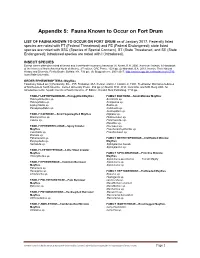
Appendix 5: Fauna Known to Occur on Fort Drum LIST OF FAUNA KNOWN TO OCCUR ON FORT DRUM as of January 2017. Federally listed species are noted with FT (Federal Threatened) and FE (Federal Endangered); state listed species are noted with SSC (Species of Special Concern), ST (State Threatened, and SE (State Endangered); introduced species are noted with I (Introduced). INSECT SPECIES Except where otherwise noted all insect and invertebrate taxonomy based on (1) Arnett, R.H. 2000. American Insects: A Handbook of the Insects of North America North of Mexico, 2nd edition, CRC Press, 1024 pp; (2) Marshall, S.A. 2013. Insects: Their Natural History and Diversity, Firefly Books, Buffalo, NY, 732 pp.; (3) Bugguide.net, 2003-2017, http://www.bugguide.net/node/view/15740, Iowa State University. ORDER EPHEMEROPTERA--Mayflies Taxonomy based on (1) Peckarsky, B.L., P.R. Fraissinet, M.A. Penton, and D.J. Conklin Jr. 1990. Freshwater Macroinvertebrates of Northeastern North America. Cornell University Press. 456 pp; (2) Merritt, R.W., K.W. Cummins, and M.B. Berg 2008. An Introduction to the Aquatic Insects of North America, 4th Edition. Kendall Hunt Publishing. 1158 pp. FAMILY LEPTOPHLEBIIDAE—Pronggillled Mayflies FAMILY BAETIDAE—Small Minnow Mayflies Habrophleboides sp. Acentrella sp. Habrophlebia sp. Acerpenna sp. Leptophlebia sp. Baetis sp. Paraleptophlebia sp. Callibaetis sp. Centroptilum sp. FAMILY CAENIDAE—Small Squaregilled Mayflies Diphetor sp. Brachycercus sp. Heterocloeon sp. Caenis sp. Paracloeodes sp. Plauditus sp. FAMILY EPHEMERELLIDAE—Spiny Crawler Procloeon sp. Mayflies Pseudocentroptiloides sp. Caurinella sp. Pseudocloeon sp. Drunela sp. Ephemerella sp. FAMILY METRETOPODIDAE—Cleftfooted Minnow Eurylophella sp. Mayflies Serratella sp. -
An Introduction to the Immature Stages of British Flies
Royal Entomological Society HANDBOOKS FOR THE IDENTIFICATION OF BRITISH INSECTS To purchase current handbooks and to download out-of-print parts visit: http://www.royensoc.co.uk/publications/index.htm This work is licensed under a Creative Commons Attribution-NonCommercial-ShareAlike 2.0 UK: England & Wales License. Copyright © Royal Entomological Society 2013 Handbooks for the Identification of British Insects Vol. 10, Part 14 AN INTRODUCTION TO THE IMMATURE STAGES OF BRITISH FLIES DIPTERA LARVAE, WITH NOTES ON EGGS, PUP ARIA AND PUPAE K. G. V. Smith ROYAL ENTOMOLOGICAL SOCIETY OF LONDON Handbooks for the Vol. 10, Part 14 Identification of British Insects Editors: W. R. Dolling & R. R. Askew AN INTRODUCTION TO THE IMMATURE STAGES OF BRITISH FLIES DIPTERA LARVAE, WITH NOTES ON EGGS, PUPARIA AND PUPAE By K. G. V. SMITH Department of Entomology British Museum (Natural History) London SW7 5BD 1989 ROYAL ENTOMOLOGICAL SOCIETY OF LONDON The aim of the Handbooks is to provide illustrated identification keys to the insects of Britain, together with concise morphological, biological and distributional information. Each handbook should serve both as an introduction to a particular group of insects and as an identification manual. Details of handbooks currently available can be obtained from Publications Sales, British Museum (Natural History), Cromwell Road, London SW7 5BD. Cover illustration: egg of Muscidae; larva (lateral) of Lonchaea (Lonchaeidae); floating puparium of Elgiva rufa (Panzer) (Sciomyzidae). To Vera, my wife, with thanks for sharing my interest in insects World List abbreviation: Handbk /dent. Br./nsects. © Royal Entomological Society of London, 1989 First published 1989 by the British Museum (Natural History), Cromwell Road, London SW7 5BD.