Alcelaphus Buselaphus Swaynei) in Maze National Park, Ethiopia
Total Page:16
File Type:pdf, Size:1020Kb
Load more
Recommended publications
-
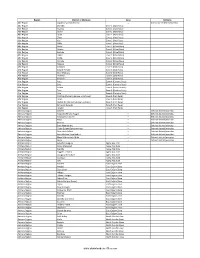
Districts of Ethiopia
Region District or Woredas Zone Remarks Afar Region Argobba Special Woreda -- Independent district/woredas Afar Region Afambo Zone 1 (Awsi Rasu) Afar Region Asayita Zone 1 (Awsi Rasu) Afar Region Chifra Zone 1 (Awsi Rasu) Afar Region Dubti Zone 1 (Awsi Rasu) Afar Region Elidar Zone 1 (Awsi Rasu) Afar Region Kori Zone 1 (Awsi Rasu) Afar Region Mille Zone 1 (Awsi Rasu) Afar Region Abala Zone 2 (Kilbet Rasu) Afar Region Afdera Zone 2 (Kilbet Rasu) Afar Region Berhale Zone 2 (Kilbet Rasu) Afar Region Dallol Zone 2 (Kilbet Rasu) Afar Region Erebti Zone 2 (Kilbet Rasu) Afar Region Koneba Zone 2 (Kilbet Rasu) Afar Region Megale Zone 2 (Kilbet Rasu) Afar Region Amibara Zone 3 (Gabi Rasu) Afar Region Awash Fentale Zone 3 (Gabi Rasu) Afar Region Bure Mudaytu Zone 3 (Gabi Rasu) Afar Region Dulecha Zone 3 (Gabi Rasu) Afar Region Gewane Zone 3 (Gabi Rasu) Afar Region Aura Zone 4 (Fantena Rasu) Afar Region Ewa Zone 4 (Fantena Rasu) Afar Region Gulina Zone 4 (Fantena Rasu) Afar Region Teru Zone 4 (Fantena Rasu) Afar Region Yalo Zone 4 (Fantena Rasu) Afar Region Dalifage (formerly known as Artuma) Zone 5 (Hari Rasu) Afar Region Dewe Zone 5 (Hari Rasu) Afar Region Hadele Ele (formerly known as Fursi) Zone 5 (Hari Rasu) Afar Region Simurobi Gele'alo Zone 5 (Hari Rasu) Afar Region Telalak Zone 5 (Hari Rasu) Amhara Region Achefer -- Defunct district/woredas Amhara Region Angolalla Terana Asagirt -- Defunct district/woredas Amhara Region Artuma Fursina Jile -- Defunct district/woredas Amhara Region Banja -- Defunct district/woredas Amhara Region Belessa -- -

Download E-Book (PDF)
Journal of Public Health and Epidemiology Volume 9 Number 6 June 2017 ISSN 2141-2316 ABOUT JPHE The Journal of Public Health and Epidemiology (JPHE) is published monthly (one volume per year) by Academic Journals. Journal of Public Health and Epidemiology (JPHE) is an open access journal that provides rapid publication (monthly) of articles in all areas of the subject such as health observatory, biostatistics, occupational health, behavioral medicine etc. The Journal welcomes the submission of manuscripts that meet the general criteria of significance and scientific excellence. Papers will be published shortly after acceptance. All articles published in JPHE are peer-reviewed. Contact Us Editorial Office: jphe@academicjournals.org Help Desk: helpdesk@academicjournals.org Website: http://www.academicjournals.org/journal/JPHE Submit manuscript online http://ms.academicjournals.me/ Editors Professor Mostafa A. Abolfotouh Professor of Family & Community Medicine Head of Medical Team - Biobanking Section. King Abdullah International Medical Research CEnter, King Saud Bin-Abdulaziz University for Health Sciences, National Guard Health Affairs, Saudi Arabia Editorial Board Dr. Guolian Kang Prof. Tariq Javed The University of Alabama at Birmingham/1665 Department of Pathology, Faculty of Veterinary Science, University Blvd, Ryals 443 University of Agriculture, Faisalabad-38040. Guolian Pakistan. USA Dr. María Elena Dávila L Universidad Centroccidental “Lisandro Alvarado”. Dr. Mohammed Danlami Salihu School of Medicine/ School of Health Science . Av. Public Health Department Andrés Bello C/ Av. Libertador. Barquisimeto, Lara, Faculty of Veterinary Medicine Venezuela, SA Usmanu Danfodiyo University, Sokoto. Nigeria. Dr. Lay Ching Chai Centre of Excellence for Food Safety Research, Faculty of Prof. Jahanfar Jahanban Food Science and Technology, Universiti Putra Malaysia, Oral Pathology Dept.Dental faculty of Tehran Islamic 43400 UPM Serdang, Selangor, Azad University/ Malaysia Address:B 107 Pezeshkan-Farabi Build No 67 Javanshir St. -

Ethiopia Round 6 SDP Questionnaire
Ethiopia Round 6 SDP Questionnaire Always 001a. Your name: [NAME] Is this your name? ◯ Yes ◯ No 001b. Enter your name below. 001a = 0 Please record your name 002a = 0 Day: 002b. Record the correct date and time. Month: Year: ◯ TIGRAY ◯ AFAR ◯ AMHARA ◯ OROMIYA ◯ SOMALIE BENISHANGUL GUMZ 003a. Region ◯ ◯ S.N.N.P ◯ GAMBELA ◯ HARARI ◯ ADDIS ABABA ◯ DIRE DAWA filter_list=${this_country} ◯ NORTH WEST TIGRAY ◯ CENTRAL TIGRAY ◯ EASTERN TIGRAY ◯ SOUTHERN TIGRAY ◯ WESTERN TIGRAY ◯ MEKELE TOWN SPECIAL ◯ ZONE 1 ◯ ZONE 2 ◯ ZONE 3 ZONE 5 003b. Zone ◯ ◯ NORTH GONDAR ◯ SOUTH GONDAR ◯ NORTH WELLO ◯ SOUTH WELLO ◯ NORTH SHEWA ◯ EAST GOJAM ◯ WEST GOJAM ◯ WAG HIMRA ◯ AWI ◯ OROMIYA 1 ◯ BAHIR DAR SPECIAL ◯ WEST WELLEGA ◯ EAST WELLEGA ◯ ILU ABA BORA ◯ JIMMA ◯ WEST SHEWA ◯ NORTH SHEWA ◯ EAST SHEWA ◯ ARSI ◯ WEST HARARGE ◯ EAST HARARGE ◯ BALE ◯ SOUTH WEST SHEWA ◯ GUJI ◯ ADAMA SPECIAL ◯ WEST ARSI ◯ KELEM WELLEGA ◯ HORO GUDRU WELLEGA ◯ Shinile ◯ Jijiga ◯ Liben ◯ METEKEL ◯ ASOSA ◯ PAWE SPECIAL ◯ GURAGE ◯ HADIYA ◯ KEMBATA TIBARO ◯ SIDAMA ◯ GEDEO ◯ WOLAYITA ◯ SOUTH OMO ◯ SHEKA ◯ KEFA ◯ GAMO GOFA ◯ BENCH MAJI ◯ AMARO SPECIAL ◯ DAWURO ◯ SILTIE ◯ ALABA SPECIAL ◯ HAWASSA CITY ADMINISTRATION ◯ AGNEWAK ◯ MEJENGER ◯ HARARI ◯ AKAKI KALITY ◯ NEFAS SILK-LAFTO ◯ KOLFE KERANIYO 2 ◯ GULELE ◯ LIDETA ◯ KIRKOS-SUB CITY ◯ ARADA ◯ ADDIS KETEMA ◯ YEKA ◯ BOLE ◯ DIRE DAWA filter_list=${level1} ◯ TAHTAY ADIYABO ◯ MEDEBAY ZANA ◯ TSELEMTI ◯ SHIRE ENIDASILASE/TOWN/ ◯ AHIFEROM ◯ ADWA ◯ TAHTAY MAYCHEW ◯ NADER ADET ◯ DEGUA TEMBEN ◯ ABIYI ADI/TOWN/ ◯ ADWA/TOWN/ ◯ AXUM/TOWN/ ◯ SAESI TSADAMBA ◯ KLITE -

June, 2016 Arba Minch, Ethiopia
ARBA MINCH UNIVERSITY SCHOOL OF GRADUATE STUDIES DEPARTMENT OF BIOLOGY A STUDY ON MEDICINAL PLANTS OF GAMO PEOPLE: THE CASE OF BONKE WOREDA, SNNPR, ETHIOPIA A Thesis submitted to the School of Graduate Studies of Arba Minch University Department of Biology in partial fulfillment of the requirements for the Degree of Master of Science in Botanical Sciences BY BISHAW BAYE WOLDEAMANUEL (ID RMSC058/06) Advisor: FELEKE WOLDEYES (PhD) June, 2016 Arba Minch, Ethiopia I APPROVALPAGE This research paper entitled ‘A Study onMedicinal Plants of Gamo People: the Case of Bonke Woreda, SNNPR, Ethiopia’ is submitted in partial fulfillment of the requirement for the degree of Master of Science in botanical Science. Submitted By Signature Date Bishaw Baye ___________ __________ Approved By: Advisor: Feleke Woldeyes (PhD) ___________ __________ Department Head: Zeleke Assefa __________ __________ Examiner: ___________ ___________ __________ II Acknowledgments First of all, I would like to express my honest gratitude to my advisor Dr. Feleke Woldeyes for his unlimited and constant encouragement at all steps of my study. I would also like to appreciate him for his immeasurable guidance, ideas, opinions and other support required for this research work. I would like to thank local peoples of Bonke Wereda for their willingness to deliver important information to my inquiries to share their knowledge about ethnomedicinal uses of medicinal plants. I would also like to express my deepest thanks to my field guide Melkamu Belay and Eyasu Desalegn who greatly helped me in data collection. I also acknowledge the support extended by Bonke Wereda Administration, the Woreda Agricultural and Rural Development Office and the Wereda Health center for their all-round support that allowed the smooth running of my field work and secondary data collection. -

Delivery at Home and Associated Factors Among Women in Child Bearing Age, Who Gave Birth in the Preceding Two Years in Zala Woreda, Southern Ethiopia
Vol. 9(6), pp. 177-188, June 2017 DOI: 10.5897/JPHE2017.0921 Article Number: 65593B764379 Journal of Public Health and ISSN 2141-2316 Copyright © 2017 Epidemiology Author(s) retain the copyright of this article http://www.academicjournals.org/JPHE Full Length Research Paper Delivery at home and associated factors among women in child bearing age, who gave birth in the preceding two years in Zala Woreda, southern Ethiopia Bedilu Kucho1 and Niguse Mekonnen2* 1Mayor of Sawla Town, Demba Gofa Woreda, Gamo Gofa Zone, Southern Nation Nationalities peoples State, Ethiopia. 2School of Public Health, College of Health Sciences, Wolaita Sodo University, Wolaita Sodo, Ethiopia. Received 26 January, 2017; Accepted 24 March, 2017 A key intervention to achieve the goal of maternal mortality reduction in deliveries that occur at home is significant. In Ethiopia, the MMR has reduced from 676/100,000 live births in 2011 to 420/100,000 live births in 2013 with a skilled attendant of 23%, whereas 77% deliveries occurred at home without proper medical attention and care during childbirth. Little is known about cultural factors that contribute to home delivery. Therefore, this study aimed to explore the cultural factors and other factors in detail that previous studies did not address in detail and assess prevalence of home delivery and associated factors among child bearing age women who gave birth in the preceding two years in Zala Woreda, Southern Ethiopia. A community based cross sectional study that triangulates quantitative with qualitative approaches was conducted from March 15 to April 10, 2015. Multistage sampling through simple random technique was employed to select 447 study participants. -
(SNNPR) Overview of Livelihood Profiles
Ethiopia Southern Nations, Nationalities and Peoples Region (SNNPR) Overview of Livelihood Profiles SNNPR Follow-On to Regional Livelihoods Baseline Study 2005 This document was produced for review by the United States Agency for International Development. It was prepared by Chemonics International Inc. ETHIOPIA SNNPR FOLLOW-ON TO REGIONAL LIVELIHOODS BASELINE STUDY Contract No. 663-C-00-05-00446-00 The author’s views expressed in this publication do not necessarily reflect the views of the United States Agency for International Development or the United States Government. SNNPR LIVELIHOOD PROFILES Introduction USAID FEWS NET PROJECT Regional Overview Contents Page INTRODUCTION........................................................................................... 1 THE USES OF THE PROFILES .................................................................... 1 KEY CONCEPTS....................................................................................... 2 INTRODUCTION TO THE HOUSEHOLD ECONOMY APPROACH................... 3 WHAT IS IN A LIVELIHOOD PROFILE........................................................ 6 METHODOLOGY ...................................................................................... 7 REGIONAL OVERVIEW............................................................................. 8 INTRODUCTION ....................................................................................... 8 GEOGRAPHY AND CLIMATE .................................................................... 9 RURAL LIVELIHOOD ZONES ................................................................... -

Biology and Management of Indigenous Bamboo Species of Ethiopia
Biology and Management of Indigenous Bamboo Species of Ethiopia Based on Research and Practical Field Experience Yigardu Mulatu Asabeneh Alemayehu Zebene Tadesse ©Ethiopian Environment and Forest Research Institute (EEFRI), 2016 All rights reserved Tel.: +251-116-464606/0286 Fax: +251-116-464882 E-mail: info@eefri.et P. O. Box: 24536 code 1000 Addis Ababa, Ethiopia ISBN: 978-99944-950-1-6 Ethiopian Environment and Forest Research Institute (EEFRI) Yigardu et. al. CONTENTS PAGES LIST OF FIGURES ...................................................................................................................... IV ACKNOWLEDGEMENTS ......................................................................................................... V PREFACE ...................................................................................................................................... VI CHAPTER I OVERVIEW OF BAMBOOS ................................................................................ 1 1.1. Overview of bamboos in global context ............................................................................ 1 1.2. Over view on uses and prospects of indigenous bamboo species of Ethiopia ........... 2 CHAPTER II BIOLOGY OF INDIGENOUS BAMBOOS ..................................................... 4 2.1. Taxonomy of bamboos in Ethiopia ..................................................................................... 4 2.2. Morphology ............................................................................................................................ -
Urban Water Supply Universal Access Plan.Pdf
Federal Democratic Republic of Ethiopia Ministry of Water and Energy PART III Urban Water Supply Universal Access Plan (UWSPUAP) 2011-2015 December 2011 Addis Ababa 1 URBAN WATER SUPPLY UAP Table of Contents Executive Summary .............................................................................................................................................. 1 1. Introduction ................................................................................................................................................... 2 2. Background ................................................................................................................................................... 2 3. The Urban UAP model and Assumptions ..................................................................................................... 4 4. Sector policy and Strategy ............................................................................................................................. 7 5. Cross cutting Issues ..................................................................................................................................... 10 6. Physical Plan ............................................................................................................................................... 10 7. Financial Plan .............................................................................................................................................. 12 7.1. Financial plan for Project Implementation ......................................................................................... -
Assessment of Fattenin Effect of Concentrate S
CORE Metadata, citation and similar papers at core.ac.uk Provided by CGSpace ASSESSMENT OF FATTENING AND MARKETING SYSTEM, AND EFFECT OF CONCENTRATE SUPPLEMENTATION WITH LOCALLY AVAILABLE FEEDS ON FATTENING PERFORMANCE OF INDIGENOUS CATTLE IN BONKE WOREDA OF GAMO GOFA ZONE M.Sc. THESIS GUYO DEMISSE ANNO HAWASSA UNIVERSITY COLLEGE OF AGRICULTURE HAWASSA, ETHIOPIA JUNE, 2016 - 0 - ASSESSMENT OF FATTENING AND MARKETING SYSTEM, AND EFFECT OF CONCENTRATE SUPPLEMENTATION WITH LOCALLY AVAILABLE FEEDS ON FATTENING PERFORMANCE OF INDIGENOUS CATTLE IN BONKE WOREDA OF GAMO GOFA ZONE GUYO DEMISSE ANNO ADVISOR: AJEBU NURFETA (PhD, ASSOCIATE PROFFER) CO – ADVISOR: YOSEPH MEKASHA (PhD, ASSOCIATE PROFFER) A THESIS SUBMITTED TO THE SCHOOL OF ANIMAL AND RANGE SCIENCES HAWASSA UNIVERSITY COLLEGE OF AGRICULTURE IN PARTIAL FULFILLMENT OF THE REQUIREMENT FOR THE DEGREE OF MASTER OF SCIENCE IN ANIMAL AND RANGE SCIENCES (SPECIALIZATION: ANIMAL PRODUCTION) HAWASSA, ETHIOPIA JUNE, 2016 i APPROVAL SHEET - I DEPARTMENT OF GRADUATE COMMITTEE HAWASSA UNIVERSITY This is to certify that the thesis entitled “Assessment of Fattening and Marketing System, and Effect of Concentrate Supplementation with Locally Available Feeds on Fattening Performance of Indigenous Cattle in Bonke Woreda of Gamo Gofa Zone” submitted in partial fulfillment of the requirements for the degree of Master of Sciences with the specialization in ANIMAL PRODUCTION of the graduate of the school of Animal and Range sciences, College of Agriculture, Hawassa University, is a record of original research carried out by Guyo Demisse ID. No. SGS/136/06, under my supervision, and no part of the thesis has been submitted for any other degree or diploma. The assistance and help received during the course of this investigation have been dully acknowledged. -

Anthropogenic Influences on the Wildlife Conservation Efforts in Maze National Park, Southern Ethiopia
Journal of Environment and Earth Science www.iiste.org ISSN 2224-3216 (Paper) ISSN 2225-0948 (Online) Vol.6, No.6, 2016 Anthropogenic Influences on the Wildlife Conservation Efforts in Maze National Park, Southern Ethiopia Wondimagegnehu Tekalign 1* Afework Bekele 2 1.Department of Biology, College of Natural and Computational Sciences, Wolaita Sodo University, PO Box 138, Wolaita Sodo, Ethiopia 2.Department of Zoological Sciences, Addis Ababa University, Addis Ababa, Ethiopia Abstract Studies on anthropogenic impacts on wildlife resources were carried out in the newly established Maze National Park, southern Ethiopia, during April 2011 to February 2012. An investigation on anthropogenic impacts in the Park area was made through household questionnaire survey, direct observation, group discussion and key informant interviews. Vehicle-wildlife collision and human intrusion are major problems in the Park. Livestock predation, crop raiding and encroachment of the local community in to the Park for exploitation of resources are important causes of conflict. Unless proper and urgent measures are taken to limit illegal activities, the benefits from the existing wildlife such as Swayne’s hartebeests which is the endangered and endemic sub-species of the country, and their habitat will continue to decline and the future of the existing species of the Park might be in danger. Keywords: Impacts, Human-wildlife conflict, Maze National Park, Wildlife Resources INTRODUCTION The human population increases exerts more severe and intensifying pressure on natural resources including wildlife (WILDCRU, 2010). The establishment of conservation areas is a widely used technique for reducing such human induced threats (Margules and Pressey, 2000). However, human population density tends to be high in areas surrounding protected areas (Chown et al ., 2003). -

REPUBLIC of SOUTH SUDAN SOMALIA UGANDA DJIBOUTI KENYA YEMEN ETHIOPIA ERITREA SUDAN Djibouti Asmara Addis Ababa
! ACT Alliance Ethiopia Operational Map January 2018 ! ! Asmara Sanaa ERITREA R Tahitay Adiyabo v® Zalambesa Dawuhan Gerihu Sernay ! ! E Laelay ! Erop Shiraro Rama v® Gulo ! Adiabo ! !( Meheda Erop D v® v® Mereb Leha Ê Ahiferom Dalol HumeÊ®ra North Westernv® Humer!va Town v® Chasa ! Bazev®t!Adi Gir!at Town Adwa Adkuwa Tigray !( ! Dalol Adwa Town Ganta Afeshum! EDEGA HAMUS Tahitay Qoraro ! ! v®! v® Saesi Tsadamba S v®! Akisuvm Town Nebelat ! n Selekileha Ê Berehale Qafta Humera Shire Atsbi Enida We!(reilehi H!(awzen TIGRAY Asegede Tahitay ! Wonberta! YEMEN n E Silase Western Tsimbila Maychew Hawzen KonÊaba Central Atsbi Endasilasie ! Not Covered Medebay Nader ñ ! Berahile Tigray Mezega Tigray !( Ê Konaba by Field Work A ! Zana Adet ! Wekero Welqayet v® Klite n Kola Temben Hagere Sñelam Awlalo ! ! Ê Tselemt Abiyi adi Degua Tsegede ! May Tsebri d ÊDebuvb® & Abrha jara Temben SÊe!men MIrab ! Adi Arikay v® v®v® ! Abala Armacho Tselemet Tanqua !Mekele Ê Zone 02 Adiarikay Tselemt Sehart$i SUDAN Abeñrgele Samre Enderta ! Ê Not Covered Adiarikay Beyeda ! Ê Tegede Gijet Abala Lakora v® Adiarikay $ ! Afdera by Field Work ! ® d Afdera ! Dvebark $ Hintalo ! Debarq Jan Dil Yibza Abergele South ! Wajirat Erebti Amora Ê Ê Assab Tach Armacho Tigray ! Dabat ! Mekane Berhan Aden Metema Sanja ! ! v® Dabat $ ! Ambalage v® Gedebge Sehale Seyemt Abergele Ê Megale Chilga Alibuko ! Sehal$e ! Metema Ê Seyemt $ ! Lay ! Wag Himra ! Lile Chlga ! Wv®egera Tsitsika Maychew Town ² Chilga ® Armvachew ZIKWALA Sekota v® $ Ofla Rya ®Gondar Sek!ota Endamehone Teru Gondvar -

Gamo Society Vernacular House Typologies and Their Science, Southern Ethiopia
American Scientific Research Journal for Engineering, Technology, and Sciences (ASRJETS) ISSN (Print) 2313-4410, ISSN (Online) 2313-4402 © Global Society of Scientific Research and Researchers http://asrjetsjournal.org/ Gamo Society Vernacular House Typologies and Their Science, Southern Ethiopia Habte Mengistua aInstitute Of Technology, Arba Minch University, Arba Minch POBox 21, Ethiopia aEmail: habte0@gmail.com Abstract The main purpose in this study is to identifying house typology & their science in Gamo society, southern Ethiopia. It provides facts about the vernacular houses of the society. Types are identified without looking in to architectural detail, ornament, building materials and construction techniques. In determining house typologies, generally only the core or main part of the house is considered; small side wings, rear service (or extensions) later additions, and attached outbuildings usually are not taken in to account. A case study which is supplemented with a qualitative research method was conducted from Nov./2012-Jan./2013. The case study was done in one year by taking 57 sample vernacular house typologies from 42 Deres/communities/. Data were collected using qualitative methods, Capturing images, videos and as well as observation. After clearing and checking for consistency data was grouped, edited, coded and analyzed.The result shows in Gamo society three major vernacular house typologies; Waje, Kara and Yara, were identified based on their shape, function, method of construction and construction material they used. And the result of this study showed that Gamo society is inter-related with their vernacular houses. Keywords: Society;Vernacular; Gamo; Waje; Kara and Yara 1. Introduction Ethiopia officially known as the Federal Democratic Republic of Ethiopia, is a country located in the, Horn of Africa.