Mumbai (India)
Total Page:16
File Type:pdf, Size:1020Kb
Load more
Recommended publications
-

REVISED Marine Molluscs in Nearshore Habitats of the United
1 REVISED 2 3 Marine Molluscs in Nearshore Habitats of the United Arab Emirates: 4 Decadal Changes and Species of Public Health Significance 5 6 Raymond E. Grizzle1*, V. Monica Bricelj2, Rashid M. AlShihi3, Krystin M. Ward1, and 7 Donald M. Anderson4 8 9 1Jackson Estuarine Laboratory 10 University of New Hampshire 11 Durham, NH 03824, U.S.A. 12 ray.grizzle@unh.edu 13 14 2Department of Marine and Coastal Sciences 15 Haskin Shellfish Laboratory, Rutgers University, NJ 08349, U.S.A. 16 17 3Ministry of Climate Change and Environment 18 Marine Environment Research Centre, Umm Al Quwain, U.A.E. 19 20 4Biology Department, Woods Hole Oceanographic Institution 21 Woods Hole, MA 02543, U.S.A. 22 23 24 25 26 27 28 29 30 31 32 33 34 35 36 37 38 39 40 LRH: Grizzle, Bricelj, AlShihi, Ward, Anderson 41 42 RRH: Marine Molluscs in the United Arab Emirates 43 44 45 46 1 47 ABSTRACT 48 49 This paper describes the results of three qualitative surveys of marine molluscs conducted in 50 December 2010 and May 2011 and 2012 in nearshore benthic habitats along the Arabian Gulf and 51 Gulf of Oman coasts of the United Arab Emirates. Findings are compared to historical studies, 52 focusing on extensive surveys from the 1960s and 1970s. Molluscan species of public health 53 significance are identified based on their potential as vectors of algal toxins in light of the recent 54 occurrence of harmful algal blooms (HABs) in the region. Habitats sampled included intertidal 55 sand or gravel beaches, rocks and jetties, sheltered soft-sediment flats and mangroves, and shallow 56 subtidal coral reefs. -

Checklist of Marine Gastropods Around Tarapur Atomic Power Station (TAPS), West Coast of India Ambekar AA1*, Priti Kubal1, Sivaperumal P2 and Chandra Prakash1
www.symbiosisonline.org Symbiosis www.symbiosisonlinepublishing.com ISSN Online: 2475-4706 Research Article International Journal of Marine Biology and Research Open Access Checklist of Marine Gastropods around Tarapur Atomic Power Station (TAPS), West Coast of India Ambekar AA1*, Priti Kubal1, Sivaperumal P2 and Chandra Prakash1 1ICAR-Central Institute of Fisheries Education, Panch Marg, Off Yari Road, Versova, Andheri West, Mumbai - 400061 2Center for Environmental Nuclear Research, Directorate of Research SRM Institute of Science and Technology, Kattankulathur-603 203 Received: July 30, 2018; Accepted: August 10, 2018; Published: September 04, 2018 *Corresponding author: Ambekar AA, Senior Research Fellow, ICAR-Central Institute of Fisheries Education, Off Yari Road, Versova, Andheri West, Mumbai-400061, Maharashtra, India, E-mail: ajit.ambekar14@gmail.com The change in spatial scale often supposed to alter the Abstract The present study was carried out to assess the marine gastropods checklist around ecologically importance area of Tarapur atomic diversity pattern, in the sense that an increased in scale could power station intertidal area. In three tidal zone areas, quadrate provide more resources to species and that promote an increased sampling method was adopted and the intertidal marine gastropods arein diversity interlinks [9]. for Inthe case study of invertebratesof morphological the secondand ecological largest group on earth is Mollusc [7]. Intertidal molluscan communities parameters of water and sediments are also done. A total of 51 were collected and identified up to species level. Physico chemical convergence between geographically and temporally isolated family dominant it composed 20% followed by Neritidae (12%), intertidal gastropods species were identified; among them Muricidae communities [13]. -

Do Singapore's Seawalls Host Non-Native Marine Molluscs?
Aquatic Invasions (2018) Volume 13, Issue 3: 365–378 DOI: https://doi.org/10.3391/ai.2018.13.3.05 Open Access © 2018 The Author(s). Journal compilation © 2018 REABIC Research Article Do Singapore’s seawalls host non-native marine molluscs? Wen Ting Tan1, Lynette H.L. Loke1, Darren C.J. Yeo2, Siong Kiat Tan3 and Peter A. Todd1,* 1Experimental Marine Ecology Laboratory, Department of Biological Sciences, National University of Singapore, 16 Science Drive 4, Block S3, #02-05, Singapore 117543 2Freshwater & Invasion Biology Laboratory, Department of Biological Sciences, National University of Singapore, 16 Science Drive 4, Block S3, #02-05, Singapore 117543 3Lee Kong Chian Natural History Museum, Faculty of Science, National University of Singapore, 2 Conservatory Drive, Singapore 117377 *Corresponding author E-mail: dbspat@nus.edu.sg Received: 9 March 2018 / Accepted: 8 August 2018 / Published online: 17 September 2018 Handling editor: Cynthia McKenzie Abstract Marine urbanization and the construction of artificial coastal structures such as seawalls have been implicated in the spread of non-native marine species for a variety of reasons, the most common being that seawalls provide unoccupied niches for alien colonisation. If urbanisation is accompanied by a concomitant increase in shipping then this may also be a factor, i.e. increased propagule pressure of non-native species due to translocation beyond their native range via the hulls of ships and/or in ballast water. Singapore is potentially highly vulnerable to invasion by non-native marine species as its coastline comprises over 60% seawall and it is one of the world’s busiest ports. The aim of this study is to investigate the native, non-native, and cryptogenic molluscs found on Singapore’s seawalls. -

Are the Traditional Medical Uses of Muricidae Molluscs Substantiated by Their Pharmacological Properties and Bioactive Compounds?
Mar. Drugs 2015, 13, 5237-5275; doi:10.3390/md13085237 OPEN ACCESS marine drugs ISSN 1660-3397 www.mdpi.com/journal/marinedrugs Review Are the Traditional Medical Uses of Muricidae Molluscs Substantiated by Their Pharmacological Properties and Bioactive Compounds? Kirsten Benkendorff 1,*, David Rudd 2, Bijayalakshmi Devi Nongmaithem 1, Lei Liu 3, Fiona Young 4,5, Vicki Edwards 4,5, Cathy Avila 6 and Catherine A. Abbott 2,5 1 Marine Ecology Research Centre, School of Environment, Science and Engineering, Southern Cross University, G.P.O. Box 157, Lismore, NSW 2480, Australia; E-Mail: n.nongmaithem.10@student.scu.edu.au 2 School of Biological Sciences, Flinders University, G.P.O. Box 2100, Adelaide 5001, Australia; E-Mails: david.rudd@flinders.edu.au (D.R.); cathy.abbott@flinders.edu.au (C.A.A.) 3 Southern Cross Plant Science, Southern Cross University, G.P.O. Box 157, Lismore, NSW 2480, Australia; E-Mail: ben.liu@scu.edu.au 4 Medical Biotechnology, Flinders University, G.P.O. Box 2100, Adelaide 5001, Australia; E-Mails: Fiona.young@scu.edu.au (F.Y.); Vicki.Edwards@bioinnovationsa.com.au (V.E.) 5 Flinders Centre for Innovation in Cancer, Flinders University, G.P.O. Box 2100, Adelaide 5001, Australia 6 School of Health Science, Southern Cross University, G.P.O. Box 157, Lismore, NSW 2480, Australia; E-Mail: Cathy.avila@scu.edu.au * Author to whom correspondence should be addressed; E-Mail: Kirsten.benkendorff@scu.edu.au; Tel.: +61-2-8201-3577. Academic Editor: Peer B. Jacobson Received: 2 July 2015 / Accepted: 7 August 2015 / Published: 18 August 2015 Abstract: Marine molluscs from the family Muricidae hold great potential for development as a source of therapeutically useful compounds. -
Note DNA Barcoding of Thais Species (Family: Muricidae) from West Coast
See discussions, stats, and author profiles for this publication at: https://www.researchgate.net/publication/279524315 DNA barcoding of Thais species (Family: Muricidae) from west coast of India Article in Indian Journal of Fisheries · July 2015 CITATION READS 1 525 6 authors, including: Ravi Kumar Gautam A. K. Jaiswar Indian Council of Agricultural Research ICAR- Central Institute of Fisheries Education 15 PUBLICATIONS 22 CITATIONS 244 PUBLICATIONS 781 CITATIONS SEE PROFILE SEE PROFILE Annam Pavan Kumar S. K. Chakraborty Central Institute of Fisheries Education Central Institute of Fisheries Education 98 PUBLICATIONS 374 CITATIONS 254 PUBLICATIONS 1,455 CITATIONS SEE PROFILE SEE PROFILE Some of the authors of this publication are also working on these related projects: UPCST Project View project Fisheries Resource Management View project All content following this page was uploaded by Annam Pavan Kumar on 02 July 2015. The user has requested enhancement of the downloaded file. Indian J. Fish., 62(2): 92-97, 2015 92 Note DNA barcoding of Thais species (Family: Muricidae) from west coast of India RAVI KUMAR, A. K. JAISWAR, A. PAVAN-KUMAR. A, S. K. CHAKRABORTY S. JAHAGEERDAR AND W. S. LAKRA Central Institute of Fisheries Education (Deemed University), Versova, Andheri West, Mumbai - 400 061 Maharashtra, India e-mail: pavanannam@gmail.com ABSTRACT Accurate species identification is essential for defining biological entities for sustainable management and conservation. Species identification under the genus Thais (Mollusca: Neogastropoda: Muricidae) based on shell morphology often mystify due to the phenotype plasticity. In this study, efficiency of DNA barcodes (mitochondrial cytochrome c oxidase subunit I gene – COI gene) was tested to discriminate six species of Thais from west coast of India. -

Jurnal Hubungan Ukuran Partikel Dan Bahan Organik
0 JURNAL HUBUNGAN UKURAN PARTIKEL DAN BAHAN ORGANIK SEDIMEN DENGAN KELIMPAHAN MAKROZOOBENTHOS DI PERAIRAN MEDANG KAMPAI KOTA DUMAI OLEH NOVHITASARI SIMBOLON 1504120388 FAKULTAS PERIKANAN DAN KELAUTAN UNIVERSITAS RIAU PEKANBARU 2019 1 THE CORRELATION OF SIZE AND SEDIMENT ORGANIC MATTER WITH MAKROZOOBENTHOS ABUNDANCE IN MEDANG KAMPAI DUMAI CITY By Novhitasari Simbolon1), Afrizal Tanjung2), Elizal2) Departement of Marine Science, Faculty Of Fisheries and Marine Science Universitas Riau, Pekanbaru, Indonesia novhitasarisimbolon@gmail.com ABSTRACT This research was conducted in March 2019 at Medang Kampai Waters of Dumai City. This study aims to determine the relationship between particle size and sediment organic matter with abundance of macrozoobenthos in Medang Kampai waters. The method used is survey. Determination of stations using purposive sampling method. Sampling was carried out in the field and then taken to the Marine Chemistry Laboratory for analysis of sediment and organic material fractions. The identification of macrozoobenthos was carried out at the Marine Biology Laboratory. The results of the study of sediment fractions showed different types of sediments, namely sandy mud, gravel sand, and mud. Particle size and density of silt sediments (4.90 - 7.30 Ø). The content of organic ingredients is 3.37% - 19.40%. And the abundance of macrozoobenthos ranges from 1.11 ind / m2 - 3.56 ind / m2 with 16 numbers of species found from the dominating class of gastropods. The relationship of sediment particle size (Mz) to the abundance of macrozoobenthos has a value (r) = 0.0721 a very weak relationship (H0.1 is accepted). The relationship between the total organic matter content of sediments and the abundance of macrozoobenthos has a value (r) = 0.1044 which means it has a very weak relationship (H1.1 is accepted). -
Shell's Field Guide C.20.1 150 FB.Pdf
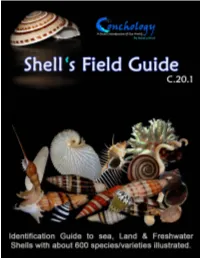
1 C.20.1 Human beings have an innate connection and fascination with the ocean & wildlife, but still we know more about the moon than our Oceans. so it’s a our effort to introduce a small part of second largest phylum “Mollusca”, with illustration of about 600 species / verities Which will quit useful for those, who are passionate and involved with exploring shells. This database made from our personal collection made by us in last 15 years. Also we have introduce website “www.conchology.co.in” where one can find more introduction related to our col- lection, general knowledge of sea life & phylum “Mollusca”. Mehul D. Patel & Hiral M. Patel At.Talodh, Near Water Tank Po.Bilimora - 396321 Dist - Navsari, Gujarat, India conchology2017@gmail.com www.conchology.co.in 2 Table of Contents Hints to Understand illustration 4 Reference Books 5 Mollusca Classification Details 6 Hypothetical view of Gastropoda & Bivalvia 7 Habitat 8 Shell collecting tips 9 Shell Identification Plates 12 Habitat : Sea Class : Bivalvia 12 Class : Cephalopoda 30 Class : Gastropoda 31 Class : Polyplacophora 147 Class : Scaphopoda 147 Habitat : Land Class : Gastropoda 148 Habitat :Freshwater Class : Bivalvia 157 Class : Gastropoda 158 3 Hints to Understand illustration Scientific Name Author Common Name Reference Book Page Serial No. No. 5 as Details shown Average Size Species No. For Internal Ref. Habitat : Sea Image of species From personal Land collection (Not in Scale) Freshwater Page No.8 4 Reference Books Book Name Short Format Used Example Book Front Look p-Plate No.-Species Indian Seashells, by Dr.Apte p-29-16 No. -

Les Mollusques Exotiques De La Côte Libanaise
Bull. Soc. zool. Fr., 2014, 139(1-4) : 37-45. Écologie - espèces invasives LES MOLLUSQUES EXOTIQUES DE LA CÔTE LIBANAISE par Ghazi BITAR 1 Depuis l’ouverture du canal de Suez, le nombre d'espèces indo-pacifiques par- venu à la côte libanaise ne cesse d’augmenter. À ce jour, 972 espèces d’invertébrés marins ont été enregistrées au Liban, dont 108 sont exotiques. Parmi elles, les mol- lusques représentent 371 espèces, dont 30 gastéropodes et 18 bivalves exotiques: Trochus erithreus, Pseudominolia nedyma, Cerithium scabridum, Rhinoclavis kochi, Finella pupoides, Diala semistriata, Nanopsis pulvis, Conomurex persicus, Purpuradusta gracilis notata, Murex forskoehlii, Indothais sacellum, Ergalatax junio- nae, Fusinus verrucosus, Zafra savignyi, Chrysallida maiae, Cingulina isseli, Syrnola fasciata, Amathina tricarinata, Aplysia dactylomela, Acteocina mucronata, Cylichnina girardi, Pyrunculus fourierii, Bursatella leachii, Goniobranchus annulatus, Elysia gran- difolia, Hypselodoris infucata, Plocamopherus ocellatus, Syphonota geographica, Pleurobranchus forskalii, Flabellina rubrolineata, Anadara natalensis, Brachidontes pharaonis, Lioberus ligneus, Pinctada imbricata radiata, Malleus regula, Spondylus spinosus, Spondylus sp., Dendostrea folium, Chama asperella, Chama pacifica, Afrocardium richardi, Fulvia fragilis, Mactra lilacea, Mactra olorina, Gafrarium savi- gnyi, Petricola fabagella, Sphenia rueppellii, Laternula anatina. Plusieurs espèces exo- tiques sont actuellement bien établies tout le long de la côte libanaise et, en particulier, -

The Biodiversity of Marine Gastropods of Thailand in the Late Decade
Malaysian Journal of Science 32 (SCS Sp Issue) : 47-64 (2013) The Biodiversity of Marine Gastropods of Thailand in the Late Decade. Kitithorn Sanpanich1*and Teerapong Duangdee2 1Institute of Marine Science, Burapha University, Tambon Saensook, Amphur Moengchonburi, Chonburi, 20131 Thailand. 2Department of Marine Science, Faculty of Fisheries, Kasetsart University, Bangkok, 10900 Thailand. *kitithor@buu.ac.th (Corresponding author) ABSTRACT This study is mainly based on the collection of marine gastropods along the east coast of the Gulf of Thailand which had been carried out along the coastline in 55 sites from the province of Chonburi to Trad during April 2005 – December 2009. As many habitats as possible were examined at each sites from sandy beaches, muddy sand, rocky shore, and coral reefs. A total of 306 species of gastropods were collected and had been classifi ed in53families 116genera.The most widespread species were Planaxis sulcatus (Planaxidae) and Polinices mammilla (Naticidae) found in 37 sites, followed by Echinolittorina malaccana (Littorinidae) in 35 sites. The highest diversity was 187 species in Trat whereas Koh Mark had the most abundance in this area. The lowest diversity was in Chanthaburi, 88 species, whereas Koh Nomsoa was the most abundant site.The diversity of gastropods in Chonburi was 152 species, whereas Koh Samaesarn and Koh Juang were the most abundant site. 137 species had been found in Rayong and Koh Munnai was the most abundant site. The data from this study had been compared with the resent studies in the late decade from the west coast of the Gulf of Thailand and Andaman Sea.The total gastropods in the late decade were 454 species 205 genera 69 families. -

IMPACTS of SELECTIVE and NON-SELECTIVE FISHING GEARS on the INLAND WATERS of BANGLADESH
A checklist of molluscans inhabiting Bandri Beach along the Jiwani coast, Balochistan, Pakistan Item Type article Authors Ghani, Abdul; Afsar, Nuzhat; Moazzam, Muhammad Download date 26/09/2021 00:44:50 Link to Item http://hdl.handle.net/1834/40825 Pakistan Journal of Marine Sciences, Vol. 27(1), 61-71, 2018. A CHECKLIST OF MOLLUSCANS INHABITING BANDRI BEACH ALONG THE JIWANI COAST, BALOCHISTAN, PAKISTAN Abdul Ghani, Nuzhat Afsar and Muhammad Moazzam Institute of Marine Science, University of Karachi, Karachi-75270, Pakistan. (AG, NA); WWF, Karachi office, Bungalow # 46/K, Block 6, P.E.C.H.S, Shahrah-e-Faisal, Karachi (MM). email: nuzhatafsar259@hotmail.com; nafsar@uok.edu.pk ABSTRACT: Main object of the study was to record the composition and diversity of intertidal molluscan species of the Bandri Beach along the Jiwani coast, Balochistan to develop baseline data information which could be helpful in future conservation perspective. The study revealed the presence of ninety eight (98) species comprising of sixty eight (68) gastropods, twenty six (26) bivalves, two (2) scaphopods, one (1) Polyplacophora and one (1) Cephalopod species at two selected points of the Bandri Beach, Jiwani coast. Among these molluscan species, members of cerithids, trochid Umbonium vestairium, bivalve Branchidontes variabilis and oyster Crassostrea madrasensis were found in abundance. Study presents the first report on the occurrence of molluscan species in the area. KEYWORDS: Molluscs, checklist, Bandri Beach, Jiwani, Balochistan coast, Pakistan. INTRODUCTION Molluscan species of Pakistan coast especially those found along the Sindh coast have been studied extensively and several authors have published papers on species diversity, distribution, and abundance (Burney and Barkati, 1995; Nasreen et al., 2000; Rahman and Barkati, 2004; Afsar et al., 2012; Rahman and Barkati, 2012; Afsar et al., 2013 a,b), as compared to molluscan abunadance and distribution studies along Balochistan coast. -

Marine Gastropods (Gastropoda; Mollusca) Diversity and Distribution on Intertidal Rocky Shores of Terengganu, Peninsular Malaysia Nursalwa Baharuddin, Nurul B
Marine gastropods (Gastropoda; Mollusca) diversity and distribution on intertidal rocky shores of Terengganu, Peninsular Malaysia Nursalwa Baharuddin, Nurul B. Basri, Nurul H. Syawal School of Marine and Environmental Sciences, Malaysia Terengganu University, Kuala Nerus, Terengganu, Malaysia. Corresponding author: N. Baharuddin, nursalwa@gmail.com Abstract. Rocky shores are considered heterogenous environments due to their composition and structure. Therefore, they support numerous habitats of flora and fauna. Organisms found on rocky shores are facing intense physicochemical conditions during tidal changes from upper to lower intertidal zones. Gastropoda, or snails, belonging to the phylum Mollusca, have colonized highly contrasting habitats with single taxonomic orders represented in marine, freshwater, and terrestrial domains. To date, there is no documented evidence on the diversity of molluscan fauna found by intertidal rocky shores along the South China Sea in Peninsular Malaysia. This study determines the diversity and distribution of gastropods present along two intertidal rocky shores, Tanjung Jara and Teluk Bidara, in Dungun District, Terengganu, between November 2016 and February 2017. A total of five subclasses of gastropods (Caenogastropoda, Heterobranchia, Neritimorpha, Patellogastropoda and Vetigastropoda) belonging to nine families and 28 species were found from upper to lower intertidal zones. On Tanjung Jara, the upper zone was recorded to have the highest diversity and evenness indices (Shannon-Wiener diversity index: H’ = 0.702±0.213, and Pielou’s evenness index: J’ = 0.303±0.075) compared to the lower and middle zones. Planaxidae and Muricidae were the most predominant species found in all intertidal zones. In contrast, the lower zone in Teluk Bidara was recorded to have the highest diversity and evenness indices (Shannon-Wiener diversity index: H’ = 0.414±0.082, and Pielou’s evenness index: J’ = 0.269±0.028) compared to the upper and middle zones. -

Comparative Taxonomic Evaluation of Thais Species (Order: Gastropoda; Family: Muricidae) of Mollusca from Maharashtra Coast of India
Indian Journal of Geo Marine Sciences Vol. 46 (06), June 2017, pp. 1098-1104 Comparative taxonomic evaluation of Thais species (Order: Gastropoda; Family: Muricidae) of Mollusca from Maharashtra coast of India Ravi Kumar1, A.K. Jaiswar1, S. Jahageerdar1, S.K. Chakraborty1, A. Pavan Kumar1 & Laxmi Prasad2 1Central Institute of Fisheries Education (ICAR), Mumbai, Maharashtra - 400061, India 2Narendra Dev University of Agriculture & Technology, Kumarganj, Faizabad, U.P. -224229, India [Email- akjaiswar@cife.edu.in] Received 17 December 2014 ; revised 15 November 2016 Based on shell morphology alone, it was difficult to differentiate the species belonging to genus Thais because of large amount of plasticity, observed in the shell characters. The colour of the shells was poorly defined as species identifying character in Thais species. The morphometric and meristic characters of the shell along with radular characters can solve the taxonomic ambiguities in Thais species (Thais lacera; T. blanfordi; T. tissoti; T. rudolphi; T. bufo and T. subnodulosa). The radular morphology was found to be different in each species except in T. rudolphi and T. blanfordi and hence these two species were differentiated based on radular morphology where the first denticle on outer base of the lateral cusp was smaller than other five denticles in T. rudolphi but in T. blanfordi, all were same in size. A deep ‘V’ shaped notch was present between inner denticle base of lateral cusp and central cusp in T. blanfordi, which was found to be a species specific character. [Keywords: Thais, Muricidae, Gastropods, Mollusca, radular] Introduction 5 Molluscs have been evolved about 500 of phylogeny for Thaidid gastropods .