Gemälde Alter Meister Lot 3001 – 3082
Total Page:16
File Type:pdf, Size:1020Kb
Load more
Recommended publications
-
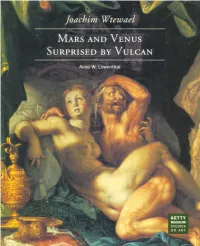
Mars and Venus Surprised by Vulcan
Joachim Wtewael MARS AND VENUS SURPRISED BY VULCAN Joachim Wtewael MARS AND VENUS SURPRISED BY VULCAN Anne W. Lowenthal GETTY MUSEUM STUDIES ON ART Malibu, California Christopher Hudson, Publisher Cover: Mark Greenberg, Managing Editor Joachim Wtewael (Dutch, 1566-1638). Cynthia Newman Bohn, Editor Mars and Venus Surprised by Vulcan, Amy Armstrong, Production Coordinator circa 1606-1610 [detail]. Oil on copper, Jeffrey Cohen, Designer 20.25 x 15.5 cm (8 x 6/8 in.). Malibu, J. Paul Getty Museum (83.PC.274). © 1995 The J. Paul Getty Museum 17985 Pacific Coast Highway Frontispiece: Malibu, California 90265-5799 Joachim Wtewael. Self-Portrait, 1601. Oil on panel, 98 x 74 cm (38^ x 29 in.). Utrecht, Mailing address: Centraal Museum (2264). P.O. Box 2112 Santa Monica, California 90407-2112 All works of art are reproduced (and photographs provided) courtesy of the owners unless otherwise Library of Congress indicated. Cataloging-in-Publication Data Lowenthal, Anne W. Typography by G & S Typesetting, Inc., Joachim Wtewael : Mars and Venus Austin, Texas surprised by Vulcan / Anne W. Lowenthal. Printed by C & C Offset Printing Co., Ltd., p. cm. Hong Kong (Getty Museum studies on art) Includes bibliographical references and index. ISBN 0-89236-304-5 i. Wtewael, Joachim, 1566-1638. Mars and Venus surprised by Vulcan. 2. Wtewael, Joachim, 1566-1638 — Criticism and inter- pretation. 3. Mars (Roman deity)—Art. 4. Venus (Roman deity)—Art. 5. Vulcan (Roman deity)—Art. I. J. Paul Getty Museum. II. Title. III. Series. ND653. W77A72 1995 759-9492-DC20 94-17632 CIP CONTENTS Telling the Tale i The Historical Niche 26 Variations 47 Vicissitudes 66 Notes 74 Selected Bibliography 81 Acknowledgments 88 TELLING THE TALE The Sun's loves we will relate. -

MARTEN VAN CLEVE I (C. 1527 – Antwerp – Before 1581) a Wedding
VP4739 MARTEN VAN CLEVE I (c. 1527 – Antwerp – before 1581) A Wedding Procession On canvas, 61¼ X 101 ins. (155.3 X 256 cm) PROVENANCE Marchesa de Bermejillo del Rey, by the early 20th century And by descent to the previous owner Private Collection, Spain, until 2015 LITERATURE M. Diaz Padrón, ‘La Obra de Pedro Brueghel el jóven en Espana”, Archivo Espanol de Arte, 1980, p. 309, fig. 18. K. Ertz, Pieter Brueghel der Jüngere, Lingen, 2000, vol. II, p. 702, no. A830. Against a backdrop of rolling farmlands and a giant windmill, a wedding party makes its way along a road from the village on the right, where preparations are being made for the wedding feast, to the church in the upper left-hand corner. As was customary, the bride and groom walk separately, each processed by a man playing a doedelzac (bagpipes). Tall trees single out the groom, who is identified by the wedding crown he wears on top of his bright red cap. He is followed by two older men, probably the fathers of the bridal couple, and the other menfolk of the village. Then comes the plump and solemn-looking bride, wearing a bridal crown and flanked on either side by pages. She is attended by the two mothers and the other female members of the party. Work in the fields has all but stopped: three sacks of flour sit at the foot of the windmill and a cart stands idle. The workers have all turned out to accompany the wedding procession on its way: among the crowd of well-wishers are young men and old, a shepherd, a miller, his face white with flour, and many more besides. -

Gillis Mostaert Geschilderd in Opdracht Van De Moeten Zijn
1968/6 GILLIS MOST AERT plex was omstreeks het midden van de eeuw zo bouwvallig geworden, - doordat het aan de zuid 1530 1598) (Hulst ca. - Antwerpen zijde tot tegen de rui reikte, maakte waterschade een voortdurende versterking van de grondvesten noodzakelijk, - dat er een zegswijze bestond: beven gelijk het oud stadhuis. Reeds in 1541 be sloot de magistraat een gloednieuw raadhuis te bouwen. Op 27 februari 1561 had de eerste steen legging plaats en vier jaar later, in 1565, kon het imposante, in de 'moderne' renaissancestijl opge trokken gebouw plechtig in gebruik worden ge nomen. Indien we aanvaarden, dat het schilderij Christus door Pilatus aan het volk getoond tot stand kwam vóór de afbraak in 1565 van het oude raadhuis (theoretisch bestaat immers de mo Olieschildering op paneel - 120 x 151 cm gelijkheid dat het nadien werd geschilderd, terug grijpend op een vroegere afbeelding die ons niet Verzameling van het Stadhuls - Antwerpen bekend is), dan bekomen we als terminus ante quem het jaar der afbraak, 1565. In acht genomen echter het feit, dat men reeds in juni 1561 druk werkte aan de nieuwe bouw, waarvan in oktober 1562 het Het schilderij dat ons bezighoudt wordt in de oude houtwerk der eerste verdieping was opgetrokken, re literatuur beschreven als de voorstelling van een zou het schilderij, waarop van die bouwbedrijvig passiespel op de Grote Markt te Antwerpen, door heid geen spoor te merken valt, vóór 1561 ontstaan Gillis Mostaert geschilderd in opdracht van de moeten zijn. stedelijke magistraat, die uit piëteit een konter Ook op het stuk van de auteur worden we klaar en feitsel van het voor de slopershamer bestemde duidelijk door de gravure ingelicht: 'Mostart pin oude stadhuis wilde bewaren. -

A Self-Portrait by Francesco Mezzara (1774–1845), the Italian Painter Who Changed New York State Constitutional Law with a Pair of Ass’S Ears
Katlijne Van der Stighelen A Self-Portrait by Francesco Mezzara (1774–1845), the Italian Painter Who Changed New York State Constitutional Law with a Pair of Ass’s Ears Nineteenth-Century Art Worldwide 13, no. 2 (Autumn 2014) Citation: Katlijne Van der Stighelen, “A Self-Portrait by Francesco Mezzara (1774–1845), the Italian Painter Who Changed New York State Constitutional Law with a Pair of Ass’s Ears,” Nineteenth-Century Art Worldwide 13, no. 2 (Autumn 2014), http://www.19thc- artworldwide.org/autumn14/new-discovery-a-self-portrait-by-francesco-mezzara. Published by: Association of Historians of Nineteenth-Century Art. Notes: This PDF is provided for reference purposes only and may not contain all the functionality or features of the original, online publication. Stighelen: A Self-Portrait by Francesco Mezzara (1774—1845) Nineteenth-Century Art Worldwide 13, no. 2 (Autumn 2014) A Self-Portrait by Francesco Mezzara (1774–1845), the Italian Painter Who Changed New York State Constitutional Law with a Pair of Ass’s Ears by Katlijne Van der Stighelen Introduction Two years ago, I visited a private collection in Belgium to look at a painting said to be by Anthony van Dyck. The painting was not worth the visit, but my curiosity was piqued by another piece in the collection, a self-portrait by the looks of it, painted by an unidentified artist (fig. 1). Because it was covered with layers of dark varnish, I suggested to the owner that he have it cleaned. Unexpectedly, the restorer uncovered the full signature of the artist, “Francesco Mezzara,” as well as a date, 1806. -
MARTEN VAN CLEVE the Elder (C
VP4795 MARTEN VAN CLEVE the Elder (c. 1527 – Antwerp – before 1581) The Wedding Dance Outdoors circa 1570 On panel, 30¼ x 41⅜ ins. (77 x 105 cm) PROVENANCE: Private collection, Italy, for at least 80 years, until 2016 Considered a follower of Pieter Bruegel the Elder (c. 1527/30-1569), Marten van Cleve reveals all his inventiveness in this wedding celebration. While the theme is indeed borrowed from the pictorial production of the Brueghel family, the painting’s style and originality shows an independent and innovative artist. Van Cleve was undoubtedly influenced by the peasant life inherent in Bruegel’s paintings, but his composition is unique in its rendering of one of the most widespread subjects of the era. Just like Bruegel, Marten van Cleve found the subjects for his paintings in scenes of daily life, especially peasant feasts and celebrations. Peasant weddings were a favourite subject which he portrayed in numerous panels. The version presented here draws direct inspiration from two sources. First of all, a wedding scene painting by Pieter Bruegel the Elder, dated 1566, in the Detroit Institute of Artsi. Secondly, an engraving by Pieter van der Heyden based on a drawing by Pieter Bruegel the Elderii. Van Cleeve copies the position of the three couples dancing in the foreground. The couple composed of the bride and groom is just behind and is also taken from the painting in Detroit. Contrary to numerous small-size paintings portraying this subject, this work appears to be an exception to Marten van Cleve’s body of work. Here he offers a far more spacious and airy scene. -

PICTORIAL BABEL: INVENTING the FLEMISH VISUAL VERNACULAR James J. Bloom* I. Rethinking Vernacularity to a Degree That Might Be T
PICTORIAL BABEL: INVENTING THE FLEMISH VISUAL VERNACULAR James J. Bloom* I. Rethinking Vernacularity To a degree that might be thought unusual in the history of art, the works of the so-called Flemish Primitives comprise a pictorial style both instantly recognizable and intimately associated with a partic- ular locale. The startling novelty of thisars nova originating in the Burgundian Netherlands circa 1420 engendered immediate interna- tional acclaim and, not surprisingly, wholesale imitation, such that the idiom introduced by painters such as Robert Campin, Jan van Eyck, and Rogier van der Weyden proved remarkably stable across an extended historical moment.1 The familiar stillness of these fifteenth- century paintings was shattered, however, by the kaleidoscopic array of styles that emerged coincident with the efflorescence of Antwerp as a mercantile center at the turn of the sixteenth century.2 Within a comparatively short span of years, panels exploring such divergent formal interests as Mannerism, Romanism, and myriad improvisations * Many thanks are due to the editors of this volume, Joost Keizer and Todd Rich- ardson; I owe an especial debt of gratitude to Todd for his patient support. This essay also benefitted from the assistance of Jesse Hurlbut and Jennifer Naumann, and from the gracious aid and invaluable contributions of Alexandra Onuf and Joost vander Auwera. Susan Jarosi saw me through the culmination of this project, and it is whole- heartedly dedicated to her. 1 The sustained and consistent reception of fifteenth-century Netherlandish paint- ing can be inferred from the opprobrious remarks on Flemish art ascribed to Michel- angelo by Francisco de Hollanda in his Roman Dialogues, on which see Agoston L.C., “Michelangelo as Voice versus Michelangelo as Text”, Journal of Medieval and Early Modern Studies 36 (2006) 135–167. -

Art at Auction in Th Century Amsterdam
JOHN MICHAEL MONTIAS This book exploits a trove of original documents that have survived on the auctions organized by the Orphan Chamber of Amsterdam in the first half of the seventeenth century. For the first time, the names of some 2000 buyers of works of art at auction in the 29 extant notebooks of the Chamber have been systematically analyzed. On the basis of archival research, data have been assembled on the occupation of these buyers (most of whom were merchants), their origin (Southern Netherlands, Holland, and other), their religion, their year of birth, their date of marriage, the taxes they paid and other indicators of their wealth. Buyers were found to cluster in groups, not only by extended family but by occupation, religion (Remonstrants, Counter-Remonstrants) and avocation (amateurs of tulips and of porcelain, members of Chambers Art at Auction in of Rhetoricians, and so forth). The subjects of the works of art they bought and the artists to which they were attributed are also analyzed. The second part of the book on “Selected Buyers”, is devoted to art dealers who bought at auction and four to buyers who had special connections with artists, including principally Rembrandt. As a whole, the book offers a penetrating insight into the culture of the Amsterdam elite in the seventeenth century. In Art at Auction in 17th Century Amsterdam Montias has created a richly patterned panorama of the interactions between artists, art lovers and art dealers who were active in one of Europe’s most JOHN MICHAEL th Century Amsterdam important art scenes of the 17th century. -

The Small Landscape Prints and the Depiction of the Countryside in Early Modem Antwerp
Local Terrains: The Small Landscape Prints and the Depiction of the Countryside in Early Modem Antwerp Alexandra Kirkman Onuf Submitted in partial fulfillment of the requirements for the degree of Doctor of Philosophy in the Graduate School of Arts and Sciences COLUMBIA UNIVERSITY 2006 Reproduced with permission of the copyright owner. Further reproduction prohibited without permission. UMI Number: 3213572 INFORMATION TO USERS The quality of this reproduction is dependent upon the quality of the copy submitted. Broken or indistinct print, colored or poor quality illustrations and photographs, print bleed-through, substandard margins, and improper alignment can adversely affect reproduction. In the unlikely event that the author did not send a complete manuscript and there are missing pages, these will be noted. Also, if unauthorized copyright material had to be removed, a note will indicate the deletion. ® UMI UMI Microform 3213572 Copyright 2006 by ProQuest Information and Learning Company. All rights reserved. This microform edition is protected against unauthorized copying under Title 17, United States Code. ProQuest Information and Learning Company 300 North Zeeb Road P.O. Box 1346 Ann Arbor, Ml 48106-1346 Reproduced with permission of the copyright owner. Further reproduction prohibited without permission. ©2006 Alexandra Kirkman Onuf All Rights Reserved Reproduced with permission of the copyright owner. Further reproduction prohibited without permission. ABSTRACT Local Terrains: The Small Landscape Prints and the Depiction of the Countryside in Early Modem Antwerp Alexandra Kirkman Onuf This dissertation reexamines the Small Landscape prints, two series of views of the local landscape around Antwerp published by Hieronymus Cock in the middle of the sixteenth century. -

327 Bei Der Beurteilung Seiner Tätigkeit Als Bildhauer Wurde Angerissen
E.1. Kunst und Gesellschaft 327 bei der Beurteilung seiner Tätigkeit als Bildhauer wurde angerissen Die deutliche Abgrenzung Maderns gegenüber einer Abhängigkeit von westlichen Traditionen zu- gunsten einer ‚parlerisch‘ geprägten Schulung seiner Formenwelt, die Ringshausen seit der Erstfassung seiner Arbeit stets vertreten hat, ist auch im Lichte der aktuellen Forschung und der erneuten stilistischen Einordnung in der vorliegenden Mono- graphie gerechtfertigt 40 Gewünscht hätte man sich vielleicht noch ein Kapitel zur be- trächtlichen Wirkungsgeschichte des Frankfurter Meisters am Mittelrhein und darü- ber hinaus, um auch die eingangs zitierte Arbeit Fischers von 1962 auf einen aktuellen Forschungsstand zu heben, vielleicht eine zu vermessene Forderung für eine Werk- meister-Monographie Im Hinblick auf die ausführlichen Stilvergleiche wäre aller- dings eine üppigere Ausstattung vor allem mit etwas großformatigeren Abbildungen wünschenswert gewesen 41 Franz Bischoff Kunstbibliothek Staatliche Museen zu Berlin – Preußischer Kulturbesitz 40 Vgl auch den Versuch einer ausführlichen Begründung und den Widerspruch gegenüber den The- sen von Fischer in G Ringshausen, „Die spätgotische Architektur in Deutschland unter besonderer Berücksichtigung ihrer Beziehungen zu Burgund im Anfang des 15 Jahrhunderts“, in: Zeitschrift des Deutschen Vereins für Kunstwissenschaft 17, 1973, S 63–78 41 Einige kleine Mängel: Besonders im ersten Teil der Arbeit fehlt eine sorgfältigere Redaktion; dort finden sich vor allem häufiger falsche Hinweise auf die Abbildungen, z B S 108, S 225, S 259, S 266, S 269; außerdem: S 375 (Anm 20): „Heften“ statt „Helten“ bzw S 253 (Anm 45): Kurztitel „U Schubert, Mauerwerk“ fehlt im Literaturverzeichnis Wenig professionell gestaltet sich auch das Seitenlayout an manchen Stellen, so vor allem zwischen Seite 159 und 160 Christine Göttler, Bart Ramakers und Joanna Woodall (Hrsg.); Trading values in early modern Antwerp. -

Pieter Bruegel's Children's Games, Folly, and Chance Author(S): Sandra Hindman Source: the Art Bulletin, Vol
Pieter Bruegel's Children's Games, Folly, and Chance Author(s): Sandra Hindman Source: The Art Bulletin, Vol. 63, No. 3 (Sep., 1981), pp. 447-475 Published by: College Art Association Stable URL: http://www.jstor.org/stable/3050145 . Accessed: 04/11/2013 10:51 Your use of the JSTOR archive indicates your acceptance of the Terms & Conditions of Use, available at . http://www.jstor.org/page/info/about/policies/terms.jsp . JSTOR is a not-for-profit service that helps scholars, researchers, and students discover, use, and build upon a wide range of content in a trusted digital archive. We use information technology and tools to increase productivity and facilitate new forms of scholarship. For more information about JSTOR, please contact support@jstor.org. College Art Association is collaborating with JSTOR to digitize, preserve and extend access to The Art Bulletin. http://www.jstor.org This content downloaded from 129.100.254.149 on Mon, 4 Nov 2013 10:51:31 AM All use subject to JSTOR Terms and Conditions 1 Pieter Bruegel, Children'sGames. Vienna, KunsthistorischesMuseum (photo: Museum) Pieter Bruegel's Children's Games, Folly, and Chance Sandra Hindman I. Introduction Early information on Pieter Bruegel's painting, Children's Khinderspill, appeared first in a 1594 inventory of the Games (Vienna, Kunsthistorisches Museum), is sparse but collection in Brussels of the Governor of the Netherlands, unambiguous.1 Signed by the artist and dated 1560, Archduke Ernest.2 In 1604, Carel van Mander described Children's Games includes depictions of more than ninety the painting briefly as one "with all manner of children's actual games (Fig. -

Goede Nacht: Images of the Night in Seventeenth-Century Dutch Visual Culture by © 2019 Reilly Oliver Winston Shwab Submitted To
Goede Nacht: Images of the Night in Seventeenth-Century Dutch Visual Culture by © 2019 Reilly Oliver Winston Shwab Submitted to the graduate degree program in Art History and the Graduate Faculty of the University of Kansas in partial fulfillment of the requirements for the degree of Doctor of Philosophy _______________________________________ Chair: Linda Stone-Ferrier, Ph.D. _______________________________________ Stephen Goddard, Ph.D. _______________________________________ David Cateforis, Ph.D. _______________________________________ John Pultz, Ph.D. _______________________________________ Megan Kaminski Date defended: July 8, 2019 The dissertation committee for Reilly Shwab certifies that this is the approved version of the following dissertation: Goede Nacht: Images of the Night in Seventeenth-Century Dutch Visual Culture _______________________________________ Chair: Linda Stone-Ferrier, Ph.D. Date approved: July 8, 2019 ii Abstract Goede Nacht: Images of the Night in Seventeenth-Century Dutch Visual Culture provides a comprehensive study of depictions of the night in Dutch art from seventeenth century, and of a number of different ways in which contemporary understandings of the nighttime informed artistic practice throughout the northern Netherlands. The dramatic increase in the production of such pictures, the impressive diversity of their compelling subjects, and their exquisite visual appeal demand scholarly attention. To better understand this complex topic, analysis focuses on the most frequently represented subject matter in Dutch nocturnal imagery—religious scenes, urban fires, labor and leisure—and contextualizes the meanings and functions of the remarkable pictures within relevant historical, religious, socio-economic and cultural associations and circumstances. The wide range of depicted subjects demonstrates the richness of such imagery and engages the sometimes conflicting cultural perceptions of the night among the Dutch at this time. -

Italian Paintings in Amsterdam Around 1635: Additions to the Familiar
Volume 5, Issue 2 (Summer 2013) Italian Paintings in Amsterdam around 1635: Additions to the Familiar Amy Golahny Recommended Citation: Amy Golahny, “Italian Paintings in Amsterdam Around 1635: Additions to the Familiar” JHNA 5:2 (Summer 2013), DOI:10.5092/jhna.2013.5.2.6 Available at https://jhna.org/articles/italian-paintings-amsterdam-around-1635-additions- familiar/ Published by Historians of Netherlandish Art: https://hnanews.org/ Republication Guidelines: https://jhna.org/republication-guidelines/ Notes: This PDF is provided for reference purposes only and may not contain all the functionality or features of the original, online publication. This is a revised PDF that may contain different page numbers from the previous version. Use electronic searching to locate passages. This PDF provides paragraph numbers as well as page numbers for citation purposes. ISSN: 1949-9833 JHNA 5:2 (Summer 2013) 1 ITALIAN PAINTINGS IN AMSTERDAM AROUND 1635: ADDITIONS TO THE FAMILIAR Amy Golahny Two documents in the Amsterdam City Archives, recently made accessible through databases, augment our knowledge of Italian paintings in the Netherlands around 1630. The 1633 inventory of Samuel Godijn and the 1638 list of paintings owned by Lucas van Uffelen and Jacomo Noirot include works by Palma Giovane, Guido Reni, and Giuseppe Ribera. While these paintings have not yet been identified with extant works, their visual character may be suggested by analogy with other pieces. 10.5092/jhna.2013.5.2.5 1 ecent scholarship on Italian art in Amsterdam in the seventeenth century is lively indeed. Well known are the collections brought to Holland en bloc by Gerard Reynst (ca.