Wallis' Dark Saltflat Tiger Beetle (Cicindela Parowana Wallisi)
Total Page:16
File Type:pdf, Size:1020Kb
Load more
Recommended publications
-
AEXT Ucsu2062256012007.Pdf (677.1Kb)
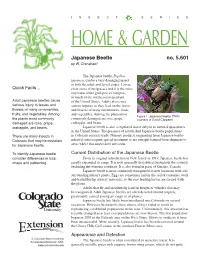
I N S E C T S E R I E S HOME & GARDEN Japanese Beetle no. 5.601 by W. Cranshaw1 The Japanese beetle, Popillia japonica, can be a very damaging insect in both the adult and larval stages. Larvae Quick Facts... chew roots of turfgrasses and it is the most important white grub pest of turfgrass in much of the northeastern quadrant Adult Japanese beetles cause of the United States. Adults also cause serious injury to leaves and serious injuries as they feed on the leaves flowers of many ornamentals, and flowers of many ornamentals, fruits, fruits, and vegetables. Among and vegetables. Among the plants most Figure 1. Japanese beetle. Photo the plants most commonly commonly damaged are rose, grape, courtesy of David Cappaert. damaged are rose, grape, crabapple, and beans. crabapple, and beans. Japanese beetle is also a regulated insect subject to internal quarantines in the United States. The presence of established Japanese beetle populations There are many insects in in Colorado restricts trade. Nursery products originating from Japanese beetle- Colorado that may be mistaken infested states require special treatment or are outright banned from shipment to for Japanese beetle. areas where this insect does not occur. To identify Japanese beetle Current Distribution of the Japanese Beetle consider differences in size, From its original introduction in New Jersey in 1919, Japanese beetle has shape and patterning. greatly expanded its range. It is now generally distributed throughout the country, excluding the extreme southeast. It is also found in parts of Ontario, Canada. Japanese beetle is most commonly transported to new locations with soil surrounding nursery plants. -

Rare Native Animals of RI
RARE NATIVE ANIMALS OF RHODE ISLAND Revised: March, 2006 ABOUT THIS LIST The list is divided by vertebrates and invertebrates and is arranged taxonomically according to the recognized authority cited before each group. Appropriate synonomy is included where names have changed since publication of the cited authority. The Natural Heritage Program's Rare Native Plants of Rhode Island includes an estimate of the number of "extant populations" for each listed plant species, a figure which has been helpful in assessing the health of each species. Because animals are mobile, some exhibiting annual long-distance migrations, it is not possible to derive a population index that can be applied to all animal groups. The status assigned to each species (see definitions below) provides some indication of its range, relative abundance, and vulnerability to decline. More specific and pertinent data is available from the Natural Heritage Program, the Rhode Island Endangered Species Program, and the Rhode Island Natural History Survey. STATUS. The status of each species is designated by letter codes as defined: (FE) Federally Endangered (7 species currently listed) (FT) Federally Threatened (2 species currently listed) (SE) State Endangered Native species in imminent danger of extirpation from Rhode Island. These taxa may meet one or more of the following criteria: 1. Formerly considered by the U.S. Fish and Wildlife Service for Federal listing as endangered or threatened. 2. Known from an estimated 1-2 total populations in the state. 3. Apparently globally rare or threatened; estimated at 100 or fewer populations range-wide. Animals listed as State Endangered are protected under the provisions of the Rhode Island State Endangered Species Act, Title 20 of the General Laws of the State of Rhode Island. -

Insects and Related Arthropods Associated with of Agriculture
USDA United States Department Insects and Related Arthropods Associated with of Agriculture Forest Service Greenleaf Manzanita in Montane Chaparral Pacific Southwest Communities of Northeastern California Research Station General Technical Report Michael A. Valenti George T. Ferrell Alan A. Berryman PSW-GTR- 167 Publisher: Pacific Southwest Research Station Albany, California Forest Service Mailing address: U.S. Department of Agriculture PO Box 245, Berkeley CA 9470 1 -0245 Abstract Valenti, Michael A.; Ferrell, George T.; Berryman, Alan A. 1997. Insects and related arthropods associated with greenleaf manzanita in montane chaparral communities of northeastern California. Gen. Tech. Rep. PSW-GTR-167. Albany, CA: Pacific Southwest Research Station, Forest Service, U.S. Dept. Agriculture; 26 p. September 1997 Specimens representing 19 orders and 169 arthropod families (mostly insects) were collected from greenleaf manzanita brushfields in northeastern California and identified to species whenever possible. More than500 taxa below the family level wereinventoried, and each listing includes relative frequency of encounter, life stages collected, and dominant role in the greenleaf manzanita community. Specific host relationships are included for some predators and parasitoids. Herbivores, predators, and parasitoids comprised the majority (80 percent) of identified insects and related taxa. Retrieval Terms: Arctostaphylos patula, arthropods, California, insects, manzanita The Authors Michael A. Valenti is Forest Health Specialist, Delaware Department of Agriculture, 2320 S. DuPont Hwy, Dover, DE 19901-5515. George T. Ferrell is a retired Research Entomologist, Pacific Southwest Research Station, 2400 Washington Ave., Redding, CA 96001. Alan A. Berryman is Professor of Entomology, Washington State University, Pullman, WA 99164-6382. All photographs were taken by Michael A. Valenti, except for Figure 2, which was taken by Amy H. -

Status and Conservation of an Imperiled Tiger Beetle Fauna in New York State, USA
J Insect Conserv (2011) 15:839–852 DOI 10.1007/s10841-011-9382-y ORIGINAL PAPER Status and conservation of an imperiled tiger beetle fauna in New York State, USA Matthew D. Schlesinger • Paul G. Novak Received: 29 October 2010 / Accepted: 17 January 2011 / Published online: 15 February 2011 Ó Springer Science+Business Media B.V. 2011 Abstract New York has 22 documented species of tiger Introduction beetles (Coleoptera: Cicindelidae). Over half of these species are considered rare, at risk, or potentially extirpated Tiger beetles (Coleoptera: Cicindelidae) are strikingly from the state. These rare species specialize on three sandy patterned, predatory insects that have captured the attention habitat types under threat from human disturbance: bea- of entomologists and collectors for centuries. Beyond their ches, pine barrens, and riparian cobble bars. In 2005, we intrinsic interest, tiger beetles can serve as model organ- began a status assessment of eight of New York’s rarest isms or indicator species to enable broad conclusions about tiger beetles, examining museum records, searching the a region or ecosystem’s biodiversity (Pearson and Cassola literature, and conducting over 130 field surveys of his- 1992; Pearson and Vogler 2001). Tiger beetles are threa- torical and new locations. Significant findings included (1) tened by habitat destruction and modification, alteration of no detections of four of the eight taxa; (2) no vehicle-free natural processes like fire and flooding, and overcollection; beach habitat suitable for reintroducing Cicindela dorsalis across the United States, approximately 15% of taxa are dorsalis; (3) C. hirticollis at only 4 of 26 historical loca- threatened with extinction (Pearson et al. -

The Entomological Society of Manitoba
The Entomological Society of Manitoba Newsletter Volume 40 Number 3 ISSN 0836-5830 Spring 2014 About the ESM Editors’ Comments Newsletter The Entomological Society of In this issue of the ESM Manitoba Newsletter is Newsletter, our President, published three times per year. Robbin Lindsay, updates us It is a forum whereby on recent decisions of the information can be Executive, including a move disseminated to Society to using e-mail to save on members. As such, all mailing costs of ESM members are encouraged to publications. Robbin also contribute often. The Newsletter is interested in outlines the theme and likely opinions, short articles, news dates (mid- or late October) of research projects, meeting of the Annual Scientific announcements, workshops, Meeting. Stay tuned for courses and other events, further details as well as information on participating in the requests for materials or oral and poster presentations. information, news of personnel or visiting scientists, Many of you remember Joanne Buth, a long-time member literature reviews or of the ESM, who was appointed as a member of the Senate announcements and anything in 2012 by Prime Minister Stephen Harper. Joanne recently that may be of interest to ESM stepped down as Senator and accepted the position of CEO members. of the Canadian International Grains Institute. Our best Marjorie Smith, Editor1 wishes to Joanne on her new appointment. Jordan Bannerman, Editor2 Dept. of Entomology, On a sad note, former ESM member Lloyd Dosdall died on University of Manitoba 12 June in Edmonton after a battle with cancer. Lloyd Winnipeg, Manitoba worked briefly as a research associate in the Department of R3T 2N2 Entomology at the University of Manitoba in the late 1980s working on biting flies. -

Wallis' Dark Saltflat Tiger Beetle (Cicindela Parowana Wallisi)
PROPOSED Species at Risk Act Recovery Strategy Series Adopted under Section 44 of SARA Recovery Strategy for the Wallis’ Dark Saltflat Tiger Beetle (Cicindela parowana wallisi) in Canada Wallis’ Dark Saltflat Tiger Beetle 2016 Recommended citation: Environment Canada. 2016. Recovery Strategy for the Wallis’ Dark Saltflat Tiger Beetle (Cicindela parowana wallisi) in Canada [Proposed]. Species at Risk Act Recovery Strategy Series. Environment Canada, Ottawa. 7 pp. + Annex. For copies of the recovery strategy, or for additional information on species at risk, including the Committee on the Status of Endangered Wildlife in Canada (COSEWIC) Status Reports, residence descriptions, action plans, and other related recovery documents, please visit the Species at Risk (SAR) Public Registry1. Cover illustration: © Suzie Lavallee Également disponible en français sous le titre « Programme de rétablissement de la cicindèle de Wallis (Cicindela parowana wallisi) au Canada [Proposition] » © Her Majesty the Queen in Right of Canada, represented by the Minister of the Environment, 2016. All rights reserved. ISBN Catalogue no. Content (excluding the illustrations) may be used without permission, with appropriate credit to the source. 1 http://www.registrelep-sararegistry.gc.ca i RECOVERY STRATEGY FOR THE WALLIS’ DARK SALTFLAT TIGER BEETLE (Cicindela parowana wallisi) IN CANADA 2016 Under the Accord for the Protection of Species at Risk (1996), the federal, provincial, and territorial governments agreed to work together on legislation, programs, and policies to protect wildlife species at risk throughout Canada. In the spirit of cooperation of the Accord, the Government of British Columbia has given permission to the Government of Canada to adopt the Recovery Plan for Dark Saltflat Tiger Beetle (Cicindela parowana) in British Columbia (Part 2) under Section 44 of the Species at Risk Act (SARA). -

Cobblestone Tiger Beetle ( Cicindela Marginipennis)
COSEWIC Assessment and Status Report on the Cobblestone Tiger Beetle Cicindela marginipennis in Canada ENDANGERED 2008 COSEWIC status reports are working documents used in assigning the status of wildlife species suspected of being at risk. This report may be cited as follows: COSEWIC. 2008. COSEWIC assessment and status report on the Cobblestone Tiger Beetle Cicindela marginipennis in Canada. Committee on the Status of Endangered Wildlife in Canada. Ottawa. vii + 27 pp. (www.sararegistry.gc.ca/status/status_e.cfm). Production note: COSEWIC acknowledges Dr. Reginald P. Webster for writing the provisional status report on the Cobblestone Tiger Beetle Cicindela marginipennis prepared under contract with Environment Canada. The contractor’s involvement with the writing of the status report ended with the acceptance of the provisional report. Any modifications to the status report during the subsequent preparation of this report were overseen by Dr. Paul Catling, Co-chair of the COSEWIC Arthropods Specialist Subcommittee. For additional copies contact: COSEWIC Secretariat c/o Canadian Wildlife Service Environment Canada Ottawa, ON K1A 0H3 Tel.: 819-953-3215 Fax: 819-994-3684 E-mail: COSEWIC/COSEPAC@ec.gc.ca http://www.cosewic.gc.ca Également disponible en français sous le titre Ếvaluation et Rapport de situation du COSEPAC sur la cicindèle des galets (Cicindela marginipennis) au Canada. Cover illustration: Cobblestone Tiger Beetle — Photo by Dwayne Sabine. ©Her Majesty the Queen in Right of Canada, 2009. Catalogue No. CW69-14/559-2009E-PDF ISBN 978-1-100-12410-0 Recycled paper COSEWIC Assessment Summary Assessment Summary – November 2008 Common name Cobblestone Tiger Beetle Scientific name Cicindela marginipennis Status Endangered Reason for designation This distinctive species of tiger beetle has a fragmented distribution with a very small extent of occurrence and area of occupancy, and is currently only found in two small regions of the St. -

1 Inventory of Habitats in the Area of Sandy, Jeremiah and Old Pocha
Inventory of Habitats in the Area of Sandy, Jeremiah and Old Pocha Roads for State-listed Insects Mark J. Mello Research Director Lloyd Center for the Environment 430 Potomska Rd. Dartmouth. MA 02748 INTRODUCTION Pitch pine/scrub oak barrens contain a mosaic of globally rare habitats (including pitch pine woodland, scrub oak thickets, heathlands, sandplain grasslands, and acid wetlands) located primarily on the coastal plain from Maine to New Jersey. A few sandy riverine oxbows and serpentine mountain ridgetops also support smaller patches of barrens. Roughly half of the original acreage remains, approximately 900,000 acres. Although most of the remaining barrens habitat (750,000 acres) is in New Jersey, Massachusetts ranks third, with about 53,000 acres in southeastern Massachusetts (Cryan, 1985). As the name indicates, these barrens are dominated by pitch pine (Pinus rigida) and scrub oak (Quercus ilicifolia). The nutrient poor, acid soils also support a variety of blueberries and huckleberries (Ericaceae) in the understory. Pitch pine/scrub oak barrens is a disclimax habitat that requires disturbance, particularly periodic fires, in order to maintain itself. Nearly sixty percent (23 out of 39) of the rare moth fauna listed in the Massachusetts Endangered Species Protection Act (Table 1) as of June, 2006 are found primarily in scrub oak barrens (9 species), coastal heathlands (8 species), or sandplain grasslands (7 species). Forty-four percent (17 of 39) are restricted to native heathland or shrubland (including scrub oak barrens) habitat as described by Wagner et al (2003); and this number represents only a fraction of the 56 species of “Conservation Concern” they list as uncommon shrubland/heathland specialists. -

Hypoxia Tolerance in Adult and Larval Cicindela Tiger Beetles Varies by Life History but Not Habitat Association
University of Nebraska - Lincoln DigitalCommons@University of Nebraska - Lincoln Entomology Papers from Other Sources Entomology Collections, Miscellaneous 2009 Hypoxia Tolerance in Adult and Larval Cicindela Tiger Beetles Varies by Life History but Not Habitat Association Mathew L. Brust Chadron State College, mbrust@csc.edu W. Wyatt Hoback University of Nebraska-Kearney, whoback@okstate.edu Follow this and additional works at: https://digitalcommons.unl.edu/entomologyother Part of the Entomology Commons Brust, Mathew L. and Hoback, W. Wyatt, "Hypoxia Tolerance in Adult and Larval Cicindela Tiger Beetles Varies by Life History but Not Habitat Association" (2009). Entomology Papers from Other Sources. 1. https://digitalcommons.unl.edu/entomologyother/1 This Article is brought to you for free and open access by the Entomology Collections, Miscellaneous at DigitalCommons@University of Nebraska - Lincoln. It has been accepted for inclusion in Entomology Papers from Other Sources by an authorized administrator of DigitalCommons@University of Nebraska - Lincoln. ECOLOGY AND POPULATION BIOLOGY Hypoxia Tolerance in Adult and Larval Cicindela Tiger Beetles Varies by Life History but Not Habitat Association 1 2 MATHEW L. BRUST AND W. WYATT HOBACK Ann. Entomol. Soc. Am. 102(3): 462Ð466 (2009) ABSTRACT Flooding exposes terrestrial organisms to severe hypoxia. Among the best-studied insects that are frequently exposed to ßooding are tiger beetle (Coleoptera: Cicindelidae) larvae. In previous studies with a limited number of species, a correlation was found between habitat and hypoxia tolerance. In the current study, we examined hypoxia tolerance among third instars of six Cicindela species that vary in habitat association; we also tested adult survival of these species. -

Species Risk Assessment
Ecological Sustainability Analysis of the Kaibab National Forest: Species Diversity Report Ver. 1.2 Prepared by: Mikele Painter and Valerie Stein Foster Kaibab National Forest For: Kaibab National Forest Plan Revision Analysis 22 December 2008 SpeciesDiversity-Report-ver-1.2.doc 22 December 2008 Table of Contents Table of Contents............................................................................................................................. i Introduction..................................................................................................................................... 1 PART I: Species Diversity.............................................................................................................. 1 Species List ................................................................................................................................. 1 Criteria .................................................................................................................................... 2 Assessment Sources................................................................................................................ 3 Screening Results.................................................................................................................... 4 Habitat Associations and Initial Species Groups........................................................................ 8 Species associated with ecosystem diversity characteristics of terrestrial vegetation or aquatic systems ...................................................................................................................... -

2002 D Contents 10\ ~1/' ------'------~~
NSECTS THE NEWSJOURNALOF THE TORONTO ENTOMOLOGISTS' ASSOCIATION VOLUME 7, NUMBER2 JANUARY2002 D Contents 10\ ~1/' ----------'-----------------~~ From the Editor's Desk 25 Announcements 25 Upcoming Meetings 26 Meeting Reports 28 Field TripReports 29 Tiger Beetles of the Bruce Peninsula by Steve Marshall ; 30 Cicindela hirticollis • new to Pelee Island by Mike Gurr 34 Results of the 2001 Pelee Island Butterfly and Odonate Counts by Bob Bowles 34 Butterflies in the Publication "Wild Species 2000" • worse than it looks by Paul Catling : 36 Results of the 2001 Carden and Orillia ButterflyC()untsby Bob Bowles 38 Results of the 2001 Carden Odonate Count by Bob Bowles 39 Sixth Annual Algonquin Odonate Count by Colm D. Jones 40 The Insect Net 42 The Bookworm 43 T.E.A. Lepidoptera and Odonata Summaries 44 Flea Market (Classitieds) .Inside Back Cover Items for Sale throught the T.E.A Back Cover Front Cover Photograph:· BeachDune Tiger Beetle (Cicindella hirticollis) at Rondeau Provincial Park. Photo taken by Dr. Steve Marshall of the University of Guelph. Issue Date: January 23, 2002 ISSN: l:lL'j-j~~) DEADLINE INFORMATION· Members Please Note: The deadline for submissions to the May 2002 issue of Ontario Insects is April 1. Late submissions may be added at the discretion of the Editor after that date. Ifthere are any questions or concerns regarding submissions, please feel free to contact Colin Jones at the address below. Please remember when submitting electronic information to minimize formatting and send documents as plain text wherever possible. OntarioInsects the significant finds we made, or of some of the interesting Notes from the Editor's Desk observations we witnessed. -

Twelve Ground Beetles New to Virginia Or the District of Columbia
Banisteria, Number 43, pages 40-55 © 2014 Virginia Natural History Society Twelve Ground Beetles New to Virginia or the District of Columbia and an Annotated Checklist of the Geadephaga (Coleoptera, Adephaga) from the George Washington Memorial Parkway Brent W. Steury U.S. National Park Service 700 George Washington Memorial Parkway Turkey Run Park Headquarters McLean, Virginia 22101 Peter W. Messer 4315 W. Riverlake Drive Mequon, Wisconsin 53092 ABSTRACT One-hundred eighty-four species in 70 genera of geadephagan beetles (183 carabids and one rhysodid) were documented during a nine-year field survey of a national park site (George Washington Memorial Parkway) that spans parts of Fairfax and Arlington counties and the City of Alexandria in Virginia, and the District of Columbia. The capture of Elaphropus quadrisignatus (Duftschmid) represents the second record for the New World. Seven species, E. quadrisignatus, Harpalus rubripes (Duftschmid), Microlestes pusio (LeConte), Platynus opaculus LeConte, Pterostichus permundus (Say), P. sculptus LeConte, and Scarites vicinus Chaudoir are documented for the first time from the Commonwealth. Seven species, Anisodactylus dulcicollis (LaFerté-Sénectère), Elaphropus anceps (LeConte), E. saturatus (Casey), Oodes americanus Dejean, P. permundus, S. vicinus, and Tachys potomaca (Erwin) are documented for the first time from the District of Columbia. The study increases the number of geadephagan beetles known from the Potomac River Gorge to 255 species and the number from Virginia to 543 taxa. Hand picking and Malaise traps proved to be the most successful capture methods of the eight methods employed during the survey. Periods of adult activity, based on dates of capture, are given for each species.