Chineseness in Contemporary Chinese Art Criticism
Total Page:16
File Type:pdf, Size:1020Kb
Load more
Recommended publications
-

Chinese Contemporary Art and the Value of Dissidence by Marie
Transition and Transformation: Chinese Contemporary Art and the Value of Dissidence by Marie Dorothée Leduc A thesis submitted in partial fulfillment of the requirements for the degree of Doctor of Philosophy in Visual Art and Globalization Department of Sociology and Art and Design University of Alberta © Marie Leduc, 2016 Abstract Transition and Transformation: Chinese Contemporary Art and the Value of Dissidence Marie Leduc Taking an interdisciplinary approach combining sociology and art history, this dissertation considers the phenomenal rise of Chinese contemporary art in the global art market since 1989. The dissertation explores how Western perceptions of difference and dissidence have contributed to the recognition and validation of Chinese contemporary art. Guided by Nathalie Heinich’s sociology of values and Pierre Bourdieu’s work on the field of cultural production, the dissertation proposes that dissidence may be understood as an artistic value, one that distinguishes artists and artwork as singular and original. Following the careers of nine Chinese artists who moved to France in and around 1989, the dissertation demonstrates how perceptions of dissidence – artistic, cultural, and political – have distinguished Chinese artists as they have transitioned into an artistic field dominated by Western liberal-democratic values and artistic taste. The transition and transformation of Chinese contemporary art and artists then highlights how the valorization of dissidence in the West is both artistic and political, and significant to the production of contemporary art. ii Preface This thesis is an original work by Marie Leduc. The research project, of which this thesis is a part, received research ethics approval from the University of Alberta Research Ethics Board, Project Name “Transition and Transformation: Contemporary Chinese Art in the Global Marketplace,” No. -
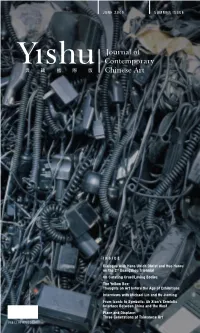
JUNE 2005 SUMMER ISSUE Dialogue with Hans Ulrich Obrist
JUNE 2005 SUMMER ISSUE INSIDE Dialogue with Hans Ulrich Obrist and Huo Hanru on the 2nd Guangzhou Triennial On Curating Cruel/Loving Bodies The Yellow Box: Thoughts on Art before the Age of Exhibitions Interviews with Michael Lin and Hu Jieming From Iconic to Symbolic: Ah Xian’s Semiotic Interface Between China and the West Place and Displace: Three Generations of Taiwanese Art US$12.00 NT$350.00 US$10.00 NT$350.00 Editor’s Note Contributors : Opening remarks Richard Vinograd p. 7 Re-Placing Contemporary Chinese Art Richard Vinograd Remarks Michael Sullivan : Prodigal Sons: Chinese Artists Return to the Homeland Melissa Chiu Between Truth and Fiction: Notes on Fakes, Copies and Authenticity in Contemporary Chinese Art Pauline J. Yao Ink Painting in the Contemporary Chinese Art World Shen Kuiyi Remarks p. 12 Richard Vinograd : Reflections on the First Chinese Art Seminar/Workshop, San Diego 1991 Zheng Shengtian Between the Worlds: Chinese Art at Biennials Since 1993 John Clark Between Scylla and Charybdis: The New Context of Chinese Contemporary Art and Its Creation since 2000 Pi Li Remarks: “Whose Stage Is It, Anyway?” Reflections on the Correlation of “Beauty” and International Exhibition Practices of Chinese Contemporary Art p. 83 Francesca Dal Lago : How Western People Support/Influence Contemporary Chinese Art Zhou Tiehai The Positioning of Chinese Contemporary Artworks in the International Art Market Uli Sigg Chinese Contemporary Art: At the Margin of the American Mainstream Jane Debevoise Remarks Britta Erickson p. 93 Artist Project: Zhou Tiehai WILL On the Edge Visiting Artists Program Britta Erickson On the Spot: The Stanford Visiting Artists Program Pauline J. -

The Reception in the West of Experimental Mainland
2 1 THE RECEPTION IN THE WEST OF EXPERIMENTAL MAINLAND CHINESE Three issues colored Western reception of Chinese art at the beginning of the | | ART OF THE 1990S ( 2002 ) 1990s, and endure to this day: first, vestiges of the colonialist search for exoticism in By Britta Erickson “the other” persisted; second, June 4[, 1989] dominated Western perceptions of China; third, Western art experts frequently had difficulty seeing beyond the surface IntroductIon appearance of contemporary Chinese art, with the result that they perceived much as During the 1990s, the overseas profile of the Chinese art world increased dramatically, as derivative. The first two issues have surfaced in exhibitions, and may have been the number of overseas exhibitions and publications focusing on — or featuring — exploited as points of accessibility for the art, particularly in group shows where there Chinese art grew year by year. At the same time, the relationship between Chinese is a need for a unifying theme. Critics accused Magiciens de la Terre, for example, of artists and overseas art workers and consumers evolved from one of keen but largely fostering the perception of Chinese artists as shamans. uninformed interest to one that was both better informed and more self-conscious. By Early solo exhibitions launched the overseas careers of outstanding émigré artists. 2000, Chinese art had achieved a sustainable profile on the international art circuit, and In 1987, Wenda Gu installed a major show, Dangerous Chessboard Leaves the Ground, in scholars, critics, curators, and collectors had begun to treat it as part of the general the Art Gallery of York University in Toronto.4 Yang Jiechang exhibited in Paris and scenery, rather than as an exoticism. -

To Enter Art History – Reading and Writing Art History in China During the Reform Era
To enter art history – reading and writing art history in China during the reform era Orianna Cacchione Figure 1 Lin Jiahua, To Enter Art History - Slideshow Activity, 1988, Courtesy of the artist and the Fei Dawei Archive held at the Asia Art Archive. In November 1988, Lin Jiahua, Chinese artist and member of the Xiamen Dada group, organized the event, To Enter Art History – Slideshow Activity (Jinru yishushi – huandeng huodong) (figure 1) in Xiamen, China. Documentary photographs of the event capture slide images of masterpieces from the canon of Western art projected onto the naked body of the artist. In one image, the face of Leonardo Da Vinci’s Mona Lisa is distorted along the curves of the artist’s posterior. In another, the Journal of Art Historiography Number 10 June 2014 Orianna Cacchione To enter art history – reading and writing art history in China during the reform era profile of the artist is covered over by the Mona Lisa, her eyes, nose and mouth masking the artist’s cheek. The artist’s chest provides a screen on which the genitals and legs of Michelangelo’s David are projected, while a close up of the artist’s face is lost under the hard lines and emphasised cross-hatching of Picasso’s rendering of prostitutes in Demoiselles D’Avignon. In the photographs documenting the event, the body of the artist and the images projected from the slide are flattened into a single hybrid image. As the artist physically enters into the frame of a slide and ‘enters’ art history, the work questions the relationship between the body of Chinese artists and Western art historical masterpieces. -

Transexperience and Chinese Experimental Art, 1990–2000 By
Transexperience and Chinese Experimental Art, 1990–2000 by Melissa Chiu A Thesis Submitted in Full Completion of the Requirements for the Degree of Doctor of Philosophy Department of Cultural Histories and Futures University of Western Sydney September 2003 2 SUMMARY This dissertation focuses on Chinese artists who migrated to the West (Australia, the United States, and France) during the late eighties and early nineties. Their work bears a number of similarities despite settlement in different cultures, most notable amongst these is a reinterpretation of Chineseness. The introduction sets out and examines the theoretical explanations for this interest in China in spite of an absence of nearly a decade. Ideas such as diaspora, exile, and travel are the main focus, with particular attention to the way that a duality tends to emerge in this discourse between the past and present or homeland and site of settlement. In place of such ideas, this dissertation introduces the concept of transexperience developed by the late Chinese artist Chen Zhen for his own practice, but it is one, I would argue, that can be applied to the artistic expression of all of the overseas artists discussed in this dissertation. The main body of the thesis is devoted to developing this idea of transexperience in relation to Chinese artists who settled in Sydney, New York, and Paris. Throughout this dissertation, I argue that transexperience encourages a more fluid perception of the relationship to the homeland, not only positing it in the past but also the present. This allows us to interpret the work of Chinese artists as an evolving identity that parallels their changing perception of China from the distance of living in the West.