Two Oriental Turtle-Doves (Streptopelia Orientalis) Reach California Jon L
Total Page:16
File Type:pdf, Size:1020Kb
Load more
Recommended publications
-

Bird Checklists of the World Country Or Region: Myanmar
Avibase Page 1of 30 Col Location Date Start time Duration Distance Avibase - Bird Checklists of the World 1 Country or region: Myanmar 2 Number of species: 1088 3 Number of endemics: 5 4 Number of breeding endemics: 0 5 Number of introduced species: 1 6 7 8 9 10 Recommended citation: Lepage, D. 2021. Checklist of the birds of Myanmar. Avibase, the world bird database. Retrieved from .https://avibase.bsc-eoc.org/checklist.jsp?lang=EN®ion=mm [23/09/2021]. Make your observations count! Submit your data to ebird. -

India: Kaziranga National Park Extension
INDIA: KAZIRANGA NATIONAL PARK EXTENSION FEBRUARY 22–27, 2019 The true star of this extension was the Indian One-horned Rhinoceros (Photo M. Valkenburg) LEADER: MACHIEL VALKENBURG LIST COMPILED BY: MACHIEL VALKENBURG VICTOR EMANUEL NATURE TOURS, INC. 2525 WALLINGWOOD DRIVE, SUITE 1003 AUSTIN, TEXAS 78746 WWW.VENTBIRD.COM INDIA: KAZIRANGA NATIONAL PARK EXTENSION February 22–27, 2019 By Machiel Valkenburg This wonderful Kaziranga extension was part of our amazing Maharajas’ Express train trip, starting in Mumbai and finishing in Delhi. We flew from Delhi to Guwahati, located in the far northeast of India. A long drive later through the hectic traffic of this enjoyable country, we arrived at our lodge in the evening. (Photo by tour participant Robert Warren) We enjoyed three full days of the wildlife and avifauna spectacles of the famous Kaziranga National Park. This park is one of the last easily accessible places to find the endangered Indian One-horned Rhinoceros together with a healthy population of Asian Elephant and Asiatic Wild Buffalo. We saw plenty individuals of all species; the rhino especially made an impression on all of us. It is such an impressive piece of evolution, a serious armored “tank”! On two mornings we loved the elephant rides provided by the park; on the back of these attractive animals we came very close to the rhinos. The fertile flood plains of the park consist of alluvial silts, exposed sandbars, and riverine flood-formed lakes called Beels. This open habitat is not only good for mammals but definitely a true gem for some great birds. Interesting but common birds included Bar-headed Goose, Red Junglefowl, Woolly-necked Stork, and Lesser Adjutant, while the endangered Greater Adjutant and Black-necked Stork were good hits in the stork section. -

Migratory Birds of Ladakh a Brief Long Distance Continental Migration
WORLD'S MIGRATORY BIRDS DAY 08 MAY, 2021 B R O W N H E A D E D G U L L MIGRATORY BIRDS OF LADAKH A BRIEF LONG DISTANCE CONTINENTAL MIGRATION the Arctic Ocean and the Indian Ocean, and comprises several migration routes of waterbirds. It also touches “West Asian- East African Flyway”. Presence of number of high-altitude wetlands (>2500 m amsl altitude) with thin human population makes Ladakh a suitable habitat for migration and breeding of continental birds, including wetlands of very big size (e.g., Pangong Tso, Tso Moriri, Tso Kar, etc.). C O M M O N S A N D P I P E R Ladakh provides a vast habitat for the water birds through its complex Ladakh landscape has significance network of wetlands including two being located at the conjunction of most important wetlands (Tso Moriri, four zoogeographic zones of the world Tso Kar) which have been designated (Palearctic, Oriental, Sino-Japanese and as Ramsar sites. Sahara-Arabian). In India, Ladakh landscape falls in Trans-Himalayan Nearly 89 bird species (long distance biogeographic zone and two provinces migrants) either breed or roost in (Ladakh Mountains, 1A) and (Tibetan Ladakh, and most of them (59) are Plateau, 1B). “Summer Migrants”, those have their breeding grounds here. Trans-Himalayan Ladakh is an integral part of the "Central Asian Flyway" of migratory birds which a large part of the globe (Asia and Europe) between Ladakh also hosts 25 bird species, during their migration along the Central Asian Flyway, as “Passage Migrants” which roost in the region. -
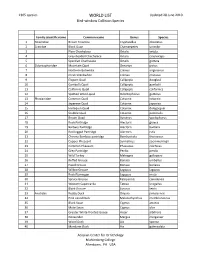
WORLD LIST Updated 28 June 2019 Bird-Window Collision Species
1305 species WORLD LIST Updated 28 June 2019 Bird-window Collision Species Family scientific name Common name Genus Species 1 Tinamidae Brown Tinamou Crypturellus obsoletus 2 Cracidae Black Guan Chamaepetes unicolor 3 Plain Chachalaca Ortalis vetula 4 Grey-headed Chachalaca Ortalis cinereiceps 5 Speckled Chachalaca Ortalis guttata 6 Odontophoridae Mountain Quail Oreortyx pictus 7 Northern Bobwhite Colinus virginianus 8 Crested Bobwhite Colinus cristatus 9 Elegant Quail Callipepla douglasii 10 Gambel's Quail Callipepla gambelii 11 California Quail Callipepla californica 12 Spotted Wood-quail Odontophorus guttatus 13 Phasianidae Common Quail Coturnix coturnix 14 Japanese Quail Coturnix japonica 15 Harlequin Quail Coturnix delegorguei 16 Stubble Quail Coturnix pectoralis 17 Brown Quail Synoicus ypsilophorus 18 Rock Partridge Alectoris graeca 19 Barbary Partridge Alectoris barbara 20 Red-legged Partridge Alectoris rufa 21 Chinese Bamboo-partridge Bambusicola thoracicus 22 Copper Pheasant Syrmaticus soemmerringii 23 Common Pheasant Phasianus colchicus 24 Grey Partridge Perdix perdix 25 Wild Turkey Meleagris gallopavo 26 Ruffed Grouse Bonasa umbellus 27 Hazel Grouse Bonasa bonasia 28 Willow Grouse Lagopus lagopus 29 Rock Ptarmigan Lagopus muta 30 Spruce Grouse Falcipennis canadensis 31 Western Capercaillie Tetrao urogallus 32 Black Grouse Lyrurus tetrix 33 Anatidae Ruddy Duck Oxyura jamaicensis 34 Pink-eared Duck Malacorhynchus membranaceus 35 Black Swan Cygnus atratus 36 Mute Swan Cygnus olor 37 Greater White-fronted Goose Anser albifrons 38 -

Home Point Study of Birds and Mammals Diversity Allied to Humans in Lockdown of COVID-19 at Bharatpur, Chitwan, Nepal
Open Journal of Ecology, 2020, 10, 612-631 https://www.scirp.org/journal/oje ISSN Online: 2162-1993 ISSN Print: 2162-1985 Home Point Study of Birds and Mammals Diversity Allied to Humans in Lockdown of COVID-19 at Bharatpur, Chitwan, Nepal Budhan Chaudhary Birendra Multiple Campus, Tribhuvan University, Bharatpur, Chitwan, Nepal How to cite this paper: Chaudhary, B. Abstract (2020) Home Point Study of Birds and Mammals Diversity Allied to Humans in The birds and mammals are nature gifted gene banks which differ greatly Lockdown of COVID-19 at Bharatpur, with variation in altitudes, climates, landscapes, vegetation and availability of Chitwan, Nepal. Open Journal of Ecology, food and water. The altitudinal variation in Nepal is 60 m to 8,848 m which 10, 612-631. https://doi.org/10.4236/oje.2020.109038 affects climatic conditions and habitat types within short distance that influ- ence species diversity of wild animals. Therefore, the objectives of this study Received: August 10, 2020 were to reveal species richness, behaviors and luring factors for birds and Accepted: September 22, 2020 mammals to attract to an urban area of Bharatpur Metropolitan City, the Published: September 25, 2020 South-central lowland of Nepal. The methods applied to record species diver- Copyright © 2020 by author(s) and sity of birds and mammals were made from a home point (a point of study Scientific Research Publishing Inc. made at the North-west corner of verandah in first floor of my home) located This work is licensed under the Creative in Bharatpur-9, Saradpur, Sitalpath, in the coordinates of 27˚39'55"N and Commons Attribution International License (CC BY 4.0). -
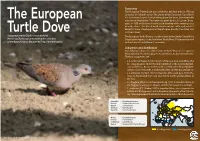
The European Turtle Dove Was Named for the First Time in 1758 by Linnaeus As Columba Turtur
Taxonomy The European Turtle Dove was named for the first time in 1758 by Linnaeus as Columba turtur. The genus of the European Turtle Dove has had several name changes throughout the years, but eventually The European was named Streptopelia. This name was given by Carolo Luciano Bona- parte in 1855 and is based on the neck drawing of the many species of turtle doves. The Greek word streptos means collar and peleia is Greek for dove. Streptopelia can therefore be directly translated into Turtle Dove ‘collared doves’. Text composed by Charles van de Kerkhof The European Turtle Dove is closely related to the Dusky Turtle Dove Photos by Charles van de Kerkhof in the collection (Streptopelia lugens), to the Adamawa Turtle Dove (S. hypopyrrha) and of the Natural History Museum at Tring, United Kingdom to the Oriental Turtle Dove (S. orientalis). Subspecies and distribution Currently four subspecies of the European Turtle Dove are recognised, the previously described subspecies isabellina is included in rufescens. The four subspecies are: • S. t. turtur (Linnaeus, 1758) is found in Europe, Asia and Africa, the breeding grounds stretch from Great Britain in the west to Kazakh- stan in the east, Russia in the north to the North-African Mediter- ranean cost in the south, including Madeira and the Canary Islands. • S. t. arenicola (Hartert, 1894) is found in Africa and Asia, from Mo- rocco to Tripoli and from Iraq and Iran to north-western China in the east. • S. t. hoggara (Geyr von Schweppenburg, 1916) is found in Africa, in the Hoggar mountains in Algeria and the Aïr mountains in Niger. -

Western Birds
WESTERN BIRDS Volume 37, Number 2, 2006 THE 30TH REPORT OF THE CALIFORNIA BIRD RECORDS COMMITTEE: 2004 RECORDS LUKE W. COLE, 561 Hill Street, San Francisco, California 94114; luke@igc.org KRISTIE N. NELSON, P.O. Box 402, Lee Vining, California 93541; storm_petrel@hotmail.com JOHN C. STERLING, 26 Palm Avenue, Woodland, California 95695 ABSTRACT: The California Bird Records Committee reached decisions on 220 records involving 87 species and one species pair reported in 2004, endorsing 161 of them. New to California were the Common Eider (Somateria mollissima) and Stonechat (Saxicola torquatus). Adjusted for these additions and the species-level merger of the White and Black-backed Wagtails within Motacilla alba, California’s bird list stands at 629 species, ten of which are nonnative. A potential first state record of the Hawaiian Goose (Branta sandvicensis) was not accepted on grounds of questionable natural occurrence, and potential first state records of Parkinson’s Petrel (Procellaria parkinsoni) and Flame-colored Tanager (Piranga bidentata) were not accepted on grounds of identification. Other significant records reported here include the state’s second accepted records of the Oriental Turtle-Dove (Streptopelia orientalis) and Magnificent Hummingbird (Eugenes fulgens), third of the Common Black-Hawk (Buteogallus anthracinus) and Red-legged Kittiwake (Rissa brevirostris), fifth of the Greater Shearwater Puffinus( gravis), fifth and sixth of the Crested Ca- racara (Caracara cheriway), a returning fifth Anhinga Anhinga( anhinga), and the sixth Ruby-throated Hummingbird (Archilochus colubris). This report also includes an appendix reporting the results of the committee’s review of historical records accepted for statistical purposes, previously unpublished committee decisions, and resolution of contentious records from earlier periods. -

Status and Occurrence of Oriental Turtle-Dove (Streptopelia Orientalis) in British Columbia
Status and Occurrence of Oriental Turtle-Dove (Streptopelia orientalis) in British Columbia. By Rick Toochin. Submitted: April 15, 2017. Introduction and Distribution The Oriental Turtle-Dove (Streptopelia orientalis) is a large Dove species that is mostly sedentary in much of its range, but the northern subspecies are migratory (Brazil 2009). This species is found as a permanent resident in South and Central Asia from India, north to north- western Pakistan, north-western Afghanistan, north into Tajikistan, western Kyrgyzstan, northern Kazakhstan, across southern areas of Siberia, Mongolia, through most of China, Korea, and southern Japan, south to Vietnam, throughout South-east Asia to Malaysia, north to Burma and Bangladesh (Clements et al. 2015). The breeding range of the migratory subspecies of the Oriental Turtle-Dove is as far west as the Ural Mountains and includes northern Kazakhstan, across Siberia, throughout northern Mongolia, to Sakhalin Island and northern Japan (Brazil 2009). There are 6 recognized subspecies of the Oriental Turtle-Dove (Clements et al. 2015). Some are migratory and some have restricted ranges. The nominate subspecies of Oriental Turtle-Dove (Streptopelia orientalis orientalis) is highly migratory and is found breeding in central Siberia to China, Korea, Japan and Kuril Islands and accounts for all North American records from Alaska to California (Gibson and Kessel 1997, Hamilton et al. 2007, Brazil 2009, Clements et al. 2015). The second subspecies of Oriental Turtle-Dove (Streptopelia orientalis meena) is also migratory and is found from the Ural Mountains of northern Kazakhstan, through south-western Siberia to Iran, Afghanistan, Kashmir and Nepal (Goodwin 1983, Gibbs et al. -

Breeding Status of Wild Doves in Bangladesh
International Journal of Research Studies in Zoology Volume 6, Issue 1, 2020, PP 1-4 ISSN No. 2454-941X DOI: http://dx.doi.org/10.20431/2454-941X.0601001 www.arcjournals.org Breeding Status of Wild Doves in Bangladesh Ashraful Kabir* Department of Biology, Saidpur Cantonment Public College, Nilphamari, Bangladesh *Corresponding Author: Ashraful Kabir, Department of Biology, Saidpur Cantonment Public College, Nilphamari, Bangladesh Out of 17 species of wild doves in Bangladesh their incubation period ranges from 12-20 and fledging 12-27 days. Within these 14 species were in Least Concern (LC), 2 Data Deficit (DD), and 1 Critically Endangered (CR). Among these maximum numbers were found in the genus Treron (6) then Streptopelia (4), Columba and Ducula each 2, and Spilopelia and Macropygia 1. Observed doves were bred mostly all the year round. For hunting or pet purpose people sometime catch them and rear in cage and ultimately birds’die. For strong ‘Wildlife Act’ now doves of Bangladesh are living well and are increasing everywhere in nature as well. On the basis of evolutionary sequences pigeons/doves have great significance. It has lots of connecting links which are very important for the study of evolution. In fancy pigeons, their tumbling behaviour is an exceptional and peculiar characteristic which came through mutation then modified by millions of thousands selective breeding. From the history, we have found that pigeon/dove keeping was an ancient hobby of people. Large-sized birds are called pigeon and small are dove; but this is not true always. For message sending, pigeons had great commitment in the world. -

Phthiraptera: Amblycera, Ischnocera) from 7 Egyptian Pigeons and Doves (Columbiformes), with Description of One New Species
$FWD7URSLFD ² Contents lists available at ScienceDirect Acta Tropica journal homepage: www.elsevier.com/locate/actatropica New records of chewing lice (Phthiraptera: Amblycera, Ischnocera) from 7 Egyptian pigeons and doves (Columbiformes), with description of one new species Eslam Adlya,⁎, Mohamed Nassera, Doaa Solimana, Daniel R. Gustafssonb, Magdi Shehataa a Department of Entomology, Faculty of Science, Ain Shams University, Cairo, Egypt b Guangdong Key Laboratory of Animal Conservation and Resources, Guangdong Public Laboratory of Wild Animal Conservation and Utilization, Guangdong Institute of Applied Biological Resources, Guangzhou, Guangdong, China ARTICLE INFO ABSTRACT Keywords: Little information is available about the chewing lice of wild birds of Egypt, including common groups such as Egypt pigeons and doves (Columbiformes). Through this work, parasitic chewing lice of common columbiformes of New species Egypt were revised including new data. Three species of pigeons and doves (Streptopelia decaocto Frivaldszky New records 1838, Spilopelia senegalensis Linnaeus 1766 and Columba livia Gmelin 1789) were examined for chewing lice at Chewing lice three different localities. A total of 124 specimens of lice were collected. Nine species were identified from these Columbiformes samples; one species (Columbicola joudiae n. sp.) was considered a new species to science, six species were Columbicola fi fi Coloceras recorded from Egypt for the rst time, and two species have been identi ed in Egypt before. Taxonomic and fi Campanulotes ecological remarks for all identi ed chewing lice samples are provided along with known and local hosts, Colpocephalum measurements and material examined. Description and images of the new species are also provided. 1. Introduction the Rock Dove is the most widely domesticated by humans for hundreds of years and have become feral in cities around the world (Beletsky, The study of chewing lice has been neglected for many years in the 2007). -
Western India
This is an excellent tour to see the handsome Demoiselle Crane in good numbers (Hannu Jännes). WESTERN INDIA 2 – 18 FEBRUARY 2018 LEADER: HANNU JÄNNES This was yet another very successful Birdquest tour to the north western of India with an epic journey through the states of Punjab, Rajasthan and Gujarat plus a short visit to the state of Maharasthra to conclude. We recorded no fewer than 330 bird species and 17 mammals, and, more importantly, we found almost every bird specialty of the dry western and central regions of the subcontinent including a number of increasingly scarce species with highly restricted ranges like the impressive Great Indian Bustard (with a world population of only 150 or so), the beautifully patterned White-naped Tit, White-browed (or Stoliczka’s) Bush Chat and the Critically Endangered Indian Vulture. Many Indian subcontinent endemics were seen including Rock Bush Quail, Red Spurfowl, Red-naped (or Black) Ibis, Indian Courser, Painted Sandgrouse, the highly-localised Forest Owlet, Mottled Wood and Indian Eagle Owls, the elusive Sirkeer Malkoha, White- naped Woodpecker, Malabar Trogon, Plum-headed Parakeet, Rufous-tailed and Sykes’s Larks, Ashy- crowned Sparrow-Lark, Indian Bush Lark, the lovely White-bellied Minivet, Marshall’s Iora, Indian Black-lored Tit, Brahminy Starling, Streak-throated Swallow, Rufous-fronted and Rufous-vented Prinias, Green Avadavat, Indian Scimitar Babbler, Indian Spotted Creeper, Vigors’s and Purple-rumped Sunbirds, Sind Sparrow and the range restricted western form of the Jerdon’s Babbler. -

Oriental Turtle Dove Kijibato (Jpn) Streptopelia Orientalis Morphology and Classification Four Days
Bird Research News Vol.3 No.8 2006. 8.11. Oriental Turtle Dove Kijibato (Jpn) Streptopelia orientalis Morphology and classification four days. The nest is built at a height of 3m on average with a range of 0-10m. They usually build a nest in a tree, but sometimes Classification: Columbiformes Columbidae in a bush about half a meter from the ground. Total length: 33-35cm From egg-laying to fledging: Wing length: ♂192-201mm ♀188-196mm The clutch size is usually two eggs, Tail length: ♂126-142mm ♀124-138mm which are small (33 by 26 mm) Culmen length: ♂16.3-18.2mm ♀15.3-18.3mm and white (Kakizawa & Kogaito Tarsus length: ♂25.5-29.1mm ♀24.7-29.3mm 1999). Males incubate in the day- Weight: 165-274g time and females from the evening The total length and weight after del Hoyo et al. (1997), and the other measurements till the next morning. The incuba- after Cramp (1985). tion period is 14-16 days, and ei- ther parent bird continue to brood Appearance: nestlings for about four days after Photo 2. Five-day-old nestlings Oriental Turtle Doves are similar in plum- hatching. Hatchlings are charcoal age coloration in males and females. They gray and sparsely covered with yellow down (Photo 2). are purplish ashy brown from the head to Oriental Turtle Doves also feed to their nestlings pigeon milk se- the chest and belly. They have a patch of creted from the crop as other pigeons. Pigeon milk is a cottage black and blueish gray stripes on both cheese-like substance rich in nutrients, such as protein and lipids.