15 MB 25 Nov 2015 Coastal Garden Guide
Total Page:16
File Type:pdf, Size:1020Kb
Load more
Recommended publications
-

Additional Land South of the Gas Treatment Plant Vegetation and Flora Survey
Additional Land South of the Gas Treatment Plant Vegetation and Flora Survey October 2013 Prepared for Chevron Australia Pty Ltd Astron Environmental Services 129 Royal Street East Perth WA 6004 Phone: (08) 9421 9600 Fax: (08) 9421 9699 Report Reference: 2609-13-BSR-1Rev0_131128 Email: perth@astron.com.au Doc. ID: G1-NT-REP00000220 Doc. ID: G1-NT-REP00000220 Additional Land South of the Gas Treatment Plant Vegetation and Flora Survey Prepared for Chevron Australia Pty Ltd Job Number: 2609-13 Reference: 2609-13-BSR-1Rev0_131128 Revision Status Rev Date Description Author(s) Reviewer A 01/11/2013 Draft Issued for Client Review N. Cadd J. Kruger B 08/11/2013 Revised Draft Issued for Client Review N. Cadd J. Kruger C 12/11/2013 Revised Draft Issued for Client Review N. Cadd V. Clarke 0 28/11/2013 Final Issued for Information N. Cadd V. Clarke Approval Rev Date Issued to Authorised by Name Signature A 01/11/2013 A. Smith/S. Finn S. Pearse B 08/11/2013 A. Smith/S. Finn S. Pearse C 12/11/2013 A. Smith/S. Finn S. Atkinson 0 28/11/2013 A. Smith/S. Finn S. Pearse © Copyright 2012 Astron Environmental Services Pty Ltd. All rights reserved. This document and information contained in it has been prepared by Astron Environmental Services under the terms and conditions of its Doc.contract ID: with G1-NT-REP00000220 its client. The report is for the clients use only and may not be used, exploited, copied, duplicated or reproduced in any form or medium whatsoever without the prior written permission of Astron Environmental Services or its client. -

PUBLISHER S Candolle Herbarium
Guide ERBARIUM H Candolle Herbarium Pamela Burns-Balogh ANDOLLE C Jardin Botanique, Geneva AIDC PUBLISHERP U R L 1 5H E R S S BRILLB RI LL Candolle Herbarium Jardin Botanique, Geneva Pamela Burns-Balogh Guide to the microform collection IDC number 800/2 M IDC1993 Compiler's Note The microfiche address, e.g. 120/13, refers to the fiche number and secondly to the individual photograph on each fiche arranged from left to right and from the top to the bottom row. Pamela Burns-Balogh Publisher's Note The microfiche publication of the Candolle Herbarium serves a dual purpose: the unique original plants are preserved for the future, and copies can be made available easily and cheaply for distribution to scholars and scientific institutes all over the world. The complete collection is available on 2842 microfiche (positive silver halide). The order number is 800/2. For prices of the complete collection or individual parts, please write to IDC Microform Publishers, P.O. Box 11205, 2301 EE Leiden, The Netherlands. THE DECANDOLLEPRODROMI HERBARIUM ALPHABETICAL INDEX Taxon Fiche Taxon Fiche Number Number -A- Acacia floribunda 421/2-3 Acacia glauca 424/14-15 Abatia sp. 213/18 Acacia guadalupensis 423/23 Abelia triflora 679/4 Acacia guianensis 422/5 Ablania guianensis 218/5 Acacia guilandinae 424/4 Abronia arenaria 2215/6-7 Acacia gummifera 421/15 Abroniamellifera 2215/5 Acacia haematomma 421/23 Abronia umbellata 221.5/3-4 Acacia haematoxylon 423/11 Abrotanella emarginata 1035/2 Acaciahastulata 418/5 Abrus precatorius 403/14 Acacia hebeclada 423/2-3 Acacia abietina 420/16 Acacia heterophylla 419/17-19 Acacia acanthocarpa 423/16-17 Acaciahispidissima 421/22 Acacia alata 418/3 Acacia hispidula 419/2 Acacia albida 422/17 Acacia horrida 422/18-20 Acacia amara 425/11 Acacia in....? 423/24 Acacia amoena 419/20 Acacia intertexta 421/9 Acacia anceps 419/5 Acacia julibross. -

Their Botany, Essential Oils and Uses 6.86 MB
MELALEUCAS THEIR BOTANY, ESSENTIAL OILS AND USES Joseph J. Brophy, Lyndley A. Craven and John C. Doran MELALEUCAS THEIR BOTANY, ESSENTIAL OILS AND USES Joseph J. Brophy School of Chemistry, University of New South Wales Lyndley A. Craven Australian National Herbarium, CSIRO Plant Industry John C. Doran Australian Tree Seed Centre, CSIRO Plant Industry 2013 The Australian Centre for International Agricultural Research (ACIAR) was established in June 1982 by an Act of the Australian Parliament. ACIAR operates as part of Australia's international development cooperation program, with a mission to achieve more productive and sustainable agricultural systems, for the benefit of developing countries and Australia. It commissions collaborative research between Australian and developing-country researchers in areas where Australia has special research competence. It also administers Australia's contribution to the International Agricultural Research Centres. Where trade names are used this constitutes neither endorsement of nor discrimination against any product by ACIAR. ACIAR MONOGRAPH SERIES This series contains the results of original research supported by ACIAR, or material deemed relevant to ACIAR’s research and development objectives. The series is distributed internationally, with an emphasis on developing countries. © Australian Centre for International Agricultural Research (ACIAR) 2013 This work is copyright. Apart from any use as permitted under the Copyright Act 1968, no part may be reproduced by any process without prior written permission from ACIAR, GPO Box 1571, Canberra ACT 2601, Australia, aciar@aciar.gov.au Brophy J.J., Craven L.A. and Doran J.C. 2013. Melaleucas: their botany, essential oils and uses. ACIAR Monograph No. 156. Australian Centre for International Agricultural Research: Canberra. -
Table of Contents Below) with Family Name Provided
1 Australian Plants Society Plant Table Profiles – Sutherland Group (updated August 2021) Below is a progressive list of all cultivated plants from members’ gardens and Joseph Banks Native Plants Reserve that have made an appearance on the Plant Table at Sutherland Group meetings. Links to websites are provided for the plants so that further research can be done. Plants are grouped in the categories of: Trees and large shrubs (woody plants generally taller than 4 m) Medium to small shrubs (woody plants from 0.1 to 4 m) Ground covers or ground-dwelling (Grasses, orchids, herbaceous and soft-wooded plants, ferns etc), as well as epiphytes (eg: Platycerium) Vines and scramblers Plants are in alphabetical order by botanic names within plants categories (see table of contents below) with family name provided. Common names are included where there is a known common name for the plant: Table of Contents Trees and Large shrubs........................................................................................................................... 2 Medium to small shrubs ...................................................................................................................... 23 Groundcovers and other ground‐dwelling plants as well as epiphytes. ............................................ 64 Vines and Scramblers ........................................................................................................................... 86 Sutherland Group http://sutherland.austplants.com.au 2 Trees and Large shrubs Acacia decurrens -

Grevillea Study Group
AUSTRALIAN NATIVE PLANTS SOCIETY (AUSTRALIA) INC GREVILLEA STUDY GROUP NEWSLETTER NO. 109 – FEBRUARY 2018 GSG NSW Programme 2018 02 | EDITORIAL Leader: Peter Olde, p 0432 110 463 | e peter.olde@exemail.com.au For details about the NSW chapter please contact Peter, contact via email is preferred. GSG Vic Programme 2018 03 | TAXONOMY Leader: Neil Marriott, 693 Panrock Reservoir Rd, Stawell, Vic. 3380 SOME NOTES ON HOLLY GREVILLEA DNA RESEARCH p 03 5356 2404 or 0458 177 989 | e neil@whitegumsaustralia.com Contact Neil for queries about program for the year. Any members who would PHYLOGENY OF THE HOLLY GREVILLEAS (PROTEACEAE) like to visit the official collection, obtain cutting material or seed, assist in its BASED ON NUCLEAR RIBOSOMAL maintenance, and stay in our cottage for a few days are invited to contact Neil. AND CHLOROPLAST DNA Living Collection Working Bee Labour Day 10-12 March A number of members have offered to come up and help with the ongoing maintenanceof the living collection. Our garden is also open as part of the FJC Rogers Goodeniaceae Seminar in October this year, so there is a lot of tidying up and preparation needed. We think the best time for helpers to come up would be the Labour Day long weekend on 10th-12th March. We 06 | IN THE WILD have lots of beds here, so please register now and book a bed. Otherwise there is lots of space for caravans or tents: neil@whitegumsaustralia.com. We will have a great weekend, with lots of A NEW POPULATION OF GREVILLEA socializing, and working together on the living collection. -

<I>Ustilago-Sporisorium-Macalpinomyces</I>
Persoonia 29, 2012: 55–62 www.ingentaconnect.com/content/nhn/pimj REVIEW ARTICLE http://dx.doi.org/10.3767/003158512X660283 A review of the Ustilago-Sporisorium-Macalpinomyces complex A.R. McTaggart1,2,3,5, R.G. Shivas1,2, A.D.W. Geering1,2,5, K. Vánky4, T. Scharaschkin1,3 Key words Abstract The fungal genera Ustilago, Sporisorium and Macalpinomyces represent an unresolved complex. Taxa within the complex often possess characters that occur in more than one genus, creating uncertainty for species smut fungi placement. Previous studies have indicated that the genera cannot be separated based on morphology alone. systematics Here we chronologically review the history of the Ustilago-Sporisorium-Macalpinomyces complex, argue for its Ustilaginaceae resolution and suggest methods to accomplish a stable taxonomy. A combined molecular and morphological ap- proach is required to identify synapomorphic characters that underpin a new classification. Ustilago, Sporisorium and Macalpinomyces require explicit re-description and new genera, based on monophyletic groups, are needed to accommodate taxa that no longer fit the emended descriptions. A resolved classification will end the taxonomic confusion that surrounds generic placement of these smut fungi. Article info Received: 18 May 2012; Accepted: 3 October 2012; Published: 27 November 2012. INTRODUCTION TAXONOMIC HISTORY Three genera of smut fungi (Ustilaginomycotina), Ustilago, Ustilago Spo ri sorium and Macalpinomyces, contain about 540 described Ustilago, derived from the Latin ustilare (to burn), was named species (Vánky 2011b). These three genera belong to the by Persoon (1801) for the blackened appearance of the inflores- family Ustilaginaceae, which mostly infect grasses (Begerow cence in infected plants, as seen in the type species U. -
Flowers, Posts and Plates of Dirk Hartog Island
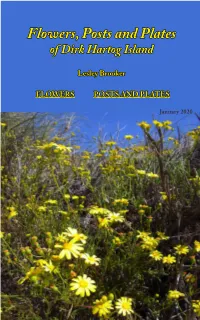
Flowers, Posts and Plates of Dirk Hartog Island Lesley Brooker FLOWERS POSTS AND PLATES January 2020 Home Flowers, Posts and Plates of Dirk Hartog Island Lesley Brooker For the latest revision go to https://lesmikebrooker.com.au/Dirk-Hartog-Island.php Please direct feedback to Lesley Brooker at LesMikeBrooker@bigpond.com Home INTRODUCTION This document is in two parts:- Part 1 — FLOWERS is an interactive reference to some of the flora of Dirk Hartog Island. Plants are arranged alphabetically within families. Hyperlinks are provided for quick access to historical material found on-line. Attention is drawn (in the green boxes below the species accounts) to some features which may help identification or may interest the reader, but these are by no means diagnostic. Where technical terms are used, these are explained in parenthesis. The ultimate on-line authority on the Western Australian flora is FloraBase. It provides the most up-to-date nomenclature, details of subspecies, flowering periods and distribution maps. Please use this guide in conjunction with FloraBase. Part 2 — POSTS AND PLATES provides short historical accounts of some the people involved in erecting and removing posts and plates on Dirk Hartog Island between 1616 and 1907, and those who may have collected plants on the island during their visit. Home FLOWERS PHOTOGRAPHS REFERENCES BIRD LIST Home Flower Photos The plants are presented in alphabetical order within plant families - this is so that plants that are closely related to one another will be grouped together on nearby pages. All of the family names and genus names are given at the top of each page and are also listed in an index. -
Supplementary Material Spatial Analysis of Limiting Resources on An
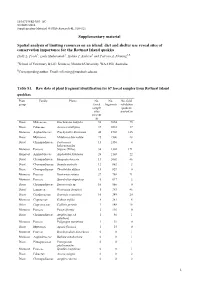
10.1071/WR14083_AC ©CSIRO 2014 Supplementary Material: Wildlife Research 41 , 510–521 Supplementary material Spatial analysis of limiting resources on an island: diet and shelter use reveal sites of conservation importance for the Rottnest Island quokka Holly L. Poole A, Laily Mukaromah A, Halina T. Kobryn A and Patricia A. Fleming A,B ASchool of Veterinary & Life Sciences, Murdoch University, WA 6150, Australia. BCorresponding author. Email: t.fleming@murdoch.edu.au Table S1. Raw data of plant fragment identification for 67 faecal samples from Rottnest Island quokkas Plant Family Plants No. No. No. field group faecal fragments validation sample quadrats sites present in present in Dicot Malvaceae Guichenotia ledifolia 52 9854 75 Dicot Fabaceae Acacia rostellifera 37 3018 37 Monocot Asphodelaceae Trachyandra divaricata 46 2702 145 Dicot Myrtaceae Melaleuca lanceolata 25 1506 28 Dicot Chenopodiaceae Tecticornia 13 1350 4 halocnemoides Monocot Poaceae Stipeae (Tribe) 34 1302 171 Monocot Asphodelaceae Asphodelus fistulosus 26 1103 22 Dicot Chenopodiaceae Rhagodia baccata 13 1002 46 Dicot Chenopodiaceae Suaeda australis 12 862 2 Dicot Chenopodiaceae Threlkeldia diffusa 15 829 0 Monocot Poaceae Rostraria cristata 27 788 71 Monocot Poaceae Sporobolus virginicus 5 617 2 Dicot Chenopodiaceae Sarcocornia sp . 10 560 0 Dicot Lamiaceae Westringia dampieri 5 383 46 Dicot Goodeniaceae Scaevola crassifolia 10 349 20 Monocot Cyperaceae Gahnia trifida 8 281 6 Other Cupressaceae Callitris preissii 3 148 18 Monocot Poaceae Poa poiformis 2 116 0 Dicot Chenopodiaceae Atriplex spp. (A. 1 40 1 paludosa ) Monocot Poaceae Polypogon maritimus 1 39 0 Dicot Myrtaceae Agonis flexuosa 1 15 0 Monocot Poaceae Brachypodium distachyon 0 0 1 Monocot Asphodelaceae Bulbine semibarbata 0 0 1 Dicot Pittosporaceae Pittosporum 0 0 1 phylliraeoides Monocot Poaceae Spinifex longifolius 0 0 1 Dicot Fabaceae Acacia saligna 0 0 2 Dicot Chenopodiaceae Atriplex cinerea 0 0 2 1 Dicot Asteraceae Centaurea sp . -

SIS) – 2017 Version
Information Sheet on EAA Flyway Network Sites Information Sheet on EAA Flyway Network Sites (SIS) – 2017 version Available for download from http://www.eaaflyway.net/about/the-flyway/flyway-site-network/ Categories approved by Second Meeting of the Partners of the East Asian-Australasian Flyway Partnership in Beijing, China 13-14 November 2007 - Report (Minutes) Agenda Item 3.13 Notes for compilers: 1. The management body intending to nominate a site for inclusion in the East Asian - Australasian Flyway Site Network is requested to complete a Site Information Sheet. The Site Information Sheet will provide the basic information of the site and detail how the site meets the criteria for inclusion in the Flyway Site Network. When there is a new nomination or an SIS update, the following sections with an asterisk (*), from Questions 1-14 and Question 30, must be filled or updated at least so that it can justify the international importance of the habitat for migratory waterbirds. 2. The Site Information Sheet is based on the Ramsar Information Sheet. If the site proposed for the Flyway Site Network is an existing Ramsar site then the documentation process can be simplified. 3. Once completed, the Site Information Sheet (and accompanying map(s)) should be submitted to the Flyway Partnership Secretariat. Compilers should provide an electronic (MS Word) copy of the Information Sheet and, where possible, digital versions (e.g. shapefile) of all maps. ----------------------------------------------------------------------------------------------------------------------------- -
Technical Report
A STRATEGIC FRAMEWORK FOR BIODIVERSITY CONSERVATION Report B: For practitioners of conservation planning Copyright text 2012 Southwest Australia Ecoregion Initiative. All rights reserved. Author: Danielle Witham, WWF-Australia First published: 2012 by the Southwest Australia Ecoregion Initiative. Any reproduction in full or in part of this publication must mention the title and credit the above-mentioned publisher as the copyright Cover Image: ©Richard McLellan Design: Three Blocks Left Design Printed by: SOS Print & Media Printed on Impact, a 100% post-consumer waste recycled paper. For copies of this document, please contact SWAEI Secretariat, PO Box 4010, Wembley, Western Australia 6913. This document is also available from the SWAEI website at http://www.swaecoregion.org SETTING THE CONTEXT i CONTENTS EXECUTIVE SUMMARY 1 ACKNOWLEDGEMENTS 2 SETTING THE CONTEXT 3 The Southwest Australia Ecoregion Initiative SUMMARY OF THE PROJECT METHODOLOGY 5 STEP 1. IDENTIFYING RELEVANT STAKEHOLDERS AND CLARIFYING ROLES 7 Expert engagement STEP 2. DEFINING PROJECT BOUNDARY 9 The boundary of the Southwest Australia Ecoregion STEP 3. APPLYING PLANNING UNITS TO PROJECT AREA 11 STEP 4. PREPARING AND CHOOSING SOFTWARE 13 Data identification 13 Conservation planning software 14 STEP 5. IDENTIFYING CONSERVATION FEATURES 16 Choosing conservation features 16 Fauna conservation features 17 Flora conservation features 21 Inland water body conservation features 22 Inland water species conservation features 27 Other conservation features 27 Threatened and Priority Ecological communities (TECs and PECs) 31 Vegetation conservation features 32 Vegetation connectivity 36 STEP 6. APPLYING CONSERVATION FEATURES TO PLANNING UNITS 38 STEP 7. SETTING TARGETS 40 Target formulae 40 Special formulae 42 STEP 8. IDENTIFYING AND DEFINING LOCK-INS 45 STEP 9. -

Alllists Simple Pictures
141 King Road Oakford, WA, 6121 Ph : (08) 9525 1324 Fax : (08) 9525 4703 Email : FarmTrees@hotlinks.net.au www.AustralianNativeNursery.com.au Open 7 Days 9am to 4:30pm Plant List May14 2019 <NEW> Australian Native Nursery Number Of Species #Error Plant List May14 2019 141 King Road Oakford Page 1 of 61 Botanical Name * Habit Height/Width Orgin Notes Comment Common Name * Flower Colour , Period (LGA or IBRA) * Soil type and Envirnoment Acacia acuminata • tree,shrub 6-10m h x 3-5m w Avon Wheatbelt P1, Avon Wheatbelt P2, Dandaragan Shade, Shelter, Posts, craft wood, Sandalwood Rasberry Jam Wattle • Flw:yellow ball • Dec to feb Fol:green Plateau, Eastern Goldfield, Eastern Mallee, Eastern host Murchison, Fitzgerald, Geraldton Hills, Lesueur Sandplain, Acacia acuminata has edible seeds and an • Sand,Coastal Mardabilla, Northern Jarrah Forest, Perth, Shield, Southern edible gum. Seeds, essence, add to icecream, Cross, Southern Jarrah Forest, Tallering, Western Mallee bread and cakes. Acacia aphylla • tree 0.9-3m h x 2m w Kalamunda, Mundaring, Northam, York Rare and endangered Leafless Rock Wattle • Flw:yellow • Aug to Oct • Sand,Loam,Gravel,Clay Threatened Flora (Declared Rare Flora — Extant) Acacia celastrifolia • bushy shrub or tree 1-3m h x 1-3m w Armadale, Beverley, Boddington, Boyup Brook, Brookton, Glowing Wattle • Flw:yellow • April - August Chittering, Collie, Cuballing, Gingin, Goomalling, Harvey, Kalamunda, Mundaring, Murray, Narrogin, Northam, • Gravel,Shade Pingelly, Serpentine-Jarrahdale, Swan, Toodyay, Victoria Plains, Wagin, Wandering, Waroona, West Arthur, Williams, York Acacia cyclops • dense shrub or tree (rarely) 0.8-4m h x 2-4m w Eastern Mallee, Fitzgerald, Geraldton Hills, Hampton, Good Windbreak Western Coastal Wattle • Flw:yellow • September - May Lesueur Sandplain, Mardabilla, Northern Jarrah Forest, Seeds can be ground to make flour when Perth, Recherche, Southern Jarrah Forest, Warren, Western mixed with water and cooked as a bread. -

Nyangumarta Warrarn Indigenous Protected Area
Traditional Ecological Knowledge of Nyangumarta Warrarn Indigenous Protected Area GENO DI US IGENO IN D US IN P R S P O A R S T E O A EC AR TE RE TED CTED A INDEX INTRODUCTION 2 BOTH (INLAND) AND COASTAL / WALYARTA NYANGUMARTA HIGHWAY (KIDSON TRACK) - INLAND TREE SPECIES SPECIES PARNTARL 78 TREE SPECIES JIKILY 80 JUKURTANY 6 MAKARTU / LAKURRU1 82 YALAKURRA 8 WURTARR 84 JULUKU 10 LOW TREE or SHRUB SPECIES JUNYJU 12 KUMPAJA 86 LOW TREE or SHRUB SPECIES LIRRINGKIN 88 MIRNTIRRJINA 14 SHRUB SPECIES NGALYANTA 16 JIMA 90 Warning: This document may contain pictures or names of people who PAJINAWANTI 18 PIRRNYURU 92 have since passed away. WIRLINY 20 MANGARR 94 JUMPURR 22 KARLUNKARLUN 96 This project was supported by Yamatji Marlpa Aboriginal Corporation, through KUMPALY 24 KARTAWURRU 98 funding from the Australian Government’s National Landcare Programme and JIMPIRRINY 26 JALKUPURTA 100 1 Indigenous Protected Areas Programme. YURTURL 28 WALYARTA (MANDORA MARSH) AND COASTAL SPECIES SHRUB SPECIES TREE SPECIES The traditional ecological knowledge contained in this publication was recorded by KARLAYIN 30 NGALINYMARRA 102 KAWARR 32 KURNTURUNGU 104 Vicki Long, ethno-botanist (Vicki Long & Associates), with the assistance of Brian PALMANGU 34 RANYJAMAYI 106 Geytenbeek, linguist. WAYALANY 36 TAMARISK 108 WARRI WARRI 38 LOW TREE or SHRUB SPECIES Photography: Vicki Long, José Kalpers, Volker Mischker and Mamoru Matsuki, PURNTAKARNU 40 KULINYJIRR 110 unless otherwise stated. PURARRPURARR 42 YURTURL 112 JULYUNGKU 44 YURTUL 114 Coordination: José Kalpers, Yamatji Marlpa Aboriginal Corporation. KALAYAKALAYA 46 JUMPURRU 116 PURTATU 48 MUNTURU 118 © All traditional and cultural knowledge in this publication is the MANGARR 50 SHRUB SPECIES intellectual property of the Nyangumarta people.