Entomologische Zeitschrift
Total Page:16
File Type:pdf, Size:1020Kb
Load more
Recommended publications
-
Populus Nigra Network
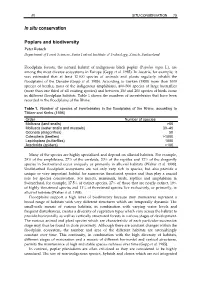
IN SITU CONSERVATION 79 In situ conservation Poplars and biodiversity PeterȱRotachȱ Department of Forest Sciences, Swiss Federal Institute of Technology, Zürich, Switzerland Floodplain forests, the natural habitat of indigenous black poplar (Populus nigra L.), are among the most diverse ecosystems in Europe (Gepp et al. 1985). In Austria, for example, it was estimated that at least 12 000 species of animals and plants regularly inhabit the floodplains of the Danube (Gepp et al. 1985). According to Gerken (1988) more than 1000 species of beetles, most of the indigenous amphibians, 400–500 species of large butterflies (more than one third of all existing species) and between 150 and 200 species of birds occur in different floodplain habitats. Table 1 shows the numbers of invertebrates that have been recorded in the floodplains of the Rhine. Table 1. Number of species of invertebrates in the floodplains of the Rhine, according to Tittizer and Krebs (1996) Order Number of species Mollusca (land snails) >60 Mollusca (water snails and mussels) 30–40 Odonata (dragonflies) 50 Coleoptera (beetles) >1000 Lepidoptera (butterflies) 1000 Arachnida (spiders) >100 Many of the species are highly specialized and depend on alluvial habitats. For example, 29% of the amphibians, 27% of the carabids, 20% of the reptiles and 12% of the dragonfly species in Switzerland occur uniquely or primarily in alluvial habitats (Walter et al. 1998). Undisturbed floodplain ecosystems are not only very rich in species, but also provide a unique or very important habitat for numerous threatened species and thus play a crucial role for species conservation. For insects, mammals, birds, reptiles and amphibians in Switzerland, for example, 17.5% of extinct species, 27% of those that are nearly extinct, 19% of highly threatened species and 11% of threatened species live exclusively, or primarily, in alluvial habitats (Walter et al. -

CBD First National Report
FIRST NATIONAL REPORT OF THE REPUBLIC OF SERBIA TO THE UNITED NATIONS CONVENTION ON BIOLOGICAL DIVERSITY July 2010 ACRONYMS AND ABBREVIATIONS .................................................................................... 3 1. EXECUTIVE SUMMARY ........................................................................................... 4 2. INTRODUCTION ....................................................................................................... 5 2.1 Geographic Profile .......................................................................................... 5 2.2 Climate Profile ...................................................................................................... 5 2.3 Population Profile ................................................................................................. 7 2.4 Economic Profile .................................................................................................. 7 3 THE BIODIVERSITY OF SERBIA .............................................................................. 8 3.1 Overview......................................................................................................... 8 3.2 Ecosystem and Habitat Diversity .................................................................... 8 3.3 Species Diversity ............................................................................................ 9 3.4 Genetic Diversity ............................................................................................. 9 3.5 Protected Areas .............................................................................................10 -
Poleward Shifts in Geographical Ranges of Butterfly Species Associated with Regional Warming
letters to nature between 270 and 4,000 ms after target onset) and to ignore changes in the distractor. Failure to respond within a reaction-time window, responding to a change in the distractor or deviating the gaze (monitored with a scleral search Poleward shifts in coil) by more than 1Њ from the fixation point caused the trial to be aborted without reward. The change in the target and distractors was selected so as to geographical ranges of be challenging for the animal. In experiments 1 and 2 the animal correctly completed, on average, 79% of the trials, broke fixation in 11%, might have butterfly species associated responded to the distractor stimulus in 6% and responded too early or not at all in 5% of the trials. In Experiment 3 the corresponding values are 78, 13%, 8% with regional warming and 2%. In none of the three experiments was there a difference between the Camille Parmesan*†, Nils Ryrholm‡, Constantı´ Stefanescu§, performances for the two possible targets. Differences between average eye Jane K. Hillk, Chris D. Thomas¶, Henri Descimon#, positions during trials where one or the other stimulus was the target were Brian Huntleyk, Lauri Kaila!, Jaakko Kullberg!, very small, with only an average shift of 0.02Њ in the direction of the shift of Toomas Tammaru**, W. John Tennent††, position between the stimuli. Only correctly completed trials were considered. Jeremy A. Thomas‡‡ & Martin Warren§§ Firing rates were determined by computing the average neuronal response * National Center for Ecological Analysis and Synthesis, 735 State Street, across trials for 1,000 ms starting 200 ms after the beginning of the target Suite 300, Santa Barbara, California 93101, USA stimulus movement. -

Lepidoptera: Noctuoidea: Erebidae) and Its Phylogenetic Implications
EUROPEAN JOURNAL OF ENTOMOLOGYENTOMOLOGY ISSN (online): 1802-8829 Eur. J. Entomol. 113: 558–570, 2016 http://www.eje.cz doi: 10.14411/eje.2016.076 ORIGINAL ARTICLE Characterization of the complete mitochondrial genome of Spilarctia robusta (Lepidoptera: Noctuoidea: Erebidae) and its phylogenetic implications YU SUN, SEN TIAN, CEN QIAN, YU-XUAN SUN, MUHAMMAD N. ABBAS, SAIMA KAUSAR, LEI WANG, GUOQING WEI, BAO-JIAN ZHU * and CHAO-LIANG LIU * College of Life Sciences, Anhui Agricultural University, 130 Changjiang West Road, Hefei, 230036, China; e-mails: nagato0621@163.com (Y. Sun), 471618348@qq.com (S. Tian), qiancenqiancen@163.com (C. Qian), sun6667@163.com (Y.-X. Sun), abbasmndr@outlook.com (M.-N. Abbas), drkausarsn@hotmail.com (S. Kausar), wanglei20041225@163.com (L. Wang), weiguoqing@tom.com (G.-Q. Wei), zhubaojian@ahau.edu.cn (B.-J. Zhu), clliu@ahau.edu.cn (C.-L. Liu) Key words. Lepidoptera, Noctuoidea, Erebidae, Spilarctia robusta, phylogenetic analyses, mitogenome, evolution, gene rearrangement Abstract. The complete mitochondrial genome (mitogenome) of Spilarctia robusta (Lepidoptera: Noctuoidea: Erebidae) was se- quenced and analyzed. The circular mitogenome is made up of 15,447 base pairs (bp). It contains a set of 37 genes, with the gene complement and order similar to that of other lepidopterans. The 12 protein coding genes (PCGs) have a typical mitochondrial start codon (ATN codons), whereas cytochrome c oxidase subunit 1 (cox1) gene utilizes unusually the CAG codon as documented for other lepidopteran mitogenomes. Four of the 13 PCGs have incomplete termination codons, the cox1, nad4 and nad6 with a single T, but cox2 has TA. It comprises six major intergenic spacers, with the exception of the A+T-rich region, spanning at least 10 bp in the mitogenome. -

The Lesser Purple Emperor, Apatura Ilia: from Mimesis to Biomimetics
Faraday Discussions The Lesser Purple Emperor, Apatura ilia: from mimesis to biomimetics Journal: Faraday Discussions Manuscript ID FD-ART-03-2020-000036.R1 Article Type: Paper Date Submitted by the 27-Mar-2020 Author: Complete List of Authors: Schenk, Franziska; Birmingham City University, School of Art Stavenga, Doekele; University Groningen, Computational Physics Page 1 of 18 Faraday Discussions 1 The Lesser Purple Emperor butterfly, Apatura ilia: from mimesis to biomimetics 2 3 Franziska Schenk1,* and Doekele G. Stavenga2 4 1 School of Art, Birmingham Institute of Art and Design, Birmingham City University, 5 Birmingham, U.K. 6 2 Zernike Institute for Advanced Materials, University of Groningen, Groningen, the 7 Netherlands 8 * E-Mail: Franziska.Schenk@bcu.ac.uk 9 10 Abstract. Until now, hues as dynamic as those adorning the Apatura Emperor butterflies have 11 never been encountered in the painting world. Unlike and unmatched by the chemical pigments 12 traditionally found on the painter’s palette, the Emperor’s wings are studded with strongly 13 reflecting iridescent scales that are structured like those of the iconic morpho butterflies. The 14 scale ridges act as diffractive multilayers, giving rise to narrow-band reflectance spectra. All 15 scales together create a vividly purple iridescent wing colouration that is observed within a 16 narrow angular range only. Recently, synthetic structures analogous to the multilayer reflectors 17 found on butterfly wings have been developed, referred to as effect pigments. Artists can obtain 18 vital clues on how to adapt and adopt these challenging new materials for painting, by tracing the 19 origin of biomimetics back to the ancient concept of mimesis and building on the knowledge 20 accumulated by optical studies. -

Complete Mitogenome of the Lesser Purple Emperor Apatura Ilia (Lepidoptera: Nymphalidae: Apaturinae) and Comparison with Other
动 物 学 研 究 2012,Apr. 33(2): 191−201 CN 53-1040/Q ISSN 0254-5853 Zoological Research DOI:10.3724/SP.J.1141.2012.02191 Complete mitogenome of the Lesser Purple Emperor Apatura ilia (Lepidoptera: Nymphalidae: Apaturinae) and comparison with other nymphalid butterflies CHEN Mei1, TIAN Li-Li1, SHI Qing-Hui1, CAO Tian-Wen2,*, HAO Jia-Sheng1,* (1. College of life Sciences, Anhui Normal University, Wuhu Anhui 241000, China; 2. Institute of Plant Protection, Shanxi Academy of Agriculture Science, Taiyuan Shanxi 030031, China) Abstract: The complete mitochondrial genome of Apatura ilia (GenBank accession no. JF437925) was determined as a circular DNA molecule of 15 242 bp, with common genes of 13 putative proteins, 2 rRNAs, and 22 tRNAs and of the same gene arrangement as in other sequenced lepidopterans. All protein-coding genes had the typical start codon ATN, except for the COI’s using CGA as its start codon as previously demonstrated in other lepidopteran species. The comparison of the nucleotide sequences of the A. ilia mitogenome with ten other Nymphalidae species showed nearly identical gene orientation and arrangement, with only a few alterations in non-coding fragments. The nucleotide composition and codon frequency all fell into the range estimated for the order Lepidoptera. The A. ilia mitochondrial genome had the canonical set of 22 tRNA genes folded in the typical cloverleaf structure, with an unique exception of tRNASer (AGN). The mitochondrial genes from A. ilia were overlapped in a total of 33 bp at 9 locations, as well as interleaved with a total of 155 bp intergenic spacers, spread over 12 regions with the size ranging from 1 to 49 bp. -

Apatura Ilia (Denis & Schiffermüller, 1775) Apaturinae Le Petit Mars Changeant
Famille Nymphalidae Sous-famille Apatura ilia (Denis & Schiffermüller, 1775) Apaturinae le Petit Mars changeant Statut Le Petit Mars changeant était autrefois assez commun, bien qu’en populations assez localisées. Les effectifs sont connus pour être assez fl uctuants, et l’espèce montre une nette tendance à la régression, ce phénomène semblant d’ailleurs s’accé- RE lérer depuis une vingtaine d’années. CR Phénologie OINOT Espèce univoltine, paraissant habi- EN Claude V tuellement de la mi-juin à la mi-juillet, mais qui se montre de plus en plus tôt (en VU moyenne avec quinze jours d’avance sur les éclosions des années 1980) ; quelques exemplaires observés tardivement les Bourgogne NT années chaudes, correspondent probable- Franche-Comté ment (comme dans le Sud de la France) à LC une deuxième génération, très partielle ici. Dates extrêmes : (17 mai 2007 ; DD 21 mai 2011) 26 mai – 2 août, (11 août 2003 ; 13 août 1983 ; 20 août 2011, 22 août 2003 ; 25 août 2010). NA Atteintes et menaces NE L’espèce est menacée par diverses atteintes portées à ses habitats. En Europe – LC contexte forestier, l’élimination des es- Mâles, forme clytie à gauche, forme nominative blanche à droite (Côte-d’Or, 2005). France – LC sences dites secondaires et l’entretien des abords de sommières par gyrobroyage Écologie et biologie dite Mars orangé, dont les taches bien peuvent compromettre le maintien de marquées varient de l’ocre au brun-roux. Le Petit Mars changeant est une ce papillon. De façon similaire, la recti- Ces différences se retrouvent au revers. fi cation et l’enrochement de nombreuses espèce mésophile à mésohygrophile des Comme pour le Grand Mars changeant, berges de cours d’eau éliminent les arbres milieux boisés, assez ouverts, présentant les mâles présentent sur le dessus de nourriciers indispensables au bon déve- une végétation arbustive ensoleillée : magnifi ques refl ets bleu-violet, variables loppement des chenilles. -

Ring Roads and Urban Biodiversity: Distribution of Butterflies in Urban
www.nature.com/scientificreports OPEN Ring roads and urban biodiversity: distribution of butterfies in urban parks in Beijing city and Received: 1 June 2018 Accepted: 26 April 2019 correlations with other indicator Published: xx xx xxxx species Kong-Wah Sing1,2, Jiashan Luo3, Wenzhi Wang1,2,4,5, Narong Jaturas6, Masashi Soga7, Xianzhe Yang8, Hui Dong9 & John-James Wilson10,6,8 The capital of China, Beijing, has a history of more than 800 years of urbanization, representing a unique site for studies of urban ecology. Urbanization can severely impact butterfy communities, yet there have been no reports of the species richness and distribution of butterfies in urban parks in Beijing. Here, we conducted the frst butterfy survey in ten urban parks in Beijing and estimated butterfy species richness. Subsequently, we examined the distribution pattern of butterfy species and analyzed correlations between butterfy species richness with park variables (age, area and distance to city center), and richness of other bioindicator groups (birds and plants). We collected 587 individual butterfies belonging to 31 species from fve families; 74% of the species were considered cosmopolitan. The highest butterfy species richness and abundance was recorded at parks located at the edge of city and species richness was signifcantly positively correlated with distance from city center (p < 0.05). No signifcant correlations were detected between the species richness and park age, park area and other bioindicator groups (p > 0.05). Our study provides the frst data of butterfy species in urban Beijing, and serves as a baseline for further surveys and conservation eforts. China is a megadiverse country but is rapidly losing biodiversity as a consequence of socioeconomic development and expansion of urban land since the 1990s1,2. -

Serbia for the Period 2011 – 2018
MINISTRY OF ENVIRONmeNT AND SPATIAL PLANNING BIODIVERSITY STRATEGY OF THE RePUBLIC OF SeRBIA FOR THE PERIOD 2011 – 2018 Belgrade, 2011. IMPRINT Title of the publication: Biodiversity Strategy of the Republic of Serbia for the period 2011 – 2018 Publisher: Ministry of Environment and Spatial Planning, Belgrade For Publisher: Oliver Dulic, MD Editors: Prof. Ivica Radovic, PhD Milena Kozomara, MA Photography: Boris Erg, Sergej Ivanov and Predrag Mirkovic Design: Coba&associates Printed on Recycled paper in “PUBLIKUM”, Belgrade February 2011 200 copies ISBN 978-86-87159-04-4 FOR EWORD “Because of the items that satisfy his fleeting greed, he destroys large plants that protect the soil everywhere, quickly leading to the infertility of the soil he inhabits and causing springs to dry up, removing animals that relied on this nature for their food and resulting in large areas of the once very fertile earth that were largely inhabited in every respect, being now barren, infertile, uninhabitable, deserted. One could say that he is destined, after making the earth uninhabitable, to destroy himself” Jean Baptiste Lamarck (Zoological Philosophy, 1809). Two centuries after Lamarck recorded these thoughts, it is as if we were only a step away from fulfilling his alarming prophecy. Today, unfortunately, it is possible to state that man’s influence over the environment has never been as intensive, extensive or far-reaching. The explosive, exponential growth of the world’s population, coupled with a rapid depletion of natural resources and incessant accumulation of various pollutants, provides a dramatic warning of the severity of the situation at the beginning of the third millennium. -

The Role of Ecological Compensation Areas in Conservation Biological Control
The role of ecological compensation areas in conservation biological control ______________________________ Promotor: Prof.dr. J.C. van Lenteren Hoogleraar in de Entomologie Promotiecommissie: Prof.dr.ir. A.H.C. van Bruggen Wageningen Universiteit Prof.dr. G.R. de Snoo Wageningen Universiteit Prof.dr. H.J.P. Eijsackers Vrije Universiteit Amsterdam Prof.dr. N. Isidoro Università Politecnica delle Marche, Ancona, Italië Dit onderzoek is uitgevoerd binnen de onderzoekschool Production Ecology and Resource Conservation Giovanni Burgio The role of ecological compensation areas in conservation biological control ______________________________ Proefschrift ter verkrijging van de graad van doctor op gezag van de rector magnificus van Wageningen Universiteit, Prof. dr. M.J. Kropff, in het openbaar te verdedigen op maandag 3 september 2007 des namiddags te 13.30 in de Aula Burgio, Giovanni (2007) The role of ecological compensation areas in conservation biological control ISBN: 978-90-8504-698-1 to Giorgio Multaque tum interiisse animantum saecla necessest nec potuisse propagando procudere prolem. nam quaecumque vides vesci vitalibus auris aut dolus aut virtus aut denique mobilitas est ex ineunte aevo genus id tutata reservans. multaque sunt, nobis ex utilitate sua quae commendata manent, tutelae tradita nostrae. principio genus acre leonum saevaque saecla tutatast virus, vulpis dolus et gfuga cervos. at levisomma canum fido cum pectore corda et genus omne quod est veterino semine partum lanigeraeque simul pecudes et bucera saecla omnia sunt hominum tutelae tradita, Memmi. nam cupide fugere feras pacemque secuta sunt et larga suo sine pabula parta labore, quae damus utilitatiseorum praemia causa. at quis nil horum tribuit natura, nec ipsa sponte sua possent ut vivere nec dare nobis praesidio nostro pasci genus esseque tatum, scilicet haec aliis praedae lucroque iacebant indupedita suis fatalibus omnia vinclis, donec ad interutum genus id natura redegit. -

How Much Biodiversity Is in Natura 2000?
Alterra Wageningen UR Alterra Wageningen UR is the research institute for our green living environment. P.O. Box 47 We off er a combination of practical and scientifi c research in a multitude of How much Biodiversity is in Natura 2000? 6700 AA Wageningen disciplines related to the green world around us and the sustainable use of our living The Netherlands environment, such as fl ora and fauna, soil, water, the environment, geo-information The “Umbrella Eff ect” of the European Natura 2000 protected area network T +31 (0) 317 48 07 00 and remote sensing, landscape and spatial planning, man and society. www.wageningenUR.nl/en/alterra The mission of Wageningen UR (University & Research centre) is ‘To explore Technical report Alterra Report 2730B the potential of nature to improve the quality of life’. Within Wageningen UR, ISSN 1566-7197 nine specialised research institutes of the DLO Foundation have joined forces with Wageningen University to help answer the most important questions in the Theo van der Sluis, Ruud Foppen, Simon Gillings, Thomas Groen, René Henkens, Stephan Hennekens, domain of healthy food and living environment. With approximately 30 locations, 6,000 members of staff and 9,000 students, Wageningen UR is one of the leading Kim Huskens, David Noble, Fabrice Ottburg, Luca Santini, Henk Sierdsema, Andre van Kleunen, organisations in its domain worldwide. The integral approach to problems and Joop Schaminee, Chris van Swaay, Bert Toxopeus, Michiel Wallis de Vries and Lawrence Jones-Walters the cooperation between the various disciplines -

Bioscore 2: Potential Distribution of Butterflies and Assessment of Environmental Pressures in Europe
Bioscore 2: Potential distribution of butterflies and assessment of environmental pressures in Europe Bioscore 2: Potential distribution of butterflies and assessment of environmental pressures in Europe Text Chris van Swaay, Oliver Schweiger, Josef Settele, Elisabeth Kühn, Alexander Harpke, Martin Wiemers, Martin Musche, Guy Pe’er, Constanti Stefanescu, Benoit Fontaine, Romain Julliard, David Roy, Tom Brereton, Lars B. Pettersson, Mikko Kuussaari, Janne Heliola, Reto Schmucki Reportnumber VS2014.003 Production De Vlinderstichting Butterfly Conservation Europe Mennonietenweg 10 P.O. Box 506 Postbus 506 NL-6700 AM Wageningen 6700 AM Wageningen E info@bc-europe.eu T 0317 46 73 46 www.bc-europe.eu E info@vlinderstichting.nl www.vlinderstichting.nl Commisioned by Planbureau voor de Leefomgeving Jaap Wiertz, Arjen Hinsberg, Onno Knol, Marjon Hendrikx Preferred citation Van Swaay, C.A.M., Schweiger, O., Settele, J., Kühn, E., Harpke, A., Wiemers, M., Musche, M., Pe’er, G., Stefanescu, C., Fontaine, B., Julliard, R., Roy, D., Brereton, T., Pettersson, L.B., Kuussaari, M., Heliola, J., Schmucki, R. (2014) Bioscore 2: Potential distribution of butterflies and assessment of environmental pressures in Europe. Report VS2014.003, De Vlinderstichting, Wageningen & Butterfly Conservation Europe December 2014 Revised version September 2015 Niets uit deze uitgave mag worden verveelvoudigden/of openbaar gemaakt d.m.v. druk, fotokopie, microfilm of op welke andere wijze dan ook zonder voorafgaande toestemming van De Vlinderstichting, noch mag het zonder