Botanica Marina Diatoms from the Vaal Dam Catchment Area
Total Page:16
File Type:pdf, Size:1020Kb
Load more
Recommended publications
-
Investigation of Stratification in the Vaal Dam Using Electrical Conductivity Profiling
Investigation of Stratification in the Vaal Dam using Electrical Conductivity Profiling Reveck Hariram*, Nicolene Van der Walt** Rand Water, Scientific Services Division, P.O. Box 1127, Johannesburg, 2000, South Africa E-mail: rhariram@randwater.co.za ; nvdwalt@randwater.co.za; Tel: +2711 682 0479/0735 ABSTRACT water to more than 11 million people in South Africa. Purifying it and selling it to various Municipalities, mines and industries. The Vaal Dam is continuously monitored to provide an early warning of changes to water quality so that the configuration of the water treatment plant can be adapted to ensure only the best quality water is supplied to our customers. er quality by sampling bi-monthly at four strategically located sampling sites. The two major tributaries entering the Vaal Dam are monitored, namely the Wilge and Vaal River respectively. Furthermore, the water quality at the confluence of these tributaries is also monitored together with the most essential It has been found that the electrical conductivity in the Vaal Dam has been relatively consistent over the years (2003 to 2014) with an average of 25 mS/m. The salinity of the Vaal Dam is greatly influenced by the water quality of the two major tributaries (Wilge and Vaal) and the source water from Lesotho (via Lesotho Highlands Water Scheme) that feeds into the Wilge tributary. The purpose of this study was to investigate and verify if any stratification occurs in the Vaal Dam as previous studies indicated no stratification. In 2014, a new monitoring tool was utilized called the CastAway- CTD. The instrument can be lowered into a river or dam capturing data such as GPS position, conductivity and depth along the vertical profile. -

Strongylopus Hymenopus (Boulenger, 1920) (Anura: Pyxicephalidae)
A SYSTEMATIC REVIEW OF AMIETIA VERTEBRALIS (HEWITT, 1927) AND STRONGYLOPUS HYMENOPUS (BOULENGER, 1920) (ANURA: PYXICEPHALIDAE) Jeanne Berkeljon A dissertation submitted in partial fuIJilment of the requirementsfor the degree of Master of Environmental Science North- West University (Potchefitroom campus) Supervisor: Prof Louis du Preez (North-West University) Co-supervisor: Dr Michael Cunningham (University of the Free State) November 2007 Walk away quietly in any direction and taste the fieedom of the mountaineer... Climb the mountains and get their good tidings. Nature's peace will flow into you as sunshine flows into trees. The winds will blow their own freshness into you, and the storms their energy, while cares drop ofSlike autumn leaves. John Muir (1838 - 1914) ACKNOWLEDGEMENTS VIII 1.1 Background 1 1.2 A review of the literature 3 1.2.2 Taxonomic history of the Aquatic River Frog, Amietia vertebralis 3 1.2.3 Taxonomic history of the Berg Stream Frog, 7 Strongylopus hymenopus 7 1.3 Research aims and objectives 9 2.1 Study area 2.1.1 Lesotho and the Drakensberg Mountains 2.2 Species Description 2.2.1 Description of the Aquatic River Frog, Amietia vertebralis 2.2.2 Description of the Berg Stream Frog, Strongylopus hymenopus 2.3 Species Distribution 2.3.1 Distribution of Amietia vertebralis 2.3.2 Distribution of Strongylopus hymenopus 2.4 Conservation status 2.5 General Methods 2.5.1 Fieldwork 2.5.2 Morphometrics 2.5.3 Molecular analysis CHAPTER3 : MORPHOMETRICASSESSMENT OF AMETIA VERTEBRALIS AND STRONGYLOPUSHYMENOPUS 33 3.1 Abstract -
The Search for Cryptosporidium Oocysts and Giardia Cysts in Source Water Used for Purification
The search for Cryptosporidium oocysts and Giardia cysts in source water used for purification M Grundlingh* and CME de Wet Rand Water, Microbiology Laboratory, Scientific Services, PO Box 3526, Vereeniging 1930, South Africa Abstract Cryptosporidium and Giardia are intestinal parasites which cause a self limiting gastro-enteritis, in healthy people but severe and often fatal disease in immuno-compromised individuals. Both organisms are characterised by the ability to survive in an aquatic environment with Cryptosporidium having a high tolerance to most of the drinking water disinfectants. The absence of bacteria associated with feacal pollution does not necessarily indicate the absence of Cryptosporidium or Giardia. Being a common cause of waterborne disease, the requirement for detecting the presence of these organisms in environmental and treated water samples is growing. Although cysts and oocysts can be found in natural waters from any source, the risks of contamination are much greater in surface waters than in ground waters. A number of waterborne outbreaks of cryptosporidiosis, from potable and recreational water have been recorded. In many cases these outbreaks have occurred from water that complies to current microbiology standards. Introduction finished waters during the treatment process, which may result in additional interference. Organisms and debris that autofluoresce or The potential occurrence of Cryptosporidium oocysts and Giardia demonstrate non-specific fluorescence, such as algal and yeast cysts in water supplies is a significant issue for the water industry cells, when examined by epifluorescent microscopy, may interfere since outbreaks have been reported in Milwaukee, New Jersey, with the detection of oocysts and cysts and contribute to false North West (UK) and more recently in Sydney, Australia. -
Feasibility Study of Botterkloof and Merino II Hydropower Sites
Feasibility Study of Botterkloof and Merino II Hydropower Sites Presented By BJ Rochecouste Collet W: aurecongroup.com E: Bertrand.Collet@aurecongroup.com T: +27 12 427 3144 History & Treaty Lesotho Highlands Water Project delivers water from the Mountains of Lesotho to South Africa by means of dams and tunnels constructed which discharges in the Ash River, near Clarens, Free State Province. Several phases were envisaged. A Treaty between the two governments was signed to ensure the delivery of an average flow of 24.5 m3/s (based on an annual volume) which is applicable to Phase 1 (1A and 1B). New Treaty for Phase 2 states that delivery of (additional) water from Phase 2 would be “on-demand” based on the volume required to compensate the yield of the Vaal catchment (including existing transfers). Scope of Services Aurecon Scope of Services Include: •The Environmental studies; •The Geotechnical Investigation; •The assistance for the WUL application ; •The Interconnections studies; •The Technical Feasibility Study; •Necessary assistance in the bid submission to the DoE for the REIPP programme; •The Detailed Design, Project Management & Construction Supervision. Ash River Reserve Flow (Minimum Maintenance Low Flow): 50 l/s. Phase 1 (A & B) annual flowrate: 24.5 m3/s. Flows into the Liebensbergvlei, then into the Wilge River and thereafter into the Vaal River. Serious erosion problems which lead to construction of several structures to reduce the flow velocity and minimise erosion. Hydrology & Future Flows Year Increase in Yield from Total Mean Annual Flow Phase 2 (m3/s) (m3/s) 2012 - 24.5 2014 - 24.5 2020 5.0 29.5 2025 5.0 29.5 2026 5.2 29.7 2030 6.8 31.3 2034 8.5 33.0 2038 10.1 34.6 Hydrology & Future Flows (Cont.) Botterkloof/Stortemelk Site Project Location The Stortemelk Site is located approximately 1.6 km downstream of the Ash River Outfall at the existing Boston A Dam. -
Review of Existing Infrastructure in the Orange River Catchment
Study Name: Orange River Integrated Water Resources Management Plan Report Title: Review of Existing Infrastructure in the Orange River Catchment Submitted By: WRP Consulting Engineers, Jeffares and Green, Sechaba Consulting, WCE Pty Ltd, Water Surveys Botswana (Pty) Ltd Authors: A Jeleni, H Mare Date of Issue: November 2007 Distribution: Botswana: DWA: 2 copies (Katai, Setloboko) Lesotho: Commissioner of Water: 2 copies (Ramosoeu, Nthathakane) Namibia: MAWRD: 2 copies (Amakali) South Africa: DWAF: 2 copies (Pyke, van Niekerk) GTZ: 2 copies (Vogel, Mpho) Reports: Review of Existing Infrastructure in the Orange River Catchment Review of Surface Hydrology in the Orange River Catchment Flood Management Evaluation of the Orange River Review of Groundwater Resources in the Orange River Catchment Environmental Considerations Pertaining to the Orange River Summary of Water Requirements from the Orange River Water Quality in the Orange River Demographic and Economic Activity in the four Orange Basin States Current Analytical Methods and Technical Capacity of the four Orange Basin States Institutional Structures in the four Orange Basin States Legislation and Legal Issues Surrounding the Orange River Catchment Summary Report TABLE OF CONTENTS 1 INTRODUCTION ..................................................................................................................... 6 1.1 General ......................................................................................................................... 6 1.2 Objective of the study ................................................................................................ -
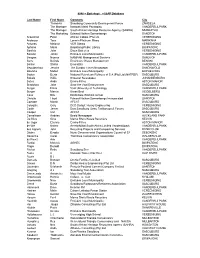
8848 – Boitshepi – I&AP Database Last Name First Name Company
8848 – Boitshepi – I&AP Database Last Name First Name Company City Thandeka Sasolburg Community Developemnt Forum ZAMDELA The Manager Nampak Metal Packaging VANDERBIJLPARK The Manager South African Heritage Resource Agency (SAHRA) MMABATHO The Marketing Edward Nathan Sonnenbergs SANDTON Ackerman PMeaterna ger African Cables (Pty) Ltd VEREENIGING Anderson Tara Lonmin Platinum Mines MARIKANA Antunes Melanie VCR Stereo VEREENIGING Aphane Maria Boipatong Public Library BOIPATONG Banfield John Dixon Batteries VEREENIGING Basson Johan Emfuleni Local Municipality VANDERBIJLPARK Bengani Nomsa NAMPAK Management Services SANDTON Berry Belinda Enviroserv Waste Management BENONI Bester Stefan EnviroBits VANDERBIJLPARK Bezuidenhout Jessica The Sunday Times Newspaper SAXONWOLD Biketsha Mabuli Emfuleni Local Municipality BOPHELONG Boden Denis National Petroleum Refiners of S A (Pty) Ltd (NATREF) SASOLBURG Bokala Willie Sowetan Newspaper JOHANNESBURG Botes Andre Enviro-Fill cc ASTON MANOR Bradshaw John Save the Vaal Environment SASOLBURG Burger Elmie Vaal University of Technology VANDERBIJLPARK Burger Marcia Karan Beef HEIDELBERG Cave Billy Itshokolele Working Group SASOLBURG Christie Lloyd Edward Nathan Sonnenbergs Incorporated SANDTON Coetzee Martin AFCAT SASOLBURG Colegate Gary DCD Dorbyl: Heavy Engineering VEREENIGING Cooks James Dow Sasolburg (Leeu Taaibosspruit Forum) SASOLBURG Cooper Ivan AFCAT SASOLBURG Cornelissen Andries Beeld Newspaper AUCKLAND PARK Da Silva Gina Mama She's Waste Recyclers KELVIN de Jager Etienne Enviro-Fill cc ASTON MANOR -

Labeo Capensis (Orange River Mudfish) Ecological Risk Screening Summary
Orange River Mudfish (Labeo capensis) Ecological Risk Screening Summary U.S. Fish & Wildlife Service, 2014 Revised, May and July 2019 Web Version, 9/19/2019 Image: G. A. Boulenger. Public domain. Available: https://archive.org/stream/catalogueoffres01brit/catalogueoffres01brit. (July 2019). 1 Native Range and Status in the United States Native Range From Froese and Pauly (2019): “Africa: within the drainage basin of the Orange-Vaal River system [located in Lesotho, Namibia, and South Africa] to which it is possibly restricted. Hitherto thought to occur in the Limpopo system and in southern Cape watersheds [South Africa] which records may be erroneous.” From Barkhuizen et al. (2017): “Native: Lesotho; Namibia; South Africa (Eastern Cape Province - Introduced, Free State, Gauteng, Mpumalanga, Northern Cape Province, North-West Province)” 1 Status in the United States This species has not been reported as introduced or established in the United States. There is no indication that this species is in trade in the United States. Means of Introductions in the United States This species has not been reported as introduced or established in the United States. Remarks A previous version of this ERSS was published in 2014. 2 Biology and Ecology Taxonomic Hierarchy and Taxonomic Standing From ITIS (2019): “Kingdom Animalia Subkingdom Bilateria Infrakingdom Deuterostomia Phylum Chordata Subphylum Vertebrata Infraphylum Gnathostomata Superclass Actinopterygii Class Teleostei Superorder Ostariophysi Order Cypriniformes Superfamily Cyprinoidea Family Cyprinidae Genus Labeo Species Labeo capensis (Smith, 1841)” From Fricke et al. (2019): “Current status: Valid as Labeo capensis (Smith 1841). Cyprinidae: Labeoninae.” Size, Weight, and Age Range From Froese and Pauly (2019): “Max length : 50.0 cm FL male/unsexed; [de Moor and Bruton 1988]; common length : 45.0 cm FL male/unsexed; [Lévêque and Daget 1984]; max. -
Literature Review and Terms of Reference for Case Study For
Literature Review and Terms of Reference for Case Study for Linking the Setting of Water Quality License Conditions with Resource Quality Objectives and/or Site-Specific Conditions in the Vaal Barrage Area and Associated Rivers within the Lower Sections of the Upper Vaal River Catchment Report to the Water Research Commission By ON Odume, N. Griffin and PK Mensah Unilever Centre for Environmental Water Quality Institute for Water Research, Rhodes University P.O. Box 94 Grahamstown, 6140 Report no. 2782/1/17 ISBN 978-1-4312-0950-7 January 2018 Obtainable from Water Research Commission Private Bag X03 Gezina 0031 South Africa orders@wrc.org.za or dowload form www.wrc.org.za DISCLAIMER This report has been reviewed by the Water Research Commission (WRC) and approved for publication. Approval does not signify that the contents necessarily reflect the views and policies of the WRC, nor does mention of trade names or commercial products constitute endorsement or recommendation for use. © Water Research Commission ii EXECUTIVE SUMMARY In a recent study of the Vaal Catchment, the WRC, DWS and major industries agreed that there are identified challenges in the approaches used to setting applicable water use license conditions, including discharge quality specifications, which do not take all stakeholder and ecological requirements into consideration. There were concerns from stakeholders regarding how the license conditions are set and used to achieve the set Resource Quality Objectives (RQOs) and how to improve the resource class to a desired class. It was clear that both regulators and users have no clear understanding of the link between Source Directed Controls (SDCs) and Resource Directed Measures (RDMs), and how they inform each other. -

Rivers of South Africa Hi Friends
A Newsletter for Manzi’s Water Wise Club Members May 2016 Rivers of South Africa Hi Friends, This month we are exploring our rivers. We may take them for granted but they offer us great services. Rivers provide a home and food to a variety of animals. You will find lots of plants, insects, birds, freshwater animals and land animals near and in a river. You can say rivers are rich with different kinds of living things. These living things play different roles such as cleaning the river and providing food in the river for other animals. Rivers carry water and nutrients and they play an important part in the water cycle. We use rivers for water supply which we use for drinking, in our homes, watering in farms, making products in factories and generating electricity. Sailing, taking goods from one place to another and water sports such as swimming, skiing and fishing happens in most rivers. Have you ever wondered where rivers begin and end? Well friends, rivers begin high in the mountains or hills, or where a natural spring releases water from underground. They usually end by flowing into the ocean, sea or lake. The place where the river enters the ocean, sea or lake is called the mouth of the river. Usually there are lots of different living things there. Some rivers form tributaries of other rivers. A tributary is a stream or river that feeds into a larger stream or river. South Africa has the following major rivers: . Orange River (Lesotho, Free State & Northern Cape Provinces), Limpopo River (Limpopo Province), Vaal River (Mpumalanga, Gauteng, Free State & Northern Cape Provinces), Thukela River reprinted with permission withreprinted (Kwa-Zulu Natal Province), Olifants River – (Mpumalanga & Limpopo Provinces), Vol. -

The Times History of the War in South Africa, 1899-1902;
aia of The War in South Africa of The War in South Africa 1899-1902 Edited by L. S. Amery Fellow of All Souls With many Photogravure and other Portraits, Maps and Battle Plans Vol. VII Index and Appendices LONDON SAMPSON Low, MARSTON AND COMPANY, LTD. loo, SOUTHWARK STREET, S.E. 1909 LONDON : PRINTED BY WILLIAM CLOWES AND SONS, LIMITED, DUKE STREET, STAMFORD STREET, S.E., AND GREAT WINDMILL STREET, W PREFACE THE various appendices and the index which make up the present volume are the work of Mr. G. P. Tallboy, who has acted as secretary to the History for the last seven years, and whom I have to thank not only for the labour and research comprised in this volume, but for much useful assistance in the past. The index will, I hope, prove of real service to students of the war. The general principles on which it has been compiled are those with which the index to The Times has familiarized the public. The very full bibliography which Mr. Tallboy has collected may give the reader some inkling of the amount of work involved in the composition of this history. I cannot claim to have actually read all the works comprised in the list, though I think there are comparatively few among them that have not been consulted. On the other hand the list does not include the blue-books, despatches, magazine and newspaper articles, and, above all, private diaries, narratives and notes, which have formed the real bulk of my material. L. S. AMERY. CONTENTS APPENDIX I PAGE. -

Emfuleni Steeling the River City?
EMFULENI STEELING THE RIVER CITY? Joburg Metro Building, 16th floor, 158 Loveday Street, Braamfontein 2017 Tel: +27 (0)11-407-6471 | Fax: +27 (0)11-403-5230 | email: info@sacities.net | www.sacities.net CONTENTS 1. Introduction 6 2. The iron ore and steel industry value chain 9 2.1 Mining of iron ore and the scrap metal system 9 2.2 Steel production and the steel market 9 2.3 Concluding comments and the future of the iron ore and steel industry 12 3. Historical perspective on Emfuleni 14 4. Demographic and economic analysis 19 4.1 Demographic analysis 19 4.1.1 Urbanisation and in-migration 19 4.1.2 Population age distribution 21 4.1.3 Daily commuting to Johannesburg 22 4.2 Economic and development profile 23 4.2.1 Economic profile 23 4.2.2 The manufacturing industry in Emfuleni 27 4.2.3 Income poverty 31 4.2.4 Human Development Index 33 4.2.5 Gini coefficient 34 4.3 Synthesis 34 5. Business environment 35 5.1 Business profile 35 5.2 ArcelorMittal 35 5.3 DAV steel (Cape Gate Pty Ltd) 37 5.4 DCD ringrollers 38 5.5 Downstreaming in the steel industry 38 5.6 Business / local government relations 38 5.7 Synthesis 40 6. Municipal responses 40 6.1 The Integrated Development Plan and LED plans 40 6.2 Spatial planning 42 6.2.1 Spatial planning pressures 43 i 6.2.2 The river city concept 44 6.2.3 Land use regulations 44 6.2.4 Student housing 45 6.2.5 Desegregation 45 6.2.6 The provision of RDP housing units 45 6.2.7 CBD development 46 6.2.8 Spatial planning: A synthesis 46 6.3 Municipal governance and management 47 6.4 Municipal engineering services 48 6.4.1 Water 48 6.4.2 Sanitation 49 6.4.3 Electricity 50 6.5 Municipal finance 50 6.5.1 Auditor-General findings 51 6.5.2 Income 52 6.5.3 Expenditure 54 6.5.4 Comparing Emfuleni with other areas 55 6.6 Service delivery protests 56 6.7 Social relations 57 7. -

A Case Study of Sanitation Governance in the Emfuleni Local Municipality
CuDyWat Report 2/2019 North-West University Vanderbijlpark South Africa 21 August 2019 Version 1.6 The Anthropocene and the hydrosphere A case study of sanitation governance in Emfuleni Local Municipality (2018-19) By Johann Tempelhoff Hilda Jaka Sanjay Mahabir Martin Ginster CuDyWat Annika Kruger Njabulo Mthembu Report 2/2019 Lerato Nkomo North-West University Version 3.0 2 September 2019 0 1 Table of Contents Acknowledgements ............................................................................................................. iv Summary .............................................................................................................................. v Lessons for practitioners .....................................................................................................vii Keywords ................................................................................................................................... viii Introduction ......................................................................................................................... 1 Theoretical and methodological considerations (not necessarily the exact wording of the section) ......................................................................................................................................... 5 Grassroots participation .......................................................................................................................... 5 Wastewater leadership sector section ....................................................................................................