Billy Sol Estes a Texas Legend by Billie Sol Estes (2005).Pdf
Total Page:16
File Type:pdf, Size:1020Kb
Load more
Recommended publications
-

Supreme Court of the United States Billie Sol ESTES, Petitioner, V
85 S.Ct. 1628 Page 1 381 U.S. 532, 85 S.Ct. 1628, 14 L.Ed.2d 543, 1 Media L. Rep. 1187 (Cite as: 381 U.S. 532, 85 S.Ct. 1628) 92 Constitutional Law 92XXVII Due Process Supreme Court of the United States 92XXVII(H) Criminal Law Billie Sol ESTES, Petitioner, 92XXVII(H)4 Proceedings and Trial v. 92k4603 Public Trial STATE OF TEXAS. 92k4605 k. Publicity. Most Cited Cases No. 256. (Formerly 92k268(7), 92k268) Argued April 1, 1965. Decided June 7, 1965. Criminal Law 110 633.16 Rehearing Denied Oct. 11, 1965. 110 Criminal Law See 86 S.Ct. 18. 110XX Trial 110XX(B) Course and Conduct of Trial in The defendant was convicted in the District General Court for the Seventh Judicial District of Texas at 110k633.16 k. Cameras, Recording Tyler for swindling. The conviction was affirmed Devices, Sketches, and Drawings. Most Cited by the Texas Court of Criminal Appeals. Certiorari Cases was granted. The Supreme Court held that defend- (Formerly 110k633(1), 92k268(7), 92k268) ant was deprived of his right under the Fourteenth Amendment to due process by the televising of his Defendant was deprived of his right under the notorious, heavily publicized and highly sensational Fourteenth Amendment to due process by the tele- criminal trial. vising of his notorious, heavily publicized and highly sensational criminal trial. U.S.C.A.Const. Reversed. Amend. 14. Mr. Chief Justice Warren filed concurring [2] Criminal Law 110 635.2 opinion in which Mr. Justice Douglas and Mr. Justice Goldberg joined. 110 Criminal Law 110XX Trial Mr. -

Honest John Williams
Honest John Williams • .,;,.J:1-· . ,· \ •' U.S. Senator from Delaware Carol E. Hoffecker Senator John J. Williams. Photograph by Robert Gifford. Courtesy of the University of Delaware Library. HONEST JOHN WILLIAMS U.S. Senator from Delaware Carol E. Hoffecker ............... DElAWARE Newark: University of Delaware Press London: Associated University Presses © 2000 by Associated University Presses, Inc. All rights reserved. Authorization to photocopy items for internal or personal use, or the internal or personal use of specific clients, is granted by the copyright owner, provided that a base fe e of $10.00, plus eight cents per page, per copy is paid di rectly to the Copyright Clearance Center, 222 Rosewood Drive, Danvers, Massa chusetts 01923. [0-87413-713-6/00 $10.00 + 8¢ pp, pc.] Other than as indicated in the foregoing, this book may not be reproduced, in whole or in part, in any form (except as permitted by Sections 107 and 108 of the U.S. Copyright Law, and ex- cept for brief quotes appearing in reviews in the public press). Associated University Presses 440 Forsgate Drive Cranbury, NJ 085 12 Associated University Presses 16 Barter Street London WC 1A 2AH, England Associated University Presses P.O. Box 338, Port Credit Mississauga, Ontario Canada L5G 4L8 The paper used in this publication meets the requirements of the American National Standard for Permanence of Paper for Printed Library Materials Z39.48- 1984. Library of Congress Cataloging-in-Publication Data Hoffecker, Carol E. Honest John Williams : U.S. senator from Delaware I Carol E. Hoffecker. p. cm.-(Cultural studies of Delaware and the Eastern Shore) Includes bibliographical references and index. -

"Missed" by Hsca
COVERUPS! Number 16 Gary Mack, Editor & Publisher May, 1984 IMPORTANT PHOTO "MISSED" BY HSCA by Gary Mack A long-ignored picture, taken by Dallas Morning News photographer Clint Grant from Press Car 2, of- fers the clearest view yet of the two most suspicious witnesses to the Kennedy assassination. Incredibly, the original black and white negative was in the possession of HSCA investigators who failed to note it's significance. We now know that one man was black, wore a dark- colored cap or beret, had extremely short hair or was bald, and wore glasses. And underneath his jacket was a mysterious object. The other witness is not inconsis- tent with Louie Steven Witt, the man accepted by the HSCA as the Umbrella Man. The Witt controversy, whether he really was the Um- brella Man, is as strong today as when he first surfaced in July 1978. And that, too, was the result of a similar photograph that was "overlooked." One Sunday afternoon early in 1978, HSCA photo consultant Robert Groden noticed some pictures in a Committee office. They were to be returned to Time/Life the next day, even though he had not seen them! Included were Dealey Plaza scenes taken by Art Rickerby, the second of which showed the Umbrella Man's face. Robert quickly notified Committee staff- ers, pointing out this was the only known picture with a clear view of the man's features (Black Man was block- ed from sight by AP photographer James Altgens). 2 That summer the HSCA decided to go public with said he didn't remember talking with anyone; he admit- photographs of several people it wanted identified. -
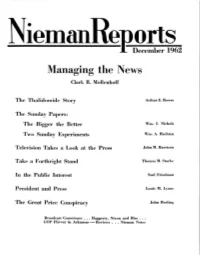
Managing the News Clark R
1eman• orts -December 1962 Managing the News Clark R. Mollenhoff The Thalidomide Story Arthur E. Rowse The Sunday Papers: The Bigger the Better W m. I. Nichols Two Sunday Experiments Wm. A. Hachten Television Takes a Look at the Press John M. Harrison Take a Forthright Stand Thomas M. Storke In the Public Interest Saul Friedman President and Press Louis M. Lyons The Great Price Conspiracy John Herling Broadcast Conscience ••• Haggerty, Nixon and Hiss •.. GOP Flivver in Arkansas- Reviews •.• Nieman Notes 2 NIEMAN REPORTS to join the correspondents his fast footwork hadn't put off. He came out for the full B.ow of the news. If the rules got in the way, they'd change the rules. This was a NiemanRe:ports notable public incident. Few, if any, previous Presidents would have had the complete awareness of the problem VOL. XVI., NO. 4 DECEMBER 1962 to manage it as shrewdly, yet, finally, as satisfactorily. He defended the practices of his Administration in the clutch Nieman Reports is published by the Nieman Alumni Council. of the Cuban affair without denying the principle that the Published quarterly from 44 Holyoke House, Cambridge 38, Mass. Subscription $3 a year. Second-class postage paid at Boston, persistent correspondents kept defining until it stuck. They Massachusetts. wisely refrained from further rebuttal in the President's own arena. Yet they were, of course, aware of relevant Press and President points that could be made. In his extended colloquy with the reporters at his No The President said correspondents could not be al vember 20th press conference, the President came out lowed on Guantanamo because it was a danger spot. -

The Watergate Cover-Up Trial: Justice Denied? - Politics - the Atlantic Page 1 of 12
The Watergate Cover-Up Trial: Justice Denied? - Politics - The Atlantic Page 1 of 12 SUBSCRIBE RENEW GIVE A GIFT DIGITAL EDWtON Print I Close The Watergate Cover-Up Trial: Justice Denied? By Geoff Shepard A courtroom sketch shows the scene on March 9, 1974, as Judge John Sirica faced the seven men being arraigned on charges stemming from their alleged involvement in the Watergate affair, including John Ehrlichman, left; H.R. Haldeman, second from left; and John Mitchell, second from right. (Associated Press) Foul deeds will rise, though all the earth o’erwhelm them, to men’s eyes. -- William IShakespeare, Hamlet Watergate remains the greatest political scandal in modern American history. It culminated not only in President Nixon’s announcement of his resignation, 39 years ago Thursday, but in the conviction and imprisonment of his three most senior aides. Attorney General John Mitchell, White House Chief of Staff H.R. Haldeman, and Assistant to the President for Domestic Affairs John Ehrliehman were found guilty of conspiracy, obstruction of justice, and perjury in the three-month Watergate cover-up trial, which ended on January 1, 1975. I saw it all unfold. I was a young lawyer working on the White House staff and assisting in Nixon’s defense efforts. It is true that we failed spectacularly. Of course, I’m disappointed we weren’t more successful. But whether the defendants were innocent or guilty, I’ve always worried on a more basic level that the heightened emotions of the times denied them the due process of law envisioned by our Constitution. -

Do We Want a Responsible Press?: a Call for the Creation of Self-Regulatory Mechanisms Robert J
William Mitchell Law Review Volume 8 | Issue 1 Article 1 1982 Do We Want a Responsible Press?: A Call for the Creation of Self-regulatory Mechanisms Robert J. Sheran Barbara S. Isaacman Follow this and additional works at: http://open.mitchellhamline.edu/wmlr Recommended Citation Sheran, Robert J. and Isaacman, Barbara S. (1982) "Do We Want a Responsible Press?: A Call for the Creation of Self-regulatory Mechanisms," William Mitchell Law Review: Vol. 8: Iss. 1, Article 1. Available at: http://open.mitchellhamline.edu/wmlr/vol8/iss1/1 This Article is brought to you for free and open access by the Law Reviews and Journals at Mitchell Hamline Open Access. It has been accepted for inclusion in William Mitchell Law Review by an authorized administrator of Mitchell Hamline Open Access. For more information, please contact sean.felhofer@mitchellhamline.edu. © Mitchell Hamline School of Law Sheran and Isaacman: Do We Want a Responsible Press?: A Call for the Creation of Self- DO WE WANT A RESPONSIBLE PRESS?: A CALL FOR THE CREATION OF SELF-REGULATORY MECHANISMS ROBERT J. SHERANt & BARBARA S. ISAACMANt The frst amendment guarantee of afree press has never been more impor- tant to American society. The guarantee offleedom of expression now extends beyond the printedpage to the airwaves of radio and television broadcasting. The media in this electronicage wield unprecedentedpower to infuence public opinion. For the most part the media have admirably fl4filled their role as society's eyes and ears, acting as watchdog over gov- ernmental deeds and misdeeds. In recent years, however, abuses of this first amendment privilege have causedmany to view the media as an arro- gant, self-righteous institution, insensitive to the rights and interests of others.