Bohove Starych Slovanu Cz 130X200 DO TLACE.Indd
Total Page:16
File Type:pdf, Size:1020Kb
Load more
Recommended publications
-

Shamanic Wisdom, Parapsychological Research and a Transpersonal View: a Cross-Cultural Perspective Larissa Vilenskaya Psi Research
International Journal of Transpersonal Studies Volume 15 | Issue 3 Article 5 9-1-1996 Shamanic Wisdom, Parapsychological Research and a Transpersonal View: A Cross-Cultural Perspective Larissa Vilenskaya Psi Research Follow this and additional works at: http://digitalcommons.ciis.edu/ijts-transpersonalstudies Part of the Philosophy Commons, Psychology Commons, and the Religion Commons Recommended Citation Vilenskaya, L. (1996). Vilenskaya, L. (1996). Shamanic wisdom, parapsychological research and a transpersonal view: A cross-cultural perspective. International Journal of Transpersonal Studies, 15(3), 30–55.. International Journal of Transpersonal Studies, 15 (3). Retrieved from http://digitalcommons.ciis.edu/ijts-transpersonalstudies/vol15/iss3/5 This work is licensed under a Creative Commons Attribution-Noncommercial-No Derivative Works 4.0 License. This Article is brought to you for free and open access by the Journals and Newsletters at Digital Commons @ CIIS. It has been accepted for inclusion in International Journal of Transpersonal Studies by an authorized administrator of Digital Commons @ CIIS. For more information, please contact digitalcommons@ciis.edu. SHAMANIC WISDOM, PARAPSYCHOLOGICAL RESEARCH AND A TRANSPERSONAL VIEW: A CROSS-CULTURAL ' PERSPECTIVE LARISSA VILENSKAYA PSI RESEARCH MENLO PARK, CALIFORNIA, USA There in the unbiased ether our essences balance against star weights hurled at the just now trembling scales. The ecstasy of life lives at this edge the body's memory of its immutable homeland. -Osip Mandelstam (1967, p. 124) PART I. THE LIGHT OF KNOWLEDGE: IN PURSUIT OF SLAVIC WISDOM TEACHINGS Upon the shores of afar sea A mighty green oak grows, And day and night a learned cat Walks round it on a golden chain. -

Revista Inclusiones Issn 0719-4706 Volumen 7 – Número Especial – Octubre/Diciembre 2020
CUERPO DIRECTIVO Mg. Amelia Herrera Lavanchy Universidad de La Serena, Chile Director Dr. Juan Guillermo Mansilla Sepúlveda Mg. Cecilia Jofré Muñoz Universidad Católica de Temuco, Chile Universidad San Sebastián, Chile Editor Mg. Mario Lagomarsino Montoya OBU - CHILE Universidad Adventista de Chile, Chile Editor Científico Dr. Claudio Llanos Reyes Dr. Luiz Alberto David Araujo Pontificia Universidad Católica de Valparaíso, Chile Pontificia Universidade Católica de Sao Paulo, Brasil Dr. Werner Mackenbach Editor Europa del Este Universidad de Potsdam, Alemania Dr. Aleksandar Ivanov Katrandzhiev Universidad de Costa Rica, Costa Rica Universidad Suroeste "Neofit Rilski", Bulgaria Mg. Rocío del Pilar Martínez Marín Cuerpo Asistente Universidad de Santander, Colombia Traductora: Inglés Ph. D. Natalia Milanesio Lic. Pauline Corthorn Escudero Universidad de Houston, Estados Unidos Editorial Cuadernos de Sofía, Chile Dra. Patricia Virginia Moggia Münchmeyer Portada Pontificia Universidad Católica de Valparaíso, Chile Lic. Graciela Pantigoso de Los Santos Editorial Cuadernos de Sofía, Chile Ph. D. Maritza Montero Universidad Central de Venezuela, Venezuela COMITÉ EDITORIAL Dra. Eleonora Pencheva Dra. Carolina Aroca Toloza Universidad Suroeste Neofit Rilski, Bulgaria Universidad de Chile, Chile Dra. Rosa María Regueiro Ferreira Dr. Jaime Bassa Mercado Universidad de La Coruña, España Universidad de Valparaíso, Chile Mg. David Ruete Zúñiga Dra. Heloísa Bellotto Universidad Nacional Andrés Bello, Chile Universidad de Sao Paulo, Brasil Dr. Andrés Saavedra Barahona Dra. Nidia Burgos Universidad San Clemente de Ojrid de Sofía, Bulgaria Universidad Nacional del Sur, Argentina Dr. Efraín Sánchez Cabra Mg. María Eugenia Campos Academia Colombiana de Historia, Colombia Universidad Nacional Autónoma de México, México Dra. Mirka Seitz Dr. Francisco José Francisco Carrera Universidad del Salvador, Argentina Universidad de Valladolid, España Ph. -

Pagan Beliefs in Ancient Russia. by Luceta Di Cosimo, Barony Marche of the Debatable Lands, Aethelmearc
1 Pagan Beliefs in Ancient Russia. By Luceta di Cosimo, Barony Marche of the Debatable Lands, Aethelmearc. lucetadicosimo@yahoo.com ©2006-2017 Slavic mythology is a difficult subject. The historical evidence is fragmented, with many conflicting sources and multiple later literary inventions. This is a brief reconstruction of ancient Russian mythology. The first archaeological findings that can be attributed to Slavs date to approximately 6th c. AD. The origins of Slavs are still debated. The pagan Slavic society was an oral society. Christianity, which introduced writing, was more concerned with eradication rather than preservation of pagan beliefs. No one really tried to preserve and record whatever remained, until late period. Then, there is some evidence recorded from the Germans who visited Russia in 18th c., but a lot of it is based on the written 15thc. sources, rather than eyewitness accounts. The 19th c. Europe saw renewed interest in folklore, and combined with rise of nationalism and need for developed mythos, a lot of what was left was recorded, but a lot was altered to make it more palatable, and questionable things (especially with fertility rituals) were edited out as not to besmirch the emerging national character. During the Soviet time, the study of any religion was problematic, due to mandatory atheism. Eventually, the study of the early Slavic traditions was permitted, and even encouraged, but, everything had to pass stringent censorship rules, and could not contradict Marxist-Leninist philosophy. So, people who had the material (in the USSR) could not publish, and people who actually could publish (in the West) did not have access to the materials. -

Slavic Pagan World
Slavic Pagan World 1 Slavic Pagan World Compilation by Garry Green Welcome to Slavic Pagan World: Slavic Pagan Beliefs, Gods, Myths, Recipes, Magic, Spells, Divinations, Remedies, Songs. 2 Table of Content Slavic Pagan Beliefs 5 Slavic neighbors. 5 Dualism & The Origins of Slavic Belief 6 The Elements 6 Totems 7 Creation Myths 8 The World Tree. 10 Origin of Witchcraft - a story 11 Slavic pagan calendar and festivals 11 A small dictionary of slavic pagan gods & goddesses 15 Slavic Ritual Recipes 20 An Ancient Slavic Herbal 23 Slavic Magick & Folk Medicine 29 Divinations 34 Remedies 39 Slavic Pagan Holidays 45 Slavic Gods & Goddesses 58 Slavic Pagan Songs 82 Organised pagan cult in Kievan Rus' 89 Introduction 89 Selected deities and concepts in slavic religion 92 Personification and anthropomorphisation 108 "Core" concepts and gods in slavonic cosmology 110 3 Evolution of the eastern slavic beliefs 111 Foreign influence on slavic religion 112 Conclusion 119 Pagan ages in Poland 120 Polish Supernatural Spirits 120 Polish Folk Magic 125 Polish Pagan Pantheon 131 4 Slavic Pagan Beliefs The Slavic peoples are not a "race". Like the Romance and Germanic peoples, they are related by area and culture, not so much by blood. Today there are thirteen different Slavic groups divided into three blocs, Eastern, Southern and Western. These include the Russians, Poles, Czechs, Ukrainians, Byelorussians, Serbians,Croatians, Macedonians, Slovenians, Bulgarians, Kashubians, Albanians and Slovakians. Although the Lithuanians, Estonians and Latvians are of Baltic tribes, we are including some of their customs as they are similar to those of their Slavic neighbors. Slavic Runes were called "Runitsa", "Cherty y Rezy" ("Strokes and Cuts") and later, "Vlesovitsa". -
'Standardized Chapel Library Project' Lists
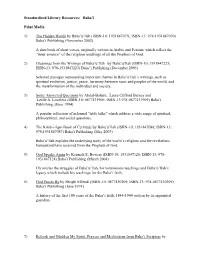
Standardized Library Resources: Baha’i Print Media: 1) The Hidden Words by Baha’u’llah (ISBN-10: 193184707X; ISBN-13: 978-1931847070) Baha’i Publishing (November 2002) A slim book of short verses, originally written in Arabic and Persian, which reflect the “inner essence” of the religious teachings of all the Prophets of God. 2) Gleanings from the Writings of Baha’u’llah by Baha’u’llah (ISBN-10: 1931847223; ISBN-13: 978-1931847223) Baha’i Publishing (December 2005) Selected passages representing important themes in Baha’u’llah’s writings, such as spiritual evolution, justice, peace, harmony between races and peoples of the world, and the transformation of the individual and society. 3) Some Answered Questions by Abdul-Baham, Laura Clifford Barney and Leslie A. Loveless (ISBN-10: 0877431906; ISBN-13 978-0877431909) Baha’i Publishing, (June 1984) A popular collection of informal “table talks” which address a wide range of spiritual, philosophical, and social questions. 4) The Kitab-i-Iqan Book of Certitude by Baha’u’llah (ISBN-10: 1931847088; ISBN-13: 978:1931847087) Baha’i Publishing (May 2003) Baha’u’llah explains the underlying unity of the world’s religions and the revelations humankind have received from the Prophets of God. 5) God Speaks Again by Kenneth E. Bowers (ISBN-10: 1931847126; ISBN-13: 978- 1931847124) Baha’i Publishing (March 2004) Chronicles the struggles of Baha’u’llah, his voluminous teachings and Baha’u’llah’s legacy which include his teachings for the Baha’i faith. 6) God Passes By by Shoghi Effendi (ISBN-10: 0877430209; ISBN-13: 978-0877430209) Baha’i Publishing (June 1974) A history of the first 100 years of the Baha’i faith, 1844-1944 written by its appointed guardian. -

Russian Neo-Pagan Myths and Antisemitism
Victor A. Shnirelman Institute of Ethnology and Anthropology, Russian Academy of Sciences RUSSIAN NEO-PAGAN MYTHS AND ANTISEMITISM Abstract Russian Neo-paganism is one branch of contemporary Russian nationalism which emerged and developed in the 1970s - 1990s. Its ideology is based on the glorification of the pre-Christian Russian past and accuses Christianity of the brutal destruction of the legacy of the Great Ancestors. At the same time, Christianity is treated as an evil ideology created by Jews in order to establish their own dominance in the world and the subjugation of all peoples. Russian Neo-paganism is in fact rooted in Nazi-style rhetoric full of latent or open antisemitism. This paper discusses the ideol- ogy and its political implications. Contemporary Russian Nationalism and Neo-paganism In November 1995, the Moscow newspaper «Moskovskii komsomolets» informed readers of the establishment of the Pagan community there with its own folklore, cults, and rituals. Well, one more cult, a reader could say, already tired of endless information about numerous exotic religions competing for space in contemporary Russia. True, one can appreciate that pluralism a principle long accepted in democracies - has come to the Russian religious sphere. However, on February 10, 1996, the meeting of the National Republican Party in Saint-Petersburg decided to support the lead- er of the Communist Party of the Russian Federation (CPRF), Gennadii A. Ziuganov, in the presi- dential elections scheduled for June 1996. What could be in common between the Neo-pagans (who claim to be dissociated from politics) and a political party which represents an extremist wing of the contemporary Russian nationalist movement? - Nothing, save that at the December 1994 meeting of this party, its newly-elected leader Yuri Beliaev (a favourite student of Viktor N. -

Revue Des Études Slaves, LXXXVIII-4 | 2017 Boris Oguibénine, L’Héritage Du Lexique Indo-Européen Dans Le Vocabulaire Rus
View metadata, citation and similar papers at core.ac.uk brought to you by CORE provided by OpenEdition Revue des études slaves LXXXVIII-4 | 2017 1914, l’Autriche-Hongrie entre en guerre : récits de soldats et de civils Boris OGUIBÉNINE, L’héritage du lexique indo-européen dans le vocabulaire russe. Première série : compléments au dictionnaire étymologique de la langue russe de Max Vasmer Paris, Institut d’études slaves, 2016, 396 pages Anatoly Liberman Édition électronique URL : http://journals.openedition.org/res/1332 ISSN : 2117-718X Éditeur Institut d'études slaves Édition imprimée Date de publication : 31 décembre 2017 Pagination : 837-840 ISBN : 978-2-7204-0553-2 ISSN : 0080-2557 Référence électronique Anatoly Liberman, « Boris OGUIBÉNINE, L’héritage du lexique indo-européen dans le vocabulaire russe. Première série : compléments au dictionnaire étymologique de la langue russe de Max Vasmer », Revue des études slaves [En ligne], LXXXVIII-4 | 2017, mis en ligne le 30 novembre 2018, consulté le 19 avril 2019. URL : http://journals.openedition.org/res/1332 Ce document a été généré automatiquement le 19 avril 2019. Revue des études slaves Boris Oguibénine, L’héritage du lexique indo-européen dans le vocabulaire rus... 1 Boris OGUIBÉNINE, L’héritage du lexique indo-européen dans le vocabulaire russe. Première série : compléments au dictionnaire étymologique de la langue russe de Max Vasmer Paris, Institut d’études slaves, 2016, 396 pages Anatoly Liberman RÉFÉRENCE Boris OGUIBÉNINE, L’héritage du lexique indo-européen dans le vocabulaire russe. Première série : compléments au dictionnaire étymologique de la langue, Paris, Institut d’études slaves, 2016, 396 p. ISBN 978-2-7204-0546-4 1 People never stop asking questions about word origins, and publishers try to satisfy their curiosity. -
CODEX SLAVORUM by Brian N
CODEX SLAVORUM BY BRIAN N. YOUNG EDITOR: LIBBIE OKEY FRONT COVER: PETER BRADLEY INTERIOR ART: PETER BRADLEY, JASON WALTON ART DIRECTION/ CARTOGRAPHY: PETER BRADLEY PRODUCED BY: THE CHENAULT BROTHERS 1818 North Taylor, #143, Little Rock, AR, 72207 email: troll@trolllord.com // website: www.trolllord.com // www.castlesandcrusades.com ©2016 Troll Lord Games. All Rights Reserved. Castles & Crusades® is a registered Trademark of Chenault & Gray Publishing LLC, d/b/a Troll Lord Games. SIEGE Engine™ is Trademark of Chenault & Gray Publishing LLC, d/b/a Troll Lord Games. Amazing Adventures is a Trademark of Chenault & Gray Publishing, d/b/a Troll Lord Games. The Troll Lord Games, Castles & Crusades, SIEGE Engine, Amazing Adventures and Troll Lord Games logos are Trademarks of Troll Lord Games. All Rights Reserved. 2016. Art, artwork, cover art, cartography is copyright Peter Bradley of Ravenchilde Illustrations, 2016 or Troll Lord Games. All Rights Reserved. All content copyright 2016 Troll Lord Games. All Rights Reserved. SampleFirst Printing file Printed in the United States of America Sample file TABLE OF CONTENTS CHAPTER 1: IN BYGONE YEARS 6 FROM MISTY HISTORY TO BYZANTIUM 6 THE EARLY SLAVS 6 THE WIDE WORLD & ALL BELOW IT 9 CHAPTER 2: THE WHOLE WORLD & THAT WHICH IS BEYOND 14 THE MYTHIC REALMS 21 MAGICAL ISLES 24 CHAPTER3: DID DWELL MANY PEOPLES 26 MONSTERS 26 THE MAGICAL BORN 48 ZMAJEVIT – THE DRAGON BORN 48 Zduhać – The elemenTal One 50 VAMPIRDZHIJA – THE VAMPIRE HUNTER 53 CHAPTER 4: FILLED WITH GREAT MAGIC 57 THE KOLDUNY (INTELLIGENCE) -

Slavic Journeys to the Otherworld. Remarks on the Eschatology of Early Medieval Pomeranians
Slavic Journeys to the Otherworld. Remarks on the Eschatology of Early Medieval Pomeranians Kamil Kajkowski Many obstacles appear in attempts at explore and reconstruct the pagan rituals and beliefs of early medieval Pomeranians. This is not only due to the lack of written accounts referring to such practices, but also because of the various problems with unravelling the meaning and content of the archaeological evidence. Today, it is often difficult to determine how certain places or objects were perceived by past societies and with what symbolism they had been imbued. The burial finds are equally problematic since, while excavating cemeteries, we discover only the final result of the complex funerary process, i.e. the grave. Therefore, a question arises as to whether the material remains found at cemeteries could allow for revealing such abstract and subtle matters as eschatological beliefs. In an attempt to reconstruct the Slavic vision of the Otherworld, this paper will examine in detail the no- tions of the soul (spirit) and the meaning of grave-goods. Keywords: Slavs, Pomeranians, Early Middle Ages, funerary practices, soul and spirit, grave-goods. Death Various beliefs concerning death and dying are deeply rooted in human conscious- ness and belong to the most archaic cultural phenomena. In every society, the sphere of beliefs and eschatological concepts is regarded as the oldest and most basic form of reli- gious expression (Potkowski 1973: 7). Practically every mythological system known today regards death as a process of initiation, transition or human transformation. Mythological accounts also empahsise its uniqueness and ability to mirror all other forms of existence (Trzciński 2006: 40). -
Glassford-Rachel-Thesis.Pdf
DEATH OBJECTIFIED, LIFE AFFIRMED: MORTALITY AND MATERIALISM IN RUSSIAN FOLKTALES FEATURING KOSCHEI THE DEATHLESS HONORS THESIS Presented to the Honors College of Texas State University in Partial Fulfillment of the Requirements for Graduation in the Honors College by Rachel Glassford San Marcos, Texas November 2018 DEATH OBJECTIFIED, LIFE AFFIRMED: MORTALITY AND MATERIALISM IN RUSSIAN FOLKTALES FEATURING KOSCHEI THE DEATHLESS by Rachel Glassford Thesis Supervisor: ________________________________ Teya Rosenberg, Ph.D. Department of English Approved: ____________________________________ Heather C. Galloway, Ph.D. Dean, Honors College TABLE OF CONTENTS I. ABSTRACT……………………………………………………………...iv II. A STATEMENT OF RELEVANCE: WHY SHOULD WE CARE?...........1 III. INTRODUCTION……………………………………………………….10 IV. BACKGROUND & METHODOLOGY…………………………………13 V. LITERATURE REVIEW………………………………………………...22 i. Koshchey the Deathless ii. Maria Morevna iii. Tsarevich Ivan and Elena the Beautiful iv. Prince Ivan and Princess Martha VI. CONTEMPORARY ADAPTATIONS…………………………………..41 VII. ANALYSIS………………………………………………………………45 i. Transactional Relationships ii. Materialism iii. Treatment of Immortality VIII. CONCLUSION…………………………………………………………57 IX. BIBLIOGRAPHY………………………………………………………60 iii Death Objectified, Life Affirmed: Mortality and Materialism in Russian Folktales Featuring Koschei the Deathless Koschei the Deathless, a stock villain of Russian folklore, is a powerful sorcerer who achieves immortality by physically hiding his death, which is treated as an object rather than an event. This project investigates the objectification of Koschei’s death as a product of cultural anxieties about the uncertainties of peasant life in the Late Tsarist period. The project has two parts, the first a literary analysis of the portrayal of Koschei the Deathless in early English translations of Russian folktales and their subsequent adaptations, and the second investigates how specific social factors (including literacy and mortality rates) may have influenced particular narrative attributes. -

Analysis of the Illustrations by Ivan Yakovlevich Bilibin (1876-1942) to Russian Fairy Tales
Analysis of the Illustrations by Ivan Yakovlevich Bilibin (1876-1942) to Russian Fairy Tales ABSTRACT The article analyzes the works performed by Ivan Yakovlevich Bilibin, a Russian artist, whose artistic ascent took place at the turn of the 20th century while Russian intellectuals were actively engaged in identifying the specific features of Russian cultural identity. The article also provides a short description of the works by Ivan Yakovlevich Bilibin in the context of visual arts theory and performance. The analysis of the artist’s works brings to light visual images of the Russian cultural identity that they contain and help to construct this identity in a specific way. Based on the philosophical, artistic, and culturological analysis of the two illustrations "Koschei the Deathless" (1901) and "Vasilisa the Beautiful at Baba Yaga’s Hut" (1899), the craftsman’s representative works on Russian fairy tales, an ethnocultural world view model was constructed in the works by Ivan Yakovlevich Bilibin. The artistically displayed Russian cultural features visualized by the artist as "an emphasis on chthonic forces", "the quiet acceptance of death", "the coexistence of opposite forces, including life and death", "femininity", "the three-part structure of the world", "the relativity and transparency of boundaries", and "the forest as a model of the Russian world" have been specified. By resorting to folklore plots, the famous Russian artist Ivan Yakovlevich Bilibin brought into light in his visual illustrations the archetypes that exert the greatest influence on the formation of ideas about the Russian world view, Russian people, and Russian cultural features. Keywords: Folk Art, Ivan Y. -

Neopaganism and New Age in Russia
NEOPAGANISM AND NEW AGE IN RUSSIA Anne Ferlat Since the 1990s various new pagan organisations have emerged in Russia. Religious phenomena known in Western Europe, such as the emergence of new religious movements, including the New Age, are also taking place in Russia. The article aims to find out whether the pagan movements in today’s Russia are related and if so, how they are related according to the comparative perspective expli- cated by Michael York, Paul Heelas and Wouter Hanegraaff. In The Emerging Network, Michael York (1995) affirms that the main three characteristics of Neopaganism and New Age are the stewardship of the Earth, personal growth, and religious consum- erism. I will observe whether these characteristics apply to Neo- paganism and New Age in Russia. We will focus on self development, which is one of the key notions in New Age, in order to observe how this notion is presently under- stood in the specific context of post-communist Russia, as well as the relationship with nature, “strongest overlap between Neopaga- nism and New Age. Both of these concepts are important in regard to the form that contemporary pagan organisations have assumed: some emphasise nationhood and people, though its members may make references to the western New Age literature, while others try to revive the past and the link with the Earth, which still ex- isted in early 20th century rural communities owing to the “double faith”. It appears that the New Age and Neopaganism share the same goals: namely, letting the integral voice of each individual express itself after freeing the self from one’s conditioning.