Downloaded for Personal Non-Commercial Research Or Study, Without Prior Permission Or Charge
Total Page:16
File Type:pdf, Size:1020Kb
Load more
Recommended publications
-

Phylogenetische Analyse Der 18S Rrna Identifiziert Den
ZOBODAT - www.zobodat.at Zoologisch-Botanische Datenbank/Zoological-Botanical Database Digitale Literatur/Digital Literature Zeitschrift/Journal: Denisia Jahr/Year: 2004 Band/Volume: 0013 Autor(en)/Author(s): Wylezich Claudia, Radek Renate, Schlegel Martin Artikel/Article: Phylogenetische Analyse der 18S rRNA identifiziert den parasitschen Protisten Nephridiophaga blattellae (Nephridiophagidae) als Vertreter der Zygomycota (Fungi) 435-442 © Biologiezentrum Linz/Austria; download unter www.biologiezentrum.at Denisia 13 | 17.09.2004 | 435-442 Phylogenetische Analyse der 18S rRNA identifiziert den parasitischen Protisten Nephridiophaga blattet I ae (Nephridiophagidae) als Vertreter der Zygomycota (Fungi)1 C. WYLEZICH, R. RADEK £t M. SCHLEGEL Abstract: Phylogenetic analysis of 18S rRNA identifies the parasitic protist Nephridiophaga blattellae (Nephrid- iophagidae) as a member of fungi. — The taxonomic affiliation of the spore-forming, unicellular nephridiophagids that thrive in the Malpighian tubules of insects is still completely unresolved. Their morphological and ultrastruc- tural characters do not closely resemble any known taxon of spore-forming protists. Some authors classed them with the Haplosporidia but proof is poor; e.g. the typical haplosporosomes are missing in nephridiophagids. In the present examination, the 18S rRNA of Nephridiophaga blatiellae (from the German cockroach Blauella germanica) was ampli- fied and sequenced in order to reconstruct the phylogenetic relationships of that group. Results exclude a close rela- tion to haplosporidia. Data rather support their classification within the fungi. Morphological findings such as the presence of chitin also argue in favour of this hypothesis. According to our analysis the exact position of nephridio- phagids seems to be near to the Zygomycota, as it is also reported for microsporidia. Key words: Nephridiophagidae, phylogeny, Zygomycota, Microsporidia, 18S rRNA. -

Protistology an International Journal Vol
Protistology An International Journal Vol. 10, Number 2, 2016 ___________________________________________________________________________________ CONTENTS INTERNATIONAL SCIENTIFIC FORUM «PROTIST–2016» Yuri Mazei (Vice-Chairman) Welcome Address 2 Organizing Committee 3 Organizers and Sponsors 4 Abstracts 5 Author Index 94 Forum “PROTIST-2016” June 6–10, 2016 Moscow, Russia Website: http://onlinereg.ru/protist-2016 WELCOME ADDRESS Dear colleagues! Republic) entitled “Diplonemids – new kids on the block”. The third lecture will be given by Alexey The Forum “PROTIST–2016” aims at gathering Smirnov (Saint Petersburg State University, Russia): the researchers in all protistological fields, from “Phylogeny, diversity, and evolution of Amoebozoa: molecular biology to ecology, to stimulate cross- new findings and new problems”. Then Sandra disciplinary interactions and establish long-term Baldauf (Uppsala University, Sweden) will make a international scientific cooperation. The conference plenary presentation “The search for the eukaryote will cover a wide range of fundamental and applied root, now you see it now you don’t”, and the fifth topics in Protistology, with the major focus on plenary lecture “Protist-based methods for assessing evolution and phylogeny, taxonomy, systematics and marine water quality” will be made by Alan Warren DNA barcoding, genomics and molecular biology, (Natural History Museum, United Kingdom). cell biology, organismal biology, parasitology, diversity and biogeography, ecology of soil and There will be two symposia sponsored by ISoP: aquatic protists, bioindicators and palaeoecology. “Integrative co-evolution between mitochondria and their hosts” organized by Sergio A. Muñoz- The Forum is organized jointly by the International Gómez, Claudio H. Slamovits, and Andrew J. Society of Protistologists (ISoP), International Roger, and “Protists of Marine Sediments” orga- Society for Evolutionary Protistology (ISEP), nized by Jun Gong and Virginia Edgcomb. -
Phylogenomics Supports the Monophyly of the Cercozoa T ⁎ Nicholas A.T
Molecular Phylogenetics and Evolution 130 (2019) 416–423 Contents lists available at ScienceDirect Molecular Phylogenetics and Evolution journal homepage: www.elsevier.com/locate/ympev Phylogenomics supports the monophyly of the Cercozoa T ⁎ Nicholas A.T. Irwina, , Denis V. Tikhonenkova,b, Elisabeth Hehenbergera,1, Alexander P. Mylnikovb, Fabien Burkia,2, Patrick J. Keelinga a Department of Botany, University of British Columbia, Vancouver V6T 1Z4, British Columbia, Canada b Institute for Biology of Inland Waters, Russian Academy of Sciences, Borok 152742, Russia ARTICLE INFO ABSTRACT Keywords: The phylum Cercozoa consists of a diverse assemblage of amoeboid and flagellated protists that forms a major Cercozoa component of the supergroup, Rhizaria. However, despite its size and ubiquity, the phylogeny of the Cercozoa Rhizaria remains unclear as morphological variability between cercozoan species and ambiguity in molecular analyses, Phylogeny including phylogenomic approaches, have produced ambiguous results and raised doubts about the monophyly Phylogenomics of the group. Here we sought to resolve these ambiguities using a 161-gene phylogenetic dataset with data from Single-cell transcriptomics newly available genomes and deeply sequenced transcriptomes, including three new transcriptomes from Aurigamonas solis, Abollifer prolabens, and a novel species, Lapot gusevi n. gen. n. sp. Our phylogenomic analysis strongly supported a monophyletic Cercozoa, and approximately-unbiased tests rejected the paraphyletic topologies observed in previous studies. The transcriptome of L. gusevi represents the first transcriptomic data from the large and recently characterized Aquavolonidae-Treumulida-'Novel Clade 12′ group, and phyloge- nomics supported its position as sister to the cercozoan subphylum, Endomyxa. These results provide insights into the phylogeny of the Cercozoa and the Rhizaria as a whole. -

Anaerobic Metabolism of Foraminifera Thriving Below the Seafloor 2 3 Authors: William D
bioRxiv preprint doi: https://doi.org/10.1101/2020.03.26.009324; this version posted March 27, 2020. The copyright holder for this preprint (which was not certified by peer review) is the author/funder, who has granted bioRxiv a license to display the preprint in perpetuity. It is made available under aCC-BY-NC-ND 4.0 International license. 1 Anaerobic metabolism of Foraminifera thriving below the seafloor 2 3 Authors: William D. Orsi1,2*, Raphaël Morard4, Aurele Vuillemin1, Michael Eitel1, Gert Wörheide1,2,3, 4 Jana Milucka5, Michal Kucera4 5 Affiliations: 6 1. Department of Earth and Environmental Sciences, Paleontology & Geobiology, Ludwig-Maximilians- 7 Universität München, 80333 Munich, Germany. 8 2. GeoBio-CenterLMU, Ludwig-Maximilians-Universität München, 80333 Munich, Germany 9 3. SNSB - Bayerische Staatssammlung für Paläontologie und Geologie, 80333 Munich, Germany 10 4. MARUM – Center for Marine Environmental Sciences, University of Bremen, Germany 11 5. Department of Biogeochemistry, Max Planck Institute for Marine Microbiology, Bremen, Germany 12 13 *To whom correspondence should be addressed: w.orsi@lrz.uni-muenchen.de 14 15 Abstract: Foraminifera are single-celled eukaryotes (protists) of large ecological importance, as well as 16 environmental and paleoenvironmental indicators and biostratigraphic tools. In addition, they are capable 17 of surviving in anoxic marine environments where they represent a major component of the benthic 18 community. However, the cellular adaptations of Foraminifera to the anoxic environment remain poorly 19 constrained. We sampled an oxic-anoxic transition zone in marine sediments from the Namibian shelf, 20 where the genera Bolivina and Stainforthia dominated the Foraminifera community, and use 21 metatranscriptomics to characterize Foraminifera metabolism across the different geochemical 22 conditions. -
Molecular Phylogeny of Euglyphid Testate Amoebae (Cercozoa: Euglyphida)
View metadata, citation and similar papers at core.ac.uk brought to you by CORE ARTICLE IN PRESS provided by Infoscience - École polytechnique fédérale de Lausanne Molecular Phylogenetics and Evolution xxx (2010) xxx–xxx Contents lists available at ScienceDirect Molecular Phylogenetics and Evolution journal homepage: www.elsevier.com/locate/ympev Molecular phylogeny of euglyphid testate amoebae (Cercozoa: Euglyphida) suggests transitions between marine supralittoral and freshwater/terrestrial environments are infrequent Thierry J. Heger a,b,c,d,e,*, Edward A.D. Mitchell a,b,c, Milcho Todorov f, Vassil Golemansky f, Enrique Lara c, Brian S. Leander e, Jan Pawlowski d a Ecosystem Boundaries Research Unit, Swiss Federal Institute for Forest, Snow and Landscape Research (WSL), CH-1015 Lausanne, Switzerland b Environmental Engineering Institute, École Polytechnique Fédérale de Lausanne (EPFL), Station 2, CH-1015 Lausanne, Switzerland c Institute of Biology, University of Neuchâtel, CH-2009 Neuchâtel, Switzerland d Department of Zoology and Animal Biology, University of Geneva, Sciences III, CH-1211 Geneva 4, Switzerland e Departments of Zoology and Botany, University of British Columbia, Vancouver, BC, Canada V6T 1Z4 f Institute of Zoology, Bulgarian Academy of Sciences, 1000 Sofia, Bulgaria article info abstract Article history: Marine and freshwater ecosystems are fundamentally different regarding many biotic and abiotic factors. Received 24 June 2009 The physiological adaptations required for an organism to pass the salinity barrier are considerable. Many Revised 22 November 2009 eukaryotic lineages are restricted to either freshwater or marine environments. Molecular phylogenetic Accepted 25 November 2009 analyses generally demonstrate that freshwater species and marine species segregate into different Available online xxxx sub-clades, indicating that transitions between these two environments occur only rarely in the course of evolution. -
Mitochondria and Anaerobic Energy Metabolism in Eukaryotes
William F. Martin, Aloysius G. M. Tielens, Marek Mentel Mitochondria and Anaerobic Energy Metabolism in Eukaryotes William F. Martin, Aloysius G. M. Tielens, Marek Mentel Mitochondria and Anaerobic Energy Metabolism in Eukaryotes Biochemistry and Evolution Authors William F. Martin Marek Mentel Institute of Molecular Evolution Department of Biochemistry Heinrich-Heine-Universität Düsseldorf Comenius University in Bratislava Düsseldorf Bratislava Germany Slovak Republic e-mail: bill@hhu.de e-mail: marek.mentel@uniba.sk Aloysius G. M. Tielens Department of Medical Microbiology and Infectious Diseases Erasmus MC University Medical Center Rotterdam Netherlands e-mail: a.tielens@erasmusmc.nl ISBN 978-3-11-066677-9 e-ISBN (PDF) 978-3-11-061241-7 e-ISBN (EPUB) 978-3-11-061272-1 Library of Congress Control Number: 2020939095 Bibliographic information published by the Deutsche Nationalbibliothek The Deutsche Nationalbibliothek lists this publication in the Deutsche Nationalbibliografie; detailed bibliographic data are available in the Internet at http://dnb.dnb.de. © 2021 Walter de Gruyter GmbH, Berlin/Boston d|u|p Düsseldorf University Press is an imprint of Walter de Gruyter GmbH Cover Image: Dlumen / iStock / Getty Images Plus Typesetting: Integra Software Services Pvt. Ltd. Printing and binding: CPI books GmbH, Leck dup.degruyter.com For our families Preface Views of eukaryote evolution continue to undergo significant change. The cell nu- cleus is the defining organelle of eukaryotes, the compartment that gave them their name. But in addition to the nucleus, mitochondria have become recognized as or- ganelles ancestral to eukaryotic cells. The family of mitochondria now includes, however, reduced forms of the organelle that do not respire oxygen: hydrogeno- somes and mitosomes. -
Foraminifera and Cercozoa Share a Common Origin According to RNA Polymerase II Phylogenies
International Journal of Systematic and Evolutionary Microbiology (2003), 53, 1735–1739 DOI 10.1099/ijs.0.02597-0 ISEP XIV Foraminifera and Cercozoa share a common origin according to RNA polymerase II phylogenies David Longet,1 John M. Archibald,2 Patrick J. Keeling2 and Jan Pawlowski1 Correspondence 1Dept of zoology and animal biology, University of Geneva, Sciences III, 30 Quai Ernest Jan Pawlowski Ansermet, CH 1211 Gene`ve 4, Switzerland jan.pawlowski@zoo.unige.ch 2Canadian Institute for Advanced Research, Department of Botany, University of British Columbia, #3529-6270 University Blvd, Vancouver, British Columbia, Canada V6T 1Z4 Phylogenetic analysis of small and large subunits of rDNA genes suggested that Foraminifera originated early in the evolution of eukaryotes, preceding the origin of other rhizopodial protists. This view was recently challenged by the analysis of actin and ubiquitin protein sequences, which revealed a close relationship between Foraminifera and Cercozoa, an assemblage of various filose amoebae and amoeboflagellates that branch in the so-called crown of the SSU rDNA tree of eukaryotes. To further test this hypothesis, we sequenced a fragment of the largest subunit of the RNA polymerase II (RPB1) from five foraminiferans, two cercozoans and the testate filosean Gromia oviformis. Analysis of our data confirms a close relationship between Foraminifera and Cercozoa and points to Gromia as the closest relative of Foraminifera. INTRODUCTION produces an artificial grouping of Foraminifera with early protist lineages. The long-branch attraction phenomenon Foraminifera are common marine protists characterized by was suggested to be responsible for the position of granular and highly anastomosed pseudopodia (granulo- Foraminifera and some other putatively ancient groups of reticulopodia) and, typically, an organic, agglutinated or protists in rDNA trees (Philippe & Adoutte, 1998). -

Systema Naturae. the Classification of Living Organisms
Systema Naturae. The classification of living organisms. c Alexey B. Shipunov v. 5.601 (June 26, 2007) Preface Most of researches agree that kingdom-level classification of living things needs the special rules and principles. Two approaches are possible: (a) tree- based, Hennigian approach will look for main dichotomies inside so-called “Tree of Life”; and (b) space-based, Linnaean approach will look for the key differences inside “Natural System” multidimensional “cloud”. Despite of clear advantages of tree-like approach (easy to develop rules and algorithms; trees are self-explaining), in many cases the space-based approach is still prefer- able, because it let us to summarize any kinds of taxonomically related da- ta and to compare different classifications quite easily. This approach also lead us to four-kingdom classification, but with different groups: Monera, Protista, Vegetabilia and Animalia, which represent different steps of in- creased complexity of living things, from simple prokaryotic cell to compound Nature Precedings : doi:10.1038/npre.2007.241.2 Posted 16 Aug 2007 eukaryotic cell and further to tissue/organ cell systems. The classification Only recent taxa. Viruses are not included. Abbreviations: incertae sedis (i.s.); pro parte (p.p.); sensu lato (s.l.); sedis mutabilis (sed.m.); sedis possi- bilis (sed.poss.); sensu stricto (s.str.); status mutabilis (stat.m.); quotes for “environmental” groups; asterisk for paraphyletic* taxa. 1 Regnum Monera Superphylum Archebacteria Phylum 1. Archebacteria Classis 1(1). Euryarcheota 1 2(2). Nanoarchaeota 3(3). Crenarchaeota 2 Superphylum Bacteria 3 Phylum 2. Firmicutes 4 Classis 1(4). Thermotogae sed.m. 2(5). -
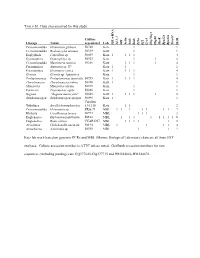
Marine Biological Laboratory) Data Are All from EST Analyses
TABLE S1. Data characterized for this study. rDNA 3 - - Culture 3 - etK sp70cyt rc5 f1a f2 ps22a ps23a Lineage Taxon accession # Lab sec61 SSU 14 40S Actin Atub Btub E E G H Hsp90 M R R T SUM Cercomonadida Heteromita globosa 50780 Katz 1 1 Cercomonadida Bodomorpha minima 50339 Katz 1 1 Euglyphida Capsellina sp. 50039 Katz 1 1 1 1 4 Gymnophrea Gymnophrys sp. 50923 Katz 1 1 2 Cercomonadida Massisteria marina 50266 Katz 1 1 1 1 4 Foraminifera Ammonia sp. T7 Katz 1 1 2 Foraminifera Ovammina opaca Katz 1 1 1 1 4 Gromia Gromia sp. Antarctica Katz 1 1 Proleptomonas Proleptomonas faecicola 50735 Katz 1 1 1 1 4 Theratromyxa Theratromyxa weberi 50200 Katz 1 1 Ministeria Ministeria vibrans 50519 Katz 1 1 Fornicata Trepomonas agilis 50286 Katz 1 1 Soginia “Soginia anisocystis” 50646 Katz 1 1 1 1 1 5 Stephanopogon Stephanopogon apogon 50096 Katz 1 1 Carolina Tubulinea Arcella hemisphaerica 13-1310 Katz 1 1 2 Cercomonadida Heteromita sp. PRA-74 MBL 1 1 1 1 1 1 1 7 Rhizaria Corallomyxa tenera 50975 MBL 1 1 1 3 Euglenozoa Diplonema papillatum 50162 MBL 1 1 1 1 1 1 1 1 8 Euglenozoa Bodo saltans CCAP1907 MBL 1 1 1 1 1 5 Alveolates Chilodonella uncinata 50194 MBL 1 1 1 1 4 Amoebozoa Arachnula sp. 50593 MBL 1 1 2 Katz lab work based on genomic PCRs and MBL (Marine Biological Laboratory) data are all from EST analyses. Culture accession number is ATTC unless noted. GenBank accession numbers for new sequences (including paralogs) are GQ377645-GQ377715 and HM244866-HM244878. -
THE THECAMOEBIAN BIBLIOGRAPHY 2Nd Edition
Palaeontologia Electronica http://palaeo-electronica.org Preamble to the 2nd Edition. Since the publication of the first edition we have collected about 1,000 new titles which are inserted in the second edition. All the remarks and caveats in the Introduction are valid for both editions. The first edition of this document was published in 1999. THE THECAMOEBIAN BIBLIOGRAPHY 2nd Edition F.S. Medioli, L. Bonnet, David B. Scott, and Barbara Elizabeth Medioli ABSTRACT The literature on thecamoebians can be rather confusing, partly because it has been published in many different languages, but mainly because these Rhizopoda have been the subject of study for a wide array of researchers with very different inter- ests. Not only has this resulted in fragmentation of the literature due to research results being published in journals specializing in different fields, but inevitably has also resulted in development of a chaotic terminology and nomenclature. For example there is even confusion as to what to call the group, as terms such as "rhizopods," "testate amoebae," and "arcellaceans" have all been used by various authors as synonyms of "Thecamoebians." Even more confusing is the nomenclature of the described the- camoebian species. Lack of access to the literature and limited interchange between the various research groups has generated many synonyms. Although only a first step this fairly complete bibliography on thecamoebians has been compiled to assist researchers become more aware of the available literature. F.S. Medioli, David B. Scott. Dalhousie University, Department of Earth Sciences, Halifax, Nova Scotia, B3H 3J5, Canada. Franco.Medioli@Dal.Ca. David.Scott@Dal.Ca. -

Kingdom Chromista)
J Mol Evol (2006) 62:388–420 DOI: 10.1007/s00239-004-0353-8 Phylogeny and Megasystematics of Phagotrophic Heterokonts (Kingdom Chromista) Thomas Cavalier-Smith, Ema E-Y. Chao Department of Zoology, University of Oxford, South Parks Road, Oxford OX1 3PS, UK Received: 11 December 2004 / Accepted: 21 September 2005 [Reviewing Editor: Patrick J. Keeling] Abstract. Heterokonts are evolutionarily important gyristea cl. nov. of Ochrophyta as once thought. The as the most nutritionally diverse eukaryote supergroup zooflagellate class Bicoecea (perhaps the ancestral and the most species-rich branch of the eukaryotic phenotype of Bigyra) is unexpectedly diverse and a kingdom Chromista. Ancestrally photosynthetic/ major focus of our study. We describe four new bicil- phagotrophic algae (mixotrophs), they include several iate bicoecean genera and five new species: Nerada ecologically important purely heterotrophic lineages, mexicana, Labromonas fenchelii (=Pseudobodo all grossly understudied phylogenetically and of tremulans sensu Fenchel), Boroka karpovii (=P. uncertain relationships. We sequenced 18S rRNA tremulans sensu Karpov), Anoeca atlantica and Cafe- genes from 14 phagotrophic non-photosynthetic het- teria mylnikovii; several cultures were previously mis- erokonts and a probable Ochromonas, performed ph- identified as Pseudobodo tremulans. Nerada and the ylogenetic analysis of 210–430 Heterokonta, and uniciliate Paramonas are related to Siluania and revised higher classification of Heterokonta and its Adriamonas; this clade (Pseudodendromonadales three phyla: the predominantly photosynthetic Och- emend.) is probably sister to Bicosoeca. Genetically rophyta; the non-photosynthetic Pseudofungi; and diverse Caecitellus is probably related to Anoeca, Bigyra (now comprising subphyla Opalozoa, Bicoecia, Symbiomonas and Cafeteria (collectively Anoecales Sagenista). The deepest heterokont divergence is emend.). Boroka is sister to Pseudodendromonadales/ apparently between Bigyra, as revised here, and Och- Bicoecales/Anoecales. -
1 New Barcoded Primers for Efficient Retrieval of Cercozoan Sequences In
bioRxiv preprint doi: https://doi.org/10.1101/171611; this version posted August 2, 2017. The copyright holder for this preprint (which was not certified by peer review) is the author/funder, who has granted bioRxiv a license to display the preprint in perpetuity. It is made available under aCC-BY-NC-ND 4.0 International license. 1 New barcoded primers for efficient retrieval of cercozoan sequences in high-throughput environmental diversity surveys, with emphasis on worldwide biological soil crusts Anna Maria Fiore-Donno,a# Christian Rixen,b Martin Rippin,c Karin Glaser,d Elena Samolov,d Ulf Karsten,d Burkhard Becker,c Michael Bonkowskia Institute of Zoology, Terrestrial Ecology, Cluster of Excellence in Plant Sciences, University of Cologne, Zülpicher Str. 47b, 50674 Cologne, Germanya; Institute for Snow and Avalanche Research SLF, Flüelastrasse 11, 7260 Davos Dorf, Switzerlandb; Institute of Botany, University of Cologne, Zülpicher Str. 47b, 50674 Cologne, Germanyc; University of Rostock, Institute of Biological Sciences, Applied Ecology and Phycology, Albert-Einstein-Strasse 3, 18059 Rostock, Germanyd. Running title: New barcoded cercozoan primers Correspondence: Anna Maria Fiore-Donno, Institute of Zoology, Department of Terrestrial Ecology, University of Cologne, Zülpicher Str. 47b, 50674 Cologne, Germany; Fax: +492214705038; E-mail: afiore-donno6@infomaniak.ch. Keywords: Cercozoa, environmental sampling, protists, metabarcoding, 18S V4 variable region. Abstract We describe the performance of a new metabarcoding approach to investigate the environmental diversity of a prominent group of widespread unicellular organisms, the Cercozoa. Cercozoa is an immensely large group of protists and although it may dominate in soil and aquatic ecosystems, its environmental diversity remains undersampled.