Lenard Lind L.H.Lind Realty Inc
Total Page:16
File Type:pdf, Size:1020Kb
Load more
Recommended publications
-

Lessons in Womanhood: Education at the Prison for Women, 1934-1965
Lessons in Womanhood: Education at the Prison for Women, 1934-1965 By Katie-Marie McNeill A thesis submitted to the Graduate Program in Education in conformity with the degree requirements for the Degree of Master of Education Queen’s University Kingston, Ontario, Canada August, 2017 Copyright © Katie-Marie McNeill, 2017 Lessons in Womanhood i Abstract The Prison for Women (P4W) in Kingston, Ontario was the sole federal prison for Canadian women throughout the majority of the twentieth century. As such, studying P4W represents a comprehensive study of Canadian women’s incarceration, which is unique in Canadian prison history in comparison to men’s institutions. This thesis explores the educational history of P4W from 1934-1965 to examine what opportunities were afforded to incarcerated women and to reveal the intentions of the Penitentiary Service in their provision of education. This thesis argues that education at P4W intended to reform incarcerated women into models of respectable womanhood. This project relies on archival documents from the Correctional Service of Canada fonds at Library and Archives Canada, files from the Public Safety Library Archives, the Isabel J. Macneill fonds from the Nova Scotia Archives, and prisoner press publications. To frame this research, this thesis takes a blended functionalist and narrative approach to legal history to underscore that the development of education in P4W followed the development of education in Ontario, and that narratives are required to appreciate P4W’s gendered educational history. P4W’s education is contextualized by Chapter One, which provides an overview of imprisonment in English Canadian history. To further deepen analysis, education has been separated and organized into three categories: academic, vocational, and recreational. -

The Fife and Drum, Dec. 2015, V. 19 No. 5
The Newsletter of The Friends of Fort York and Garrison Common v. 19 No. 5 Dec. 2015 1 For King and Country: 8 Project: Under Gardiner Update WW I and the Mayors of Toronto 8 Celebrating the Magna Carta 3 New Light on Toronto’s Oldest Cold Case 9 Digitizing Manuscripts from the City's 5 The Gibraltar Point Lighthouse Museums Collection 6 What The Friends of Fort York Do: 10 From the Ashes: Breathing New Life into the Our Accomplishments for 2015 Wellington Destructor 7 Manager’s Report 10 Upcoming Events For King and Country: WW I and the Mayors of Toronto by Victor Russell The declaration of war in early August 1914 was not a surprise to Torontonians. The newspapers had warned of the possibility for months and throughout that summer residents paid close attention to events in Europe. Indeed, on the Civic Holiday of 3 August 1914 thousands gathered at newspaper offices for the latest news when they could have been at a city park or enjoying an excursion to the Toronto Islands. A few days later, the Toronto Star reported sales of 100,000 copies of its Extra edition containing the news that on 4 August 1914 Great Britain had declared war on Germany and that perforce, Canada was at war. Within days, officials in Ottawa announced that an expeditionary force of volunteers would be assembled at Valcartier military camp north of Quebec City. Thousands Thomas Langton Church (1870-1950), mayor of Toronto 1915-1921, seen here from across Canada, having anticipated war, headed there on the right striking a jaunty pose, attended hundreds of recruiting rallies immediately. -

St. Clair West in Pictures
St. Clair West in Pictures A history of the communities of Carlton, Davenport, Earlscourt, and Oakwood Third Edition Revised and Expanded 1 Nancy Byers and Barbara Myrvold St Clair district west of Dufferin Street, 1890. Charles E. Goad, Atlas of the city of Toronto and vicinity, plate 40 and plate 41(section) Digitally merged. TRL 912.7135 G57.11 BR fo St. Clair West in Pictures A history of the communities of Carlton, Davenport, Earlscourt, and Oakwood Nancy Byers and Barbara Myrvold Third Edition Revised and Expanded Local History Handbook No. 8 a Library and Archives Canada Cataloguing in Back: Key to Abbreviations in Picture Credits and Notes Publication G. A. Reid. The Family, 1925/6. Interior murals, Dufferin/St. Clair Branch, Toronto Public Library. Adam Adam, G. Mercer. Toronto, Old and New. Byers, Nancy, 1924- Restored by Restorart Inc., 2004-7. Toronto: Mail Printing, 1891; Coles, 1974. St. Clair West in pictures : a history of the AO Archives of Ontario communities of Canton, Davenport, Earlscourt and Dufferin/St. Clair Branch is home to interior AO/Horwood Archives ofOntario. J. C. B. and Oakwood / Nancy Byers and Barbara Myrvold. -- 3rd murals painted between 1925 and 1932 by George E. C. Horwood Collection ed. rev. and expanded A. Reid (1860-1947), principal of the Ontario ATA Archdiocese of Toronto Archives College of Art, and two of Reid’s former students. CTA City of Toronto Archives (Local history handbook ; no. 8) Reid depicted “various aspects of community Careless Careless, J. M. S. Toronto to 1918. Includes bibliographical references and index. life.” His panel representing ‘The Family’ was Toronto: J. -
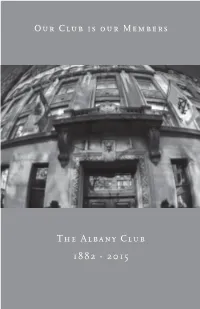
AC History Booklet-FC-Single-V1
Our Club is our Members The Albany Club 1882 - 2015 Overview Throughout 2015, the Club celebrated the 200th anniversary of the 75 Bay Street birth of Sir John A. Macdonald, Canada’s first Prime Minister. The participation of Rt. Hon Brian Mulroney, Prime Minister of Canada from 1984 to 1993, made the dinner on November 5, 2015 a highlight of our celebrations. Over 625 members & guests attended. Interest in this event was so strong it was moved from the Club to the Fairmont Royal York – only the second time this has happened in our history. In 1893, Prime Minister Sir John Thompson was guest speaker at a Sir John A. dinner that attracted 62 people (more than could be accommodated at 34 Colborne Street). This was one factor that prompted the Club to move to 91 King Street East in 1898. The souvenir booklet handed out at the event included considerable information about our most important attribute – our members - that we are pleased to make available on the Club website. Founding of the Albany Club October 27, 1882 Sir John A. Macdonald was the inspiration when the Albany Club was founded in 1882. Two of his protégées – Alexander Macdonell of Alex- andria and Alexander Morris of Kingston – played key roles in the Club’s establishment and early operations. Macdonell, the son of Sir John A.’s law partner in Kingston, was called upon to reorganize the Party after the 1873 election and it was only natural he should perform a similar role, after the failure of the United Empire Club, the original Conservative club in Toronto.