After Eastern German State Elections 2019: Germany Facing Serious Politico-Economic Problems
Total Page:16
File Type:pdf, Size:1020Kb
Load more
Recommended publications
-
The New Philosemitism: Exploring a Changing Relationship Between Jews and the Far-Right
The New Philosemitism: Exploring a Changing Relationship Between Jews and the Far-Right Hannah Rose CONTACT DETAILS For questions, queries and additional copies of this report, please contact: ICSR King’s College London Strand London WC2R 2LS United Kingdom T. +44 20 7848 2098 E. mail@icsr.info Twitter: @icsr_centre Like all other ICSR publications, this report can be downloaded free of charge from the ICSR website at www.icsr.info. © ICSR 2020 The New Philosemitism: Exploring a Changing Relationship Between Jews and the Far-Right Executive Summary About this Report • This report views emerging cooperation and changing attitudes of the populist radical right towards Jews as a new wave of Philosemitism. • This new wave of Philosemitism is not a genuine and sincere positioning, but a strategic tool used by the far‑right in order to present itself as liberal and mainstream, gain support and engage in a ‘divide and conquer’ tactic among minority communities. Far-right Reframings of Jewishness • A shift from antisemitism to philosemitism has originated from a fundamental re‑imagining of Jewishness, where Jews and Judaism are understood through far‑right framings in order to legitimise existing ideologies. For example, by seeing Jews as European, pro‑Israel and anti‑Muslim, the far‑right allows itself to align philosemitism to its own interests. • In this way, deliberately positive sentiments of Jews based on stereotypes are rooted in the same processes as antisemitism, whereby the two phenomena are two sides of the same coin. • Strategies of ‘Collective Action Framing’ are used to impose a Christian‑derived framing of Jewishness onto Jewish people • ‘Frame Extension’, in the case of the radical right’s understanding of Israel as a European frontier against the Arab world, is used to expand far‑right ideology beyond its primary interests in order to appeal to a wider audience. -
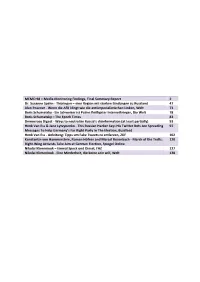
MEMO 98 – Media Monitoring Findings, Final Summary Report 2 Dr
MEMO 98 – Media Monitoring Findings, Final Summary Report 2 Dr. Susanne Spahn - Thüringen – eine Region mit starken Bindungen zu Russland 47 Alan Posener - Wenn die AfD klingt wie die antiimperialistischen Linken, Welt 73 Boris Schumatsky - Ein Schweizer ist Putins fleißigster Internetkrieger, Die Welt 78 Boris Schumatsky – The Epoch Times 83 Democracy Digest - Ways to neutralize Russia’s disinformation (at least partially) 93 Henk Van Ess & Jane Lytvynenko - This Russian Hacker Says His Twitter Bots Are Spreading 97 Messages To Help Germany’s Far Right Party In The Election, Buzzfeed Henk Van Ess - Anleitung: Tipps um Fake Tweets zu entlarven, ZDF 102 Konstantin von Hammerstein, Roman Höfner and Marcel Rosenbach - March of the Trolls: 120 Right-Wing Activists Take Aim at German Election, Spiegel Online Nikolai Klimeniouk – Einmal Speck und Diesel, FAZ 127 Nikolai Klimeniouk - Eine Minderheit, die keine sein will, Welt 128 GERMANY Parliamentary Elections | 24 September 2017 Media Monitoring Findings FINAL Summary Report (8 July - 22 September 2017) 24 November 2017 MEMO 98 Martinengova 8, 811 02 Bratislava, Slovakia | www.memo98.sk, memo98@memo98.sk, +421 903 581 591 2 MEMO 98 1. INTRODUCTION MEMO 98, in cooperation with Internews Ukraine, monitored five Russian-speaking channels and three other outlets prior to the 24 September 2017 parliamentary elections in Germany.1 The monitoring was carried out in three different periods between 8 July and 22 September 2017. The methodology included quantitative and qualitative analysis developed by MEMO 98 that conducted similar projects in more than 50 countries over the course oF twenty years since 1998. Given its comprehensive and content-oriented approach, the methodology was specially designed to provide in-depth Feedback on pluralism in media reporting, including coverage of chosen subjects and topics. -
Partisan and News Content, Participation and Content Curation
Partisan and News Content on YouTube during 2019 Federal State Elections in Germany Philipp Kessling Bastian Kiessling philipp.kessling@haw-hamburg.de bastian.kiessling@haw-hamburg.de HAW Hamburg, Department of Information HAW Hamburg, Department of Information Hamburg, Germany Hamburg, Germany Steffen Burkhardt Christian Stöcker steffen.burkhardt@haw-hamburg.de christian.stoecker@haw-hamburg.de HAW Hamburg, Department of Information HAW Hamburg, Department of Information Hamburg, Germany Hamburg, Germany ABSTRACT of party and media content as well as the related interaction YouTube has emerged as one of the most commonly used plat- of users and patterns within the ranking system. forms for entertainment, information and political communi- cation, for media consumers as well as professional commu- YouTube and Political Communication nicators. News organizations and political parties alike have YouTube is a platform for news, information, entertainment adopted strategies for publishing video content–ranging and especially social interaction [15]. It is the most rele- from already broadcasted news programs to political speeches vant video-sharing platform worldwide – n western Europe of local party members. In this ongoing study we interrogate it is even more popular than Facebook [10]. According to YouTube ranking algorithm on the occasions of three fed- YouTube, users watch over a billion hours of video and gen- eral state elections in Germany. We retrieved ranked search erate billions of views every day. More than 1.9 billion regis- results for every parties leading candidate in the elections, tered users visit the platform every month. More than 70% as well as the comments and replies which YouTube deter- of the traffic now comes from mobile devices23 [ ]. -

A Movement Between Parliamentary Politics and the Pathway to Violence and Terrorism Germany’S Radical Right Narratives and Counter-Narratives 3
1 A MOVEMENT BETWEEN PARLIAMENTARY POLITICS AND THE PATHWAY TO VIOLENCE AND TERRORISM GERMANY’S RADICAL RIGHT NARRATIVES AND COUNTER-NARRATIVES 3 The CARR-Hedayah Radical Right Counter Narratives Project is a year-long project between CARR and Hedayah that is funded by the EU STRIVE programme. It is designed to create one of the first comprehensive online toolkits for practitioners and civil society engaged in radical right extremist counter-narrative campaigns. It uses online research to map nar- ratives in nine countries and regions (Australia, Canada, Germany, Hungary, New Zealand, Norway, Ukraine, United Kingdom, and the United States), proposes counter-narratives for these countries and regions, and advises on how to conduct such campaigns in an effec- tive manner. This country report is one of such outputs. ABOUT THE AUTHOR Maximilian Kreter’s doctoral research focuses on the development of the role of the ideology of right-wing extremism in germanophone White Power music (“Rechtsrock”) from 1977 to 2017. He employs mixed methods content analysis to study song texts of White Power bands. He aims to identify changes and continuities in the narratives, the ideology and the narrative techniques of the germanophone White Power music scene. He has published books, articles and chapters and on White Power Music in (East-)Germany; violence against asylum seekers, social media and the extreme right; right-wing hate crimes in Saxony from 2011 to 2016; and extreme right-wing voting behavior in East-Germany from 2005 to 2011. The views expressed in this practical report are the opinions of the author, and do not necessarily reflect the views of Hedayah, the Centre for Analysis of the Radical Right or the European Union. -
The Radicalization of the Far-Right in Germany and Regional Disparities in Support
Winograd: The Radicalization of the Far-Right in Germany and Regional Disparities in Support The Dartmouth Undergraduate Journal of Politics, Economics, and World Affairs Volume. I, Issue. III, 91-105, June 2021 The Radicalization of the Far-Right in Germany and Regional Disparities in Support SOPHIA WINOGRAD Princeton University ABSTRACT: The radicalization of far-right political groups is becoming an increasingly dangerous problem in German politics. While Germany may be viewed as a fervent ally for liberal thought in Europe, the far-right Alternative for Germany (AfD) party is gaining substantial traction in national politics. Interestingly, the AfD has grown disproportionately by region, drawing more support from East Germany than West. The underpinnings of this trend hinge upon increased asylum being granted to Muslim immigrants and the long-held disdane by the East for the West’s economic successes. An understanding of the AfD’s popularity is integral to combating intolerance and radicalization within Germany as well as the threat of its spread throughout Europe. Introduction The radicalization and political success of Germany’s far-right party, the Alternative for Germany or AfD, could pose a threat to Germany’s role as the defender of a liberal and tolerant Europe. The AfD’s negative attitudes towards immigration and Islam have fueled its most recent political advancements in the national parliament — the party won 12.6% of the national vote in the 2017 federal elections as well as making significant electoral gains in regional state governments (Arzheimer and Berning, 2019). In the state elections in the fall of 2019, Thuringia, Brandenburg and Saxony experienced large advances by the AfD — the party is currently the second largest party in these state governments, representing dramatic increases in the AfD’s vote share since the party’s establishment in 2013 (Chase and Goldenberg, 2019). -
Open Ruman Allison Thesis.Pdf
THE PENNSYLVANIA STATE UNIVERSITY SCHREYER HONORS COLLEGE DEPARTMENT OF GERMAN “TEMPERATE BRUTALITY”: THE AfD AND RIGHT-WING EXTREMISM IN POSTWAR GERMANY ALLISON RUMAN SPRING 2020 A thesis submitted in partial fulfillment of the requirements for baccalaureate degrees in German, Political Science, and Classics & Ancient Mediterranean Studies with honors in German Reviewed and approved* by the following: Jens-Uwe Guettel Associate Professor in History and Religious Studies Thesis Supervisor and Honors Adviser Gretchen Casper Associate Professor of Political Science and Asian Studies Faculty Reader * Electronic approvals are on file. i ABSTRACT Das Ziel dieser Arbeit ist, die Entwicklung des Rechtextremismus in Nachkriegsdeutschland aufzuzeichnen. Die Arbeit beginnt mit einem Vergleich der von NSDAP Reichstagsabgeordneten benutzten Sprache in den Reichstagsdebatten von 1928 und Reden von AfD-Abgeordneten und anderen höherrangigen AfD-Vertretern seit dem Zusammentreten des jetzigen Bundestages im Jahr 2018. Durch diesen Vergleich werden die rhetorischen Ähnlichkeiten zwischen Vertretern beider Parteien und ihren Überzeugungen deutlich. Der erste Teil dieser Arbeit ist eine Analyse des Rechtextremismus seit dem Ende des zweiten Weltkrieges bis zum Aufkommen der AfD Anfang 2013. Dieser Teil basiert auf Zeitungs- und Sekundärliteraturrecherche und bietet eine umfassende Zusammenfassung des Rechtextremismus in Nachkriegsdeutschland. Nach 1949 hatten mehrere rechtsextreme Parteien kleinere Erfolge in der Bundesrepublik Deutschland, n allerdings wurden keine ihrer Vertreter in den Bundestag gewählt. Die Entwicklung dieser Parteien wurde durch mehrere Geschehnisse beeinflusst, einschließlich der relativ neuen rhetorischen Abgrenzung der „Neuen Rechten“ vom traditionellen „NS Sprech“ und der zumindest teilweise (jedoch nicht in Björn Höckes „Flügel“ der AfD) vorhandenen Bereitschaft, die fortbestehende Verantwortung der Deutschen für die Verbrechen der Nazis anzuerkennen. -

The Profiteers of Fear?
Axel Salheiser and Christoph Richter The Profiteers of Fear? Right-wing Populism and the COVID-19 Crisis in Europe Germany FRIEDRICH-EBERT-STIFTUNG Europe needs social democracy! Why do we really want Europe? Can we demonstrate to European citizens the opportunities offered by social politics and a strong social democracy in Europe? This is the aim of the new Friedrich-Ebert-Stiftung project »Politics for Europe«. It shows that European integration can be done in a democratic, economic and socially balanced way and with a reliable foreign policy. The following issues will be particularly important: – Democratic Europe – Social and ecological transformation – Economic and social policy in Europe – Foreign and security policy in Europe We focus on these issues in our events and publications. We provide impetus and offer advice to decision-makers from politics and trade unions. Our aim is to drive the debate on the future of Europe forward and to develop specific proposals to shape central policy areas. With this publication series we want to engage you in the debate on the »Politics for Europe«! About this publication Whilst the German rightwing populist party AfD faced a loss in support in the polls during the Corona-pandemic, rightwing populist views and extremist positions have nonetheless gained ground. There is considerable evidence that the protests against the COVID-19 restrictions have become a hotbed for these views, enabling their normalisation within the protest movement, and in the longer term within society as a whole. Large parts of the protest movement have adopted a right- wing populist, anti-elite and in parts an anti-democratic agenda. -

Dangers and Lessons for Europe on the Rise of the Afd in Germany
We the People? Dangers and Lessons for Europe on the Rise of the AfD in Germany Titus Molkenbur Luke Cooper CONFLICT AND ANOTHER CIVIL SOCIETY EUROPE IS EUROPE RESEARCH UNIT POSSIBLE for the many GLOSSARY PEGIDA (Patriotische Europäer Gegen die Verdachtsfall Islamisierung des Abendlandes) Suspected case Patriotic Europeans against the Islamisation If the suspicion is confirmed that anti-constitutional of Europe efforts have been made the group of persons is to Founded by Lutz Bachmann in 2014, this group be classified as an object of observation; this gives has held rallies mainly in the East German city the VS the ability to also use extensive Intelligence of Dresden and has garnered a lot of media resources for further observations. attention as well as serving to galvanise other far‑right groups. Lügenpresse Lying Press / Fake News Bundestag The accusation that the established press lies and German Federal Parliament acts in the service of dubious powers against the people. Landtag State Parliament Das Volk The people Verfassungsschutz (VS) Historically charged term alluding to the entirety of Office for the Protection of the Constitution the German nation. The use of the term Volk by AfD reveals a troubling understanding of the very nature Grundgesetz of Germany itself as an ethnically homogenous, German constitution white political space ‑ overwhelmed by ‘intruders’ endangering the true Germans. Junge Alternative (JA) AfD youth group Volkspartei People’s party Der Flügel The term Volkspartei is used to describe a party The Wing that is open in principle to voters and members of Right‑wing extremist party wing centred around all social classes and different worldviews.