I. Einführung Und Aktuelle Gefährdungssituation
Total Page:16
File Type:pdf, Size:1020Kb
Load more
Recommended publications
-
A Trait-Based Approach Laura Roquer Beni Phd Thesis 2020
ADVERTIMENT. Lʼaccés als continguts dʼaquesta tesi queda condicionat a lʼacceptació de les condicions dʼús establertes per la següent llicència Creative Commons: http://cat.creativecommons.org/?page_id=184 ADVERTENCIA. El acceso a los contenidos de esta tesis queda condicionado a la aceptación de las condiciones de uso establecidas por la siguiente licencia Creative Commons: http://es.creativecommons.org/blog/licencias/ WARNING. The access to the contents of this doctoral thesis it is limited to the acceptance of the use conditions set by the following Creative Commons license: https://creativecommons.org/licenses/?lang=en Pollinator communities and pollination services in apple orchards: a trait-based approach Laura Roquer Beni PhD Thesis 2020 Pollinator communities and pollination services in apple orchards: a trait-based approach Tesi doctoral Laura Roquer Beni per optar al grau de doctora Directors: Dr. Jordi Bosch i Dr. Anselm Rodrigo Programa de Doctorat en Ecologia Terrestre Centre de Recerca Ecològica i Aplicacions Forestals (CREAF) Universitat de Autònoma de Barcelona Juliol 2020 Il·lustració de la portada: Gala Pont @gala_pont Al meu pare, a la meva mare, a la meva germana i al meu germà Acknowledgements Se’m fa impossible resumir tot el que han significat per mi aquests anys de doctorat. Les qui em coneixeu més sabeu que han sigut anys de transformació, de reptes, d’aprendre a prioritzar sense deixar de cuidar allò que és important. Han sigut anys d’equilibris no sempre fàcils però molt gratificants. Heu sigut moltes les persones que m’heu acompanyat, d’una manera o altra, en el transcurs d’aquest projecte de creixement vital i acadèmic, i totes i cadascuna de vosaltres, formeu part del resultat final. -

Williamston SIS Species List
Williamston Special Invertebrate Site species list This is a list of invertebrate species which have been recorded at Williamston Special Invertebrate Site. Not all the records included in this list have been verified. The aim of the list is to give recorders an idea of the range of species found at the site. To the best of our knowledge, this list of records is correct, as of November 2019. Scientific name English name Bees Andrena scotica Chocolate mining bee Bombus campestris Field cuckoo bee Bombus hortorum Garden bumblebee Bombus lucorum agg. Bombus pascuorum Common carder bee Bombus pratorum Early bumblebee Bombus terrestris Buff-tailed bumblebee Halictus rubicundus Orange-legged furrow bee Lasioglossum calceatum Common furrow bee Nomada marshamella Marsham’s nomad bee Beetles Calvia quatuordecimguttata Cream-spot ladybird Coccinella septempunctata 7-spot ladybird Curtonotus aulicus Oiceoptoma thoracicum Red-breasted carrion beetle Rhagonycha fulva Common red soldier beetle Thanatophilus rugosus Bugs Anthocoris nemorum Common flower bug Liocoris tripustulatus Lygus rugulipennis Tarnished plant bug Philaenus spumarius Cuckoo-spit insect/ Common froghopper Butterflies Aglais io Peacock Aglais urticae Small tortoiseshell Lycaena phlaeas Small copper Maniola jurtina Meadow brown Pararge aegeria Speckled wood Pieris napi Green-veined white Vanessa atalanta Red admiral Vanessa cardui Painted lady Flies Bibio pomonae Red-legged St-Mark's fly Dasysyrphus albostriatus Stripe-backed Dasysyrphus Dexiosoma caninum Epistrophe grossulariae Broad-banded -
Specificity in Predator—Prey Relationships With
SPECIFICITY IN PREDATOR—PREY RELATIONSHIPS seilcoAL WITH PARILIQULAR REFERENCE TO THE APHIDOPHAGOUS COCCINELLIDAE R. L. Blackman B.Sc. A thesis submitted for the Degree of Doctor of Philosophy of the University of London Imperial College of Science and Technology, Field Station, Silwood Park, Sunninghill, ASCOT, Berkshire. October, 1965. 2. ABSTRACT In the first section of the thesis an attempt is made to present a picture of the nature and extent of specificity as it occurs in the food relations of certain groups of predacious insects, in so far as the present state of our knowledge permits. The experimental work described in the second section of the thesis was done on two species of aphidophagous Coccinellid, Adalia bipunctata L. and Coccinella septem- punctata L. The effects of different aphid species on the rate of development and mortality of the larvae and the size and fecundity of the adults are compared. The relative unsuitability of certain aphids, especially Aphis fabae as food for Adalia bipunctata, is discussed. A comparison is made of the feeding behaviour of the two Coccinellids on four species of aphid. Experiments are described in which the ability of larvae and adults to select a suitable aphid or avoid an unsuitable one was investigated. The ecological significance of the results is considered, and the potential value of such predators in pest control, given a better knowledge of their prey relations and specificity, is briefly discussed. CONTENTS SECTION 1. INTRODUCTION AND REVIEW OF THE LITERATURE. INTRODUCTION 6 SPECIFICITY IN PREDATOR-PREY RELATIONSHIPS 10 1. Insects which are predatory in the larval stage only 10 2. -

Diptera, Sy Ae)
Ce nt re fo r Eco logy & Hydrology N AT U RA L ENVIRO N M EN T RESEA RC H CO U N C IL Provisional atlas of British hover les (Diptera, Sy ae) _ Stuart G Ball & Roger K A Morris _ J O I N T NATURE CONSERVATION COMMITTEE NERC Co pyright 2000 Printed in 2000 by CRL Digital Limited ISBN I 870393 54 6 The Centre for Eco logy an d Hydrolo gy (CEI-0 is one of the Centres an d Surveys of the Natu ral Environme nt Research Council (NERC). Established in 1994, CEH is a multi-disciplinary , environmental research organisation w ith som e 600 staff an d w ell-equipp ed labo ratories and field facilities at n ine sites throughout the United Kingdom . Up u ntil Ap ril 2000, CEM co m prise d of fou r comp o nent NERC Institutes - the Institute of Hydrology (IH), the Institute of Freshw ater Eco logy (WE), the Institute of Terrestrial Eco logy (ITE), and the Institute of Virology an d Environmental Micro b iology (IVEM). From the beginning of Ap dl 2000, CEH has operated as a single institute, and the ind ividual Institute nam es have ceased to be used . CEH's mission is to "advance th e science of ecology, env ironme ntal microbiology and hyd rology th rough h igh q uality and inte rnat ionall) recognised research lead ing to better understanding and quantifia ttion of the p hysical, chem ical and b iolo gical p rocesses relating to land an d freshwater an d living organisms within the se environments". -
(Lep. Thaumetopoeidae) Dans Les Forêts De C
Diversité des ennemis naturels de Thaumetopoea pityocampa et Thaumetopoea bonjeani (Lep. Thaumetopoeidae) dans les forêts de Cedrus atlantica Manetti Mohamed Zamoum, Mustapha Gachi, Noureddine Rahim, Mohamed Khemici, Jean Claude Martin, Nadia Bouragba-Brague, Athmane Briki To cite this version: Mohamed Zamoum, Mustapha Gachi, Noureddine Rahim, Mohamed Khemici, Jean Claude Martin, et al.. Diversité des ennemis naturels de Thaumetopoea pityocampa et Thaumetopoea bonjeani (Lep. Thaumetopoeidae) dans les forêts de Cedrus atlantica Manetti. Séminaire international Biodiversité et changements globaux, Nov 2015, Djelfa, Algérie. pp.71-83, 2016. hal-01602925 HAL Id: hal-01602925 https://hal.archives-ouvertes.fr/hal-01602925 Submitted on 5 Jun 2020 HAL is a multi-disciplinary open access L’archive ouverte pluridisciplinaire HAL, est archive for the deposit and dissemination of sci- destinée au dépôt et à la diffusion de documents entific research documents, whether they are pub- scientifiques de niveau recherche, publiés ou non, lished or not. The documents may come from émanant des établissements d’enseignement et de teaching and research institutions in France or recherche français ou étrangers, des laboratoires abroad, or from public or private research centers. publics ou privés. Distributed under a Creative Commons Attribution| 4.0 International License Diversité des ennemis naturels de Thaumetopoea pityocampa et Thaumetopoea bonjeani (Lep. Thaumetopoeidae) dans les forêts de Cedrus atlantica Manetti. Zamoum Mohamed (1), Gachi Mustapha (1), -

I. Einführung Und Aktuelle Gefährdungssituation
Ökologische Schäden, gesundheitliche Gefahren und Maßnahmen zur Eindämmung des Eichenprozessionsspinners im Forst und im urbanen Grün Ökologische Schäden, gesundheitliche Gefahren und Maßnahmen zur Eindämmung des Eichenprozessionsspinners im Forst und im urbanen Grün I. Einführung und aktuelle Gefährdungssituation Moderation: Dr. M. Hommes, Julius Kühn-Institut, Braunschweig Die Prozessionsspinner Mitteleuropas - Ein Überblick The Processionary Moths of Central Europe - An Overview Dr. Nadine Bräsicke Bundesforschungsinstitut für Kulturpflanzen, Institut für Pflanzenschutz in Gartenbau und Forst, Messeweg 11/12, 38104 Braunschweig, Germany, nadine.braesicke@jki.bund.de DOI 10.5073/jka.2013.440.001 Zusammenfassung Die Auswirkungen des Klimawandels lassen sich bereits auch in Deutschland beobachten. Dabei werden die Waldökosysteme in besonderer Weise betroffen. Waldstandorte sind stärker trockenen Bedingungen ausgesetzt, die zusammen mit höheren Vegetationszeittemperaturen eine erhöhte Stressanfälligkeit der Bäume verursachen. Bei den Insekten beeinflusst eine erhöhte Temperatur u. a. die Entwicklungsdauer, die Populationsdichte und die Verwertbarkeit der Wirtspflanzen als Nahrung (BMLFUW 2003, PETERCORD et al. 2008). Es ist zu erwarten, dass die Wachstumsrate und die Entwicklung der Insektenarten beeinflusst wird (NETHERER & SCHOPF 2009), die aufgrund eines relativ hohen Populationswachstums und hoher Mobili- tät durch Migration oder Adaption auf veränderte Klimabedingungen rascher reagieren (HARRINGTON et al. 2001). Bei einigen Schädlingen -

Animal Biodiversity in Cider Apple Orchards: Simultaneous
Supplementary material of the article Animal biodiversity in cider apple orchards: simultaneous environmental drivers and effects on insectivory and pollination. Rodrigo Martínez-Sastrea, Marcos Miñarroa & Daniel Garcíab* a Servicio Regional de Investigación y Desarrollo Agroalimentario (SERIDA), Apdo. 13, E-33300, Villaviciosa, Asturias, Spain b Depto. Biología de Organismos y Sistemas, Universidad de Oviedo, and Unidad Mixta de Investigación en Biodiversidad (CSIC-Uo-PA), C/Catedrático Rodrigo Uría s/n, E- 33006, Oviedo, Asturias, Spain * Corresponding author: danielgarcia@uniovi.es Agriculture, Ecosystems and Environment (2020) https://doi.org/10.1016/j.agee.2020.106918 1 Appendix A. List of animal species recorded in cider apple orchards Table A1. List of species of forest insectivorous birds recorded in cider apple orchards in this study. Scientific name Common name Aegithalos caudatus Long-tailed tit Anthus trivialis Tree pipit Certhia brachydactyla Short-toed treecreeper Cettia cetti Cetti's warbler Cyanistes caeruleus Eurasian blue tit Dendrocopos major Great spotted woodpecker Erithacus rubecula European robin Ficedula hypoleuca European pied flycatcher Fringilla coelebs Common chaffinch Garrulus glandarius Eurasian jay Hippolais polyglotta Melodious warbler Lanius collurio Red-backed shrike Lophophanes cristatus European crested tit Oriolus oriolus Eurasian golden oriole Parus major Great tit Periparus ater Coal tit Phoenicurus phoenicurus Common redstart Phylloscopus collybita/ibericus Common/Iberian chiffchaff Picus viridis Green woodpecker Prunella modularis Dunnock Regulus ignicapilla Common firecrest Regulus regulus Goldcrest Sitta europaea Eurasian nuthatch Sylvia atricapilla Eurasian blackcap Sylvia borin Garden warbler Sylvia communis Common whitethroat Troglodytes troglodytes Eurasian wren Turdus iliacus Redwing Turdus merula Common blackbird Turdus philomelos Song thrush Turdus pilaris Fieldfare Turdus viscivorus Mistle thrush 2 Table A2. -
Shetland's Hoverflies
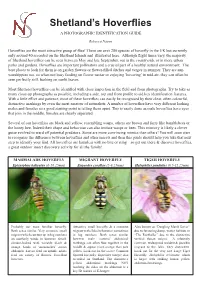
Shetland’s Hoverflies A PHOTOGRAPHIC IDENTIFICATION GUIDE Rebecca Nason Hoverflies are the most attractive group of flies! There are over 280 species of hoverfly in the UK but currently only around 40 recorded on the Shetland Islands and illustrated here. Although flight times vary, the majority of Shetland hoverflies can be seen between May and late September, out in the countryside or in more urban parks and gardens. Hoverflies are important pollinators and a crucial part of a healthy natural environment. The best places to look for them is on garden flowers or flower-filled ditches and verges in summer. They are sun- worshippers too, so when not busy feeding on flower nectar or enjoying ‘hovering’ in mid-air, they can often be seen perfectly still, basking on sunlit leaves. Most Shetland hoverflies can be identified with close inspection in the field and from photographs.Try to take as many close-up photographs as possible, including a side, top and front profile to aid key identification features. With a little effort and patience, most of these hoverflies can easily be recognised by their clear, often colourful, distinctive markings by even the most amateur of naturalists. A number of hoverflies have very different looking males and females so a good starting point is telling them apart. This is easily done as male hoverflies have eyes that join in the middle, females are clearly separated. Several of our hoverflies are black and yellow, resembling wasps, others are brown and furry like bumblebees or the honey bee. Indeed their shape and behaviour can also imitate wasps or bees. -

Hoverflies (Diptera: Syrphidae) of El Ventorrillo Biological Station, Madrid Province, Spain: a Perspective from a Late Twentieth Century Inventory
Hoverflies (Diptera: Syrphidae) of El Ventorrillo Biological Station, Madrid province, Spain: a perspective from a late twentieth century inventory Authors: Lorenzo, Daniel, Ricarte, Antonio, Nedeljković, Zorica, Nieves-Aldrey, José Luis, and Marcos-García, Maria Ángeles Source: Revue suisse de Zoologie, 127(2) : 393-412 Published By: Muséum d'histoire naturelle, Genève URL: https://doi.org/10.35929/RSZ.0029 BioOne Complete (complete.BioOne.org) is a full-text database of 200 subscribed and open-access titles in the biological, ecological, and environmental sciences published by nonprofit societies, associations, museums, institutions, and presses. Your use of this PDF, the BioOne Complete website, and all posted and associated content indicates your acceptance of BioOne’s Terms of Use, available at www.bioone.org/terms-of-use. Usage of BioOne Complete content is strictly limited to personal, educational, and non - commercial use. Commercial inquiries or rights and permissions requests should be directed to the individual publisher as copyright holder. BioOne sees sustainable scholarly publishing as an inherently collaborative enterprise connecting authors, nonprofit publishers, academic institutions, research libraries, and research funders in the common goal of maximizing access to critical research. Downloaded From: https://bioone.org/journals/Revue-suisse-de-Zoologie on 02 Nov 2020 Terms of Use: https://bioone.org/terms-of-use Revue suisse de Zoologie (September 2020) 127(2): 393-412 ISSN 0035-418 Hoverfl ies (Diptera: Syrphidae) of El Ventorrillo Biological Station, Madrid province, Spain: a perspective from a late twentieth century inventory Daniel Lorenzo1, Antonio Ricarte1*, Zorica Nedeljković1, José Luis Nieves-Aldrey2 & Maria Ángeles Marcos-García1 1 Centro Iberoamericano de la Biodiversidad (CIBIO), Universidad de Alicante, Carretera de San Vicente, s/n, 03690 San Vicente del Raspeig, Alicante, Spain. -
An Introduction to the Immature Stages of British Flies
Royal Entomological Society HANDBOOKS FOR THE IDENTIFICATION OF BRITISH INSECTS To purchase current handbooks and to download out-of-print parts visit: http://www.royensoc.co.uk/publications/index.htm This work is licensed under a Creative Commons Attribution-NonCommercial-ShareAlike 2.0 UK: England & Wales License. Copyright © Royal Entomological Society 2013 Handbooks for the Identification of British Insects Vol. 10, Part 14 AN INTRODUCTION TO THE IMMATURE STAGES OF BRITISH FLIES DIPTERA LARVAE, WITH NOTES ON EGGS, PUP ARIA AND PUPAE K. G. V. Smith ROYAL ENTOMOLOGICAL SOCIETY OF LONDON Handbooks for the Vol. 10, Part 14 Identification of British Insects Editors: W. R. Dolling & R. R. Askew AN INTRODUCTION TO THE IMMATURE STAGES OF BRITISH FLIES DIPTERA LARVAE, WITH NOTES ON EGGS, PUPARIA AND PUPAE By K. G. V. SMITH Department of Entomology British Museum (Natural History) London SW7 5BD 1989 ROYAL ENTOMOLOGICAL SOCIETY OF LONDON The aim of the Handbooks is to provide illustrated identification keys to the insects of Britain, together with concise morphological, biological and distributional information. Each handbook should serve both as an introduction to a particular group of insects and as an identification manual. Details of handbooks currently available can be obtained from Publications Sales, British Museum (Natural History), Cromwell Road, London SW7 5BD. Cover illustration: egg of Muscidae; larva (lateral) of Lonchaea (Lonchaeidae); floating puparium of Elgiva rufa (Panzer) (Sciomyzidae). To Vera, my wife, with thanks for sharing my interest in insects World List abbreviation: Handbk /dent. Br./nsects. © Royal Entomological Society of London, 1989 First published 1989 by the British Museum (Natural History), Cromwell Road, London SW7 5BD. -

Hoverfly Diversity Supported by Vineyards and the Importance of Ground Cover Management
Bulletin of Insectology 70 (1): 147-155, 2017 ISSN 1721-8861 Hoverfly diversity supported by vineyards and the importance of ground cover management 1,5 2 3 1,4 5 Gaël PÉTREMAND , Martin C. D. SPEIGHT , Dominique FLEURY , Emmanuel CASTELLA , Nicolas DELABAYS 1Institute for Environmental Sciences, University of Geneva, Switzerland 2Department of Zoology, Trinity College, Dublin, Ireland 3Direction générale de l’agriculture et de la nature, Service de l’agronomie, République et Canton de Genève, Switzerland 4Department F.-A. Forel for environmental and aquatic sciences, University of Geneva, Switzerland 5Institute Earth-Nature-Environment, hepia, University of Applied Sciences and Arts of Western Switzerland, Geneva, Switzerland Abstract The association of hoverflies with vineyards and the response of the species to different types of ground cover management were investigated in two Swiss vineyards sampled using Malaise and emergence traps from March to July 2014. Eight of the 21 species collected in emergence traps, some of them with conservation interest, were identified as having a high association with vine- yards. The most diverse fauna was found with ground cover of spontaneous, ruderal vegetation, which provided for, in particular, aphid-feeding species living in the grass-root zone. Plots in which there was no ground vegetation lacked these species. Sowing a grassy mixture of seeds, which resulted in a complete cover of ground vegetation, was not found to promote richness and abun- dance of hoverflies, and was interpreted as a “barrier” to development of syrphid biodiversity in vineyards. The various ground vegetation treatments studied were found to promote almost only polyvoltine aphidophagous species, except a few phytophagous species and univoltine species whose larvae live in the soil. -

Dynamics of Predatory Syrphidae in the Apple Orchard and Neighbouring Shrubberies
JOURNAL OF PLANT PROTECTION RESEARCH Vol. 53, No. 2 (2013) DOI: 10.2478/jppr-2013-0017 DYNAMICS OF PREDATORY SYRPHIDAE IN THE APPLE ORCHARD AND NEIGHBOURING SHRUBBERIES Paweł Trzciński*, Hanna Piekarska-Boniecka Department of Entomology and Environmental Protection, Poznan University of Life Sciences Dąbrowskiego 159, 60-594 Poznań, Poland Received: September 13, 2012 Accepted: March 15, 2013 Abstract: Shrubberies which neighbour on an orchard are among the significant structures enhancing agrocenoses. Such shrubberies maintain species diversity and stimulate self-control mechanisms in biocenoses. For these reasons, from 1999 to 2001, studies were conducted concerning predatory Syrphidae (Diptera) occurring in the orchard and shrubberies in the immediate vicinity. A quantity and quality analysis of predatory hoverflies (Diptera, Syrphidae) was performed. A total of 801 specimens were caught in both habi- tats. There were 20 species recorded there (12% of the national fauna of this predatory family). The studies proved that the orchard and the neighbouring shrubberies can be alternative habitats for Syrphidae (Diptera). There is also a possibility of the predators migrating from the shrubberies to the orchard, enhancing the potential to control the abundant Hemiptera species in the orchard. The shrubberies then become an important element of the agrocenosis structure, due to their bio- cenotic functions. Key words: orchard, predator, shrubberies, Syrphidae, Wielkopolska INTRODUCTION MATERIALS AND METHODS Shrubberies surrounding orchards are vital structures The study was carried out in the 1999–2001 time pe- enhancing agrocenoses. They provide shelter, a place riod, in the orchard of Przybroda in Poland (52°31’14’’N, for wintering and breeding as well as dispersion of en- 16°39’22’’E).