Ecological Site F133BY007TX Southern Sandy Loam Upland
Total Page:16
File Type:pdf, Size:1020Kb
Load more
Recommended publications
-

Vascular Flora of the Possum Walk Trail at the Infinity Science Center, Hancock County, Mississippi
The University of Southern Mississippi The Aquila Digital Community Honors Theses Honors College Spring 5-2016 Vascular Flora of the Possum Walk Trail at the Infinity Science Center, Hancock County, Mississippi Hanna M. Miller University of Southern Mississippi Follow this and additional works at: https://aquila.usm.edu/honors_theses Part of the Biodiversity Commons, and the Botany Commons Recommended Citation Miller, Hanna M., "Vascular Flora of the Possum Walk Trail at the Infinity Science Center, Hancock County, Mississippi" (2016). Honors Theses. 389. https://aquila.usm.edu/honors_theses/389 This Honors College Thesis is brought to you for free and open access by the Honors College at The Aquila Digital Community. It has been accepted for inclusion in Honors Theses by an authorized administrator of The Aquila Digital Community. For more information, please contact Joshua.Cromwell@usm.edu. The University of Southern Mississippi Vascular Flora of the Possum Walk Trail at the Infinity Science Center, Hancock County, Mississippi by Hanna Miller A Thesis Submitted to the Honors College of The University of Southern Mississippi in Partial Fulfillment of the Requirement for the Degree of Bachelor of Science in the Department of Biological Sciences May 2016 ii Approved by _________________________________ Mac H. Alford, Ph.D., Thesis Adviser Professor of Biological Sciences _________________________________ Shiao Y. Wang, Ph.D., Chair Department of Biological Sciences _________________________________ Ellen Weinauer, Ph.D., Dean Honors College iii Abstract The North American Coastal Plain contains some of the highest plant diversity in the temperate world. However, most of the region has remained unstudied, resulting in a lack of knowledge about the unique plant communities present there. -

Pycnanthemum Albescens Torr. & A.Gray
Conservation Assessment for the Whiteleaf Mountainmint (Pycnanthemum albescens Torr. & A.Gray) Steven R. Hill, Ph.D. Division of Biodiversity and Ecological Entomology Biotic Surveys and Monitoring Section 1816 South Oak Street Champaign, Illinois 61820 Prepared for the U.S.D.A. Forest Service, Eastern Region (Region 9), Shawnee and Hoosier National Forests INHS Technical Report 2007 (52) Date of Issue: 25 October 2007 Cover photo: Pycnanthemum albescens Torr. & A.Gray, from the PLANTS Database, U.S.D.A., photographer: Larry Allain @ USDA-NRCS PLANTS Database http://plants.usda.gov/java/largeImage?imageID=pyal_001_avp.tif This Conservation Assessment was prepared to compile the published and unpublished information on the subject taxon or community; or this document was prepared by another organization and provides information to serve as a Conservation Assessment for the Eastern Region of the Forest Service. It does not represent a management decision by the U.S. Forest Service. Though the best scientific information available was used and subject experts were consulted in preparation of this document, it is expected that new information will arise. In the spirit of continuous learning and adaptive management, if you have information that will assist in conserving the subject taxon, please contact the Eastern Region of the Forest Service - Threatened and Endangered Species Program at 310 Wisconsin Avenue, Suite 580 Milwaukee, Wisconsin 53203. 2 Conservation Assessment for the Whiteleaf Mountainmint (Pycnanthemum albescens Torr. & A.Gray) -

Vascular Flora of Gus Engeling Wildlife Management Area, Anderson County, Texas
2003SOUTHEASTERN NATURALIST 2(3):347–368 THE VASCULAR FLORA OF GUS ENGELING WILDLIFE MANAGEMENT AREA, ANDERSON COUNTY, TEXAS 1 2,3 2 JASON R. SINGHURST , JAMES C. CATHY , DALE PROCHASKA , 2 4 5 HAYDEN HAUCKE , GLENN C. KROH , AND WALTER C. HOLMES ABSTRACT - Field studies in the Gus Engeling Wildlife Management Area, which consists of approximately 4465.5 ha (11,034.1 acres) of the Post Oak Savannah of Anderson County, have resulted in an annotated checklist of the vascular flora corroborating its remarkable species richness. A total of 930 taxa (excluding family names), belonging to 485 genera and 145 families are re- corded. Asteraceae (124 species), Poaceae (114 species), Fabaceae (67 species), and Cyperaceae (61 species) represented the largest families. Six Texas endemic taxa occur on the site: Brazoria truncata var. pulcherrima (B. pulcherrima), Hymenopappus carrizoanus, Palafoxia reverchonii, Rhododon ciliatus, Trades- cantia humilis, and T. subacaulis. Within Texas, Zigadenus densus is known only from the study area. The area also has a large number of species that are endemic to the West Gulf Coastal Plain and Carrizo Sands phytogeographic distribution patterns. Eleven vegetation alliances occur on the property, with the most notable being sand post oak-bluejack oak, white oak-southern red oak-post oak, and beakrush-pitcher plant alliances. INTRODUCTION The Post Oak Savannah (Gould 1962) comprises about 4,000,000 ha of gently rolling to hilly lands that lie immediately west of the Pineywoods (Timber belt). Some (Allred and Mitchell 1955, Dyksterhuis 1948) consider the vegetation of the area as part of the deciduous forest; i.e., burned out forest that is presently regenerating. -

Phlox Nivalis Subspecies Texensis)
Species Status Assessment Report for Texas Trailing Phlox (Phlox nivalis subspecies texensis) Photo: Suzzanne Chapman, Mercer Arboretum and Nature Center U.S. Fish and Wildlife Service Texas Coastal Ecological Services Field Office Houston, Texas Version 3.1 – January 2020 ACKNOWLEDGEMENTS: This document was prepared by Amber Bearb, Texas Coastal Ecological Services Field Office- Clear Lake and Jennifer Smith-Castro, Southwest Regional Office, both with The U.S. Fish and Wildlife Service. We thank the landowners and land managers for providing access to survey the Texas trailing phlox populations and for their review and input including: Wendy Ledbetter and The Nature Conservancy staff; Herbert Young, Jr., Andrew Bennett, and The Big Thicket National Preserve staff; Ragan Bounds, Hancock Forest Management; Jennifer Smith, Resource Management Services; Campbell Timber staff; and, Jerry Rashall, Village Creek State Park. Valuable input was provided by Anita Tiller and Suzzanne Chapman, Mercer Arboretum and Botanical Gardens; Anna Strong, Jason Singhurst, and Bob Gottfried, Texas Parks and Wildlife Department; Suzanne Walker, Azimuth Forestry Services; Matt Buckingham, Texas Department of Transportation; Dawn Stover, Stephen F. Austin State University; John Fisher, U.S. Fish and Wildlife Service publications coordinator; Dr. Lawrence Gilbert, University of Texas-Austin; Dr. Carolyn Ferguson, Kansas State University; and, Dr. James Locklear, Lauritzen Gardens. LITERATURE CITATION SHOULD READ AS FOLLOWS: U.S. Fish and Wildlife Service. 2020. Species Status Assessment Report for Texas Trailing Phlox (Phlox nivalis subspecies texensis), Volume 3.1. Albuquerque, New Mexico. 81 pages. An electronic copy of this report will be made available at: https://ecos.fws.gov/ServCat/. Throughout this document, the first use of scientific and technical terms are underscored with dashed lines; these terms are in the glossary in Appendix A. -
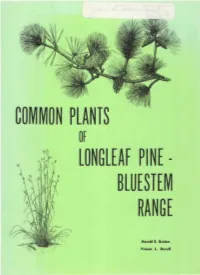
COMMON Plants Longleaf PINE
COMMON PlANTS OF lONGlEAF PINE - BlUE STEM RANGE Harold E. Grelen Vinson L. Duvall In preparing this handbook, the authors have received substantial assistance from predecessors and colleagues. Much of the information is from the Forest Service's "Field Book of Forage Plants on Longleaf Pine-Biuestem Ranges," by 0. Gordon Langdon, the late Miriam L. Bomhard, and John T. Cassady ( 1952). Charles Feddema, Lowell K. Halls, J. B. Hilmon, and Alfred W. Johnson, U. S. Forest Service, and Thomas N. Shiflet, U. S. Soil Conservation Service, reviewed the manu script and made important suggestions regarding content and organiza tion. Phil D. Goodrum, Bureau of Sport Fisheries and Wildlife, U. S. Fish and Wildlife Service, supplied much information on values of range plants to wildlife. Jane Roller, Forest Service, prepared illustrated keys as well as many technical descriptions and drawings. Most other drawings were by the late Leta Hughey, Forest Service, and the senior author; several are from other U.S. Department of Agriculture publica tions. U. S. FOREST SERVICE RESEARCH PAPER S0-23 COMMON PLANTS OF LONGLEAF PINE·BLUESTEM RANGE Harold E. Grelen V-inson L. Duvall SOUTHERN FO!;<.EST EXPERIMENT STAT ION Thomas, c·. Nelson, Director FOREST SERVICE U.S. DEPARTMENT OF AGRICULTURE 1966 Contents The type 1 Grasses 3 Bluestems 3 Panicums 13 Paspalums 21 Miscellaneous grasses 25 Grasslike plants 37 Forbs . 47 Legumes 47 Composites 59 Miscellaneous forbs 74 Shrubs and woody vines 78 Bibliography 90 Glossary . 91 Index of plant names 94 COMMON PLANTS OF LONGLEAF PINE· BLUEST EM RANGE This publication describes many grasses, salient taxonomic features of species mention grasslike plants, forbs, and shrubs that inhabit ed briefly as well as of those described fully. -

Journal of the Oklahoma Native Plant Society, Volume 9, December 2009
4 Oklahoma Native Plant Record Volume 9, December 2009 VASCULAR PLANTS OF SOUTHEASTERN OKLAHOMA FROM THE SANS BOIS TO THE KIAMICHI MOUNTAINS Submitted to the Faculty of the Graduate College of the Oklahoma State University in partial fulfillment of the requirements for the Degree of Doctor of Philosophy May 1969 Francis Hobart Means, Jr. Midwest City, Oklahoma Current Email Address: fhmeans@cox.net The author grew up in the prairie region of Kay County where he learned to appreciate proper management of the soil and the native grass flora. After graduation from college, he moved to Eastern Oklahoma State College where he took a position as Instructor in Botany and Agronomy. In the course of conducting botany field trips and working with local residents on their plant problems, the author became increasingly interested in the flora of that area and of the State of Oklahoma. This led to an extensive study of the northern portion of the Oauchita Highlands with collections currently numbering approximately 4,200. The specimens have been processed according to standard herbarium procedures. The first set has been placed in the Herbarium of Oklahoma State University with the second set going to Eastern Oklahoma State College at Wilburton. Editor’s note: The original species list included habitat characteristics and collection notes. These are omitted here but are available in the dissertation housed at the Edmon-Low Library at OSU or in digital form by request to the editor. [SS] PHYSICAL FEATURES Winding Stair Mountain ranges. A second large valley lies across the southern part of Location and Area Latimer and LeFlore counties between the The area studied is located primarily in Winding Stair and Kiamichi mountain the Ouachita Highlands of eastern ranges. -

Flora and Plant Coummunities of Deer Park Prairie
THE VASCULAR FLORA AND PLANT COMMUNITIES OF LAWTHER - DEER PARK PRAIRIE, HARRIS COUNTY, TEXAS, U.S.A. Jason R. Singhurst Jeffrey N. Mink Wildlife Diversity Program 176 Downsville Road Texas Parks & Wildlife Department Robinson, Texas 76706-7276, U.S.A. 4200 Smith School Road jeffreynormanmink@gmail.com Austin, Texas 78744, U.S.A. jmink@mclennan.edu jason.singhurst@tpwd.texas.gov Katy Emde, Lan Shen, Don Verser Walter C. Holmes Houston Chapter of Department of Biology Native Prairie Association of Texas Baylor University 2700 Southwest Fwy. Waco, Texas 76798-7388, U.S.A. Houston, Texas 77098, U.S.A. Walter_Holmes@baylor.edu ABSTRACT Field studies at the Lawther - Deer Park Prairie Preserve, an area of approximately 21 ha (51 acres) of the Gulf Coast Prairies and Marshes vegetation area, have resulted in a description of the vegetation associations and an annotated checklist of the vascular flora. Six plant com- munity associations occur on the property: (1) the Upper Texas Coast Ingleside Sandy Wet Prairie; (2) Eastern Gamagrass - Switchgrass - Yellow Indiangrass Herbaceous Vegetation; (3) Gulf Cordgrass Herbaceous Vegetation; (4) Texas Gulf Coast Live Oak - Sugarberry Forest; (5) Little Bluestem - Slender Bluestem - Big Bluestem Herbaceous Vegetation, and (6) Natural Depressional Ponds. The checklist includes 407 species belonging to 247 genera and 86 families. Forty-six species are non-native. The best-represented families (with species number following) are Poaceae (84), Asteraceae (68), Cyperaceae (33), and Fabaceae (19). West Gulf Coastal Plain (eastern Texas and western Louisiana) endemics include Helenium drummondii, Liatris acidota, Oenothera lindheimeri, and Rudbeckia texana. One Texas endemic, Chloris texensis, a Species of Greater Conservation Need, is present. -

100 Years of Change in the Flora of the Carolinas
EUPHORBIACEAE 353 Tragia urticifolia Michaux, Nettleleaf Noseburn. Pd (GA, NC, SC, VA), Cp (GA, SC), Mt (SC): dry woodlands and rock outcrops, particularly over mafic or calcareous rocks; common (VA Rare). May-October. Sc. VA west to MO, KS, and CO, south to FL and AZ. [= RAB, F, G, K, W; = T. urticaefolia – S, orthographic variant] Triadica Loureiro 1790 (Chinese Tallow-tree) A genus of 2-3 species, native to tropical and subtropical Asia. The most recent monographers of Sapium and related genera (Kruijt 1996; Esser 2002) place our single naturalized species in the genus Triadica, native to Asia; Sapium (excluding Triadica) is a genus of 21 species restricted to the neotropics. This conclusion is corroborated by molecular phylogenetic analysis (Wurdack, Hoffmann, & Chase (2005). References: Kruijt (1996)=Z; Esser (2002)=Y; Govaerts, Frodin, & Radcliffe-Smith (2000)=X. * Triadica sebifera (Linnaeus) Small, Chinese Tallow-tree, Popcorn Tree. Cp (GA, NC, SC): marsh edges, shell deposits, disturbed areas; uncommon. May-June; August-November, native of e. Asia. With Euphorbia, Chamaesyce, and Cnidoscolus, one of our few Euphorbiaceous genera with milky sap. Triadica has become locally common from Colleton County, SC southward through the tidewater area of GA, and promises to become a serious weed tree (as it is in parts of LA, TX, and FL). [= K, S, X, Y, Z; = Sapium sebiferum (Linnaeus) Roxburgh – RAB, GW] Vernicia Loureiro 1790 (Tung-oil Tree) A genus of 3 species, trees, native of se. Asia. References: Govaerts, Frodin, & Radcliffe-Smith (2000)=Z. * Vernicia fordii (Hemsley) Airy-Shaw, Tung-oil Tree, Tung Tree. Cp (GA, NC): planted for the oil and for ornament, rarely naturalizing; rare, introduced from central and western China. -

A Guide to North American Grasslands
Desert Volume 29, Number 2 Published by The University of Arizona for Plants the Boyce Thompson Arboretum A Guide to North American Grasslands David E. Brown and Elizabeth Makings Relict Great Basin Shrub-Grassland near Wupatki National Monument northeast of Flagstaff, Coconino County, Arizona, 1,650 m (5,413 ft). Volume 29, Number 2 Desert Plants Published by The University of Arizona for the Boyce Thompson Arboretum A journal devoted to broadening knowledge of plants 37615 E US Highway 60 indigenous or adapted to arid and sub-arid regions and Superior, AZ 85173 to encouraging the appreciation of these plants. Copyright 2014. The Arizona Board of Regents on Mark D. Siegwarth, editor behalf of The University of Arizona. The Boyce DesertPlants@cals.arizona.edu Thompson Arboretum at Superior, Arizona, is cooperatively managed by the Boyce Thompson Production Director: Kim Stone Southwestern Arboretum, Inc., The University of Arizona, and Arizona State Parks. Boyce Thompson Arboretum From the editor As Desert Plants begins its 35th year with a new staff, it in editorship comes the opportunity to rethink what Desert seems somewhat appropriate that as we begin a new chap- Plants is and could be. Desert Plants is devoted to broad- ter in the history of Desert Plants, we start with A Guide ening knowledge of plants indigenous or adapted to arid to North American Grasslands by David E. Brown and Eliza- and sub-arid regions and to encouraging the appreciation of beth Makings. Probably one of the most quoted, used and these plants. With such a broad mandate, it is open to vari- reprinted issues of Desert Plants to this day is Volume 4, ous interpretations. -

Roy E. Larsen Sandland Sanctuary Hardin County, Silsbee, Texas Plant
ROY E. LARSEN SANDLAND SANCTUARY HARDIN COUNTY, SILSBEE, TEXAS PLANT SPECIES LIST Taxonomic nomenclature follows Kartesz. Sources: Ajilvsgi, G. 1979. Wild flowers of the Big Thicket, East Texas and Louisiana. Texas A & M University Press. 360pp. Jones, S.D., J. K. Wipff and P.M. Montgomery. 1997. Vascular plants of Texas: a comprehensive checklist including synonmy, bibliography, and index. University of Texas Press, Austin. 404pp. Liu,C., P.A. Harcombe and I.S. Elsik. 1990. Fire study report, including Roy E. Larsen Preserve species list. Summer 1990. Dept. of Ecology and Evolutionary Biology, Rice University, Houston. Matos, J. A. 1985. Roy E. Larsen Sandylands Sanctuary vascular plant species list. Master thesis, Stephen F. Austin University, Nacgodoches. 24pp. Nixon, E. S. 1985. Trees, Shrubs & Woody Vines of East Texas. 240pp. Thanks to Bill Carr, Research Scientist for Botany, and Lee Elliott, Senior Ecologist/Metrics Coordinator, Nature Conservancy for their review and comments. Thanks to Amy Schwarzbach and Leisa Stokes for formatting and editing. Comments/additions or requests for copies of this document may be forwarded to Wendy J. Ledbetter, Forest Program Manager, 3888 Highway 327 West, Silsbee, Texas 77656. Email: wledbetter@tnc.org The Nature Conservancy Roy E. Larsen Sandyland Sanctuary, Hardin Co., Silsbee, Texas Plant List Scientific Name Common Name Habitat Type Season ACANTHUS FAMILY — Acanthaceae Justicia ovata var. lanceolata lanceleaf water-willow wet areas forb spr-sum Ruellia humilis low ruellia open mesic woodlands -

Common Plants of Longleaf Pine-Bluestem Range
LONGLEAF PINE- BLUESTEM RANGE Harold E. Grelen Vinson L. Duvall In preparing this handbook, the authors have received substantial assistance from predecessors and colleagues. Much of the information is from the Forest Service's "Field Book of Forage Plants on Longleaf Pine-Bluestem Ranges," by O. Gordon Langdon, the late Miriam L. Bomhard, and John T. Cassady (1952) . Charles Feddema, Lowell K. Halls, J. B. Hilmon, and Alfred W. Johnson, U. S. Forest Service, and Thomas N. Shiflet, U. S. Soil Conservation Service, reviewed the manu- script and made important suggestions regarding content and organiza- tion. Phil D. Goodrum, Bureau of Sport Fisheries and Wildlife, U. S. Fish and Wildlife Service, supplied much information on values of range plants to wildlife. Jane Roller, Forest Service, prepared illustrated keys as well as many technical descriptions and drawings. Most other drawings were by the late Leta Hughey, Forest Service, and the senior author; several are from other U. S. Department of Agriculture publica- tions. U. S. FOREST SERVICE RESEARCH PAPER SO-23 COMMON PLANTS OF LONGLEAF PINE-BLUESTEM RANGE Harold E. Grelen Vinson L. Duvall SOUTHERN FOREST EXPERIMENT STATION Thomas C. Nelson, Director FOREST SERVICE U. S. DEPARTMENT OF AGRICULTURE Contents The type ...... Grasses ...... Bluestems ..... Panicums ..... Paspalums .... Miscellaneous grasses Grasslike plants ... Forbs ....... Legumes ..... Composites .... Miscellaneous forbs . Shrubs and woody vines Bibliography .... Glossary ...... Index of plant names . COMMON PLANTS OF LONGLEAF PINE-BLUESTEM RANGE This publication describes many grasses, salient taxonomic features of species mention- grasslike plants, forbs, and shrubs that inhabit ed briefly as well as of those described fully. longleaf pine-bluestem range. -
Scientific Name Common Name Acanthaceae Family Acanthus
Caldwell County Modern Annuals & Perennials As of February 13, 2015 This checklist of the vascular plants of Caldwell County is primarily based on the collections in the herbarium at Plant Resource Center (PRC), University of Texas, Austin. Additional records were added from the USDA files, historic plant lists from Lockhart State Park (LSP), recent LSP surveys, and local private land surveys. Special codes used: asterisk (*) USDA, pound sign (#) local LSP and private land surveys. Rare plants listed from Rare Plants of Texas by Poole, et.al. are indicated with an exclamation point (!). New Biota of North Ameaica (BONAP) modern family names have an ampersand (&). Species marked in bold are listed on the Texas Department of Agriculture Noxious Weeds list, on the USDA list, or introduced. Scientific Name Common Name Acanthaceae Family Acanthus Family Dyschoriste linearis snake herb Ruellia nudiflora violet wild petunia Ruellia strepens limestone wild petunia Amaranthaceae Family & Amaranth Family Alternanthera caracasana mat chaffweed Amaranthus blitoides prostrate pigweed Chenopodium pratericola thickleaf goosefoot Amaranthus hybridus green amaranth Froelichia floridana field snakecotton Froelichia gracilis slender snake cotton Gossypianthus lanuginosus woolly cottonflower Apiaceae Family Carrot Family Bowlesia incana hoary bowlesia Chaerophyllum tainturieri wild chervil Conium maculata poison hemlock Hydrocotyle ranunculoides water pennywort # Spermolepis divaricata forked scaleseed Spermolepis echinata bristly scaleseed Tauschia texana