Constantine VII's Peri Ton Stratioton
Total Page:16
File Type:pdf, Size:1020Kb
Load more
Recommended publications
-

Byzantine Conquests in the East in the 10 Century
th Byzantine conquests in the East in the 10 century Campaigns of Nikephoros II Phocas and John Tzimiskes as were seen in the Byzantine sources Master thesis Filip Schneider s1006649 15. 6. 2018 Eternal Rome Supervisor: Prof. dr. Maaike van Berkel Master's programme in History Radboud Univerity Front page: Emperor Nikephoros II Phocas entering Constantinople in 963, an illustration from the Madrid Skylitzes. The illuminated manuscript of the work of John Skylitzes was created in the 12th century Sicily. Today it is located in the National Library of Spain in Madrid. Table of contents Introduction 5 Chapter 1 - Byzantine-Arab relations until 963 7 Byzantine-Arab relations in the pre-Islamic era 7 The advance of Islam 8 The Abbasid Caliphate 9 Byzantine Empire under the Macedonian dynasty 10 The development of Byzantine Empire under Macedonian dynasty 11 The land aristocracy 12 The Muslim world in the 9th and 10th century 14 The Hamdamids 15 The Fatimid Caliphate 16 Chapter 2 - Historiography 17 Leo the Deacon 18 Historiography in the Macedonian period 18 Leo the Deacon - biography 19 The History 21 John Skylitzes 24 11th century Byzantium 24 Historiography after Basil II 25 John Skylitzes - biography 26 Synopsis of Histories 27 Chapter 3 - Nikephoros II Phocas 29 Domestikos Nikephoros Phocas and the conquest of Crete 29 Conquest of Aleppo 31 Emperor Nikephoros II Phocas and conquest of Cilicia 33 Conquest of Cyprus 34 Bulgarian question 36 Campaign in Syria 37 Conquest of Antioch 39 Conclusion 40 Chapter 4 - John Tzimiskes 42 Bulgarian problem 42 Campaign in the East 43 A Crusade in the Holy Land? 45 The reasons behind Tzimiskes' eastern campaign 47 Conclusion 49 Conclusion 49 Bibliography 51 Introduction In the 10th century, the Byzantine Empire was ruled by emperors coming from the Macedonian dynasty. -

The Developmentof Early Imperial Dress from the Tetrachs to The
View metadata, citation and similar papers at core.ac.uk brought to you by CORE provided by University of Birmingham Research Archive, E-theses Repository University of Birmingham Research Archive e-theses repository This unpublished thesis/dissertation is copyright of the author and/or third parties. The intellectual property rights of the author or third parties in respect of this work are as defined by The Copyright Designs and Patents Act 1988 or as modified by any successor legislation. Any use made of information contained in this thesis/dissertation must be in accordance with that legislation and must be properly acknowledged. Further distribution or reproduction in any format is prohibited without the permission of the copyright holder. The Development of Early Imperial Dress from the Tetrarchs to the Herakleian Dynasty General Introduction The emperor, as head of state, was the most important and powerful individual in the land; his official portraits and to a lesser extent those of the empress were depicted throughout the realm. His image occurred most frequently on small items issued by government officials such as coins, market weights, seals, imperial standards, medallions displayed beside new consuls, and even on the inkwells of public officials. As a sign of their loyalty, his portrait sometimes appeared on the patches sown on his supporters’ garments, embossed on their shields and armour or even embellishing their jewelry. Among more expensive forms of art, the emperor’s portrait appeared in illuminated manuscripts, mosaics, and wall paintings such as murals and donor portraits. Several types of statues bore his likeness, including those worshiped as part of the imperial cult, examples erected by public 1 officials, and individual or family groupings placed in buildings, gardens and even harbours at the emperor’s personal expense. -
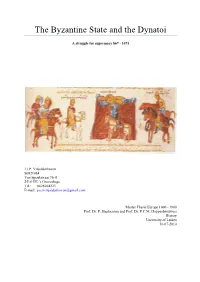
The Byzantine State and the Dynatoi
The Byzantine State and the Dynatoi A struggle for supremacy 867 - 1071 J.J.P. Vrijaldenhoven S0921084 Van Speijkstraat 76-II 2518 GE ’s Gravenhage Tel.: 0628204223 E-mail: joerivrijaldenhoven@gmail.com Master Thesis Europe 1000 - 1800 Prof. Dr. P. Stephenson and Prof. Dr. P.C.M. Hoppenbrouwers History University of Leiden 30-07-2014 CONTENTS GLOSSARY 2 INTRODUCTION 6 CHAPTER 1 THE FIRST STRUGGLE OF THE DYNATOI AND THE STATE 867 – 959 16 STATE 18 Novel (A) of Leo VI 894 – 912 18 Novels (B and C) of Romanos I Lekapenos 922/928 and 934 19 Novels (D, E and G) of Constantine VII Porphyrogenetos 947 - 959 22 CHURCH 24 ARISTOCRACY 27 CONCLUSION 30 CHAPTER 2 LAND OWNERSHIP IN THE PERIOD OF THE WARRIOR EMPERORS 959 - 1025 32 STATE 34 Novel (F) of Romanos II 959 – 963. 34 Novels (H, J, K, L and M) of Nikephoros II Phokas 963 – 969. 34 Novels (N and O) of Basil II 988 – 996 37 CHURCH 42 ARISTOCRACY 45 CONCLUSION 49 CHAPTER 3 THE CHANGING STATE AND THE DYNATOI 1025 – 1071 51 STATE 53 CHURCH 60 ARISTOCRACY 64 Land register of Thebes 65 CONCLUSION 68 CONCLUSION 70 APPENDIX I BYZANTINE EMPERORS 867 - 1081 76 APPENDIX II MAPS 77 BIBLIOGRAPHY 82 1 Glossary Aerikon A judicial fine later changed into a cash payment. Allelengyon Collective responsibility of a tax unit to pay each other’s taxes. Anagraphis / Anagrapheus Fiscal official, or imperial tax assessor, who held a role similar as the epoptes. Their major function was the revision of the tax cadastre. It is implied that they measured land and on imperial order could confiscate lands. -

Περίληψη : a Family in Asia Minor, Known Since the 9Th Century
IΔΡΥΜA ΜΕΙΖΟΝΟΣ ΕΛΛΗΝΙΣΜΟΥ Συγγραφή : Krsmanović Bojana Μετάφραση : Χρυσανθόπουλος Δημήτριος Για παραπομπή : Krsmanović Bojana , "Maleinos Family ", Εγκυκλοπαίδεια Μείζονος Ελληνισμού, Μ. Ασία URL: <http://www.ehw.gr/l.aspx?id=7766> Περίληψη : A family in Asia Minor, known since the 9th century. Its members held high military offices. They assumed their greatest power during the 10th century by creating family bonds with the Phokas family. At the time of Basil II, their estates were confiscated, an event which led to the political decline of the family. They lost their power completely during the 11th-12th century. Τόπος και Χρόνος Γέννησης prior to the 9th century, Charsianon, Cappadocia Τόπος και Χρόνος Θανάτου Κύρια Ιδιότητα Members of the military aristocracy 1. General The Maleinos family was one of the oldest aristocratic families of the Byzantine Empire, emerging during the 9th century from Charsianon and Cappadocia. Its members assumed high military offices and ranked at the top of the byzantine aristocracy from the beginning. During the 10th century, the Maleinos family ascended the social hierarchy by acquiring high offices and by creating family bonds with the Phokas family (beginning of the 10th century). Since that time, the Maleinos and the Phokas families constitute the core around which other aristocratic families of Asia Minor coil up in order to promote their interests. The Maleinos lineage was one of the wealthiest families of the empire. Its wealth is mentioned in the Novella of the year 996 by Basil II (976-1025), who confiscated all the estates of Eustathios Maleinos, an event with dire consequences on the wealth of the family. -

Masterarbeit / Master´S Thesis
MASTERARBEIT / MASTER´S THESIS Titel der Masterarbeit / Title of the Master´s Thesis „Marriage Strategies in the Early Palaiologan Period“ verfasst von / submitted by Konstantina Gerakini angestrebter akademischer Grad / in partial fulfilment of the requirements for the degree of Master of Arts (MA) Wien, 2018 / Vienna 2018 Studienkennzahl lt. Studienblatt / A 066 869 degree programme code as it appears on the student record sheet: Studienrichtung lt. Studienblatt / Masterstudium Byzantinistik und Neogräzistik degree programme as it appears on the student record sheet: Betreut von / Supervisor: Univ.- Prof. Dr. Claudia Rapp TABLE OF CONTENTS ACKNOWLEDGMENTS 3 INTRODUCTION The historical frame 4 Late Byzantine aristocracy: definition and state of research 6 Methodological approach 7 The Structure of the Thesis 8 The Sources 9 I. THE ARISTOCRACY IN THE EARLY PALAIOLOGAN PERIOD I.1. The Byzantine aristocracy: definition and terminology 13 Ranks and offices in the early Palaiologan period 18 The self-consciousness of the aristocracy 21 I.2.The Palaiologan high aristocracy 23 II. MARRIAGE STRATEGIES OF THE ARISTOCRACY IN THE EARLY PALAIOLOGAN PERIOD II.1. Marriage strategies of the aristocracy from the tenth to thirteenth century 41 Marriage strategies of the military aristocracy of the tenth century 41 Marriage strategies of the aristocratic families of the eleventh and twelfth centuries. The Komnenoi and the Doukai 44 Marriage strategies of the Angeloi and the Laskarids 49 II.2. Marriage strategies until 1259. The rise of the Palaiologoi 51 Marriage strategies of the Laskarids and other families of the aristocracy 57 1 II.3. Marriage strategies in the reign of Michael VIII Palaiologos (1259-1282) 62 II.4. -

The Political Opposition to Alexios I Komnenos (1081–1118)
The Political Opposition to Alexios I Komnenos (1081–1118) Inauguraldissertation zur Erlangung des Akademischen Grades eines Dr. phil., vorgelegt dem Fachbereich 07 Geschichts- und Kulturwissenschaften der Johannes Gutenberg-Universität Mainz von João Vicente de Medeiros Publio Dias aus São Paulo, Brasilien 2020 Dekan: 1. Gutachter: 2. Gutachter: Tag des Prüfungskolloquiums: 18. Juli 2018 Dedicado a Dai Table of Contents Acknowledgements ............................................................................................................... 1 Note on translation and transliteration .................................................................................. 2 i. Introduction ........................................................................................................................ 3 i.i. Bibliographic Review ...................................................................................................... 4 i.ii Conceptual and Theoretical Issues on Political Opposition in Byzantium ...................... 7 i.iii Sources .......................................................................................................................... 18 i.iii.i Material for History of Nikephoros Bryennios .......................................................... 24 i.iii.ii The Alexiad of Anna Komnene ................................................................................. 26 i.iii.iii The Epitome Historion of Ioannes Zonaras .............................................................. 30 i.iii.iv The Chronike -
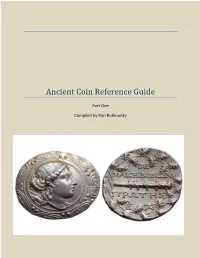
Ancient Coin Reference Guide
Ancient Coin Reference Guide Part One Compiled by Ron Rutkowsky When I first began collecting ancient coins I started to put together a guide which would help me to identify them and to learn more about their history. Over the years this has developed into several notebooks filled with what I felt would be useful information. My plan now is to make all this information available to other collectors of ancient coinage. I cannot claim any credit for this information; it has all come from many sources including the internet. Throughout this reference I use the old era terms of BC (Before Christ) and AD (Anno Domni, year of our Lord) rather than the more politically correct BCE (Before the Christian era) and CE (Christian era). Rome With most collections, there must be a starting point. Mine was with Roman coinage. The history of Rome is a subject that we all learned about in school. From Julius Caesar, Marc Anthony, to Constantine the Great and the fall of the empire in the late 5th century AD. Rome first came into being around the year 753 BC, when it was ruled under noble families that descended from the Etruscans. During those early days, it was ruled by kings. Later the Republic ruled by a Senate headed by a Consul whose term of office was one year replaced the kingdom. The Senate lasted until Julius Caesar took over as a dictator in 47 BC and was murdered on March 15, 44 BC. I will skip over the years until 27 BC when Octavian (Augustus) ended the Republic and the Roman Empire was formed making him the first emperor. -

Byzantine Names for SCA Personae
1 A Short (and rough) Guide to Byzantine Names for SCA personae This is a listing of names that may be useful for constructing Byzantine persona. Having said that, please note that the term „Byzantine‟ is one that was not used in the time of the Empire. They referred to themselves as Romans. Please also note that this is compiled by a non-historian and non-linguist. When errors are detected, please let me know so that I can correct them. Additional material is always welcomed. It is a work in progress and will be added to as I have time to research more books. This is the second major revision and the number of errors picked up is legion. If you have an earlier copy throw it away now. Some names of barbarians who became citizens are included. Names from „client states‟ such as Serbia and Bosnia, as well as adversaries, can be found in my other article called Names for other Eastern Cultures. In itself it is not sufficient documentation for heraldic submission, but it will give you ideas and tell you where to start looking. The use of (?) means that either I have nothing that gives me an idea, or that I am not sure of what I have. If there are alternatives given of „c‟, „x‟ and „k‟ modern scholarship prefers the „k‟. „K‟ is closer to the original in both spelling and pronunciation. Baron, OP, Strategos tous notious okeanous, known to the Latins as Hrolf Current update 12/08/2011 Family Names ............................................................. 2 Male First Names ....................................................... -

Table of Contents
The Sundered Eagle Contents The Middle Classes ........................ 37 I. Introduction 6 III. The Order of Hermes 20 The Lower Classes .......................... 37 BYZANTINE LANDSCAPE ....................... 6 HERMETIC HISTORY .......................... 20 Slavery ............................................ 37 BYZANTINE REALMS ............................ 6 Before the Order of Hermes ........... 20 Eunuchs .......................................... 37 BYZANTINE PEOPLES ........................... 6 Shaping the Theban Tribunal ......... 20 Women ........................................... 38 BYZANTINE LEGENDS .......................... 6 The Collapse of an Empire .................22 THE EASTERN CHURCH ..................... 38 HOW TO USE THIS BOOK ................... 7 THE LEAGUES OF THEBES .................. 22 The Two Patriarchs The League of Constantine ............ 22 of Constantinople ........................... 38 The Children of Olympos .............. 23 Buildings ......................................... 39 II. History of the Empire 8 The League of the Vigilant ............. 24 Clergy ............................................. 39 League Against Idolatry .................. 24 The Origin of Mankind .................... 8 Monastics ....................................... 40 The Age of Heroes ........................... 8 THEBAN TRIBUNAL POLITICS .............. 24 Icons ............................................... 40 The Trojan War .................................8 THE HERMETIC POLITY ..................... 24 INHABITANTS................................... -
The Column of Constantine at Constantinople: a Cultural History (330-1453 C.E.)
City University of New York (CUNY) CUNY Academic Works All Dissertations, Theses, and Capstone Projects Dissertations, Theses, and Capstone Projects 9-2017 The Column of Constantine at Constantinople: A Cultural History (330-1453 C.E.) Carey Thompson Wells The Graduate Center, City University of New York How does access to this work benefit ou?y Let us know! More information about this work at: https://academicworks.cuny.edu/gc_etds/2213 Discover additional works at: https://academicworks.cuny.edu This work is made publicly available by the City University of New York (CUNY). Contact: AcademicWorks@cuny.edu THE COLUMN OF CONSTANTINE AT CONSTANTINOPLE: A CULTURAL HISTORY (330-1453 C.E.) BY CAREY THOMPSON WELLS A master’s thesis submitted to the Graduate Faculty in Liberal Studies in partial fulfillment of the requirements for the degree of Master of Arts, The City University of New York 2017 © 2017 CAREY THOMPSON WELLS All Rights Reserved ii The Column of Constantine at Constantinople: A Cultural History (330-1453 C.E.) By Carey Thompson Wells This manuscript has been read and accepted for the Graduate Faculty in Liberal Studies in satisfaction of the thesis requirement for the degree in Master of Arts. _______________________ _____________________________ Date Dr. Eric Ivison Thesis Advisor _______________________ _____________________________ Date Dr. Elizabeth Macaulay-Lewis Executive Officer THE CITY UNIVERSITY OF NEW YORK iii Abstract The Column of Constantine at Constantinople A Cultural History (330-1453 C.E.) By Carey Thompson Wells Advisor: Dr. Eric Ivison This thesis discusses the cultural history of the Column of Constantine at Constantinople, exploring its changing function and meaning from Late Antiquity to the end of the Byzantine era. -
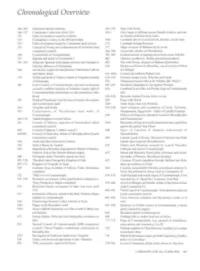
Chronological Overview
Chronological Overview 284-305 Diocletian and the tetrarchy 565-591 Wars with Persia 306-337 Constantine I (sole ruler from 324) 566 + Slavs begin to infiltrate across Danube frontier; pressure 311 Edict of toleration issued by Galerius on frontier fortresses from Avars 312 Constantine's victory at the Milvian bridge 568+ Lombards driven westward from Danube, invade Italy 313 Edict of toleration issued by Constantine and Licinius 572 Lombards besiege Ravenna 325 Council of Nicaea and condemnation of Arianism (first 577 Major invasion of Balkans led by Avars ecumenical council) 584, 586 Avaro-Slav attacks on Thessalonica 330 Consecration of Constantinople 591-602 Gradual success in pushing Avars back across Danube 337 Baptism and death of Constantine I 602 Maurice overthrown, Phokas proclaimed emperor 361-363 Julian the Apostate leads pagan reaction and attempts to 603 War with Persia; situation in Balkans deteriorates limit the influence of Christianity 610 Phokas overthrown by Heraclius, son of exarch of Africa 364 Jovian dies: empire divided between Valentinian 1 (West) at Carthage and Valens (East) 611-620s Central and northern Balkans lost 378 Defeat and death of Valens at hands of Visigoths at battle 614-619 Persians occupy Syria, Palestine and Egypt of Adrianople 622 Mohammed leaves Mecca for Medina (the 'Hijra') 381 First Council of Constantinople (second ecumenical 622-627 Heraclius campaigns in east against Persians council): reaffirms rejection of Arianism; asserts right of 626 Combined Avaro-Slav and Persian siege of Constantinople -
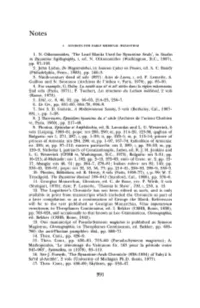
In Studies in Byzantine Sigillography, I, Ed. N. Oikonomides (Washington, D.C., 1987), Pp
Notes I. SOURCES FOR EARLY MEDIEVAL BYZANTIUM 1. N. Oikonomides, 'The Lead Blanks Used for Byzantine Seals', in Studies in Byzantine Sigillography, I, ed. N. Oikonomides (Washington, D.C., 1987), pp. 97-103. 2. John Lydus, De Magistratibus, in Joannes Lydus on Powers, ed. A. C. Bandy (Philadelphia, Penn., 1983), pp. 160-3. 3. Ninth-century deed of sale (897): Actes de Lavra, 1, ed. P. Lemerle, A. Guillou and N. Svoronos (Archives de l'Athos v, Paris, 1970), pp. 85-91. 4. For example, G. Duby, La societe aux xi' et xii' sii!cles dans la region maconnaise, 2nd edn (Paris, 1971); P. Toubert, Les structures du Latium medieval, 2 vols (Rome, 1973). 5. DAI, cc. 9, 46, 52, pp. 56-63, 214-23, 256-7. 6. De Cer., pp. 651-60, 664-78, 696-9. 7. See S. D. Goitein, A Mediterranean Society, 5 vols (Berkeley, Cal., 1967- 88), I, pp. 1-28. , 8. ]. Darrouzes, Epistoliers byzantins du x' sii!cle (Archives de I' orient Chretien VI, Paris, 1960), pp. 217-48. 9. Photius, Epistulae et Amphilochia, ed. B. Laourdas and L. G. Westerink, 6 vols (Leipzig, 1983-8), pope: nrs 288, 290; III, pp. 114-20, 123-38, qaghan of Bulgaria: nrs 1, 271, 287; 1, pp. 1-39; II, pp. 220-1; III, p. 113-14; prince of princes of Armenia: nrs 284, 298; III, pp. 1-97, 167-74; katholikos of Armenia: nr. 285; III, pp. 97-112; eastern patriarchs: nrs 2, 289; 1, pp. 39-53; III, pp. 120-3; Nicholas I, patriarch of Constantinople, Letters, ed.