ASTERACEAE: HELIANTHEAE) Polibotánica, Núm
Total Page:16
File Type:pdf, Size:1020Kb
Load more
Recommended publications
-
Chromosome Numbers in Compositae, XII: Heliantheae
SMITHSONIAN CONTRIBUTIONS TO BOTANY 0 NCTMBER 52 Chromosome Numbers in Compositae, XII: Heliantheae Harold Robinson, A. Michael Powell, Robert M. King, andJames F. Weedin SMITHSONIAN INSTITUTION PRESS City of Washington 1981 ABSTRACT Robinson, Harold, A. Michael Powell, Robert M. King, and James F. Weedin. Chromosome Numbers in Compositae, XII: Heliantheae. Smithsonian Contri- butions to Botany, number 52, 28 pages, 3 tables, 1981.-Chromosome reports are provided for 145 populations, including first reports for 33 species and three genera, Garcilassa, Riencourtia, and Helianthopsis. Chromosome numbers are arranged according to Robinson’s recently broadened concept of the Heliantheae, with citations for 212 of the ca. 265 genera and 32 of the 35 subtribes. Diverse elements, including the Ambrosieae, typical Heliantheae, most Helenieae, the Tegeteae, and genera such as Arnica from the Senecioneae, are seen to share a specialized cytological history involving polyploid ancestry. The authors disagree with one another regarding the point at which such polyploidy occurred and on whether subtribes lacking higher numbers, such as the Galinsoginae, share the polyploid ancestry. Numerous examples of aneuploid decrease, secondary polyploidy, and some secondary aneuploid decreases are cited. The Marshalliinae are considered remote from other subtribes and close to the Inuleae. Evidence from related tribes favors an ultimate base of X = 10 for the Heliantheae and at least the subfamily As teroideae. OFFICIALPUBLICATION DATE is handstamped in a limited number of initial copies and is recorded in the Institution’s annual report, Smithsonian Year. SERIESCOVER DESIGN: Leaf clearing from the katsura tree Cercidiphyllumjaponicum Siebold and Zuccarini. Library of Congress Cataloging in Publication Data Main entry under title: Chromosome numbers in Compositae, XII. -

Affinin (Spilanthol), Isolated from Heliopsis Longipes, Induces
International Journal of Molecular Sciences Article Affinin (Spilanthol), Isolated from Heliopsis longipes, Induces Vasodilation via Activation of Gasotransmitters and Prostacyclin Signaling Pathways Jesús Eduardo Castro-Ruiz 1,2, Alejandra Rojas-Molina 2, Francisco J. Luna-Vázquez 2, Fausto Rivero-Cruz 3, Teresa García-Gasca 1,* and César Ibarra-Alvarado 2,* 1 Laboratorio de Biología Celular y Molecular, Facultad de Ciencias Naturales, Universidad Autónoma de Querétaro, Campus Juriquilla, 76230 Querétaro, Qro., Mexico; dentaqro@live.com.mx 2 Laboratorio de Investigación Química y Farmacológica de Productos Naturales, Facultad de Ciencias Químicas, Universidad Autónoma de Querétaro, Centro Universitario, 76010 Querétaro, Qro., Mexico; rojasa@uaq.mx (A.R.-M.); fjlunavz@yahoo.com.mx (F.J.L.-V.) 3 Departamento de Farmacia, Facultad de Química, Universidad Nacional Autónoma de México, Ciudad Universitaria, 04510 México, D.F., Mexico; joserc@unam.mx * Correspondence: tggasca@gmail.com (T.G.-G.); cibarra@uaq.mx (C.I.-A.); Tel.: +52-442-1921-200 (ext. 5301) (T.G.-G.); +52-442-1921-200 (ext. 5527) (C.I.-A.) Academic Editor: Toshio Morikawa Received: 28 November 2016; Accepted: 13 January 2017; Published: 22 January 2017 Abstract: Heliopsis longipes roots have been widely used in Mexican traditional medicine to relieve pain, mainly, toothaches. Previous studies have shown that affinin, the major alkamide of these roots, induces potent antinociceptive and anti-inflammatory activities. However, the effect of H. longipes root extracts and affinin on the cardiovascular system have not been investigated so far. In the present study, we demonstrated that the dichloromethane and ethanolic extracts of H. longipes roots, and affinin, isolated from these roots, produce a concentration-dependent vasodilation of rat aorta. -

Insects and Weeds Hesearcfi for Toftiôrrow
Insects and Weeds Hesearcfi for Toftiôrrow [Heliopsis longipes (A. Gray) Blake], Natural mamey (Mammea americana L.), and neem (Azadirachta indica A. Juss.). Pesticides Although aU six could be commer- cially viable, the neem tree is by far Martin Jacobson, researc/i chemist, the most useful and likely to succeed. Insect Chemical Ecology Much applied research on agronomy, Laboratory, Agricultural commercial processing, and market- Environmental Quality Institute, ing is needed before commercial pro- Beltsville Agricultural Research duction of these species as sources of Center, Agricultural Research insecticides would be possible in the Service United States. From the time of the early Romans CâfâftICIS. This plant (also known until 1900, only three plant-de- as sweetflag) is a member of the fam- rived insecticides—pyre thrum, helle- ñy Araceae. It is a semiaquatic robust bore, and nicotine—have had wide- perennial that can also grow on dry spread use. The discovery of rotenone land. Calamus is 5 to 6 feet tau, has a and several plant-derived insecticides horizontal rootstock, and grows at al- followed in rapid succession. Ad- titudes from 3,000 to 6,000 feet. The vances in chemistry and improved plant grows wild in the United States screening techniques have led to the from Florida to Texas and in Idaho, discovery of many plant-derived in- and in the various provinces of On- sect toxicants, repellants, attractants, tario and Nova Scotia in Canada. It is feeding deterrents, growth inhibitors, propagated by division in the spring and sterilants. or autumn. Some of these compounds, pro- The large rhizomes are repellent or duced by the plants as defenses toxic to clothes moths, house flies, against pests and pathogens, may be fleas, lice, mosquitoes, and many developed commercially from arid or stored-grain insects. -
Index of Botanist Names Associated with the Flora of Putnam Park Frederick Warren King
Index of Botanist Names Associated with the Flora of Putnam Park Frederick Warren King Standard abbreviation form refers to how the botanist’s name may appear in the citation of a species. For a number of the botanists who appear below, they are the authorities or co- authorities for the names of many additional species. The focus in this list is on flowers that appear in Putnam Park. Andrews, Henry Cranke (c. 1759 – 1830). English botanist, botanical artist, and engraver. He is the authority for Scilla siberica, Siberian Squill. Standard abbreviation form: Andrews Aiton, William (1731–1793). He was a Scottish botanist, appointed director of Royal Botanic Gardens, Kew in 1759. He is the authority for Solidago nemoralis, Vaccinium angustifolium, Viola pubescens, and Viola sagittate. He is the former authority for Actaea rubra and Clintonia borealis. Standard abbreviation form: Aiton Aiton, William Townsend (1766 – 1849). English botanist, son of William Aiton. He is the authority for Barbarea vulgaris, Winter Cress. Standard abbreviation form: W.T. Aiton Al-Shehbaz, Ihsan Ali (b. 1939). Iraqi born American botanist, Senior Curator at the Missouri Botanical Garden. Co-authority for Arabidopsis lyrate, Lyre-leaved Rock Cress and Boechera grahamii, Spreading-pod Rock Cress, and authority for Boechera laevigata, Smooth Rock Cress. Standard abbreviation form: Al-Shehbaz Avé-Lallemant, Julius Léopold Eduard (1803 – 1867). German botanist, co-authority for Thalictrum dasycarpum, Tall Meadow Rue. The genus Lallemantia is named in his honor. Standard abbreviation form: Avé-Lall. Barnhart, John Hendley (1871 – 1949). Was an American botanist and non-practicing MD. He is the authority for Ratibida pinnata. -

Native Plants for Wildlife Habitat and Conservation Landscaping Chesapeake Bay Watershed Acknowledgments
U.S. Fish & Wildlife Service Native Plants for Wildlife Habitat and Conservation Landscaping Chesapeake Bay Watershed Acknowledgments Contributors: Printing was made possible through the generous funding from Adkins Arboretum; Baltimore County Department of Environmental Protection and Resource Management; Chesapeake Bay Trust; Irvine Natural Science Center; Maryland Native Plant Society; National Fish and Wildlife Foundation; The Nature Conservancy, Maryland-DC Chapter; U.S. Department of Agriculture, Natural Resource Conservation Service, Cape May Plant Materials Center; and U.S. Fish and Wildlife Service, Chesapeake Bay Field Office. Reviewers: species included in this guide were reviewed by the following authorities regarding native range, appropriateness for use in individual states, and availability in the nursery trade: Rodney Bartgis, The Nature Conservancy, West Virginia. Ashton Berdine, The Nature Conservancy, West Virginia. Chris Firestone, Bureau of Forestry, Pennsylvania Department of Conservation and Natural Resources. Chris Frye, State Botanist, Wildlife and Heritage Service, Maryland Department of Natural Resources. Mike Hollins, Sylva Native Nursery & Seed Co. William A. McAvoy, Delaware Natural Heritage Program, Delaware Department of Natural Resources and Environmental Control. Mary Pat Rowan, Landscape Architect, Maryland Native Plant Society. Rod Simmons, Maryland Native Plant Society. Alison Sterling, Wildlife Resources Section, West Virginia Department of Natural Resources. Troy Weldy, Associate Botanist, New York Natural Heritage Program, New York State Department of Environmental Conservation. Graphic Design and Layout: Laurie Hewitt, U.S. Fish and Wildlife Service, Chesapeake Bay Field Office. Special thanks to: Volunteer Carole Jelich; Christopher F. Miller, Regional Plant Materials Specialist, Natural Resource Conservation Service; and R. Harrison Weigand, Maryland Department of Natural Resources, Maryland Wildlife and Heritage Division for assistance throughout this project. -

Checklist of the Washington Baltimore Area
Annotated Checklist of the Vascular Plants of the Washington - Baltimore Area Part I Ferns, Fern Allies, Gymnosperms, and Dicotyledons by Stanwyn G. Shetler and Sylvia Stone Orli Department of Botany National Museum of Natural History 2000 Department of Botany, National Museum of Natural History Smithsonian Institution, Washington, DC 20560-0166 ii iii PREFACE The better part of a century has elapsed since A. S. Hitchcock and Paul C. Standley published their succinct manual in 1919 for the identification of the vascular flora in the Washington, DC, area. A comparable new manual has long been needed. As with their work, such a manual should be produced through a collaborative effort of the region’s botanists and other experts. The Annotated Checklist is offered as a first step, in the hope that it will spark and facilitate that effort. In preparing this checklist, Shetler has been responsible for the taxonomy and nomenclature and Orli for the database. We have chosen to distribute the first part in preliminary form, so that it can be used, criticized, and revised while it is current and the second part (Monocotyledons) is still in progress. Additions, corrections, and comments are welcome. We hope that our checklist will stimulate a new wave of fieldwork to check on the current status of the local flora relative to what is reported here. When Part II is finished, the two parts will be combined into a single publication. We also maintain a Web site for the Flora of the Washington-Baltimore Area, and the database can be searched there (http://www.nmnh.si.edu/botany/projects/dcflora). -

Heliopsis Longipes: Anti-Arthritic Activity Evaluated in a Freund’S
Revista Brasileira de Farmacognosia 27 (2017) 214–219 ww w.elsevier.com/locate/bjp Original Article Heliopsis longipes: anti-arthritic activity evaluated in a Freund’s adjuvant-induced model in rodents a,∗ b Carolina Escobedo-Martínez , Silvia Laura Guzmán-Gutiérrez , a c a María de los Milagros Hernández-Méndez , Julia Cassani , Alfonso Trujillo-Valdivia , a d Luis Manuel Orozco-Castellanos , Raúl G. Enríquez a Departamento de Farmacia, División de Ciencias Naturales y Exactas, Universidad de Guanajuato, Guanajuato, Mexico b Catedrática CONACyT, Departamento de Inmunología, Instituto de Investigaciones Biomédicas, Universidad Nacional Autónoma de México, México, DF, Mexico c Departamento de Sistemas Biológicos, Universidad Autónoma Metropolitana Unidad Xochimilco, México, DF, Mexico d Instituto de Química, Universidad Nacional Autónoma de México, México, DF, Mexico a b s t r a c t a r t i c l e i n f o Article history: This study assesses the anti-arthritic effect of the affinin-enriched (spilanthol, main alkamide) hexane Received 26 June 2016 extract from the roots of Heliopsis longipes (A. Gray) S.F. Blake, Asteraceae, on a Freund adjuvant-induced Accepted 5 September 2016 arthritis model in rodents. The extract was orally administered at a dose of 2, 6.6, or 20 mg/kg; a significant Available online 19 October 2016 edema-inhibitory activity in the acute and chronic phases was observed with a dose of 2 and 20 mg/kg, respectively. The extract showed higher anti-inflammatory and anti-arthritic effects than the reference Keywords: drug phenylbutazone (80 mg/kg). Moreover, the extract prevented the occurrence of secondary lesions Heliopsis longipes associated to this pharmacological model. -
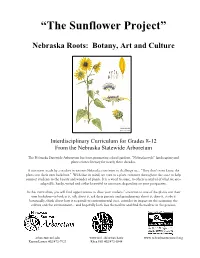
“The Sunflower Project”
“The Sunflower Project” Nebraska Roots: Botany, Art and Culture Interdisciplinary Curriculum for Grades 8-12 From the Nebraska Statewide Arboretum The Nebraska Statewide Arboretum has been promoting school gardens, “Nebraska-style” landscaping and plant science literacy for nearly three decades. A comment made by a teacher in western Nebraska continues to challenge us… “They don’t even know the plants out their own backdoor.” With that in mind, we turn to a plant common throughout the state to help connect students to the beauty and wonder of plants. It is a weed to some, to others a symbol of what we are— adaptable, hardy, varied and either beautiful or common, depending on your perspective. In this curriculum, you will find opportunities to draw your students’ attention to one of the plants out their own backdoor—to look at it, talk about it, ask their parents and grandparents about it, draw it, study it botanically, think about how it responds to environmental cues, consider its impact on the economy, the culture and the environment… and hopefully both lose themselves and find themselves in the process. arboretum.unl.edu www.unl.edu/artsarebasic www.nebraskaartscouncil.org Karma Larsen 402/472-7923 Rhea Gill 402/472-6844 “Wherever humans have gone, sunflowers have followed. The sunflower is the consummate American plant: tenacious, brash, bright, open, varied, optimistic, and cheerful, it might well be considered the true American flower. The impressive physiological characteristics of the sunflower and its very long association with -

Evolutionary Origins of a Bioactive Peptide Buried Within Preproalbuminc W
The Plant Cell, Vol. 26: 981–995, March 2014, www.plantcell.org ã 2014 American Society of Plant Biologists. All rights reserved. Evolutionary Origins of a Bioactive Peptide Buried within PreproalbuminC W Alysha G. Elliott,a Christina Delay,a,1 Huanle Liu,b Zaiyang Phua,a,2 K. Johan Rosengren,c Aurélie H. Benfield,a,3 Jose L. Panero,d Michelle L. Colgrave,e Achala S. Jayasena,f Kerry M. Dunse,g Marilyn A. Anderson,g Edward E. Schilling,h Daniel Ortiz-Barrientos,b David J. Craik,a and Joshua S. Mylnea,f,4 a The University of Queensland, Institute for Molecular Bioscience, Brisbane 4072, Australia b School of Biological Sciences, The University of Queensland, Brisbane 4072, Australia c School of Biomedical Sciences, The University of Queensland, Brisbane 4072, Australia d Section of Integrative Biology, University of Texas, Austin, Texas 78712 e CSIRO Animal, Food, and Health Sciences, St Lucia, Queensland 4067, Australia f The University of Western Australia, School of Chemistry and Biochemistry and ARC Centre of Excellence in Plant Energy Biology, Crawley, Perth 6009, Australia g La Trobe Institute for Molecular Science, La Trobe University, Melbourne 3086, Australia h University of Tennessee, Department of Ecology and Evolutionary Biology, Knoxville, Tennessee 37996 The de novo evolution of proteins is now considered a frequented route for biological innovation, but the genetic and biochemical processes that lead to each newly created protein are often poorly documented. The common sunflower (Helianthus annuus) contains the unusual gene PawS1 (Preproalbumin with SFTI-1) that encodes a precursor for seed storage albumin; however, in a region usually discarded during albumin maturation, its sequence is matured into SFTI-1, a protease-inhibiting cyclic peptide with a motif homologous to unrelated inhibitors from legumes, cereals, and frogs. -

Heliopsis Suffruticosa (Compositae, Heliantheae), Una Nueva Especie Del Occidente De Zacatecas
Acta Botanica Mexicana 97: 39-47 (2011) HELIOPSIS SUFFRUTICOSA (COMPOSITAE, HELIANTHEAE), UNA NUEVA ESPECIE DEL OCCIDENTE DE ZACATECAS DAVI D RAMÍ R EZ -NOYA 1,3, M. SOCO rr O GO N ZÁLEZ -ELIZO nd O 1 Y JO rg E MOLI N A -TO rr E S 2 1Instituto Politécnico Nacional, Centro Interdisciplinario de Investigación para el Desarrollo Integral Regional, Unidad Durango, Sigma 119, Fraccionamiento 20 de Noviembre II, 34220 Durango, Durango, México. 2Instituto Politécnico Nacional, Centro de Investigación y de Estudios Avanzados Unidad Irapuato, Depto. de Biotecnología y Bioquímica, Laboratorio de Fitobioquímica, km 9.6 Libramiento Norte, 36821 Irapuato, Guanajuato, México. 3Autor para la correspondencia: davidrnoya@yahoo.com.mx RESUMEN Se describe Heliopsis suffruticosa de la Sierra de Sombrerete al occidente de Zacatecas, de bosque bajo abierto de piñonero sobre caliza. La especie difiere de otras del género por tener hábito sufruticoso, hojas angostamente lanceoladas a lineares, enteras a espaciadamente serruladas y pedúnculo gradualmente ensanchado hacia el ápice, características que comparte con algunas especies de Zinnia. Se presenta una clave para distinguir entre las especies mexicanas de hábito perenne de Heliopsis. Al igual que en otros representantes de este género, las raíces de H. suffruticosa presentan alcamidas, detectándose en este caso cinco isobutil alcamidas diacetilénicas conjugadas, unidas a un metilo terminal en posición omega. Palabras clave: alcamidas, Compositae, endemismo, Heliantheae, Heliopsis. ABSTRACT Heliopsis suffruticosa is described from the Sierra de Sombrerete, in western Zacatecas, Mexico, growing in pinyon woodland on limestone. It differs from other species in the genus in having suffruticose habit, narrowly lanceolate to linear leaves with entire to sparsely serrulated margin, and peduncles gradually enlarged towards the apex, a combination of characters shared with some species of Zinnia. -
Plant Invaders of Mid-Atlantic Natural Areas Revised & Updated – with More Species and Expanded Control Guidance
Plant Invaders of Mid-Atlantic Natural Areas Revised & Updated – with More Species and Expanded Control Guidance National Park Service U.S. Fish and Wildlife Service 1 I N C H E S 2 Plant Invaders of Mid-Atlantic Natural Areas, 4th ed. Authors Jil Swearingen National Park Service National Capital Region Center for Urban Ecology 4598 MacArthur Blvd., N.W. Washington, DC 20007 Britt Slattery, Kathryn Reshetiloff and Susan Zwicker U.S. Fish and Wildlife Service Chesapeake Bay Field Office 177 Admiral Cochrane Dr. Annapolis, MD 21401 Citation Swearingen, J., B. Slattery, K. Reshetiloff, and S. Zwicker. 2010. Plant Invaders of Mid-Atlantic Natural Areas, 4th ed. National Park Service and U.S. Fish and Wildlife Service. Washington, DC. 168pp. 1st edition, 2002 2nd edition, 2004 3rd edition, 2006 4th edition, 2010 1 Acknowledgements Graphic Design and Layout Olivia Kwong, Plant Conservation Alliance & Center for Plant Conservation, Washington, DC Laurie Hewitt, U.S. Fish & Wildlife Service, Chesapeake Bay Field Office, Annapolis, MD Acknowledgements Funding provided by the National Fish and Wildlife Foundation with matching contributions by: Chesapeake Bay Foundation Chesapeake Bay Trust City of Bowie, Maryland Maryland Department of Natural Resources Mid-Atlantic Invasive Plant Council National Capital Area Garden Clubs Plant Conservation Alliance The Nature Conservancy, Maryland–DC Chapter Worcester County, Maryland, Department of Comprehensive Planning Additional Fact Sheet Contributors Laurie Anne Albrecht (jetbead) Peter Bergstrom (European -

Heliopsis Longipes: Anti-Arthritic Activity Evaluated in a Freund's
G Model BJP 317 1–6 ARTICLE IN PRESS Revista Brasileira de Farmacognosia xxx (2016) xxx–xxx ww w.elsevier.com/locate/bjp Original Article 1 Heliopsis longipes: anti-arthritic activity evaluated in a Freund’s 2 adjuvant-induced model in rodents a,∗ b 3 Q1 Carolina Escobedo-Martínez , Silvia Laura Guzmán-Gutiérrez , a c a 4 María de los Milagros Hernández-Méndez , Julia Cassani , Alfonso Trujillo-Valdivia , a d 5 Luis Manuel Orozco-Castellanos , Raúl G. Enríquez a 6 Departamento de Farmacia, División de Ciencias Naturales y Exactas, Universidad de Guanajuato, Guanajuato, Mexico b 7 Catedrática CONACyT, Departamento de Inmunología, Instituto de Investigaciones Biomédicas, Universidad Nacional Autónoma de México, México, DF, Mexico c 8 Departamento de Sistemas Biológicos, Universidad Autónoma Metropolitana Unidad Xochimilco, México, DF, Mexico d 9 Instituto de Química, Universidad Nacional Autónoma de México, México, DF, Mexico 10 a b s t r a c t 11 a r t i c l e i n f o 12 13 Article history: This study assesses the anti-arthritic effect of the affinin-enriched (spilanthol, main alkamide) hexane 14 Received 26 June 2016 extract from the roots of Heliopsis longipes (A. Gray) S.F. Blake, Asteraceae, on a Freund adjuvant-induced 15 Accepted 5 September 2016 arthritis model in rodents. The extract was orally administered at a dose of 2, 6.6, or 20 mg/kg; a significant 16 Available online xxx edema-inhibitory activity in the acute and chronic phases was observed with a dose of 2 and 20 mg/kg, 17 respectively. The extract showed higher anti-inflammatory and anti-arthritic effects than the reference 18 Keywords: drug phenylbutazone (80 mg/kg).