Ferrimonas Balearica Type Strain (PAT)
Total Page:16
File Type:pdf, Size:1020Kb
Load more
Recommended publications
-
The Gut Microbiome of the Sea Urchin, Lytechinus Variegatus, from Its Natural Habitat Demonstrates Selective Attributes of Micro
FEMS Microbiology Ecology, 92, 2016, fiw146 doi: 10.1093/femsec/fiw146 Advance Access Publication Date: 1 July 2016 Research Article RESEARCH ARTICLE The gut microbiome of the sea urchin, Lytechinus variegatus, from its natural habitat demonstrates selective attributes of microbial taxa and predictive metabolic profiles Joseph A. Hakim1,†, Hyunmin Koo1,†, Ranjit Kumar2, Elliot J. Lefkowitz2,3, Casey D. Morrow4, Mickie L. Powell1, Stephen A. Watts1,∗ and Asim K. Bej1,∗ 1Department of Biology, University of Alabama at Birmingham, 1300 University Blvd, Birmingham, AL 35294, USA, 2Center for Clinical and Translational Sciences, University of Alabama at Birmingham, Birmingham, AL 35294, USA, 3Department of Microbiology, University of Alabama at Birmingham, Birmingham, AL 35294, USA and 4Department of Cell, Developmental and Integrative Biology, University of Alabama at Birmingham, 1918 University Blvd., Birmingham, AL 35294, USA ∗Corresponding authors: Department of Biology, University of Alabama at Birmingham, 1300 University Blvd, CH464, Birmingham, AL 35294-1170, USA. Tel: +1-(205)-934-8308; Fax: +1-(205)-975-6097; E-mail: abej@uab.edu; sawatts@uab.edu †These authors contributed equally to this work. One sentence summary: This study describes the distribution of microbiota, and their predicted functional attributes, in the gut ecosystem of sea urchin, Lytechinus variegatus, from its natural habitat of Gulf of Mexico. Editor: Julian Marchesi ABSTRACT In this paper, we describe the microbial composition and their predictive metabolic profile in the sea urchin Lytechinus variegatus gut ecosystem along with samples from its habitat by using NextGen amplicon sequencing and downstream bioinformatics analyses. The microbial communities of the gut tissue revealed a near-exclusive abundance of Campylobacteraceae, whereas the pharynx tissue consisted of Tenericutes, followed by Gamma-, Alpha- and Epsilonproteobacteria at approximately equal capacities. -

Phylogenetic Analyses of the Genus Hymenobacter and Description of Siccationidurans Gen
etics & E en vo g lu t lo i y o h n a P r f y Journal of Phylogenetics & Sathyanarayana Reddy, J Phylogen Evolution Biol 2013, 1:4 o B l i a o n l r o DOI: 10.4172/2329-9002.1000122 u g o y J Evolutionary Biology ISSN: 2329-9002 Research Article Open Access Phylogenetic Analyses of the Genus Hymenobacter and Description of Siccationidurans gen. nov., and Parahymenobacter gen. nov Gundlapally Sathyanarayana Reddy* CSIR-Centre for Cellular and Molecular Biology, Uppal Road, Hyderabad-500 007, India Abstract Phylogenetic analyses of 26 species of the genus Hymenobacter based on the 16S rRNA gene sequences, resulted in polyphyletic clustering with three major groups, arbitrarily named as Clade1, Clade2 and Clade3. Delineation of Clade1 and Clade3 from Clade2 was supported by robust clustering and high bootstrap values of more than 90% and 100% in all the phylogenetic methods. 16S rRNA gene sequence similarity shared by Clade1 and Clade2 was 88 to 93%, Clade1 and Clade3 was 88 to 91% and Clade2 and Clade3 was 89 to 92%. Based on robust phylogenetic clustering, less than 93.0% sequence similarity, unique in silico restriction patterns, presence of distinct signature nucleotides and signature motifs in their 16S rRNA gene sequences, two more genera were carved to accommodate species of Clade1 and Clade3. The name Hymenobacter, sensu stricto, was retained to represent 17 species of Clade2. For members of Clade1 and Clade3, the names Siccationidurans gen. nov. and Parahymenobacter gen. nov. were proposed, respectively, and species belonging to Clade1 and Clade3 were transferred to their respective genera. -

Thalassomonas Agarivorans Sp. Nov., a Marine Agarolytic Bacterium Isolated from Shallow Coastal Water of An-Ping Harbour, Taiwan
International Journal of Systematic and Evolutionary Microbiology (2006), 56, 1245–1250 DOI 10.1099/ijs.0.64130-0 Thalassomonas agarivorans sp. nov., a marine agarolytic bacterium isolated from shallow coastal water of An-Ping Harbour, Taiwan, and emended description of the genus Thalassomonas Wen Dar Jean,1 Wung Yang Shieh2 and Tung Yen Liu2 Correspondence 1Center for General Education, Leader University, No. 188, Sec. 5, An-Chung Rd, Tainan, Wung Yang Shieh Taiwan winyang@ntu.edu.tw 2Institute of Oceanography, National Taiwan University, PO Box 23-13, Taipei, Taiwan A marine agarolytic bacterium, designated strain TMA1T, was isolated from a seawater sample collected in a shallow-water region of An-Ping Harbour, Taiwan. It was non-fermentative and Gram-negative. Cells grown in broth cultures were straight or curved rods, non-motile and non-flagellated. The isolate required NaCl for growth and exhibited optimal growth at 25 6C and 3 % NaCl. It grew aerobically and was incapable of anaerobic growth by fermenting glucose or other carbohydrates. Predominant cellular fatty acids were C16 : 0 (17?5 %), C17 : 1v8c (12?8 %), C17 : 0 (11?1 %), C15 : 0 iso 2-OH/C16 : 1v7c (8?6 %) and C13 : 0 (7?3 %). The DNA G+C content was 41?0 mol%. Phylogenetic, phenotypic and chemotaxonomic data accumulated in this study revealed that the isolate could be classified in a novel species of the genus Thalassomonas in the family Colwelliaceae. The name Thalassomonas agarivorans sp. nov. is proposed for the novel species, with TMA1T (=BCRC 17492T=JCM 13379T) as the type strain. Alteromonas-like bacteria in the class Gammaproteobacteria however, they are not exclusively autochthonous in the comprise a large group of marine, heterotrophic, polar- marine environment, since some reports have shown that flagellated, Gram-negative rods that are mainly non- they also occur in freshwater, sewage and soil (Agbo & Moss, fermentative aerobes. -
Dddy Is a Bacterial Dimethylsulfoniopropionate Lyase Representing a New Cupin Enzyme Superfamily with Unknown Primary Function
bioRxiv preprint doi: https://doi.org/10.1101/161257; this version posted July 9, 2017. The copyright holder for this preprint (which was not certified by peer review) is the author/funder. All rights reserved. No reuse allowed without permission. DddY is a bacterial dimethylsulfoniopropionate lyase representing a new cupin enzyme superfamily with unknown primary function Lei Lei, Uria Alcolombri & Dan S Tawfik Department of Biomolecular Sciences, Weizmann Institute of Science, Rehovot 76100, Israel. * Correspondence to: dan.tawfik@weizmann.ac.il Abstract Dimethylsulfide (DMS) is released at rates of >107 tons annually and plays a key role in the oceanic sulfur cycle and ecology. Marine bacteria, algae, and possibly other organisms, release DMS via cleavage of dimethylsulfoniopropionate (DMSP). Different genes encoding proteins with DMSP lyase activity are known belonging to different superfamilies and exhibiting highly variable levels of DMSP lyase activity. DddY shows the highest activity among all reported bacterial lyases yet is poorly characterized. Here, we describe the characterization of recombinant DddY is from different marine bacteria. We found that DddY activity demands a transition metal ion cofactor. DddY also shares two sequence motifs with other bacterial lyases assigned as cupin-like enzymes, DddQ, DddL, DddK, and DddW. These cupin motif residues are essential for DddY activity, as for the other cupin DMSP lyases, and all these enzymes are characterized by a common metal- chelator inhibitor (TPEN). Analysis of all sequences carrying these cupin motifs defined a superfamily: Cupin-DLL (DMSP lyases and lyase-like). The DMSP lyase families are sporadically distributed suggesting that DMSP lyases evolved within this superfamily independently along multiple lineages. -

Bacterial Diversity in the Intestine of Sea Cucumber Stichopus Japonicus
Bacterial diversity in the intestine of sea cucumber Stichopus japonicus Item Type article Authors Gao, M.L.; Hou, H.M.; Zhang, G.L.; Liu, Y.; Sun, L.M. Download date 29/09/2021 15:37:50 Link to Item http://hdl.handle.net/1834/37808 Iranian Journal of Fisheries Sciences 16(1)318-325 2017 Bacterial diversity in the intestine of sea cucumber Stichopus japonicus * Gao M.L.; Hou H.M. ; Zhang G.L.; Liu Y.; Sun L.M. Received: May 2015 Accepted: August 2016 Abstract The intestinal bacterial diversity of Stichopus japonicus was investigated using 16S ribosomal RNA gene (rDNA) clone library and Polymerase Chain Reaction/Denaturing Gradient Gel Electrophoresis (PCR-DGGE). The clone library yielded a total of 188 clones, and these were sequenced and classified into 106 operational taxonomic units (OTUs) with sequence similarity ranging from 88 to 100%. The coverage of the library was 77.4%, with approximately 88.7% of the sequences affiliated to Proteobacteria. Gammaproteobacteria and Vibrio sp. were the predominant groups in the intestine of S. japonicus. Some bacteria such as Legionella sp., Brachybacterium sp., Streptomyces sp., Propionigenium sp. and Psychrobacter sp were first identified in the intestine of sea cucumber. Keywords: Intestinal bacterial diversity, 16S rDNA, PCR-DGGE, Sequencing, Stichopus japonicus School of Food Science and Technology- Dalian Polytechnic University, Dalian 116034, P. R. China * Corresponding author's Email:houhongman2011@hotmail.com 319 Gao et al., Bacterial diversity in the intestine of sea cucumber Stichopus japonicas Introduction In this paper, 16S rDNA clone Sea cucumber Stichopus japonicus is library analysis approaches and one of the most important holothurian PCR-DGGE fingerprinting of the 16S species in coastal fisheries. -
Microbial Community Transcriptomes Reveal Microbes and Metabolic Pathways Associated with Dissolved Organic Matter Turnover in the Sea
Microbial community transcriptomes reveal microbes and metabolic pathways associated with dissolved organic matter turnover in the sea Jay McCarrena,b, Jamie W. Beckera,c, Daniel J. Repetac, Yanmei Shia, Curtis R. Younga, Rex R. Malmstroma,d, Sallie W. Chisholma, and Edward F. DeLonga,e,1 Departments of aCivil and Environmental Engineering and eBiological Engineering, Massachusetts Institute of Technology, Cambridge, MA 02139; cDepartment of Marine Chemistry and Geochemistry, Woods Hole Oceanographic Institution, Woods Hole, MA 02543; bSynthetic Genomics, La Jolla, CA 92037; and dJoint Genome Institute, Walnut Creek, CA 94598 This contribution is part of the special series of Inaugural Articles by members of the National Academy of Sciences elected in 2008. Contributed by Edward F. DeLong, August 2, 2010 (sent for review July 1, 2010) Marine dissolved organic matter (DOM) contains as much carbon as ventory with net accumulation following the onset of summertime the Earth’s atmosphere, and represents a critical component of the stratification, and net removal following with deep winter mixing. global carbon cycle. To better define microbial processes and activities In addition, multiyear time-series data suggest that surface-water associated with marine DOM cycling, we analyzed genomic and tran- DOM inventories have been increasing over the past 10–20 y (8). scriptional responses of microbial communities to high-molecular- The ecological factors behind these seasonal and decadal DOC weight DOM (HMWDOM) addition. The cell density in the unamended accumulations are largely unknown. Nutrient (N, P) amendments control remained constant, with very few transcript categories exhib- do not appear to result in a drawdown of DOC, and other factors iting significant differences over time. -

Pan-Genome Analyses of 24 Shewanella Strains Re-Emphasize
Zhong et al. Biotechnol Biofuels (2018) 11:193 https://doi.org/10.1186/s13068-018-1201-1 Biotechnology for Biofuels RESEARCH Open Access Pan‑genome analyses of 24 Shewanella strains re‑emphasize the diversifcation of their functions yet evolutionary dynamics of metal‑reducing pathway Chaofang Zhong, Maozhen Han, Shaojun Yu, Pengshuo Yang, Hongjun Li and Kang Ning* Abstract Background: Shewanella strains are important dissimilatory metal-reducing bacteria which are widely distributed in diverse habitats. Despite eforts to genomically characterize Shewanella, knowledge of the molecular components, functional information and evolutionary patterns remain lacking, especially for their compatibility in the metal- reducing pathway. The increasing number of genome sequences of Shewanella strains ofers a basis for pan-genome studies. Results: A comparative pan-genome analysis was conducted to study genomic diversity and evolutionary relation- ships among 24 Shewanella strains. Results revealed an open pan-genome of 13,406 non-redundant genes and a core-genome of 1878 non-redundant genes. Selective pressure acted on the invariant members of core genome, in which purifying selection drove evolution in the housekeeping mechanisms. Shewanella strains exhibited extensive genome variability, with high levels of gene gain and loss during the evolution, which afected variable gene sets and facilitated the rapid evolution. Additionally, genes related to metal reduction were diversely distributed in Shewanella strains and evolved under purifying selection, which highlighted the basic conserved functionality and specifcity of respiratory systems. Conclusions: The diversity of genes present in the accessory and specifc genomes of Shewanella strains indicates that each strain uses diferent strategies to adapt to diverse environments. -

Taxonomic Hierarchy of the Phylum Proteobacteria and Korean Indigenous Novel Proteobacteria Species
Journal of Species Research 8(2):197-214, 2019 Taxonomic hierarchy of the phylum Proteobacteria and Korean indigenous novel Proteobacteria species Chi Nam Seong1,*, Mi Sun Kim1, Joo Won Kang1 and Hee-Moon Park2 1Department of Biology, College of Life Science and Natural Resources, Sunchon National University, Suncheon 57922, Republic of Korea 2Department of Microbiology & Molecular Biology, College of Bioscience and Biotechnology, Chungnam National University, Daejeon 34134, Republic of Korea *Correspondent: scnu@scnu.ac.kr The taxonomic hierarchy of the phylum Proteobacteria was assessed, after which the isolation and classification state of Proteobacteria species with valid names for Korean indigenous isolates were studied. The hierarchical taxonomic system of the phylum Proteobacteria began in 1809 when the genus Polyangium was first reported and has been generally adopted from 2001 based on the road map of Bergey’s Manual of Systematic Bacteriology. Until February 2018, the phylum Proteobacteria consisted of eight classes, 44 orders, 120 families, and more than 1,000 genera. Proteobacteria species isolated from various environments in Korea have been reported since 1999, and 644 species have been approved as of February 2018. In this study, all novel Proteobacteria species from Korean environments were affiliated with four classes, 25 orders, 65 families, and 261 genera. A total of 304 species belonged to the class Alphaproteobacteria, 257 species to the class Gammaproteobacteria, 82 species to the class Betaproteobacteria, and one species to the class Epsilonproteobacteria. The predominant orders were Rhodobacterales, Sphingomonadales, Burkholderiales, Lysobacterales and Alteromonadales. The most diverse and greatest number of novel Proteobacteria species were isolated from marine environments. Proteobacteria species were isolated from the whole territory of Korea, with especially large numbers from the regions of Chungnam/Daejeon, Gyeonggi/Seoul/Incheon, and Jeonnam/Gwangju. -

Nutrient Enrichment Predominantly Affects Low Diversity Microbiomes in a Marine Trophic Symbiosis Between Algal Farming Fish and Corals
microorganisms Article Nutrient Enrichment Predominantly Affects Low Diversity Microbiomes in a Marine Trophic Symbiosis between Algal Farming Fish and Corals Adriana Messyasz 1,2,* , Rebecca L. Maher 1,3 , Sonora S. Meiling 4 and Rebecca Vega Thurber 1 1 Department of Microbiology, Oregon State University, Corvallis, OR 97331, USA; beccaluciamaher@gmail.com (R.L.M.); rvegathurber@gmail.com (R.V.T.) 2 Environmental Sciences Graduate Program, Oregon State University, Corvallis, OR 97331, USA 3 Institute of Ecology and Evolution, University of Oregon, Eugene, OR 97403, USA 4 Center for Marine and Environmental Studies, University of the Virgin Islands, St. Thomas 00802, U.S. Virgin Islands; sonora.meiling@gmail.com * Correspondence: messyasza@gmail.com Abstract: While studies show that nutrient pollution shifts reef trophic interactions between fish, macroalgae, and corals, we know less about how the microbiomes associated with these organisms react to such disturbances. To investigate how microbiome dynamics are affected during nutrient pollution, we exposed replicate Porites lobata corals colonized by the fish Stegastes nigricans, which farm an algal matrix on the coral, to a pulse of nutrient enrichment over a two-month period and examined the microbiome of each partner using 16S amplicon analysis. We found 51 amplicon sequence variants (ASVs) shared among the three hosts. Coral microbiomes had the lowest diversity Citation: Messyasz, A.; Maher, R.L.; with over 98% of the microbiome dominated by a single genus, Endozoicomonas. Fish and algal matrix Meiling, S.S.; Thurber, R.V. Nutrient microbiomes were ~20 to 70× more diverse and had higher evenness compared to the corals. The Enrichment Predominantly Affects addition of nutrients significantly increased species richness and community variability between Low Diversity Microbiomes in a samples of coral microbiomes but not the fish or algal matrix microbiomes, demonstrating that coral Marine Trophic Symbiosis between microbiomes are less resistant to nutrient pollution than their trophic partners. -
Appendix 1. Validly Published Names, Conserved and Rejected Names, And
Appendix 1. Validly published names, conserved and rejected names, and taxonomic opinions cited in the International Journal of Systematic and Evolutionary Microbiology since publication of Volume 2 of the Second Edition of the Systematics* JEAN P. EUZÉBY New phyla Alteromonadales Bowman and McMeekin 2005, 2235VP – Valid publication: Validation List no. 106 – Effective publication: Names above the rank of class are not covered by the Rules of Bowman and McMeekin (2005) the Bacteriological Code (1990 Revision), and the names of phyla are not to be regarded as having been validly published. These Anaerolineales Yamada et al. 2006, 1338VP names are listed for completeness. Bdellovibrionales Garrity et al. 2006, 1VP – Valid publication: Lentisphaerae Cho et al. 2004 – Valid publication: Validation List Validation List no. 107 – Effective publication: Garrity et al. no. 98 – Effective publication: J.C. Cho et al. (2004) (2005xxxvi) Proteobacteria Garrity et al. 2005 – Valid publication: Validation Burkholderiales Garrity et al. 2006, 1VP – Valid publication: Vali- List no. 106 – Effective publication: Garrity et al. (2005i) dation List no. 107 – Effective publication: Garrity et al. (2005xxiii) New classes Caldilineales Yamada et al. 2006, 1339VP VP Alphaproteobacteria Garrity et al. 2006, 1 – Valid publication: Campylobacterales Garrity et al. 2006, 1VP – Valid publication: Validation List no. 107 – Effective publication: Garrity et al. Validation List no. 107 – Effective publication: Garrity et al. (2005xv) (2005xxxixi) VP Anaerolineae Yamada et al. 2006, 1336 Cardiobacteriales Garrity et al. 2005, 2235VP – Valid publica- Betaproteobacteria Garrity et al. 2006, 1VP – Valid publication: tion: Validation List no. 106 – Effective publication: Garrity Validation List no. 107 – Effective publication: Garrity et al. -
Supplementary Figures and Tables Metavelvet-SL
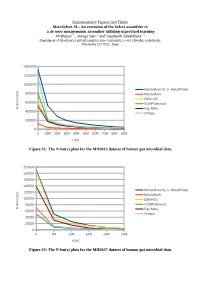
Supplementary Figures and Tables MetaVelvet-SL: An extension of the Velvet assembler to a de novo metagenomic assembler utilizing supervised learning Afiahayati 1 , Kengo Sato 1 and Yasubumi Sakakibara 1∗ Department of Biosciences and Informatics, Keio University, 3-14-1 Hiyoshi, Kohoku-ku, Yokohama 223-8522, Japan 1400000 1200000 1000000 MetaVelvet-SL (+ MetaPhlAn) ) p 800000 b MetaVelvet ( ) x ( IDBA-UD n 600000 e SOAPDenovo2 l - N Ray Meta 400000 Omega 200000 0 0 10M 20M 30M 40M 50M 60M 70M 80M 90M x (bp) Figure S1: The N-len(x) plots for the MH0012 dataset of human gut microbial data. 200000 180000 160000 140000 MetaVelvet-SL (+ MetaPhlAn) ) 120000 p b MetaVelvet ( ) 100000 x IDBA-UD ( n e l 80000 SOAPDenovo2 - N Ray Meta 60000 Omega 40000 20000 0 0 5M 10M 15M 20M 25M x(bp) Figure S2: The N-len(x) plots for the MH0047 dataset of human gut microbial data. 600000 500000 400000 MetaVelvet-SL (+ MetaPhlAn) ) p b MetaVelvet ( ) 300000 x IDBA-UD ( n e l SOAPDenovo2 - N 200000 Ray Meta Omega 100000 0 0 10M 20M 30M 40M 50M 60M 70M 80M 90M x (bp) Figure S3: The N-len(x) plots for the SRS017227 dataset of human gut microbial data. 800000 700000 600000 500000 MetaVelvet-SL (+ MetaPhlAn) ) p b MetaVelvet ( ) 400000 x IDBA-UD ( n e l SOAPDenovo2 - 300000 N Ray Meta 200000 Omega 100000 0 0 5M 10M 15M 20M 25M 30M 35M 40M 45M x (bp) Figure S4: The N-len(x) plots for the SRS018661 dataset of human gut microbial data. Formula to identify unique nodes in Velvet (Zerbino and Birney, 2008) ̄x2 ρ2− log2 2 F ( ̄x ,n,ρ )= +n 2 2 where ̄x = the coverage of node ρ = expected coverage of subgraph n = the length of node A node is “unique”, if its F > 5 . -
Bacterial Taxa Based on Greengenes Database GS1A PS1B ABY1 OD1
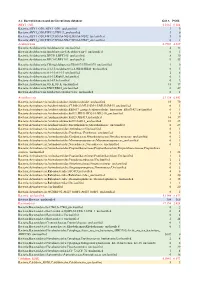
A1: Bacterial taxa based on GreenGenes database GS1A PS1B ABY1_OD1 0.1682 0.024 Bacteria;ABY1_OD1;ABY1_OD1_unclassified 1 0 Bacteria;ABY1_OD1;FW129;FW129_unclassified 4 0 Bacteria;ABY1_OD1;FW129;KNA6-NB12;KNA6-NB12_unclassified 5 0 Bacteria;ABY1_OD1;FW129;KNA6-NB29;KNA6-NB29_unclassified 0 1 Acidobacteria 0.7907 4.509 Bacteria;Acidobacteria;Acidobacteria_unclassified 4 31 Bacteria;Acidobacteria;Acidobacteria-5;Acidobacteria-5_unclassified 0 1 Bacteria;Acidobacteria;BPC015;BPC015_unclassified 8 30 Bacteria;Acidobacteria;BPC102;BPC102_unclassified 9 43 Bacteria;Acidobacteria;Chloracidobacteria;Ellin6075;Ellin6075_unclassified 1 0 Bacteria;Acidobacteria;iii1-15;Acidobacteria-6;RB40;RB40_unclassified 0 5 Bacteria;Acidobacteria;iii1-15;iii1-15_unclassified 1 8 Bacteria;Acidobacteria;iii1-15;Riz6I;Unclassified 0 1 Bacteria;Acidobacteria;iii1-8;Unclassified 0 2 Bacteria;Acidobacteria;OS-K;OS-K_unclassified 18 17 Bacteria;Acidobacteria;RB25;RB25_unclassified 6 47 Bacteria;Acidobacteria;Solibacteres;Solibacteres_unclassified 0 1 Actinobacteria 2.1198 6.642 Bacteria;Actinobacteria;Acidimicrobidae;Acidimicrobidae_unclassified 10 70 Bacteria;Actinobacteria;Acidimicrobidae;CL500-29;ML316M-15;ML316M-15_unclassified 0 3 Bacteria;Actinobacteria;Acidimicrobidae;EB1017_group;Acidimicrobidae_bacterium_Ellin7143;Unclassified 6 1 Bacteria;Actinobacteria;Acidimicrobidae;koll13;JTB31;BD2-10;BD2-10_unclassified 1 5 Bacteria;Actinobacteria;Acidimicrobidae;koll13;JTB31;Unclassified 16 37 Bacteria;Actinobacteria;Acidimicrobidae;koll13;koll13_unclassified 81 25 Bacteria;Actinobacteria;Acidimicrobidae;Microthrixineae;Microthrixineae_unclassified