Rapport D'évaluation Ex-Ante De Projets Local Juin 2018
Total Page:16
File Type:pdf, Size:1020Kb
Load more
Recommended publications
-
Pdf Projdoc.Pdf
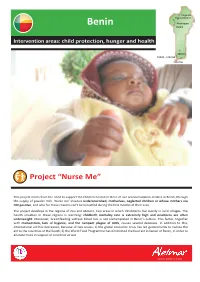
Tanguieta Toucountouna Benin Natitingou Perma Intervention areas: child protection, hunger and health Abomey Condji - Lokossa Cotonou Project “Nurse Me” This project stems from the need to support the children hosted in three of our accommodation centres in Benin, through the supply of powder milk. ‘Nurse me’ involves undernourished, motherless, neglected children or whose mothers are HIV positive, and who for these reasons can’t be breastfed during the first months of their lives. The project develops in the regions of Zou and Atacora, two areas in which inhabitants live mainly in rural villages. The health situation in these regions is alarming: childbirth mortality rate is extremely high and newborns are often underweight. Moreover, breastfeeding without blood ties is not contemplated in Benin’s culture. This factor, together with malnutrition, lack of hygiene, and the rampant plague of AIDS, causes several deceases. In addition to this, international aid has decreased, because of two issues: 1) the global economic crisis has led governments to reduce the aid to the countries of the South; 2) the World Food Programme has diminished the food aid in favour of Benin, in order to allocate more in support of countries at war. Insieme ai bambini del mondo Project objectives - Promote the right to life and health; - Prevent babies’ premature death caused by the impossibility of breastfeeding. Project beneficiaries - Undernourished, motherless, neglected children or whose mothers are HIV positive, who are hosted in our accommodation centres or monitored by the nutritional centre; - Families living in rural areas around our accommodation centres, which can benefit from a free health and nutritional service for their children. -

Proposal for Benin, Burkina Faso, Niger
AFB/PPRC.22-23/14 6 June 2018 Adaptation Fund Board Project and Programme Review Committee PROPOSAL FOR BENIN, BURKINA FASO, NIGER AFB/PPRC.22-23/14 Background 1. The strategic priorities, policies and guidelines of the Adaptation Fund (the Fund), as well as its operational policies and guidelines include provisions for funding projects and programmes at the regional, i.e. transnational level. However, the Fund has thus far not funded such projects and programmes. 2. The Adaptation Fund Board (the Board), as well as its Project and Programme Review Committee (PPRC) and Ethics and Finance Committee (EFC) considered issues related to regional projects and programmes on a number of occasions between the Board’s fourteenth and twenty-first meetings but the Board did not make decisions for the purpose of inviting proposals for such projects. Indeed, in its fourteenth meeting, the Board decided to: (c) Request the secretariat to send a letter to any accredited regional implementing entities informing them that they could present a country project/programme but not a regional project/programme until a decision had been taken by the Board, and that they would be provided with further information pursuant to that decision (Decision B.14/25 (c)) 3. In its eighth meeting in March 2012, the PPRC came up with recommendations on certain definitions related to regional projects and programmes. However, as the subsequent seventeenth Board meeting took a different strategic approach to the overall question of regional projects and programmes, these PPRC recommendations were not included in a Board decision. 4. In its twenty-fourth meeting, the Board heard a presentation from the coordinator of the working group set up by decision B.17/20 and tasked with following up on the issue of regional projects and programmes. -

Influence Des Pressions Anthropiques Sur La Structure Des Populations De Pentadesma Butyracea Au Bénin
Document generated on 09/28/2021 1:27 a.m. VertigO La revue électronique en sciences de l’environnement Influence des pressions anthropiques sur la structure des populations de Pentadesma butyracea au Bénin Influence of human activities on Pentadesma butyracea populations structure in Benin Aliou Dicko, Samadori Sorotori Honoré Biaou, Armand Kuyema Natta, Choukouratou Aboudou Salami Gado and M’Mouyohoum Kouagou Vulnérabilités environnementales : perspectives historiques Article abstract Volume 16, Number 3, December 2016 The present study examined the influence of human activities on the structural characteristics of the populations of P. butyracea, a vulnerable multipurpose URI: https://id.erudit.org/iderudit/1039997ar woody species. A total of 116 plots of 500 m² were randomly installed, 68 in the sudanian region and 48 in the sudano-guinean region, for dendrometric and See table of contents floristic inventories. The populations of P. butyracea were categorized according to human pressures they are exposed to, using a Factorial Analysis of Correspondences. Three groups were discriminated : Group 1 (populations of Penessoulou and Kandi), characterized by a pressure from wild vegetation Publisher(s) fires and agricultural activities ; Group 2 (populations of Manigri and Ségbana), Université du Québec à Montréal characterized by illegal selective logging, abusive barking of P. butyracea, Éditions en environnement VertigO animal grazing ; and Group 3 (populations of Natitingou, Toucountouna and Tchaourou), characterized by excessive seeds collection and sand removal from the stream by humans. The diameter distribution structures were of left ISSN or right dissymmetry according to pressures types to which the discriminated 1492-8442 (digital) groups are subjected. For a conservation of remnant populations of P. -

1- Etat Et Structure De La Population De L'atacora 2
REPUBLIQUE DU BENIN ------------------- MINISTERE DU PLAN ET DU DEVELOPPEMENT ------------------- Institut National de la Statistique et de l’Analyse Economique Synthèse des principaux résultats du RGPH-4 de l’ATACORA 1- Etat et structure de la population de l’Atacora Evolution de la population de l’Atacora de 2002 à 2013 DIVISIONS RGPH4-2013 RGPH3-2002 Taux Poids ADMINISTRATIVES d'accroissement démographique intercensitaire en % en 2013 en % (2002- Total Masculin Féminin Total Masculin Féminin 2013) BENIN 10 008 749 4 887 820 5 120 929 6 769 914 3 284 119 3 485 795 3,52 ATACORA 772 262 380 448 391 814 549 417 270 504 278 913 3,06 7,7 Boukoumbé 82 450 40 479 41 971 60 568 29 523 31 045 2,77 10,7 Cobly 67 603 32 784 34 819 46 660 22 421 24 239 3,34 8,8 Kérou 100 197 49 963 50 234 62 632 31 397 31 235 4,25 13,0 Kouandé 111 540 55 558 55 982 80 261 40 132 40 129 2,96 14,4 Matéri 113 958 55 676 58 282 83 721 40 255 43 466 2,77 14,8 Natitingou 103 843 50 968 52 875 75 620 37 388 38 232 2,85 13,4 Péhunco 78 217 39 147 39 070 55 082 27 546 27 536 3,15 10,1 Tanguiéta 74 675 36 431 38 244 54 719 27 120 27 599 2,79 9,7 Toucountouna 39 779 19 442 20 337 30 154 14 722 15 432 2,48 5,2 En 2013, le département de l’Atacora compte 772 262 habitants soit 7,7% de la Evolution de la structure par âge de la population de l'Atacora aux RGPH-1992, RGPH- population béninoise. -

Rapport Final De L'enquete Steps Au Benin
REPUBLIQUE DU BENIN MINISTERE DE LA SANTE Direction Nationale de la Protection Sanitaire Programme National de Lutte contre les Maladies Non Transmissibles RAPPORT FINAL DE L’ENQUETE STEPS AU BENIN Juin 2008 EQUIPE DE REDACTION Pr. HOUINATO Dismand Coordonnateur National / PNLMNT Dr SEGNON AGUEH Judith A. Médecin Epidémiologiste / PNLMNT Pr. DJROLO François Point focal diabète /PNLMNT Dr DJIGBENNOUDE Oscar Médecin Santé Publique/ PNLMNT i Sommaire RESUME ...........................................................................................................1 1 INTRODUCTION....................................................................................... 2 2 OBJECTIFS ................................................................................................ 5 3 CADRE DE L’ETUDE: (étendue géographique).........................................7 4 METHODE ............................................................................................... 16 5 RESULTATS ............................................................................................ 23 6 Références bibliographiques...................................................................... 83 7 Annexes ii Liste des tableaux Tableau I: Caractéristiques sociodémographiques des sujets enquêtés au Bénin en 2008..... 23 Tableau II: Répartition des sujets enquêtés en fonction de leur niveau d’instruction, activité professionnelle et département au Bénin en 2008. ................................................................ 24 Tableau III : Répartition des consommateurs -

Les Communes Du Benin En Chiffres
REPUBLIQUE DU BENIN Fraternité – Justice -Travail ********** COMMISSION NATIONALE DES FINANCES LOCALES ********** SECRETARIAT PERMANENT LES COMMUNES DU BENIN EN CHIFFRES 2010 IMAGE LES COMMUNES DU BENIN EN CHIFFRES 2010 1 Préface Les collectivités territoriales les ressources liées à leurs compétences et jusque- un maillon important dans le ministériels, participe de cette volonté de voir les développementdécentralisées sontde la Nation. aujourd’hui La communeslà mises disposer en œuvre de ressources par les départements financières volonté de leur mise en place suffisantes pour assumer la plénitude des missions qui sont les leurs. des Forces Vives de la Nation de février 1990. Les Si en 2003, au début de la mise en effective de la articles 150, 151,remonte 152 et 153à l’historique de la Constitution Conférence du 11 décembre 1990 a posé le principe de leur libre aux Communes représentaient environ 2% de leursdécentralisation, recettes de les fonctionnementtransferts financiers et de5% l’Etat en décentralisation dont les objectifs majeurs sont la promotionadministration de consacrantla démocratie ainsi l’avènementà la base etde lela transferts ont sensiblement augmenté et développement local. représententmatière d’investissement, respectivement 13%aujourd’hui et 73%. En cesdix Depuis dix (10) ans déjà, nos collectivités administration de leur territoire, assumant ainsi environ quatreans vingtd’expérience (80) milliards en matière de F CFA deen lesterritoriales missions quivivent sont l’apprentissage les leurs. Ces missionsde la libre ne dehorsdécentralisation, des interventions l’Etat a transféré directes auxréalisées communes dans sont guère aisées surtout au regard des ces communes. multiples et pressants besoins à la base, face aux ressources financières souvent limitées. doiventCes efforts en prendrede l’Etat la qui mesure se poursuivront pour une utilisation sans nul YAYI Bon a bien pri sainedoute etméritent transparente d’être de salués ces ressources. -

Laws of Attraction Northern Benin and Risk of Violent Extremist Spillover
Laws of Attraction Northern Benin and risk of violent extremist spillover CRU Report Kars de Bruijne Laws of Attraction Northern Benin and risk of violent extremist spillover Kars de Bruijne CRU Report June 2021 This is a joint report produced by the Conflict Research Unit of Clingendael – the Netherlands Institute of International Relations in partnership with the Armed Conflict Location & Event Data Project (ACLED). June 2021 © Netherlands Institute of International Relations ‘Clingendael’. Cover photo: © Julien Gerard Unauthorized use of any materials violates copyright, trademark and / or other laws. Should a user download material from the website or any other source related to the Netherlands Institute of International Relations ‘Clingendael’, or the Clingendael Institute, for personal or non-commercial use, the user must retain all copyright, trademark or other similar notices contained in the original material or on any copies of this material. Material on the website of the Clingendael Institute may be reproduced or publicly displayed, distributed or used for any public and non-commercial purposes, but only by mentioning the Clingendael Institute as its source. Permission is required to use the logo of the Clingendael Institute. This can be obtained by contacting the Communication desk of the Clingendael Institute (press@clingendael.org). The following web link activities are prohibited by the Clingendael Institute and may present trademark and copyright infringement issues: links that involve unauthorized use of our logo, framing, inline links, or metatags, as well as hyperlinks or a form of link disguising the URL. About the author Kars de Bruijne is a Senior Research Fellow with the Clingendael’s Conflict Research Unit and a former Senior Researcher at ACLED. -

Local Agro-Ecological Condition-Based Food Resources to Promote Infant Food Security: a Case Study from Benin
Local agro-ecological condition-based food resources to promote infant food security: a case study from Benin Flora Josiane Chadare, Nadia Fanou Fogny, Yann Eméric Madode, Juvencio Odilon G. Ayosso, Sèwanou Hermann Honfo, Folachodé Pierre Polycarpe Food Security TheKayodé, Science, Sociology et and Economicsal. of Food Production and Access to Food ISSN 1876-4517 Food Sec. DOI 10.1007/s12571-018-0819-y 1 23 Your article is protected by copyright and all rights are held exclusively by Springer Nature B.V. and International Society for Plant Pathology. This e-offprint is for personal use only and shall not be self-archived in electronic repositories. If you wish to self-archive your article, please use the accepted manuscript version for posting on your own website. You may further deposit the accepted manuscript version in any repository, provided it is only made publicly available 12 months after official publication or later and provided acknowledgement is given to the original source of publication and a link is inserted to the published article on Springer's website. The link must be accompanied by the following text: "The final publication is available at link.springer.com”. 1 23 Author's personal copy Food Security https://doi.org/10.1007/s12571-018-0819-y ORIGINAL PAPER Local agro-ecological condition-based food resources to promote infant food security: a case study from Benin Flora Josiane Chadare1,2 & Nadia Fanou Fogny1 & Yann Eméric Madode1 & Juvencio Odilon G. Ayosso1 & Sèwanou Hermann Honfo3 & Folachodé Pierre Polycarpe Kayodé1 & Anita Rachel Linnemann4 & Djidjoho Joseph Hounhouigan 1 Received: 7 July 2017 /Accepted: 19 June 2018 # Springer Nature B.V. -

The Benin Case Béatrice Lalinon Gbado Editio
Date : 28/07/2008 What challenges has your library faced? How did you respond? The Benin case Béatrice Lalinon Gbado Editions Ruisseaux d’Afrique, Parakou Library Benin Translated by : VIVIANA QUINONES La Joie par les Livres - Centre national de la literature pour la jeunesse Paris, France) Meeting: 155. Libraries for Children and Young Adults Section de bibliothèques pour enfants et jeunes de l’IFLA Simultaneous Interpretation: Not available WORLD LIBRARY AND INFORMATION CONGRESS: 74TH IFLA GENERAL CONFERENCE AND COUNCIL 10-14 August 2008, Québec, Canada http://www.ifla.org/IV/ifla74/index.htm I - Introduction I am Beatrice Lalinon GBADO. writer for children and young people, I am the founder of the publishing house Ruisseaux d’Afrique, and initiator of SELIBEJ: Beninese week for children's books. This paper was prepared in link with Ms. MORA of the Departmental Library of Parakou, the northern capital of Benin ; it describes ten years of activities programmed for children and young people in our library network. II The problem : A dying library network II.1 The absence of African books for children When I was a child, I read in a rather modest environment, third-, fourth- and fifth-hand books, public library books, books borrowed from the school case, books, bits of books, written words... I have read a lot. Books coming from elsewhere, there to tell us the life and dreams of others. I am always fascinated by the beauty of literature; I love literature. In my own personal balance, there were also the evenings, around an elder : the school of moonlight, in the joy and drunkenness of fables, the school of African wisdom, of myths, tales and legends. -
Enhancing the Private Health Sector's Role Through Access to Subsidized
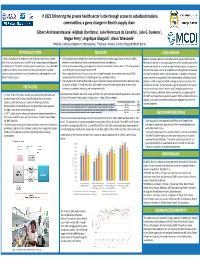
# 1822 Enhancing the private health sector’s role through access to subsidized malaria commodities: a game changer in Benin’s supply chain Gilbert Andrianandrasana1, Adjibabi Cherifatou2, Julie Niemczura de Carvalho1, Julie G. Buekens1, Megan Perry1, Angelique Gbaguidi1, Alexis Tchevoede2 1Medical Care Development International, 2 National Malaria Control Program/MOH Benin INTRODUCTION RESULTS DISCUSSION In Benin, the practice of medicine in the informal private sector, where . 56% of private sector stakeholders interviewed preferred the public supply chain, while only 18.8% Malaria indicators have improved after several years of efforts by the 65% of all consultations occur and 60% of all malaria cases are diagnosed, preferred direct delivery of malaria commodities without a middleman. MOH and its partners, showing engagement of the private sector can be has been one of the health system’s greatest weaknesses. Thus, the NMCP . 60% of entities were willing to provide public malaria commodities for free, while 13.3% only agreed to feasible and beneficial. In order to make further progress, the capacities sought to conduct a pilot project to identify a mechanism for private do so if they were compensated by the MOH. of the health sector need to be expanded and strengthened at the local clinics to access subsidized malaria commodities, improving their role in . Most respondents favored the set‐up of a formal legal framework to be implemented via an MOU level with the private sector’s full participation. In addition, the private Benin’s health system. between the National Malaria Control Program and accredited entities. sector needs to be supported in the implementation of national health . -

Laws of Attraction Northern Benin and Risk of Violent Extremist Spillover
Laws of Attraction Northern Benin and risk of violent extremist spillover CRU Report Kars de Bruijne Laws of Attraction Northern Benin and risk of violent extremist spillover Kars de Bruijne CRU Report June 2021 This is a joint report produced by the Conflict Research Unit of Clingendael – the Netherlands Institute of International Relations in partnership with the Armed Conflict Location & Event Data Project (ACLED). June 2021 © Netherlands Institute of International Relations ‘Clingendael’. Cover photo: © Julien Gerard Unauthorized use of any materials violates copyright, trademark and / or other laws. Should a user download material from the website or any other source related to the Netherlands Institute of International Relations ‘Clingendael’, or the Clingendael Institute, for personal or non-commercial use, the user must retain all copyright, trademark or other similar notices contained in the original material or on any copies of this material. Material on the website of the Clingendael Institute may be reproduced or publicly displayed, distributed or used for any public and non-commercial purposes, but only by mentioning the Clingendael Institute as its source. Permission is required to use the logo of the Clingendael Institute. This can be obtained by contacting the Communication desk of the Clingendael Institute (press@clingendael.org). The following web link activities are prohibited by the Clingendael Institute and may present trademark and copyright infringement issues: links that involve unauthorized use of our logo, framing, inline links, or metatags, as well as hyperlinks or a form of link disguising the URL. About the author Kars de Bruijne is a Senior Research Fellow with the Clingendael’s Conflict Research Unit and a former Senior Researcher at ACLED. -

Physicochemical Characterization and Microbiology Quality of The
www.nature.com/scientificreports OPEN Physicochemical characterization and microbiology quality of the Pentadesma butyracea fruit pulp collected from various parks in Benin Bernolde Paul Ayegnon1*, Ifagbémi Bienvenue Chabi1, Folachodé Ulrich Gildas Akogou1,2 & Adéchola Pierre Polycarpe Kayodé1 In Benin, P. butyracea fruit pulp undergoes signifcant post-harvest loss due to its low valorization. The collected fruits in fve parklands from a survey of transformer’s perception were characterized through their visual observations, the determination of their dimensions and pulp proportions. The nutritional value of pulp was evaluated through its chemical characterization. The results of this study revealed that four shapes (ellipsoid, globular, ovoid, ellipsoid twisted) identify the physical aspect of P. butyracea fruits in the P. butyracea parklands. The average length, diameter at the equator, mass and pulp proportion of fruits were 130.93 mm, 86.98 mm, 125.63 g and 35.79%, respectively. The physicochemical characterization showed that the P. butyracea fruit pulp contained 3.37–3.41 pH, 3.33–4.61% protein, 20.37–20.78% fber, 2.78–3.57% ash, 6.31–6.51% crude lipid, 85.77–86.47% moisture, 21.54–23.22 mg/mL total phenolics, 0.73–1.03% titratable acidity, 65.10–66.94% carbohydrates, 335.75–338.99 kcal calorie and minerals (Ca, Fe, Zn, Mn). The antioxidant activity result showed that the P. butyracea fruit pulp is a valuable source of antioxidant pigments. Faecal coliforms are not detected in pulps and the aerobic mesophilic bacteria, yeasts and moulds, and Staphylococcus aureus were below detection level in P.