The Case of Theater Illustrated (1912-17)
Total Page:16
File Type:pdf, Size:1020Kb
Load more
Recommended publications
-

The Soul of Beijing Opera: Theatrical Creativity and Continuity in the Changing World, by Li Ruru
The Soul of Beijing Opera: Theatrical Creativity and Continuity in the Changing World, by Li Ruru Author Mackerras, Colin Published 2010 Version Version of Record (VoR) Copyright Statement © 2010 CHINOPERL. The attached file is reproduced here in accordance with the copyright policy of the publisher. Please refer to the journal's website for access to the definitive, published version. Downloaded from http://hdl.handle.net/10072/71170 Link to published version https://chinoperl.osu.edu/journal/back-volumes-2001-2010 Griffith Research Online https://research-repository.griffith.edu.au CHINOPERL Papers No. 29 The Soul of Beijing Opera: Theatrical Creativity and Continuity in the Changing World. By Li Ruru, with a foreword by Eugenio Barba. Hong Kong: Hong Kong University Press, 2010, xvi + 335 pp. 22 illus. Paper $25.00; Cloth $50.00. Among the huge advances made in studies of Chinese theatre in European languages over recent decades, those on the genre now normally called jingju 京劇 in Chinese and referred to in English as Peking opera or Beijing opera occupy a significant place. Theatre is by its nature multidisciplinary in the sense that it covers history, politics, performance, literature, society and other fields. Among other book-length studies published in the last few years, this art has yielded those with a historical perspective such as Joshua Goldstein‘s Drama Kings: Players and Publics in the Re-creation of Peking Opera, 1870–1937 (University of California Press, 2007) and those focusing more on stage aesthetics such as Alexandra B. Bonds‘ Beijing Opera Costumes: The Visual Communication of Character and Culture (University of Hawai‘i Press, 2008). -

The Politics of Celebrity in Madame Chiang Kai-Shek's
China’s Prima Donna: The Politics of Celebrity in Madame Chiang Kai-shek’s 1943 U.S. Tour By Dana Ter Columbia University |London School of Economics International and World History |Dual Master’s Dissertation May 1, 2013 | 14,999 words 1 Top: Madame Chiang speaking at a New Life Movement rally, taken by the author at Sun Yat-sen Memorial Hall, Taipei, Taiwan, June 2012. Front cover: Left: Allene Talmey, “People and Ideas: May Ling Soong Chiang,” Vogue 101(8), (April 15, 1943), 34. Right: front page of the Kansas City Star, February 23, 1943, Stanford University Hoover Institution (SUHI), Henry S. Evans papers (HSE), scrapbook. 2 Introduction: It is the last day of March 1943 and the sun is beaming into the window of your humble apartment on Macy Street in Los Angeles’ “Old Chinatown”.1 The day had arrived, Madame Chiang Kai-shek’s debut in Southern California. You hurry outside and push your way through a sea of black haired-people, finding an opening just in time to catch a glimpse of China’s First Lady. There she was! In a sleek black cheongsam, with her hair pulled back in a bun, she smiled graciously as her limousine slid through the adoring crowd, en route to City Hall. The split second in which you saw her was enough because for the first time in your life you were proud to be Chinese in America.2 As the wife of the Generalissimo Chiang Kai-shek, from February-April 1943, Madame Chiang, also known by her maiden name, Soong Mayling, embarked on a carefully- crafted and well-publicized tour to rally American material and moral support for China’s war effort against the Japanese. -
Please Click Here to Download
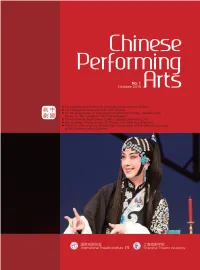
No.1 October 2019 EDITORS-IN-CHIEF Tobias BIANCONE, GONG Baorong EDITORIAL BOARD MEMBERS (in alphabetical order by Pinyin of last name) Tobias BIANCONE, Georges BANU, Christian BIET, Marvin CARLSON, CHEN Jun, CHEN Shixiong, DING Luonan, Erika FISCHER-LICHTE, FU Qiumin, GONG Baorong, HE Chengzhou, HUANG Changyong, Hans-Georg KNOPP, HU Zhiyi, LI Ruru, LI Wei, LIU Qing, LIU Siyuan, Patrice PAVIS, Richard SCHECHNER, SHEN Lin, Kalina STEFANOVA, SUN Huizhu, WANG Yun, XIE Wei, YANG Yang, YE Changhai, YU Jianchun. EDITORS WU Aili, CHEN Zhongwen, CHEN Ying, CAI Yan CHINESE TO ENGLISH TRANSLATORS HE Xuehan, LAN Xiaolan, TANG Jia, TANG Yuanmei, YAN Puxi ENGLISH CORRECTORS LIANG Chaoqun, HUANG Guoqi, TONG Rongtian, XIONG Lingling,LIAN Youping PROOFREADERS ZHANG Qing, GUI Han DESIGNER SHAO Min CONTACT TA The Center Of International Theater Studies-S CAI Yan: emillecai@hotmail.com CHEN Ying: cyening@126.com CONTENTS I 1 No.1 CONTENTS October 2019 PREFACE 2 Empowering and Promoting Chinese Performing Arts Culture / TOBIAS BIANCONE 4 Let’s Bridge the Culture Divide with Theatre / GONG BAORONG STUDIES ON MEI LANFANG 8 On the Subjectivity of Theoretical Construction of Xiqu— Starting from Doubt on “Mei Lanfang’s Performing System” / CHEN SHIXIONG 18 The Worldwide Significance of Mei Lanfang’s Performing Art / ZOU YUANJIANG 31 Mei Lanfang, Cheng Yanqiu, Qi Rushan and Early Xiqu Directors / FU QIUMIN 46 Return to Silence at the Golden Age—Discussion on the Gains and Losses of Mei Lanfang’s Red Chamber / WANG YONGEN HISTORY AND ARTISTS OF XIQU 61 The Formation -

New Actresses and Urban Publics in Early Republican Beijing Title
Carnegie Mellon University MARIANNA BROWN DIETRICH COLLEGE OF HUMANITIES AND SOCIAL SCIENCES DISSERTATION Submitted in Partial Fulfillment of the Requirements Doctor of Philosophy For the Degree of New Actresses and Urban Publics in Early Republican Beijing Title Jiacheng Liu Presented by History Accepted by the Department of Donald S. Sutton August 1, 2015 Readers (Director of Dissertation) Date Andrea Goldman August 1, 2015 Date Paul Eiss August 1, 2015 Date Approved by the Committee on Graduate Degrees Richard Scheines August 1, 2015 Dean Date NEW ACTRESSES AND URBAN PUBLICS OF EARLY REPUBLICAN BEIJING by JIACHENG LIU, B.A., M. A. DISSERTATION Presented to the Faculty of the College of the Marianna Brown Dietrich College of Humanities and Social Sciences of Carnegie Mellon University in Partial Fulfillment of the Requirements For the Degree of DOCTOR OF PHILOSOPHY CARNEGIE MELLON UNIVERSITY August 1, 2015 Acknowledgements This dissertation would not have been possible without the help from many teachers, colleages and friends. First of all, I am immensely grateful to my doctoral advisor, Prof. Donald S. Sutton, for his patience, understanding, and encouragement. Over the six years, the numerous conversations with Prof. Sutton have been an unfailing source of inspiration. His broad vision across disciplines, exacting scholarship, and attention to details has shaped this study and the way I think about history. Despite obstacle of time and space, Prof. Andrea S. Goldman at UCLA has generously offered advice and encouragement, and helped to hone my arguments and clarify my assumptions. During my six-month visit at UCLA, I was deeply affected by her passion for scholarship and devotion to students, which I aspire to emulate in my future career. -

Anna May Wong
Anna May Wong From Laundryman’s Daughter to Hollywood Legend Graham Russell Gao Hodges Hong Kong University Press 14/F Hing Wai Centre 7 Tin Wan Praya Road Aberdeen Hong Kong www.hkupress.org © Hong Kong University Press 2012 Copyright © 2004 by Graham Russell Gao Hodges First published by Palgrave Macmillan ISBN 978-988-8139-63-7 All rights reserved. No portion of this publication may be reproduced or transmitted in any form or by any means, electronic or mechanical, including photocopy, recording, or any information storage or retrieval system, without prior permission in writing from the publisher. British Library Cataloguing-in-Publication Data A catalogue record for this book is available from the British Library. 10 9 8 7 6 5 4 3 2 1 Printed and bound by Liang Yu Printing Factory Ltd. in Hong Kong, China Contents Preface to Second Edition ix Acknowledgments xi Introduction xv List of Illustrations xxiii One Childhood 1 Two Seeking Stardom 27 Three Europe 65 Four Atlantic Crossings 99 Five China 141 Six In the Service of the Motherland 159 Seven Becoming Chinese American 191 Epilogue 207 Filmography 213 Television Appearances 223 Notes 225 Selected Bibliography 251 Index 265 Introduction Anna May Wong (1905–1961) remains the premier Asian American actress. In part this distinction stems from the historical rarity of Asian actors in American cinema and theater, yet her singularity derives primarily from her laudable acting in more than fifty movies, during a career that ranged from 1919 to 1961, a record of achievement that is unmatched and likely to remain so in the foreseeable future. -

The Market, Ideology, and Convention Jingju Performers’ Creativity in the 21St Century Li Ruru
The Market, Ideology, and Convention Jingju Performers’ Creativity in the 21st Century Li Ruru Driven by the imperatives of a changing society and the pressures of new technology, China’s theatre is undergoing continual transformation, both in its performance and understanding by practitioners and in its reception by audiences. Jingju (known in the West as Beijing Opera) — a highly stylized theatrical genre founded on specific role types and spectacular stage conven- tions — is no exception to this process. As new media devices and possibilities appear at an unprecedented pace, these developments afford artists tremendous choices and fundamentally alter not only what constitutes theatre but also the mentality of practitioners and spectators. Since the nadir of the Cultural Revolution, a more than tenfold increase in gross domestic product has made China a powerful voice in the global capitalist community and a generous benefactor of its theatre. The budget for starting a stage show can now easily reach around five million RMB (about US$800,000). “Forging exquisite productions” (dazao jingpin) to obtain Figure 1. Ailiya (Shi Yihong) dances for her beggar friends. Shanghai, 2008. (Courtesy of the Shanghai Jingju Theatre) TDR: The Drama Review 56:2 (T214) Summer 2012. ©2012 New York University and the Massachusetts Institute of Technology 131 Downloaded from http://www.mitpressjournals.org/doi/pdf/10.1162/DRAM_a_00171 by guest on 28 September 2021 national prizes seems to be the ultimate objective of all theatre companies and local authorities, so the funding enables theatre, including jingju, to do things that it could not have dreamed of 30 years ago. -
Table of Contents and Contributors
Contents List of Entries viii List of Contributors ix Introduction and Acknowledgments xxx Joan Lebold Cohen xxxviii Volume 1 Abacus to Cult of Maitreya Volume 2 Cultural Revolution to HU Yaobang Volume 3 Huai River to Old Prose Movement Volume 4 Olympics Games of 2008 to TANG Yin Volume 5 Tangshan Earthquake, Great to ZUO Zongtang Image Sources Volume 5, page 2666 Index Volume 5, page 2667 © 2009 by Berkshire Publishing Group LLC List of Entries Abacus Asian Games BORODIN, Mikhail Academia Sinica Asia-Pacific Economic Cooperation Boxer Protocol (Xinchou Treaty) Acrobatics Atheism Boxer Rebellion Acupuncture Australia China Friendship Society Boycotts and Economic Adoption Australia-China Relations Nationalism Africa-China Relations Auto Industry BRIDGMAN, E. C. Agricultural Cooperatives Autonomous Areas British American Tobacco Movement BA Jin Company Agriculture Bamboo British Association for Chinese Agro-geography Bank of China Studies American Chamber of Commerce Banking—History British Chamber of Commerce in in China Banking—Modern China Ami Harvest Festival Banque de l’Indochine Bronzes of the Shang Dynasty An Lushan (An Shi) Rebellion Baojia Brookings Institution Analects Baosteel Group Buddhism Ancestor Worship Beijing Buddhism, Chan Anhui Province Beijing Consensus Buddhism, Four Sacred Sites of Antidrug Campaigns Bian Que Buddhism, Persecution of Anti-Spiritual Pollution Campaign Bianzhong Buddhism, Pure Land Anyang Bishu Shanzhuang Buddhism, Tibetan Aquaculture Black Gold Politics Buddhist Association of China Archaeology and -

"Experimenting with Dance Drama: Peking Opera Modernity, Kabuki Theater Reform and the Denishawn’S Tour of the Far East"
Journal of Global Theatre History ISSN: 2509-6990 Issue 1, Number 2, 2016, pp. 28-37 Catherine Vance Yeh "Experimenting with Dance Drama: Peking Opera Modernity, Kabuki Theater Reform and the Denishawn’s Tour of the Far East" Abstract During the 1910s and 20s, Peking opera underwent a fundamental transformation from a performing art primarily driven by singing to one included acting and dancing. Leading this new development were male actors playing female roles, with Mei Lanfang as the most outstanding example. The acknowledged sources on which these changes drew were the encounter with Western style opera. The artistic and social values carrying these changes, however, suggest that Peking opera underwent a qualitative reconceptualization that involved a critical break with its past. This paper will explore the artistic transformation of Peking opera of the 1910s-20s by focusing on the three areas of contact Paris, Japan and the US. It will argue that the particular artistic innovation in Peking can only be fully understood and appraised in the context of global cultural interaction. It suggests that a new assessment of the modernist movement is needed that sees it as a part of a global trend rather than only as a European phenomenon. Author Catherine Vance Yeh is Professor of Modern Chinese Literature and Transcultural Studies at Boston University. Her research focuses on the global migration of literary forms; the transformation of theater aesthetics in transcultural interaction, and entertainment culture as agent of social change. Her publications include Shanghai Love: Courtesans, Intellectuals and Entertainment Culture, 1850-1910; and The Chinese Political Novel: Migration of a World Genre. -

Learning Yuzhou Feng (Sword of the Cosmos): a Journey Into the Heart of the Art of Mei Lanfang
LEARNING YUZHOU FENG (SWORD OF THE COSMOS): A JOURNEY INTO THE HEART OF THE ART OF MEI LANFANG ROSE JANG Evergreen State College When I was granted a half-year sabbatical leave for the winter and spring quarters of 2010, I immediately decided that I would use this time to go to China to study Jingju 京劇 (Beijing opera) performance with a professional teacher. The desire had been there for a long time, and the timing of this opportunity could not have been more optimal. I had dabbled at learning the singing and physical movement of Jingju since the early 1990s through a local amateur opera club, and had occasionally invited and supported Chinese opera professionals in one-time college productions and workshops, but I had not seriously pursued Jingju performance for myself until eight years ago, when I became acquainted with a group of recently emigrated Chinese opera artists and musicians scattered around the U.S. Meeting these displaced professional artists, whose nostalgic comments on any aspect of the opera would instantly plunge my mind into some abyss of cognitive mystery, opened my eyes to a new world of aesthetic vision and intellectual contemplation. I began to realize that, in tackling this classical performance genre, no amount of scholarly reading, objective investigation, or creative association can get me close to the heart and essence of its complex artistry. What I really needed, as a first step into that new world of cognition, was a period of intense study with a professional Jingju teacher. What follows is the narrative documentation of such an intense study. -

Performing China on the London Stage Ashley Thorpe Performing China on the London Stage
Performing China on the London Stage Ashley Thorpe Performing China on the London Stage Chinese Opera and Global Power, 1759–2008 Ashley Thorpe Royal Holloway, University of London, UK ISBN 978-1-137-59785-4 ISBN 978-1-137-59786-1 (eBook) DOI 10.1057/978-1-137-59786-1 Library of Congress Control Number: 2016949254 © The Editor(s) (if applicable) and The Author(s) 2016 The author(s) has/have asserted their right(s) to be identifi ed as the author(s) of this work in accordance with the Copyright, Designs and Patents Act 1988. This work is subject to copyright. All rights are solely and exclusively licensed by the Publisher, whether the whole or part of the material is concerned, specifi cally the rights of translation, reprinting, reuse of illustrations, recitation, broadcasting, reproduction on microfi lms or in any other physical way, and transmission or information storage and retrieval, electronic adaptation, computer software, or by similar or dissimilar methodology now known or hereafter developed. The use of general descriptive names, registered names, trademarks, service marks, etc. in this publication does not imply, even in the absence of a specifi c statement, that such names are exempt from the relevant protective laws and regulations and therefore free for general use. The publisher, the authors and the editors are safe to assume that the advice and information in this book are believed to be true and accurate at the date of publication. Neither the pub- lisher nor the authors or the editors give a warranty, express or implied, with respect to the material contained herein or for any errors or omissions that may have been made. -
Cry to Heaven: a Play to Celebrate One Hundred Years of Chinese Spoken Drama by Nick Rongjun Yu Introduction and Translation by Shiao-Ling Yu
play Cry to Heaven: A Play to Celebrate One Hundred Years of Chinese Spoken Drama by Nick Rongjun Yu Introduction and translation by Shiao-ling Yu Yutian (Cry to Heaven) is the third Chinese stage adaptation of Harriet Beecher Stowe’s novel Uncle Tom’s Cabin between 1907 and 2007. The fi rst, Heinu yutian lu (Black Slave’s Cry to Heaven) by Zeng Xiaogu, was staged by Chinese students in Tokyo in 1907; the second, Heinu hen (Regret of the Black Slaves) by Ouyang Yuqian, was mounted as part of the fi ftieth anniversary of the fi rst production; and the third, Yutian (Cry to Heaven), commemorated the hundredth anniversary of Chinese spoken drama (huaju) in 2007. Each adaptation has a different focus that refl ects the social, political, and cultural conditions of its time, and together the works provide a historical view of the development of Chinese spoken drama. The most recent production, by Nick Rongjun Yu, juxtaposes one hundred years of dramatic history with scenes from Uncle Tom’s Cabin, making the American slaves’ struggle to gain freedom a metaphor for Chinese dramatists’ efforts to achieve their own. Yu Rongjun, also known as Nick Rongjun Yu, is the author of more than twenty plays, including Renmo gouyang (Dog’s Face), WWW.COM, and Tiantang gebi shi fengrenyuan (The Asylum Next to Heaven). His plays have won many prizes in China and have been performed in Hong Kong, Taipei, the United States, and other countries. Besides being a playwright, he is director of programming and marketing for the Shanghai Dramatic Arts Center. -

Jiang Qing and Women's Roles in Revolutionary Model Opera During
Sarah Lawrence College DigitalCommons@SarahLawrence Women's History Theses Women’s History Graduate Program 5-2018 Between Villain and Victim: Jiang Qing and Women’s Roles in Revolutionary Model Opera During the Cultural Revolution Cherie Gu Sarah Lawrence College Follow this and additional works at: https://digitalcommons.slc.edu/womenshistory_etd Part of the Women's History Commons Recommended Citation Gu, Cherie, "Between Villain and Victim: Jiang Qing and Women’s Roles in Revolutionary Model Opera During the Cultural Revolution" (2018). Women's History Theses. 35. https://digitalcommons.slc.edu/womenshistory_etd/35 This Thesis - Open Access is brought to you for free and open access by the Women’s History Graduate Program at DigitalCommons@SarahLawrence. It has been accepted for inclusion in Women's History Theses by an authorized administrator of DigitalCommons@SarahLawrence. For more information, please contact alester@sarahlawrence.edu. Between Villain and Victim: Jiang Qing and Women’s Roles in Revolutionary Model Opera During the Cultural Revolution “Submitted in partial completion of the Master of Arts Degree at Sarah Lawrence College, May 2018” Cherie Gu Table of Contents Introduction 4 Chapter One: Peking Opera in Transition 1911-1949 22 Chapter Two: Mister and Missus Mao: 1949-1963 37 Chapter Three: Women in the Spotlight, Traditional Versus Revolutionary Models on and off Stage: 1963-1976 50 Chapter Four: Cultural Recall, Oral Histories on the Memory of Model Opera 65 Conclusion: Opera in China Today 94 Appendix one: Timeline of Events 101 Appendix two: Glossary of Chinese Terms 108 Bibliography 109 !1 Note on translation and Chinese Terminology: Interviews were conducted in Mandarin Chinese and have been transcribed and translated into English by myself in the most direct translation in order to stay faithful to the subjects’ word choices.