Politischer Bericht Slowakei Februar 2006
Total Page:16
File Type:pdf, Size:1020Kb
Load more
Recommended publications
-

Diverging Voices, Converging Policies: the Visegrad States' Reactions to the Russia-Ukraine Conflict
Diverging Voices, Converging Policies: The Visegrad States’ Reactions to the Russia-Ukraine Conflict Jacek Kucharczyk and Grigorij Mesežnikov (eds.) DIVERGING VOICES, CONVERGING POLICIES: THE VISEGRAD STATES’ REACTIONS TO THE RUSSIA-UKRAINE CONFLICT HEINRICH-BÖLL-STIFTUNG Diverging Voices, Converging Policies: The Visegrad States’ Reactions to the Russia-Ukraine Conflict Edited by Jacek Kucharczyk, Grigorij Mesežnikov Commissioned by the Heinrich-Böll-Stiftung Diverging Voices, Converging Policies: The Visegrad States’ Reactions to the Russia-Ukraine Conflict Edited by Jacek Kucharczyk and Grigorij Mesežnikov Commissioned by the Heinrich-Böll-Stiftung offices in Prague and Warsaw Printed in Warsaw, 2015. Publisher: Heinrich-Böll-Stiftung Co-publishers: Europeum – Institute for European Policy (Czech Republic), Institute of Public Affairs (Poland), Institute for Public Affairs (Slovakia), Political Capital Policy Research & Consulting Institute (Hungary) Copy editing: Evan Mellander Layout and cover image: Kateřina Kubánková Copyright to the original image on the cover page: VGstockstudio/Shutterstock This material is licensed under Creative Commons “Attribution- NonCommercial 4.0 International” (CC BY-NC 4.0). For the licence agreement, see https://creativecommons.org/licenses/by-nc/4.0/ and a summary (not a substitute) at https://creativecommons.org/licenses/by-nc/4.0/legalcode. The findings and opinions expressed in this publication are those of the authors and do not necessarily reflect the positions of the Heinrich-Böll-Stiftung. ISBN: 978-80-906270-2-4 (Heinrich-Böll-Stiftung Prague, Opatovická 28, Praha 1, 110 00, Czech Republic) 978-83-61340-29-4 (Heinrich-Böll-Stiftung Warsaw, ul. Żurawia 45, IIIp., 00-680 Warsaw, Poland) 978-80-86993-13-3 (Europeum – Institute for European Policy, Rytířská 539/31 Praha 1, 110 00, Czech Republic) 978-83-7689-250-4 (Institute of Public Affairs, ul. -
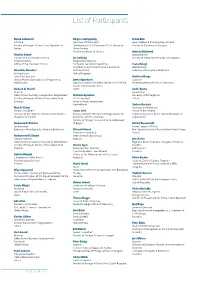
List of Participants
List of Participants Nenad Adžemović Dmytro Andriyevskiy Zoltán Bali Attaché Member of Parliament Head Defence Planning Department Ministry of Foreign Affairs of the Republic of “Batkivshchyna” (“Fatherland”) All-Ukrainian Ministry of Defence of Hungary Serbia Union faction Verkhovna Rada of Ukraine Martina Balleková Muafak Ahmad Spokesperson Adviser to the President of Iraq Ian Anthony Ministry of Defence of the Slovak Republic Public relations Programme Director Office of the President of Iraq European Security Programme Csaba Balogh Stockholm International Peace Research Ambassador Noorullah Ahmadzai Institute (SIPRI) Embassy of Hungary in Bratislava Acting Head United Kingdom Cross Practice Unit Matthias Bange United Nations Development Programme James Appathurai Captain Afghanistan Deputy Assistant Secretary General for Political Federal Defence Forces of Germany Affairs and Security Policy Mahash Al Hameli NATO Andris Banka Director Researcher International Security Cooperation Department Rowinda Appelman University of Birmingham Ministry of Foreign Affairs of the United Arab YATA President Latvia Emirates Atlantic Treaty Association Netherlands Shukria Barakzai Riad Al Khouri Member of Parliament Senior Consultant Yasser Atef House of the People Institute for Democracy and Electoral Studies Deputy Assistant Minister of Foreign Affairs for National Assembly of the Islamic Republic of University of Jordan Relations with EU Countries Afghanistan Ministry of Foreign Affairs of the Arab Republic Mohamed Al Robaiee of Egypt Michal Baranowski -

EUI RSCAS Working Paper 2021/26The Politics of Differentiated
RSC 2021/26 Robert Schuman Centre for Advanced Studies Integrating Diversity in the European Union (InDivEU) The Politics of Differentiated Integration: What do Governments Want? Country Report - Slovakia Kristína Janková European University Institute Robert Schuman Centre for Advanced Studies Integrating Diversity in the European Union (InDivEU) The Politics of Differentiated Integration: What do Governments Want? Country Report - Slovakia Kristína Janková EUI Working Paper RSC 2021/26 Terms of access and reuse for this work are governed by the Creative Commons Attribution 4.0 (CC- BY 4.0) International license. If cited or quoted, reference should be made to the full name of the author(s), editor(s), the title, the working paper series and number, the year and the publisher. ISSN 1028-3625 © Kristína Janková, 2021 This work is licensed under a Creative Commons Attribution 4.0 (CC-BY 4.0) International license. https://creativecommons.org/licenses/by/4.0/ Published in February 2021 by the European University Institute. Badia Fiesolana, via dei Roccettini 9 I – 50014 San Domenico di Fiesole (FI) Italy Views expressed in this publication reflect the opinion of individual author(s) and not those of the European University Institute. This publication is available in Open Access in Cadmus, the EUI Research Repository: https://cadmus.eui.eu Robert Schuman Centre for Advanced Studies The Robert Schuman Centre for Advanced Studies, created in 1992 and currently directed by Professor Brigid Laffan, aims to develop inter-disciplinary and comparative research on the major issues facing the process of European integration, European societies and Europe’s place in 21st century global politics. -

Snapshot of Participants
SNAPSHOT OF PARTICIPANTS Ľubomír Ábel Sinisa Aleksoski Oliver Andonov Vice President of the Police Force National Security Advisor Professor of the Slovak Republic Cabinet of the President of Faculty of Security SMIT Ministry of Interior of the Slovak Macedonia** University Republic Macedonia** Emiliano Alessandri Adrian Adam Senior Officer Ian Anthony Corporate & Diplomatic Sales External Co-operation Programme Director Auto Palace Bratislava s.r.o. Organization for Security and Co- European Security ProStockholm Slovakia operation in Europe (OSCE) International Peace Research Austria institute (SIPRI) Alexander Aksenenok Sweden Ambassador Extraordinary and Oľga Algayerová Plenipotentiary; Expert Ambassador Oksana Antonenko Committee on International Permanent Mission of the Slovak Senior Political Counsellor Affairs Republic to the International European Bank for Federation Council of the Russian Organizations Reconstruction and Development Federation United Kingdom Russia Ebtesam Al-Ketbi President James Appathurai Hussam Al Husseini Emirates Policy Center Deputy Assistant Secretary Ambassador United Arab Emirates General for Political Affairs and Embassy of the Hashemite Security Policy Kingdom of Jordan in Vienna John Allen NATO Former Special Presidential Belgium Baria Alamuddin Envoy for Global Coalition to Foreign Editor Counter ISIL Anne Applebaum Al Hayat United States of America Director United Kingdom Transitions Forum Kristóf Altusz Legatum Institute Madeleine Albright Deputy State Secretary United Kingdom Chair; former U.S. -

1 Theoretical Perspectives on European Enlargement and Democratisation
Notes 1 Theoretical Perspectives on European Enlargement and Democratisation 1. The European, 30 January–5 February 1997. 2. L. Whitehead, The International Dimensions of Democratization: Europe and the Americas (Oxford: Oxford University Press, 1996), p. 19. 3. P. Schmitter, ‘The international context of contemporary democratisation’, in G. Pridham (ed.), Transitions to Democracy: Comparative Perspectives from Southern Europe, Latin America and Eastern Europe (Dartmouth: Aldershot, 1995), p. 524. 4. See G. Pridham, ‘Measuring international factors in democratisation’, in G. Mangott, H. Waldrauch and S. Day (eds), Democratic Consolidation – the International Dimension: Hungary, Poland and Spain (Baden-Baden: Nomos Verlag, 2000), pp. 53–69; and his ‘Rethinking regime change theory and the international dimension of democratisation: ten years after in East-Central Europe’, in G. Pridham and A. Ágh (eds), Ten Years After: Democratic Transition and Consolidation in East- Central Europe (Manchester: Manchester University Press, 2001). 5. A. Pravda, ‘Introduction’, in J. Zielonka and A. Pravda (eds), Democratic Consolidation in Eastern Europe, Volume 2: International and Transnational Factors (Oxford: Oxford University Press, 2001), p. 15. 6. See, for instance, the special issue of the journal Democratization (vol. 7, no. 1, spring 2000), The Internet, Democracy and Democratization, edited by P. Ferdinand. There is now a growing literature on the role of the internet in both democrati- sation and political behaviour in general. 7. J. Pinder, ‘The European Community and democracy in Central and Eastern Europe’, in G. Pridham et al., Building Democracy?: The International Dimension of Democratisation in Eastern Europe (London: Leicester University Press, revised edition, 1997), pp. 114ff. 8. For example, Pridham et al., Chapter 1.