Valter MBIEMRI: Memisha DATËLINDJA
Total Page:16
File Type:pdf, Size:1020Kb
Load more
Recommended publications
-

Drejtshkrimi I Gjuhës Shqipe
INSTITUTI ALBANOLOGJIK I PRISHTINËS DREJTSHKRIMI I GJUHËS SHQIPE PRISHTINË - 1974 Komisioni hartues: Prof. Androkli KOSTALLARI (kryetar), Prof. Mahir DOMI, Prof. Eqrem QABEJ, B. shk. Emil LAFE RIBOTIM I INSTITUTIT ALBANOLOGJIK TË PRISHTINËS PARATHËNIE REZOLUTË E KONGRESIT TË DREJTSHKRIMIT TË GJUHËS SHQIPE PARIME TË PËRGJITHSHME ALFABETI I GJUHËS SHQIPE I. DREJSHKRIMI I ZANOREVE Zanorja e e theksuar Zanorja e e patheksuar Zanorja ë e theksuar Zanorja ë e patheksuar ë-ja paratheksore ë-ja pastheksore ë-ja fundore Zanorja u Zanoret i dhe y Zanoret u dhe y GRUPE ZANORESH DHE DIFTONGJE -ie- / -je- Grupi ye Grupet ua, ue TAKIMI I DY ZANOREVE TË NJËJTA APOSTROFI THEKSI II DREJTSHKRIMI I BASHKËTINGËLLOREVE Bashkëtingëlloret e zëshme në fund dhe në trup të fjalës sh / zh / ç nistore s / z nistore Shkrimi i j-së Shkrimi i bashkëtingëllores h Fjalët me rr nj-ja në trup e në fund të fjalës GRUPE BASHKËTINGËLLORESH mb, nd, ng, ngj TAKIME BASHKËTINGËLLORESH Takimi i t-së me sh-në Takimi i g-së ose i n-së me j-në Takimi i d-së, s-së, t-së ose i z-së me h-në Takimi i d-së me t-në Takimi i dy shkronjave të njëjta III. DISA TIPA FJALËSH ME PREARDHJE TË HUAJ DHE EMRASH TË PËRVEÇËM TË HUAJ IV. ÇËSHTJE GRAMATIKORE DISA TRAJTA TË SHUMËSIT TË EMRAVE DHE TË MBIEMRAVE SHKRIMI I NYJËS SË PËRPARME SHKRIMI I DISA PJESËZAVE DHE PARAFJALËVE V. SHKRIMI I FJALËVE NJËSH, NDARAS DHE ME VIZË NË MES VI. PËRDORIMI I SHKRONJAVE TË MËDHA VII. NDARJA E FJALËVE NË FUND TË RRESHTIT VIII. -

4 Studime 21 Komplet
400 AShAK: Studime 21 - 2014 BIBLIOGRAFIA E BOTIMEVE TË PROFESOR SHABAN DEMIRAJT1 I. Vepra shkencore a) Pa ndonjë bashkëpunim 1. Çështje të sistemit emëror të gjuhës shqipe. Botim i Universitetit të Tiranës. Tiranë 1972, f. 296 (me një përmbledhje frëngjisht). 2. Sistemi i lakimit në gjuhën shqipe. Botim i Universitetit të Tiranës. Tiranë 1975, f 275 (me një përmbledhje frëngjisht). 3. Gramatikë historike e gjuhës shqipe. Botim i Universitetit të Tiranës. Shtëpia Botuese 8 Nëntori. Tiranë 1986, f. l167 (me një përmbledhje anglisht); Shtëpia Botuese Rilindja. Prishtinë 1988 2, f. 1047. 4. Gjuha shqipe dhe historia e saj. Botim i Universitetit të Tiranës. Tiranë 1988, f. 321 (me një përmbledhje anglisht); Rilindja. Prishtinë 19892, f. 290. 5. Eqrem Çabej – një jetë kushtuar shkencës. Shtëpia Botuese 8 Nëntori. Tiranë 1990, f. 272; Akademia e Shkencave të Shqipërisë. Tiranë 2008 2, f. 322. 6. Historische Grammatik der albanischen Sprache (kurze Fassung). Österreichische Akademie der Wissenschaften; Philosophisch – historische Klasse. Schriften der Balkan-Kommission. Verlag der Österreichischen Akademie der Wissenschaften. Wien 1993, f. 366. 7. Gjuhësi ballkanike. Shtëpia Botuese Logos-A, në bashkëpunim me Katedrën e Gjuhës dhe të Letërsisë Shqiptare të Universitetit të Shkupit. Shkup 1994, f. 277 (me një përmbledhje anglisht). 8. Balkanska lingvistika = Gjuhësi ballkanike. Shtëpia botuese Logos A. Shkup 1994, f. 294 (me një përmbledhje anglisht). 9. Fonologjia historike e gjuhës shqipe. Botim i Akademisë së Shkencave të Shqipërisë. Shtëpia Botuese Toena. Tiranë 1996, f. 332 (me një permbledhje anglisht). 10. La lingua albanese – origine, storia, strutture. Centro Editoriale e Librario – Università degli Studi della Calabria. Rende – Italia 1997, f. -
Studime 20 5
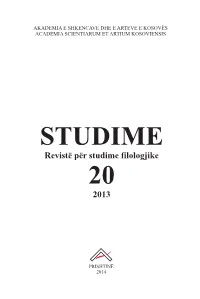
AKADEMIA E SHKENCAVE DHE E ARTEVE E KOSOVËS ACADEMIA SCIENTIARUM ET ARTIUM KOSOVIENSIS STUDIME Revistë për studime filologjike 20 2013 PRISHTINË 2014 AKADEMIA E SHKENCAVE DHE E ARTEVE E KOSOVËS KOSOVAACADEMY OF SCIENCES AND ARTS STUDIME A Review for philological Studies 20 2013 Del një herë në vit. Published annually. Këshilli redaktues - Editorial Board Rexhep Ismajli - Kryeredaktor, editor-in-chief Eqrem Basha - Sekretar, secretary Victor A. Friedman, anëtar, member Teuta Abrashi, anëtar, member Mehmet Kraja, anëtar, member Idriz Ajeti, Kryeredaktor nderi - Editor-in-chief of honour Adresa e Redaksisë / Address: Akademia e Shkencave dhe e Arteve e Kosovës Redaksia e revistës “Studime” Rr. Agim Ramadani, p.n. 10 000 Prishtinë Republika e Kosovës Tel. + 381 38 249 303 Fax. + 381 38 244 636 E-mail: ashak@ashak.org Studime 20 5 SHËNIM I REDAKSISË Revista Studime, që nga nr. 1/1994 (1995) deri tek nr. 19/ 2012 (2013) mbulonte fushëveprimtarinë e seksioneve të gjuhësisë dhe të letër- sisë, të shkencave shoqërore dhe të arteve. Nga nr. 20/ 2013 (2014) vijon të dalë me të njëjtin emër, Studime, por tani me specializim vetëm në fushat e gjera filologjike. Kështu kanë vendosur organet përkatëse të Akademisë. Me propozim të Seksionit të Gjuhësisë dhe të Letërsisë u zgjodh Re- daksia e re me këtë përbërje: profesor dr. Victor Friedman, Universiteti i Chicago-s, profesore e asociuar dr. Teuta Abrashi, Universiteti i Prishtinës, akademik Mehmet Kraja, AShAK, akademik Eqrem Basha, AShAK (se- kretar i Redaksisë) dhe akademik Rexhep Ismajli, AShAK (Kryeredaktor). Në këtë mënyrë, duke përfshirë me 2/5 e anëtarëve të redaksisë specialistë që vijnë nga mjedise shkencore jashtë Akademisë, Seksioni dhe Kryesia e AShAK-ut kanë dashur të theksojnë se Redaksia e kësaj reviste është e hapur ndaj komunitetit shkencor në këto fusha jo vetëm për ndihmesa, por edhe për vetë politikën e Redaksisë dhe përmbajtjen e revistës. -

Studia Albanica
ACADÉMIE DES SCIENCES D’ALBANIE SECTION DES SCIENCES SOCIALES STUDIA ALBANICA 2 Numéro spécial consacré à la Séance solennelle de l’Académie des Sciences à l’occasion du Centenaire de l’Indépendance de l’Albanie Tirana, le 26 novembre 2012 XLIXe Année 2012 STUDIA ALBANICA _______ Conseil de Rédaction : Seit MANSAKU (Rédacteur en chef) Muzafer KORKUTI (Rédacteur en chef adjoint) Arben LESKAJ (Secrétaire scientifique) Francesco ALTIMARI Jorgo BULO Emin RIZA Shaban SINANI Marenglen VERLI Pëllumb XHUFI © 2012, Académie des Sciences d’Albanie ISSN 0585-5047 Académie des Sciences d’Albanie Section des Sciences sociales 7, place Fan S. Noli AL-1000 Tirana STUDIA ALBANICA 2012/2 ALLOCUTION D’OUVERTURE DU PROF. GUDAR BEQIRAJ, PRÉSIDENT DE L’ACADÉMIE DES SCIENCES D’ALBANIE L’Académie des Sciences d’Albanie organise cette séance solennelle sous le signe du centenaire de la proclamation de l’indépendance de l’Albanie. À cette occasion, permettez-moi de vous saluer et de vous remercier de votre présence, avec une profonde reconnaissance pour les historiens qui se sont engagés par des discours académiques et tout particulièrement pour les scientifiques venus du Kosovo, de la Macédoine, des États-Unis, de l’Allemagne et de l’Italie, qui nous honorent par leur participation. La proclamation de l’indépendance de l’Albanie à Vlora, le 28 novembre 1912, est un évènement majeur dans la vie des Albanais. Cependant, cet acte n’a été ni inattendu, ni séparé de notre histoire nationale. Au contraire, la proclamation de l’indépendance était le résultat d’une longue évolution historique, d’un effort incessant de toutes les régions et les forces vives de la nation en vue de réaliser leur aspiration séculaire à vivre libres sur leurs propres territoires, à occuper la place qui appartenait aux Albanais, comme l’un des peuples les plus anciens de la péninsule balkanique, dans la famille des nations européennes. -

Albanian Language Management and the Generation of Kosovo Albanian National Identity Since 1945
ALBANIAN LANGUAGE MANAGEMENT AND THE GENERATION OF KOSOVO ALBANIAN NATIONAL IDENTITY SINCE 1945 JUSTIN GREGORY HAMILTON ELLIOTT University College London Doctor of Philosophy 2017 I, Justin Gregory Hamilton Elliott, confirm that the work presented in this thesis is my own. Where information has been derived from other sources, I confirm that this has been indicated in the thesis. 2 ABSTRACT This thesis is about the development of a national identity through the means of language, both as a terrain and a vehicle. This thesis argues the modern intellectuals’ sense of moral mission in colonial nation-building was a response to exogenous modernization, and involved imagining the people as Albanians separated from Albania. This was most clearly encapsulated in the adoption of the same standard language as Albania in 1968 and the intellectuals’ subsequent management and reaction to external constraint, which was imposed in such a way as to prove counterproductive and enhance the intellectuals’ status still further. Yet, because there are limits to the way in which imagination of a society can conflict with reality, the standard language has failed to bring political or linguistic unity. In arguing this, the thesis provides a new interpretation of the development of Kosovo Albanian national identity. 3 TABLE OF CONTENTS Introduction 4 Chapter One How the Modern Kosovo Albanian intellectual 57 became possible Chapter Two Writing as they hear: the Standardization of 95 Albanian in the People’s Republic of Albania Chapter Three Standard Albanian -

Russian Linguistic Bulletin
№ 3 (19) ▪ 2019 ▪ September Russian Linguistic Bulletin ISSN 2303-9868 PRINT ISSN 2227-6017 ONLINE Yekaterinburg 2019 RUSSIAN LINGUISTIC BULLETIN ISSN 2313-0288 PRINT ISSN 2411-2968 ONLINE Theoretical and scientific journal. Published 4 times a year. Founder: Sokolova M.V. Editor in chief: Smirnova N.L., PhD Publisher and editorial address: Yekaterinburg, Akademicheskaya St., Bldg. 11A, office 4, 620137, Russian Federation Email: editors@rulb.org Website: www.rulb.org 16+ Publication date 16.09.2019 № 3 (19) 2019 Signed for printing 11.09.2019 September Circulation 100 copies. Price: free. Order # 201890. Printed from the original layout. Printed by "A-Print" typography 620049, Yekaterinburg, Ln. Lobachevskogo, Bldg. 1. Russian Linguistic Bulletin is a peer-reviewed scholarly journal dedicated to the questions of linguistics, which provides an opportunity to publish scientific achievements to graduate students, university professors, persons with a scientific degree, public figures, figures of culture, education and politicians from the CIS countries and around the world. The journal is an open access journal which means that everybody can read, download, copy, distribute, print, search, or link to the full texts of these articles in accordance with CC Licence type: Attribution 4.0 International (CC BY 4.0). Certificate number of registration in the Federal Supervision Service in the Sphere of Communications, Information Technology and Mass Communications: ПИ № ФС 77 – 58339, ЭЛ № ФС 77 – 73011 Editorial board: Rastjagaev A.V. PhD in Philology, Moscow City University (Moscow, Russia) Slozhenikina Ju.V. PhD in Philology, Moscow City University (Moscow, Russia) Shtreker N.Ju. PhD in Pedagogy, PhD in Philology, Kaluga State Pedagogical University (Kaluga, Russia) Levickij A.Je. -

The Phenomenon of Gender Shift in Albanian Language
The Phenomenon of Gender Shift in Albanian Language Adelina Çerpja1 and Anila Çepani 2 1Institute of Linguistic and Literature, Academy of Albanian Studies, Sheshi “Nënë Tereza”, Tirana, Albania 2Faculty of History and Philology, University of Tirana, Rruga e Elbasanit 2, Tirana, Albania Abstract Gender is an important grammatical category for the Albanian language. According to this category, Albanian nouns are classified into masculine, feminine and neuter and their gender affiliation is defined: - by the ending sound of the stem, with case endings of the indefinite and definite singular form; - syntactically through the agreement features of the dependent elements (determiners, adjectives, pronouns and so on). But there is a large group of singular masculine nouns in Albanian, whose dependent elements have a special agreement: these elements have masculine forms in singular and feminine forms in plural. This group of nouns can be identified by the endings of plural: they are inanimate masculine nouns that have the endings -e and -ra in the plural form of the indefinite nominative case. The phenomenon, which has occasionally attracted the attention of some scholars of Albanian, exists in various Indo-European languages, such as Romanian, Italian, Slovak, Czech, modern Greek, etc., where a certain class of nouns in the singular appear as masculine, in the plural pass to the feminine. The phenomenon of gender shift of some Albanian masculine nouns in plural is relatively old, especially in the Gheg dialect, where it appeared before the Buzuku’s century (XV), although it appeared early even in the Tosk dialect. In the following years it was generalized and in ’80 it was recommended in all normative books of Albanian language.