New Zealand's Pre-Human Avifauna and Its Vulnerability
Total Page:16
File Type:pdf, Size:1020Kb
Load more
Recommended publications
-

Wetlands, Biodiversity and the Ramsar Convention
Wetlands, Biodiversity and the Ramsar Convention Wetlands, Biodiversity and the Ramsar Convention: the role of the Convention on Wetlands in the Conservation and Wise Use of Biodiversity edited by A. J. Hails Ramsar Convention Bureau Ministry of Environment and Forest, India 1996 [1997] Published by the Ramsar Convention Bureau, Gland, Switzerland, with the support of: • the General Directorate of Natural Resources and Environment, Ministry of the Walloon Region, Belgium • the Royal Danish Ministry of Foreign Affairs, Denmark • the National Forest and Nature Agency, Ministry of the Environment and Energy, Denmark • the Ministry of Environment and Forests, India • the Swedish Environmental Protection Agency, Sweden Copyright © Ramsar Convention Bureau, 1997. Reproduction of this publication for educational and other non-commercial purposes is authorised without prior perinission from the copyright holder, providing that full acknowledgement is given. Reproduction for resale or other commercial purposes is prohibited without the prior written permission of the copyright holder. The views of the authors expressed in this work do not necessarily reflect those of the Ramsar Convention Bureau or of the Ministry of the Environment of India. Note: the designation of geographical entities in this book, and the presentation of material, do not imply the expression of any opinion whatsoever on the part of the Ranasar Convention Bureau concerning the legal status of any country, territory, or area, or of its authorities, or concerning the delimitation of its frontiers or boundaries. Citation: Halls, A.J. (ed.), 1997. Wetlands, Biodiversity and the Ramsar Convention: The Role of the Convention on Wetlands in the Conservation and Wise Use of Biodiversity. -
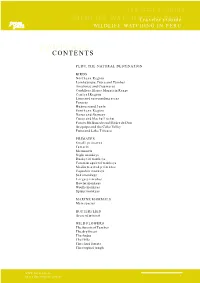
Contents Contents
Traveler’s Guide WILDLIFE WATCHINGTraveler’s IN PERU Guide WILDLIFE WATCHING IN PERU CONTENTS CONTENTS PERU, THE NATURAL DESTINATION BIRDS Northern Region Lambayeque, Piura and Tumbes Amazonas and Cajamarca Cordillera Blanca Mountain Range Central Region Lima and surrounding areas Paracas Huánuco and Junín Southern Region Nazca and Abancay Cusco and Machu Picchu Puerto Maldonado and Madre de Dios Arequipa and the Colca Valley Puno and Lake Titicaca PRIMATES Small primates Tamarin Marmosets Night monkeys Dusky titi monkeys Common squirrel monkeys Medium-sized primates Capuchin monkeys Saki monkeys Large primates Howler monkeys Woolly monkeys Spider monkeys MARINE MAMMALS Main species BUTTERFLIES Areas of interest WILD FLOWERS The forests of Tumbes The dry forest The Andes The Hills The cloud forests The tropical jungle www.peru.org.pe iperu@promperu.gob.pe 1 Traveler’s Guide WILDLIFE WATCHINGTraveler’s IN PERU Guide WILDLIFE WATCHING IN PERU ORCHIDS Tumbes and Piura Amazonas and San Martín Huánuco and Tingo María Cordillera Blanca Chanchamayo Valley Machu Picchu Manu and Tambopata RECOMMENDATIONS LOCATION AND CLIMATE www.peru.org.pe iperu@promperu.gob.pe 2 Traveler’s Guide WILDLIFE WATCHINGTraveler’s IN PERU Guide WILDLIFE WATCHING IN PERU Peru, The Natural Destination Peru is, undoubtedly, one of the world’s top desti- For Peru, nature-tourism and eco-tourism repre- nations for nature-lovers. Blessed with the richest sent an opportunity to share its many surprises ocean in the world, largely unexplored Amazon for- and charm with the rest of the world. This guide ests and the highest tropical mountain range on provides descriptions of the main groups of species Pthe planet, the possibilities for the development of the country offers nature-lovers; trip recommen- bio-diversity in its territory are virtually unlim- dations; information on destinations; services and ited. -

Native New Zealand Land Birds Present During the Holocene
New Zealand plant and vertebrate species known to be extinct Source: Tennyson, Alan, and Paul Martinson. Extinct birds of New Zealand. Wellington: Te Papa Press, 2006. New Zealand Plant Conservation Network, http://www.nzpcn.org.nz/nz_threatenedplants/threatened_list.asp (last accessed 7 June 2007). Group Common name Scientific name Distribution Cause of extinction Last known Plants a coastal cress Lepidium obtusatum North Island Introduced browsers 1950 a prostrate shrub Logania depressa North Island Habitat loss (hydro dam) and 1847 weed infestation a limestone forget-me-not Myosotis traversii var. South Island Over-collection, weed Early 1900s cinerascens invasion a stitchwort Stellaria elatinoides North and South Habitat loss, weed invasion 1940s islands Adams mistletoe Trilepidea adamsii North Island Habitat loss, lost pollinators 1954 and dispersers, possum browsing, over-collecting Bats Greater short-tailed bat Mystacina robusta North, South and Introduced predators 1967 Stewart islands Frogs Aurora frog Leiopelma auroraensis South Island Introduced predators Pre-European Markham's frog Leiopelma markhami North and South Introduced predators Pre-European islands Waitomo frog Leiopelma North Island Introduced predators Pre-European waitomoensis Lizards Northland skink Cyclodina northlandi North Island Introduced predators Pre-European (skinks and geckos) Downloaded from Te Ara – The Encyclopedia of New Zealand All rights reserved http://www.TeAra.govt.nz 2 Narrow-bodied skink Oligosoma North Island Introduced predators Pre-European -

Museum Alive Educator Guide
GRADES K-8 EDUCATOR GUIDE ABOUT COLOSSUS PRODUCTIONS Colossus Productions is the 3D-specialist production company formed by Atlantic Productions (see more below) with Sky in 2011. The joint venture was created to develop and produce high-end 3D films for UK and international audiences. Emerging from Atlantic Production’s record in producing award winning content, Colossus has already released in IMAX and Giant Screen such diverse educational and entertaining films as Flying Monsters 3D, Penguins 3D and Galapagos 3D: Nature’s Wonderland into cinemas worldwide. Colossus’ most recent IMAX/Giant Screen films are Museum Alive and Amazing Mighty Micro Monsters which were released in late 2016 and the newest Colossus production, Conquest of the Skies will be released in IMAX and Giant Screen later in 2016. ATLANTIC PRODUCTIONS Atlantic Productions is one of the world’s leading factual production companies whose multi BAFTA and Emmy award-winning films nda content are regularly seen in over 100 countries around the world. Founded in 1992, Atlantic has built a reputation for world-class story-telling, enhanced by the latest techniques and technologies including the building of pioneering cross-platform and digital experiences. Atlantic Productions leads a group of companies which make television programmes, theatrical and IMAX films, apps (Atlantic Digital), visual effects (Zoo VFX) and now, immersive virtual reality experiences (Alchemy VR). CREDITS Educator Reviewers Writer Garrick Humphrey, M.S.Ed. Literacy, Samantha Zuhlke, Creative Management elementary educator Solutions Colleen Humphrey, M.S.Ed. Curriculum and Instruction, secondary math educator Editors Christina Riska Simmons, Education Fact Checker Consultant Bob Connelly Jessica Shea, M.S. -

Northern Peru and Huascarán National Park, Cordillera Blanca
Birding Ecotours Peru Birding Adventure: June 2012 Northern Peru and Huascarán National Park, Cordillera Blanca By Eduardo Ormaeche Yellow-faced Parrotlet (all photos by Ken Logan) TOTAL SPECIES: 507 seem, including 44 country endemics (heard only excluded) Itinerary Day 1, June 1st. Arrival in Lima and transfer to the hotel. Overnight Lima Day 2, June 2nd. Explore the Pucusana beach and Puerto Viejo wetlands. Overnight Lima Day 3, June 3rd. Explore the Lomas de Lachay National Reserve. Overnight Barranca Day 4, June 4th. Drive from Barranca to Huaraz. Explore Lake Conococha. Overnight Huaraz Day 5, June 5th. Explore Huascarán (Cordillera Blanca) National Park (Llanganuco Lake and Doña Josefa Trail). Overnight Huaraz Day 6, June 6th. Explore Huascarán National Park (Portachuelo de Huayhuash mountain pass). Overnight Huaraz Day 7, June 7th. Explore Pueblo Libre, Huaylas, and drive to the coast. Overnight Casma Day 8, June 8th. Drive from Casma to Trujillo. Explore Cerro Campana and Chan Chan archeological site. Overnight Trujillo Day 9, June 9th. Explore Sinsicap and drive to Chiclayo. Overnight Chiclayo Day 10, June 10th. Explore Bosque de Pómac Historical Sanctuary and drive towards Olmos. Overnight Bosque de Frejolillo (Quebrada Limón) safari camping Day 11, June 11th. Explore Bosque de Frejolillo and drive to Salas. Overnight Los Faiques Lodge Day 12, June 12th. Drive to the Porculla Pass and to Jaén. Overnight Jaén Day 13, June 13th. Explore the Gotas de Agua Private Reserve, visit the Huembo hummingbird center, drive to Pomacochas. Overnight Pomacochas Day 14, June 14th. Drive towards Abra Patricia. Overnight Long-whiskered Owlet Lodge (LWO) Day 15, June 15th. -

Bird Ecology and Conservation in Peru's High Andean Petlands Richard Edward Gibbons Louisiana State University and Agricultural and Mechanical College
Louisiana State University LSU Digital Commons LSU Doctoral Dissertations Graduate School 2012 Bird ecology and conservation in Peru's high Andean petlands Richard Edward Gibbons Louisiana State University and Agricultural and Mechanical College Follow this and additional works at: https://digitalcommons.lsu.edu/gradschool_dissertations Recommended Citation Gibbons, Richard Edward, "Bird ecology and conservation in Peru's high Andean petlands" (2012). LSU Doctoral Dissertations. 2338. https://digitalcommons.lsu.edu/gradschool_dissertations/2338 This Dissertation is brought to you for free and open access by the Graduate School at LSU Digital Commons. It has been accepted for inclusion in LSU Doctoral Dissertations by an authorized graduate school editor of LSU Digital Commons. For more information, please contactgradetd@lsu.edu. BIRD ECOLOGY AND CONSERVATION IN PERU’S HIGH ANDEAN PEATLANDS A Dissertation Submitted to the Graduate Faculty of the Louisiana State University and Agricultural and Mechanical College in partial fulfillment of the requirements for the degree of Doctor of Philosophy in The Department of Biological Sciences by Richard Edward Gibbons B.A., Centenary College of Louisiana, 1995 M.S., Texas A&M University at Corpus Christi, 2004 May 2012 ACKNOWLEDGMENTS This dissertation would not have been possible without the sacrifice and support of my wife Kimberly Vetter and her family. She will forever have my gratitude and respect for sharing this journey with me. My advisor Dr. J. V. Remsen, Jr. is acknowledged for his incredible knack for identifying the strengths and weaknesses in proposals and manuscripts. His willingness to let me flail about in my search for answers surely has helped make me a better researcher. -

Sandgrouse to Auks, Edited by Josep Del Hoyo, Andrew Elliott and Jordi Sargatal, 1996
Handbook of the birds of the world Volume 3: Sandgrouse to Auks, edited by Josep del Hoyo, Andrew Elliott and Jordi Sargatal, 1996. Barcelona: Lynx Edicions. 821 pp, 60 colour plates, numerous colour photographs and distribution maps. £110. With the fourth volume expected imminently and with worldwide acceptance gained, there are no accolades that I can add to the many that have already been lavished on the HBW series. With this in mind, I can only say, again, that this book is cheap for all it offers, that it is a true landmark in the history of ornithological publications and a ‘must’ for ornithologists and birders alike. The general format and presentation of families and species continues as in previous volumes, as well as that of the plates and photographs. The overall quality and standards of plate and photograph reproduction are maintained in this volume; all on excellent quality paper. However, I would note that, at least in my copy, plates 31 (avocets), 37 (plovers), 47 (seedsnipes) and 54 (terns) look a bit pale or faded. A couple of very slight differences distinguish this volume from previous ones. The most important is the inclusion of a “Voice” ‘subsection’ under the description of all Gruidae and Rallidae. This subsection, which had been originally planned only for Passerines, is welcome in this volume, as it will prove particularly useful in the case of the rails and crakes, as much as it would have been for tinamous. I hope we can expect this subsection to appear in some of the other forthcoming non-passerine volumes. -

(Phthiraptera: Amblycera and Ischnocera) on Birds of Peru
Arxius de Miscel·lània Zoològica, 19 (2021): 7–52 ISSN:Minaya 1698– et0476 al. Checklist of chewing lice (Phthiraptera: Amblycera and Ischnocera) on birds of Peru D. Minaya, F. Príncipe, J. Iannacone Minaya, D., Príncipe, F., Iannacone, J., 2021. Checklist of chewing lice (Phthiraptera: Am- blycera and Ischnocera) on the birds of Peru. Arxius de Miscel·lània Zoològica, 19: 7–52, Doi: https://doi.org/10.32800/amz.2021.19.0007 Abstract Checklist of chewing lice (Phthiraptera: Amblycera and Ischnocera) on birds of Peru. Peru is one of the countries with the highest diversity of birds worldwide, having about 1,876 species in its territory. However, studies focused on chewing lice (Phthiraptera) have been carried out on only a minority of bird species. The available data are distributed in 87 publications in the national and international literature. In this checklist we summarize all the records to date of chewing lice on wild and domestic birds in Peru. Among the 301 species of birds studied, 266 species of chewing lice were recorded. The localities with the highest records were the Departments of Cusco, Junín, Lima and Madre de Dios. No records of birds pa- rasitized by these lice have been found in seven departments of Peru. Studies related to lice have only been reported in 16 % of bird species in the country, indicating that research concerning chewing lice has not yet been performed for the the majority of birds in Peru. Data published through GBIF (Doi: 10.15470/u1jtiu) Key words: Avifauna, Ectoparasites, Lice, Parasitology, Phthiraptera Resumen Lista de verificación de piojos masticadores (Phthiraptera: Amblycera e Ischnocera) de las aves de Perú. -

Neither Gondwanan Nor Ancient?
Is Ecosystem Restoration Possible in NZ? Paul Scofield Thanks for images to R.I.P • Auckland Islands Shore • North Island Takahē • South Island Goose Plover • South Island Piopio • New Zealand Raven • Bush Wren • South Island Snipe • New Zealand Musk Duck • Chatham Bellbird • Adzebill • New Zealand Blue-billed • Chatham Fernbird • Little Bush Moa Duck • Chatham Islands Penguin • Chatham Islands Duck • New Zealand Owlet-Nightjar • Chatham Islands Rail • Chatham Raven • New Zealand Swan • Dieffenbach's Rail • Coastal Moa • Scarlett's Duck • Hawkins's Rail • Crested Moa • Scarlett's Shearwater • Huia • Eastern Moa • Snipe-rail • Laughing Owl • Eyles's Harrier • Stout-legged Wren • Lyall's Wren • Finsch's Duck • Upland Moa • New Zealand Little Bittern • South Island Giant Moa • Waitaha Penguin • New Zealand Merganser • North Island Giant Moa • Chatham Island Merganser • Haast's eagle • New Zealand Quail • Heavy-footed moa • North Island Piopio • Hodgen's Rail • South Island Kokako • Long-billed Wren • North Island Snipe • North Island Goose ‘Tuesday, 5 a.m. — At this moment the wooded valley of the Mangaone, in which we have been camped for the night, is ringing with delightful music. It is somewhat difficult to distinguish the performers amidst the general chorus of voices. The silvery notes of the Bellbird, the bolder notes of the Tui, the loud continuous strain of the native Robin, the joyous chirping of a flock of Whiteheads, and the whistling cry of the Piopio — all these voices of the forest are blended in wild harmony…For more than an hour after this concert had ceased, and the sylvan choristers had dispersed in search of their daily food, one species continued to enliven the valley with his musical notes. -

BIRDS of BOLIVIA UPDATED SPECIES LIST (Version 03 June 2020) Compiled By: Sebastian K
BIRDS OF BOLIVIA UPDATED SPECIES LIST (Version 03 June 2020) https://birdsofbolivia.org/ Compiled by: Sebastian K. Herzog, Scientific Director, Asociación Armonía (skherzog@armonia-bo.org) Status codes: R = residents known/expected to breed in Bolivia (includes partial migrants); (e) = endemic; NB = migrants not known or expected to breed in Bolivia; V = vagrants; H = hypothetical (observations not supported by tangible evidence); EX = extinct/extirpated; IN = introduced SACC = South American Classification Committee (http://www.museum.lsu.edu/~Remsen/SACCBaseline.htm) Background shading = Scientific and English names that have changed since Birds of Bolivia (2016, 2019) publication and thus differ from names used in the field guide BoB Synonyms, alternative common names, taxonomic ORDER / FAMILY # Status Scientific name SACC English name SACC plate # comments, and other notes RHEIFORMES RHEIDAE 1 R 5 Rhea americana Greater Rhea 2 R 5 Rhea pennata Lesser Rhea Rhea tarapacensis , Puna Rhea (BirdLife International) TINAMIFORMES TINAMIDAE 3 R 1 Nothocercus nigrocapillus Hooded Tinamou 4 R 1 Tinamus tao Gray Tinamou 5 H, R 1 Tinamus osgoodi Black Tinamou 6 R 1 Tinamus major Great Tinamou 7 R 1 Tinamus guttatus White-throated Tinamou 8 R 1 Crypturellus cinereus Cinereous Tinamou 9 R 2 Crypturellus soui Little Tinamou 10 R 2 Crypturellus obsoletus Brown Tinamou 11 R 1 Crypturellus undulatus Undulated Tinamou 12 R 2 Crypturellus strigulosus Brazilian Tinamou 13 R 1 Crypturellus atrocapillus Black-capped Tinamou 14 R 2 Crypturellus variegatus -

Download Article As 589.6 KB PDF File
6 AvailableNew on-lineZealand at: Journal http://www.newzealandecology.org/nzje/ of Ecology, Vol. 34, No. 1, 2010 special issue: Feathers to Fur The ecological transformation of Aotearoa/New Zealand The origin and history of New Zealand’s terrestrial vertebrates Alan J.D. Tennyson Museum of New Zealand Te Papa Tongarewa, PO Box 467, Wellington, New Zealand (Email: alant@tepapa.govt.nz) Published on-line: 4 November 2009 Abstract: Since the 1980s, morphological and molecular research has resulted in significant advances in understanding the relationships and origins of the recent terrestrial vertebrate fauna in the New Zealand biogeographic region. This research has led to many taxonomic changes, with a significant increase in the number of bird and reptile species recognised. It has also resulted in the recognition of several more Holocene (<10 000 years ago) bird species extinctions. The conclusion that Holocene extinctions were primarily caused by human- hunting and predation by other introduced mammals (particularly rats and cats) has been supported by new data. Despite many local eradications of introduced pests, the number of introduced species has increased, with the establishment of five more foreign birds and (on Norfolk Island) the house gecko (Hemidactylus frenatus). Many new, significant New Zealand vertebrate fossils have been reported, including more dinosaurs from the Cretaceous, and the first Tertiary records of frogs, rhynchocephalids, lizards, crocodylians, bats and a terrestrial “Mesozoic ghost” mammal from the Early Miocene near St Bathans. For birds, the earliest known penguins in the world have been discovered, and there are intriguing Late Cretaceous – Early Paleocene remains still awaiting detailed description. -

Ultimate Chile
We saw many good shorebirds during this tour, including the stunning Rufous-chested Dotterel. (all photos by DLV) ULTIMATE CHILE 19 NOVEMBER– 3/8 DECEMBER 2018 LEADER: MARK PEARMAN and DANI LOPEZ-VELASCO 1 BirdQuest Tour Report: Ultimate Chile 2018 www.birdquest-tours.com Once again, our Ultimate Chile tour produced all of the mainland Chilean endemics, all eight tapaculos, some the size of a puffin, including walk-away views of both Chestnut-throated and Black-throated Huet- Huets, and an astonishing wader spectacle of 33 species, including Diademed Sandpiper-Plover, Magellanic Plover, Peruvian Thick-knee, Tawny-throated and Rufous-chested Dotterels and Rufous-bellied Seedsnipe. Our two main pelagics, and various ferry crossings, delivered 17 species of tubenose with highlights of Southern Royal, Chatham and Buller´s Albatrosses, one of the first Shy (White-capped) Albatross records for Chile, and some Pincoya Storm Petrels. In all, we observed 280 species (of which 28 were only seen on the extension) plus some 16 species of mammal, among which, the rarely seen Huemul and delightful Commerson's Dolphin stood out. As we travelled almost the entire spine of Chile we sampled three major biomes including several vast wilderness areas, from the Atacama desert to the high Andes and through Patagonian forests to the Magellanic and Fuegian tundra steppe. Other unforgettable highlights, from north to south, included, the critically endangered Chilean Woodstar, Tamarugo Conebill, White-throated Earthcreeper, Andean and James's Flamingos, Magellanic Woodpecker, Burrowing Parrot, Spectacled Duck, White-throated Hawk, Rufous-legged Owl, Des Murs’ Wiretail and the recently split Patagonian Forest Earthcreeper.