The Genus <I>Lenophila</I> (Diptera: Platystomatidae)
Total Page:16
File Type:pdf, Size:1020Kb
Load more
Recommended publications
-

Captain Louis De Freycinet
*Catalogue title pages:Layout 1 13/08/10 2:51 PM Page 1 CAPTAIN LOUIS DE FREYCINET AND HIS VOYAGES TO THE TERRES AUSTRALES *Catalogue title pages:Layout 1 13/08/10 2:51 PM Page 3 HORDERN HOUSE rare books • manuscripts • paintings • prints 77 VICTORIA STREET POTTS POINT NSW 2011 AUSTRALIA TEL (61-2) 9356 4411 FAX (61-2) 9357 3635 books@hordern.com www.hordern.com CONTENTS Introduction I. The voyage of the Géographe and the Naturaliste under Nicolas Baudin (1800-1804) Brief history of the voyage a. Baudin and Flinders: the official narratives 1-3 b. The voyage, its people and its narrative 4-29 c. Freycinet’s Australian cartography 30-37 d. Images, chiefly by Nicolas Petit 38-50 II. The voyage of the Uranie under Louis de Freycinet (1817-1820) Brief history of the voyage a. Freycinet and King: the official narratives 51-54 b. Preparations and the voyage 55-70 c. Freycinet constructs the narrative 71-78 d. Images of the voyage and the artist Arago’s narrative 79-92 Appendix 1: The main characters Appendix 2: The ships Appendix 3: Publishing details of the Baudin account Appendix 4: Publishing details of the Freycinet account References Index Illustrated above: detail of Freycinet’s sketch for the Baudin atlas (catalogue no. 31) Illustrated overleaf: map of Australia from the Baudin voyage (catalogue no. 1) INTRODUCTION e offer for sale here an important on the contents page). To illuminate with knowledge collection of printed and original was the avowed aim of each of the two expeditions: Wmanuscript and pictorial material knowledge in the widest sense, encompassing relating to two great French expeditions to Australia, geographical, scientific, technical, anthropological, the 1800 voyage under Captain Nicolas Baudin and zoological, social, historical, and philosophical the 1817 voyage of Captain Louis-Claude de Saulces discoveries. -

Jervis Bay Territory Page 1 of 50 21-Jan-11 Species List for NRM Region (Blank), Jervis Bay Territory
Biodiversity Summary for NRM Regions Species List What is the summary for and where does it come from? This list has been produced by the Department of Sustainability, Environment, Water, Population and Communities (SEWPC) for the Natural Resource Management Spatial Information System. The list was produced using the AustralianAustralian Natural Natural Heritage Heritage Assessment Assessment Tool Tool (ANHAT), which analyses data from a range of plant and animal surveys and collections from across Australia to automatically generate a report for each NRM region. Data sources (Appendix 2) include national and state herbaria, museums, state governments, CSIRO, Birds Australia and a range of surveys conducted by or for DEWHA. For each family of plant and animal covered by ANHAT (Appendix 1), this document gives the number of species in the country and how many of them are found in the region. It also identifies species listed as Vulnerable, Critically Endangered, Endangered or Conservation Dependent under the EPBC Act. A biodiversity summary for this region is also available. For more information please see: www.environment.gov.au/heritage/anhat/index.html Limitations • ANHAT currently contains information on the distribution of over 30,000 Australian taxa. This includes all mammals, birds, reptiles, frogs and fish, 137 families of vascular plants (over 15,000 species) and a range of invertebrate groups. Groups notnot yet yet covered covered in inANHAT ANHAT are notnot included included in in the the list. list. • The data used come from authoritative sources, but they are not perfect. All species names have been confirmed as valid species names, but it is not possible to confirm all species locations. -

Conservation Advice on 15/07/2016
THREATENED SPECIES SCIENTIFIC COMMITTEE Established under the Environment Protection and Biodiversity Conservation Act 1999 The Minister’s delegate approved this Conservation Advice on 15/07/2016. Conservation Advice Zieria prostrata Headland zieria Conservation Status Zieria prostrata (headland zieria) is listed as Endangered under the Environment Protection and Biodiversity Conservation Act 1999 (Cwlth) (EPBC Act) effective from the 16 July 2000. The species was eligible for listing under the EPBC Act at that time as, immediately prior to the commencement of the EPBC Act, it was listed as Endangered under Schedule 1 of the Endangered Species Protection Act 1992 (Cwlth). Species can also be listed as threatened under state and territory legislation. For information on the listing status of this species under relevant state or territory legislation, see http://www.environment.gov.au/cgi-bin/sprat/public/sprat.pl The main factors that are the cause of the species being eligible for listing in the Endangered category are its restricted distribution, small population size. Description The headland zieria is a prostrate shrub forming mats about 0.5 m in diameter. The branches are ridged but not warted as in some other Zieria species. The leaves are paired and divided into three narrow-oval leaflets, all with blunt ends and the central one longer than the others. Both leaf-surfaces are of similar colour and are dotted with oil-glands. The flowers are small, white (pink in bud) and have four petals. The fruits are red-green and dotted with oil-glands (OEH 2014a). Zieria species are distinguished from other Australasian genera in the Rutaceae family by the combination of opposite leaves, conspicuous and 4-merous flowers, free petals, four stamens, free filaments, deeply 4-lobed disc and dry, dehiscent fruits (Armstrong, MS.). -

Post-Fire Recovery of Woody Plants in the New England Tableland Bioregion
Post-fire recovery of woody plants in the New England Tableland Bioregion Peter J. ClarkeA, Kirsten J. E. Knox, Monica L. Campbell and Lachlan M. Copeland Botany, School of Environmental and Rural Sciences, University of New England, Armidale, NSW 2351, AUSTRALIA. ACorresponding author; email: pclarke1@une.edu.au Abstract: The resprouting response of plant species to fire is a key life history trait that has profound effects on post-fire population dynamics and community composition. This study documents the post-fire response (resprouting and maturation times) of woody species in six contrasting formations in the New England Tableland Bioregion of eastern Australia. Rainforest had the highest proportion of resprouting woody taxa and rocky outcrops had the lowest. Surprisingly, no significant difference in the median maturation length was found among habitats, but the communities varied in the range of maturation times. Within these communities, seedlings of species killed by fire, mature faster than seedlings of species that resprout. The slowest maturing species were those that have canopy held seed banks and were killed by fire, and these were used as indicator species to examine fire immaturity risk. Finally, we examine whether current fire management immaturity thresholds appear to be appropriate for these communities and find they need to be amended. Cunninghamia (2009) 11(2): 221–239 Introduction Maturation times of new recruits for those plants killed by fire is also a critical biological variable in the context of fire Fire is a pervasive ecological factor that influences the regimes because this time sets the lower limit for fire intervals evolution, distribution and abundance of woody plants that can cause local population decline or extirpation (Keith (Whelan 1995; Bond & van Wilgen 1996; Bradstock et al. -

Native Plants of Sydney Harbour National Park: Historical Records and Species Lists, and Their Value for Conservation Monitoring
Native plants of Sydney Harbour National Park: historical records and species lists, and their value for conservation monitoring Doug Benson National Herbarium of New South Wales, Royal Botanic Gardens, Mrs Macquaries Rd, Sydney 2000 AUSTRALIA doug.benson@rbgsyd.nsw.gov.au Abstract: Sydney Harbour National Park (lat 33° 53’S; long 151° 13’E), protects significant vegetation on the harbour foreshores close to Sydney City CBD; its floristic abundance and landscape beauty has been acknowledged since the writings of the First Fleet in 1788. Surprisingly, although historical plant collections were made as early as1802, and localised surveys have listed species for parts of the Park since the 1960s, a detailed survey of the flora of whole Park is still needed. This paper provides the first definitive list of the c.400 native flora species for Sydney Harbour National Park (total area 390 ha) showing occurrence on the seven terrestrial sub-regions or precincts (North Head, South Head, Dobroyd Head, Middle Head, Chowder Head, Bradleys Head and Nielsen Park). The list is based on historical species lists, records from the NSW Office of Environment and Heritage (formerly Dept of Environment, Climate Change and Water) Atlas, National Herbarium of New South Wales specimen details, and some additional fieldwork. 131 species have only been recorded from a single precinct site and many are not substantiated with a recent herbarium specimen (though there are historical specimens from the general area for many). Species reported in the sources but for which no current or historic specimen exists are listed separately as being of questionable/non-local status. -

Seed Fill, Viability and Germination of NSW Species in the Family Rutaceae
Seed fill, viability and germination of NSW species in the family Rutaceae Amelia J. Martyn , Leahwyn U. Seed , Mark K. J. Ooi 1 and Catherine A. Offord Botanic Gardens Trust, Mount Annan Botanic Garden, Mount Annan Drive, Mount Annan, NSW 2567, AUSTRALIA 1 Scientific Services Division, Department of Environment, Climate Change and Water NSW, PO Box 1967, Hurstville NSW 2220, AUSTRALIA Abstract: The New South Wales Seedbank (at Mount Annan Botanic Garden) stores seeds of both common and threatened species for conservation, research and restoration or revegetation projects. The value of the collections depends on our ability to germinate seeds once they have been retrieved from storage. The collection includes 129 collections representing 93 taxa in the family Rutaceae, but seed viability in Rutaceae is variable, germination cues are poorly-understood and problems are likely to arise in trying to grow plants from seed. In this study we quantified seed fill and/or viability and germination for 112 species in the Rutaceae family. For many of the species, this is the first time that these seed characteristics have been recorded. We found that seed fill (0–100%) and seed viability (0–97%), were highly variable, with 80% of collections having low viability (<75%). There was also a trend for threatened species to have lower seed fill than common species, while viability and germination were similar. This review reaffirms the need for further study of seed characteristics in Rutaceae. Cunninghamia (2009) 11(2): 203–212 Introduction variability to be retained. Seed research in Rutaceae has been hampered by low seed numbers and poor viability, making Plant species in the family Rutaceae make up a significant it difficult to collect sufficient seeds to study germination component of the understorey in many temperate Australian and dormancy. -
Phylogenetic Relationships of Zieria (Rutaceae) Inferred from Chloroplast, Nuclear, and Morphological Data
A peer-reviewed open-access journal PhytoKeys Phylogenetic44: 15–38 (2015) relationships of Zieria (Rutaceae) inferred from chloroplast, nuclear... 15 doi: 10.3897/phytokeys.44.8393 DATA PAPER http://phytokeys.pensoft.net Launched to accelerate biodiversity research Phylogenetic relationships of Zieria (Rutaceae) inferred from chloroplast, nuclear, and morphological data Cynthia M. Morton1 1 Head of Section of Botany, Carnegie Museum of Natural History, 4400 Forbes Avenue, Pittsburgh, Pennsyl- vania 15213-4080, U.S.A. Corresponding author: Cynthia M. Morton (mortoncm100@gmail.com) Academic editor: S. Razafimandimbison | Received 6 August 2014 | Accepted 3 December 2014 | Published 13 January 2015 Citation: Morton CM (2015) Phylogenetic relationships of Zieria (Rutaceae) inferred from chloroplast, nuclear, and morphological data. PhytoKeys 44: 15–38. doi: 10.3897/phytokeys.44.8393 Abstract Zieria Sm. (Rutaceae, Boronieae) is predominantly native to eastern Australia except for one species, which is endemic to New Caledonia. For this study, sequence data of two non-coding chloroplast regions (trnL- trnF, and rpl32-trnL), one nuclear region (ITS region) and various morphological characters, based on Armstrong’s (2002) taxonomic revision of Zieria, from 32 of the 42 described species of Zieria were selected to study the phylogenetic relationships within this genus. Zieria was supported as a monophyletic group in both independent and combined analyses herein (vs. Armstrong). On the basis of Armstrong’s (2002) non- molecular phylogenetic study, six major taxon groups were defined forZieria . The Maximum-parsimony and the Bayesian analyses of the combined morphological and molecular datasets indicate a lack of sup- port for any of these six major taxon groups. -
Zieria Smithii Jacks
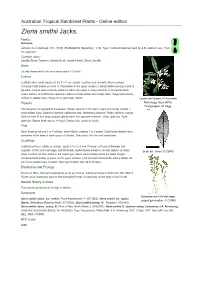
Australian Tropical Rainforest Plants - Online edition Zieria smithii Jacks. Family: Rutaceae Jackson, G. in Andrews, H.C. (1810) The Botanists Repository : t. 60. Type: Communicated last April by A.B. Lambert, esq., from his collection .. Common name: Sandfly Zieria; Turmeric; Sandfly Bush; Lanoline Bush; Zieria, Sandfly Stem Usually flowers and fruits as a shrub about 1-2 m tall. Leaves Leaflets rather small, about 2-3 x 0.7-1.1 cm, sessile. Leaflets very aromatic when crushed. Compound leaf petiole grooved or channelled on the upper surface. Lateral leaflets unequal sided at the base. Lateral veins scarcely visible on either the upper or lower surfaces of the leaflet blade. Lower surface of leaflet blade sparsely clothed in small stellate and simple hairs. Twigs and petioles clothed in stellate hairs. Twigs not longitudinally ribbed. Leaves and flowers. © Australian Flowers Plant Image Index (APII). Photographer: M. Fagg. Inflorescence not exceeding the leaves. Flowers about 6-7 mm diam. Calyx and corolla clothed in short stellate hairs. Stamens inserted outside the disk, filaments pubescent. Pollen yellow to orange. Disk consists of four large globular glands each one opposite a stamen. Ovary glabrous. Style glabrous. Stigma bright green, 4-lobed. Ovules 2 per carpel or locule. Fruit Each flower produces 3 or 4 follicles, each follicle contains 1 or 2 seeds. Calyx lobes stellate hairy, persistent at the base of each group of follicles. Testa hard. Aril thin and translucent. Seedlings Cotyledons linear, elliptic or clavate, about 5-10 x 2-3 mm. First pair of leaves trifoliolate and opposite. At the tenth leaf stage: leaf trifoliolate, leaflet blades sessile or shortly stalked, aromatic Scale bar 10mm. -

Native Plant Flowering Timetable
Native Plant Flowering Timetable by Ian Olsen From observations made from Wentworth Falls to Newnes Plateau from 2009 to 2017 Botanical Name Common Name Newnes Retains Flowering & Fruit & both Species Seeds J F M A M J J A S O N D Acacia asparagoides Acacia dealbata Silver Wattle Acacia decurrens Black Wattle Acacia dorothea Dorothy's Wattle Newnes Acacia echinula Hedgehog Wattle Newnes Acacia elata Mountain Cedar Wattle Acacia falciformis Broad-leaved Hickory Acacia floribunda White Sally Acacia hamiltoniana Hamilton's Wattle Newnes Acacia kybeanensis Kybean Wattle Newnes Acacia linifolia White Wattle Acacia longifolia Acacia mearnsii Black Wattle Acacia melanoxylon Blackwood Acacia myrtifolia Red-stemmed Wattle Newnes Acacia obtusifolia Acacia ptychoclada Acacia rubida Red-stemmed Wattle Acacia suaveolens Sweet Wattle Acacia terminalis Sunshine Wattle Acacia ulicifolia Prickly Moses Acrotriche aggregata Red Cluster Heath Actinotus forsythii Pink Flannel Flower Newnes Actinotus helianthi Flannel Flower Alania endlicheri Almaleea incurvata Amperea xiphoclada Astrotricha longifolia Atherosperma moschatum Black Sassafras Atkinsonia ligustrina Baeckea kandos Newnes Baeckea linifolia Weeping Baeckea Baeckea utilis Mountain Baeckea Banksia collina Newnes All months Banksia cunninghamii All months Banksia ericifolia Heath-leaved Banksia All months Banksia marginata Silver Banksia All months Banksia penicillata Newnes All months Banksia serrata Old-man Banksia All months Banksia spinulosa Hairpin Banksia All months Bauera rubioides River Rose -

Biodiversity Summary: Burnett Mary, Queensland
Biodiversity Summary for NRM Regions Species List What is the summary for and where does it come from? This list has been produced by the Department of Sustainability, Environment, Water, Population and Communities (SEWPC) for the Natural Resource Management Spatial Information System. The list was produced using the AustralianAustralian Natural Natural Heritage Heritage Assessment Assessment Tool Tool (ANHAT), which analyses data from a range of plant and animal surveys and collections from across Australia to automatically generate a report for each NRM region. Data sources (Appendix 2) include national and state herbaria, museums, state governments, CSIRO, Birds Australia and a range of surveys conducted by or for DEWHA. For each family of plant and animal covered by ANHAT (Appendix 1), this document gives the number of species in the country and how many of them are found in the region. It also identifies species listed as Vulnerable, Critically Endangered, Endangered or Conservation Dependent under the EPBC Act. A biodiversity summary for this region is also available. For more information please see: www.environment.gov.au/heritage/anhat/index.html Limitations • ANHAT currently contains information on the distribution of over 30,000 Australian taxa. This includes all mammals, birds, reptiles, frogs and fish, 137 families of vascular plants (over 15,000 species) and a range of invertebrate groups. Groups notnot yet yet covered covered in inANHAT ANHAT are notnot included included in in the the list. list. • The data used come from authoritative sources, but they are not perfect. All species names have been confirmed as valid species names, but it is not possible to confirm all species locations. -
Of the Hastings Point Area, North-Eastern New South Wales, Australia
©Mauritianum, Naturkundliches Museum Altenburg Mauritiana (Altenburg) 18 (2001) 1, S. 125- 129 • ISSN 0233- 173X Notes on some snakes (Reptilia, Squamata) of the Hastings Point area, north-eastern New South Wales, Australia With 2 Figures Trevor J. Hawkeswood Abstract : Biological/ecological notes are provided on the following 8 species of snakes (Class Reptilia) from the Hastings Point area, north-eastern New South Wales : Ramphotyphlops wiedii (Peters) (Typhlopidae), Morelia spilota (Lacépède) (Boidae), Amphiesma mairii (Gray) (Colubridae), Dendrelaphis punctulatus (Gray) (Colubridae), Demansia psammophis (Schlegel) (Elapidae), Pseudechis porphyriacus (Shaw) (Elapi- dae), Pseudonaja textilis (Duméril, Bibron & Duméril) (Elapidae) and Vermicella annulata (Gray) (Elapidae). Demansia psammophis and Pseudonaja textilis are illustrated in colour. Zusammenfassung: Biologisch-ökologische Notizen über folgende 8 Schlangenarten aus dem Küsten gebiet von Hastings Point, N.S.W., Australien (28° 20' S, 153° 35' E) werden mitgeteilt : Ramphotyphlops wiedii (Peters) (Typhlopidae), Morelia spilota (Lacépéde) (Boidae), Amphiesma mairii (Gray) (Colubridae), Dendre laphis punctulatus (Gray) (Colubridae), Demansia psammophis (Schlegel) (Elapidae), Pseudechis porphyria cus (Shaw) (Elapidae), Pseudonaja textilis (Duméril, Bibron & Duméril) (Elapidae) und Vermicella annulata (Gray) (Elapidae).Demansia psammophis und Pseudonaja textilis werden farbig abgebildet. Das untersuchte Gebiet ist im jüngst vergangenen Jahrzehnt durch intensive Erfassung und Dokumentation der Insektenfauna bekannt geworden. Introduction The township of Hastings Point, New South Wales (28° 20' S, 153° 35' E), is situated on the coast and is bordered by a complex system of small hills, creeks, sand dunes and a variety of vegetation habitats, such as mangroves, Melaleuca forests, heathlands and woodlands. The area is biologically diverse, despite residential development in the area and other changes to the natural habitat. -

Table 3. Species of Papilio Used in This Study, Host Plants, Larval Morphology, Host Growth Form, and Host Leaf Size
Table 3. Species of Papilio used in this study, host plants, larval morphology, host growth form, and host leaf size Species Host plants Larval morphology Host Host leaf growth size(s) form(s) Papilio aegeus Citrus australasica , Citrus australis , Citrus Cryptic (1, 11) Tree, Shrub Narrow, Wide garrawayae , Citrus inodora , Clausena brevistyla , Dinosperma erythrococca , Dinosperma melanophloia , Eriostemon australasius , Flindersia australis, Flindersia bennettii, Flindersia collina, Flindersia ifflaiana, Flindersia laevicarpa, Flindersia oppositifolia, Flindersia pimenteliana, Flindersia schottiana, Geijera salicifolia, Geijera parviflora, Halfordia spp, Leionema ambiens, Leionema dentatum, Micromelum minutum, Philotheca myoporoides, Zanthoxylum brachyachanthum, Zanthoxylum nitidum, Zieria laevigata, Zieria smithii (2) P. alexanor Opopanax chironium, Opopanax hispidus, Seseli Aposematic (11) Herb, Shrub Narrow, Wide montanum, Pimpinella saxifraga, Ptychotis saxifraga (heterophylla), Scaligera cretica (napiformis), Ferula communis, Pastinaca sativa, Trinia glauca (vulgaris) , Seseli dioicum , Falcaria vulgaris, Seseli libanotis, Torilis heterophylla, Ferula karategina, Ferula ugamica (20, 21, 23) P. anactus Citrus australasica, Citrus australis, Citrus Aposematic (2, 12, 16) Shrub, Tree Narrow, Wide garrawayae, Citrus glauca, Citrus inodora, Geijera parviflora , Citrus (Microcitrus) australis, Citrus (Microcitrus) australiasica, Eremocitrus glauca (2, 12) P. anchisiades Citrus sinensis, Citrus aurantiaca, Citrus limon, Bird dropping