2012 Mcnair Scholars Journal
Total Page:16
File Type:pdf, Size:1020Kb
Load more
Recommended publications
-
Gerald Dyson
CONTEXTS FOR PASTORAL CARE: ANGLO-SAXON PRIESTS AND PRIESTLY BOOKS, C. 900–1100 Gerald P. Dyson PhD University of York History March 2016 3 Abstract This thesis is an examination and analysis of the books needed by and available to Anglo-Saxon priests for the provision of pastoral care in the tenth and eleventh centuries. Anglo-Saxon priests are a group that has not previously been studied as such due to the scattered and difficult nature of the evidence. By synthesizing previous scholarly work on the secular clergy, pastoral care, and priests’ books, this thesis aims to demonstrate how priestly manuscripts can be used to inform our understanding of the practice of pastoral care in Anglo-Saxon England. In the first section of this thesis (Chapters 2–4), I will discuss the context of priestly ministry in England in the tenth and eleventh centuries before arguing that the availability of a certain set of pastoral texts prescribed for priests by early medieval bishops was vital to the provision of pastoral care. Additionally, I assert that Anglo- Saxon priests in general had access to the necessary books through means such as episcopal provision and aristocratic patronage and were sufficiently literate to use these texts. The second section (Chapters 5–7) is divided according to different types of priestly texts and through both documentary evidence and case studies of specific manuscripts, I contend that the analysis of individual priests’ books clarifies our view of pastoral provision and that these books are under-utilized resources in scholars’ attempts to better understand contemporary pastoral care. -

Welsh Kings at Anglo-Saxon Royal Assemblies (928–55) Simon Keynes
View metadata, citation and similar papers at core.ac.uk brought to you by CORE provided by Apollo Keynes The Henry Loyn Memorial Lecture for 2008 Welsh kings at Anglo-Saxon royal assemblies (928–55) Simon Keynes A volume containing the collected papers of Henry Loyn was published in 1992, five years after his retirement in 1987.1 A memoir of his academic career, written by Nicholas Brooks, was published by the British Academy in 2003.2 When reminded in this way of a contribution to Anglo-Saxon and Anglo-Norman studies sustained over a period of 50 years, and on learning at the same time of Henry’s outstanding service to the academic communities in Cardiff, London, and elsewhere, one can but stand back in awe. I was never taught by Henry, but encountered him at critical moments—first as the external examiner of my PhD thesis, in 1977, and then at conferences or meetings for twenty years thereafter. Henry was renowned not only for the authority and crystal clarity of his published works, but also as the kind of speaker who could always be relied upon to bring a semblance of order and direction to any proceedings—whether introducing a conference, setting out the issues in a way which made one feel that it all mattered, and that we stood together at the cutting edge of intellectual endeavour; or concluding a conference, artfully drawing together the scattered threads and making it appear as if we’d been following a plan, and might even have reached a conclusion. First place at a conference in the 1970s and 1980s was known as the ‘Henry Loyn slot’, and was normally occupied by Henry Loyn himself; but once, at the British Museum, he was for some reason not able to do it, and I was prevailed upon to do it in his place. -

The Book Collection at St Guthlac's Priory, Hereford, Before 1200
The Book Collection at St Guthlac’s Priory, Hereford, Before 1200: Acquisition, Adaptation and Use Christopher Ian Tuckley Submitted in accordance with the requirements for the degree of PhD The University of Leeds Institute for Medieval Studies June 2009 The candidate confirms that the work is his own and that appropriate credit has been given where reference has been made to the work of others. This copy has been supplied on the understanding that it is copyright material and that no quotation from the thesis may be published without proper acknowledgement. ACKNOWLEDGEMENTS I have been particularly fortunate in having had the benefit of sponsorship throughout my research: the first three years of study were funded by the White Rose Consortium of universities, which also paid a stipend. A generous grant from the Lynne Grundy Trust allowed me to present a paper on the priory book collection at the International Congress on Medieval Studies at Kalamazoo, Michigan, in May 2008. Thanks are due to a number of individuals within the academic community for their assistance and advice in the completion of this thesis. Debby Banham, Orietta Da Rold, Sarah Foot, William Flynn, Richard Gameson, Monica Green, Thom Gobbit, Michael Gullick, Juliet Hewish, Geoffrey Humble, Takako Kato, Bella Millet, Alan Murray, Katie Neville, Clare Pilsworth, Richard Sharpe, Rodney Thomson, Elaine Trehame, Karen Watts, and the staff of the Bodleian, Jesus College, Hereford Cathedral and York Minster libraries have all given guidance at one point or another. I also gratefully acknowledge the help of the Dean and Chapter of Hereford Cathedral. Julia Barrow’s advice has been especially valuable in making sense of a number of medieval charters relating to St Guthlac’s Priory, and I owe her a great debt of gratitude in this respect. -
Introduction.Pdf
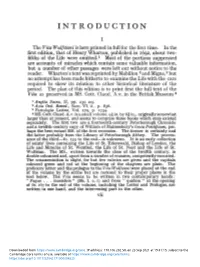
INTRODUCTION The Vita Wulfstani is here printed in full for the first time. In the first edition, that of Henry Wharton, published in 1692, about two- fifths of the Life were omitted.1 Most of the portions suppressed are accounts of miracles which contain some valuable information, but a number of other passages were left out without notice to the reader. Wharton's text was reprinted by Mabillon 2 and Migne,3 but no attempt has been made hitherto to examine the Life with the care required to show its relation to other historical literature of the period. The plan of this edition is to print first the full text of the Vita as preserved in MS. Cott. Claud. A.v. in the British Museum * 1 Anglia Sacra, II, pp. 239 seq. 'Ada Ord. Bened., Saec. VI, ii., p. 836. 3 Patrologia Latina, Vol. 179, p. 1734. 4 MS. Cott. Claud. A.v. is a small volume, 9! in. by 6| in., originally somewhat larger than at present, and seems to comprise three books which once existed separately. The first two are a fourteenth-century Peterborough Chronicle and a twelfth-century copy of William of Malmesbury's Gesta Pontificum, per- haps the best.extant MS. of the first recension. The former is certainly and the latter probably from the Library of Peterborough Abbey. The proven- ance of the third—fo. 135 to the end—is unknown. It is an early collection of saints' lives containing the Life of St. Erkenwald, Bishop of London, the Life and Miracles of St. Wenfred, the Life of St. -

Norman Conquest Secondary Sources Bibliography 2017-18 (Pdf)
1066 and All That (HST 2023) Dr Charles West, University of Sheffield Secondary sources bibliography – updated Oct 2018 In this course you are encouraged to concentrate on the primary evidence for the Norman Conquest of England, and to make use of the extraordinarily abundant historiography only selectively (though you cannot wholly ignore it). So this bibliography focuses on directly relevant works, with a preference for recent and accessible literature. I’ve starred items that we’ll be reading in class, and one or two other key items. If you would like to find more material (and there is a lot more...), you can make use of the International Medieval Bibliography, run by the publisher Brepols, available online on University servers; the Royal Historical Society Bibliography, also available on the University network; or simply read through the most recent editions of Anglo-Norman Studies (942.02 (B)) or the Haskins Society Journal (PER 905 HAS). Some of the more recent volumes of the former are now available online through the STAR library catalogue; those only available in paper in Western Bank are still however worth consulting! For primary sources, and studies of them, please see the separate primary source bibliography. Contents 1. Introductory reading and companions 2. The Normans 3. Late Anglo-Saxon England 4. The Conquest 5. Thematic approaches 6. Afterthoughts 1 1. Introductory reading and companions Introductory reading D. Bates, The Normans and Empire (Oxford, 2013). Wider Norman context. D. Bates, William the Conqueror (New Haven, 2016). Wide-ranging biography with lots to say about the Norman Conquest, though not always easy going. -

Regesta Regum Anglo-Normannorum, 1066-1154
:CD ;00 100 •OJ !oo CjD oo /!^ REGESTA WILLELMI CONQUESTORIS ET WILLELMI RUFI 1066-1100 OXFORD UNIVERSITY PRESS LONDON EDINBURGH GLASGOW NEW YORK TORONTO MELBOURNE BOMBAY HUMPHREY MILFORD M.A. PUBHSHER TO THE UNIVERSITY REGESTA REGUM ANGLO -NORMANNORUM 1066-1154 VOLUME I REGESTA WILLELMI CONQUESTORIS ET WILLELMI RUFI 1066-1100 EDITED VVITH INTRODUCTIONS NOTES AND INDEXES BY H. W. C. DAVIS, M.A. FELLOW AND TUTOR OF BALLIOL COLLEGE, OXFORD SOiAIETIME FELLOW OF ALL SOULS COLLEGE WITH THE ASSISTANCE OF R J. WHITWELL, B.Litt. OXFORD AT THE CLARENDON PRESS M UCCCC XIII 190 J)37 Y.l PREFACE This is the first of three volumes covering the period of the Anglo-Norman kings (1066-1154). The second and third volumes are far advanced, and will shortly be in the press. The object of ^ the series is to give a calendar, chronologically arranged and the of critically annotated, of the royal acts of period, and some cognate documents which are valuable for the historian. The first care of the editor has been to call attention to materials which iUustrate the development of law and institutions. But the interests of the genealogist and the topographer have not been neglected. Pains have been taken to record the names of persons, and the more important names of places, which are mentioned in the docu- ments. The collection includes charters issued in and for Normandy. Norman archives have not been searched for the purpose, since the Norman material is being coUected by Professor Haskins. But it seemed advisable to calendar such Norman charters as have been or are to be found in for of printed EngUsh manuscripts ; many these charters throw useful sideUghts upon EngUsh history. -

Greenway (2Nd Edn, London, 1981) EHR English Historical Review GR William of Malmesbury, De Gestis Regum Anglorum Libri Qyinque, Ed
NoTES Abbreviations Used in the Notes ASC Anglo-Saxon Chronicle A.NS Proceedings cif the Battle CorifCrence on Anglo-Nonnan Studies, continued from 1983 as Anglo-Norman Studies BAR British Archaeological Reports DB Domesda;y Book, seu Liber Censualis Willelmi Primi Regis Angliae, ed. A. Farley and H. Ellis (4 vols, London, 1783-1816) EHD English Historical Documents, ii: 1042-1189, ed. D. C. Douglas and G. W. Greenway (2nd edn, London, 1981) EHR English Historical Review GR William of Malmesbury, De Gestis Regum Anglorum Libri Qyinque, ed. W. Stubbs (2 vo1s, Rolls Series, London, 1887-9) ov The Ecclesiastical History cif Orderic Vitalis, ed. M. Chibnall (6 vols, Oxford, 1969-80) TRE tempore Regis Eadwardi ('in the time of King Edward') TRHS Transactions cif the Royal Historical Socie!)! VCH Victoria Coun!)! History THE SOURCES 1. The best introduction to the sources is A. Gransden, Historical Writing in England, c.55D-c.1307 (London, 1974), pp. 87-185. 194 Notes 2. EHD, ii, no. 1, p. 147. 3. J. Campbell, 'Some Twelfth-Century Views of the Anglo-Saxon Past', in Essays in Anglo-Saxon History (London, 1986), pp. 209-28; R. W. Southern, 'Aspects of the European Tradition of Historical Writing, 4: the Sense of the Past', TRHS, 5th series, 23 (1973), pp. 246-56. 4. G. A. Loud, 'The Gens Normannorum: Myth or Reality?', A.NS, 4 (1981), pp. 104-16. 5. 7he Gesta Normannorum Ducum of William of Jumieges, ed. and trans. E. M. C. van Houts (Oxford, 1992), vol. i, esp. pp. xix-xxxv. 6. See R. -

Anglo-Saxon England and the Norman Conquest 1035–1087 with Norman England 1087–1107 August 2015
AS and A LEVEL Delivery Guide H105/H505 HISTORY A Theme: Anglo-Saxon England and the Norman Conquest 1035–1087 with Norman England 1087–1107 August 2015 We will inform centres about any changes to the specification. We will also publish changes on our website. The latest version of our specification will always be the one on our website (www.ocr.org.uk) and this may differ from printed versions. Copyright © 2015 OCR. All rights reserved. Copyright OCR retains the copyright on all its publications, including the specifications. However, registered centres for OCR are permitted to copy material from this specification booklet for their own internal use. Oxford Cambridge and RSA Examinations is a Company Limited by Guarantee. Registered in England. Registered company number 3484466. Registered office: 1 Hills Road Cambridge CB1 2EU OCR is an exempt charity. AS and A LEVEL HISTORY A CONTENTS Introduction Page 4 Curriculum Content Page 5 Thinking Conceptually Page 9 Thinking Contextually Page 13 Learner Resources Page 33 3 Introduction Delivery guides are designed to represent a body of knowledge about teaching a particular topic and contain: KEY • Content: a clear outline of the content covered by the Click to view associated resources delivery guide; within this document. • Thinking Conceptually: expert guidance on the key concepts involved, common difficulties learners may have, approaches to teaching that can help learners understand Click to view external resources these concepts and how this topic links conceptually to other areas of the subject; AS Level content only • Thinking Contextually: a range of suggested teaching only activities using a variety of themes so that different activities can be selected that best suit particular classes, learning styles or teaching approaches. -

The Career of Geoffrey De Montbray, Bishop of Coutances (1048-1093) and Unus De Primatibus Anglorum (‘One of the Chief Men of the English’)
The Career of Geoffrey de Montbray, Bishop of Coutances (1048-1093) and unus de primatibus Anglorum (‘one of the chief men of the English’) by Christopher Dennis Thesis submitted for the Degree of Doctor of Philosophy History & Welsh History, Cardiff University, 2012 i Summary Geoffrey de Montbray was one of the most important men in Normandy and England during the second half of the eleventh century. As bishop of Coutances, Geoffrey made a significant contribution to the restoration of ecclesiastical life in western Normandy. In post-Conquest England, where Geoffrey became a great landholder, he played a pivotal role in the consolidation of the Conqueror’s victory. Geoffrey’s role in the conquest and settlement of England, and in particular his association with warfare, has overshadowed his achievements as a diocesan bishop. In modern historiography he has been presented as an example of an old-fashioned type of bishop that was gradually being superseded in Normandy by more reform-minded prelates. This thesis will assess the validity of this interpretation by providing a detailed examination of his career. But it will also consider his activities as a diocesan bishop and his participation in the settlement of England in the context of the development of his personal relationship with the Conqueror. In particular, it will examine the significance of charismatic elements of lordship and the importance of acquiring ‘closeness’ to a ruler as a means of self-advancement. By approaching Geoffrey’s career from his perspective, the intention of this thesis is to gain a better understanding of the mindset of an eleventh-century Norman bishop. -

Butlers and Dish-Bearers in Anglo-Saxon Courts: Household Officers at the Royal Table Alban Gautier
Butlers and dish-bearers in Anglo-Saxon courts: household officers at the royal table Alban Gautier To cite this version: Alban Gautier. Butlers and dish-bearers in Anglo-Saxon courts: household officers at the royal table. Historical Research, Wiley, 2017, 90 (248), pp.269-295. 10.1111/1468-2281.12181. hal-02186863 HAL Id: hal-02186863 https://hal-normandie-univ.archives-ouvertes.fr/hal-02186863 Submitted on 16 Nov 2019 HAL is a multi-disciplinary open access L’archive ouverte pluridisciplinaire HAL, est archive for the deposit and dissemination of sci- destinée au dépôt et à la diffusion de documents entific research documents, whether they are pub- scientifiques de niveau recherche, publiés ou non, lished or not. The documents may come from émanant des établissements d’enseignement et de teaching and research institutions in France or recherche français ou étrangers, des laboratoires abroad, or from public or private research centers. publics ou privés. Butlers and dish-bearers in Anglo-Saxon courts: household officers at the royal table It has been recognized for a long time that meals, and particularly festive meals— feasts or banquets, the words being, for all purposes, considered here as synonyms—played an important role in the life and political activity of Anglo-Saxon elites.1 Kings, thegns and other members of the elite—including some women—participated in feasts of political importance, in which both vertical and horizontal dimensions of power structures—that is, feelings of community and hierarchy—were at the same time established, consolidated and expressed.2 Instrumental in making such events a political success were a category of court officers which modern studies and translations of early medieval sources call ‘butlers’, ‘cupbearers’, ‘dish-bearers’ or ‘seneschals’. -

2018 Lane Lois 1360779 Ethe
This electronic thesis or dissertation has been downloaded from the King’s Research Portal at https://kclpure.kcl.ac.uk/portal/ Clerks and Commissioners The Role of Bishops in the Government of England, c. 1050-1087 Lane, Lois Eliza Awarding institution: King's College London The copyright of this thesis rests with the author and no quotation from it or information derived from it may be published without proper acknowledgement. END USER LICENCE AGREEMENT Unless another licence is stated on the immediately following page this work is licensed under a Creative Commons Attribution-NonCommercial-NoDerivatives 4.0 International licence. https://creativecommons.org/licenses/by-nc-nd/4.0/ You are free to copy, distribute and transmit the work Under the following conditions: Attribution: You must attribute the work in the manner specified by the author (but not in any way that suggests that they endorse you or your use of the work). Non Commercial: You may not use this work for commercial purposes. No Derivative Works - You may not alter, transform, or build upon this work. Any of these conditions can be waived if you receive permission from the author. Your fair dealings and other rights are in no way affected by the above. Take down policy If you believe that this document breaches copyright please contact librarypure@kcl.ac.uk providing details, and we will remove access to the work immediately and investigate your claim. Download date: 27. Sep. 2021 CLERKS AND COMMISSIONERS: THE ROLE OF BISHOPS IN THE GOVERNMENT OF ENGLAND, c.1050–1087 Lois Lane A thesis submitted for the degree of Doctor of Philosophy, King's College London December 2017 1 Abstract Bishops played a crucial part in the government of England and in the consolidation of the Anglo-Norman regime after 1066.